A Ring Sold for $16 Billion, Oura Prepares for IPO in the U.S.

 Prefer us on Google


Smart ring manufacturer Oura is preparing for an IPO in the U.S., with a financing scale of up to $3 billion. Bloomberg reported on August 24, citing insiders, that the listing could be completed as early as September, with the company's valuation expected to exceed $16 billion.
The reference point is less than a year ago: in September last year, Oura completed a $875 million Series E financing, with a valuation of about $10.9 billion. In less than a year, it has increased by about 47%.
The underwriting team is well-equipped: Goldman Sachs, Morgan Stanley, JPMorgan, Allen & Co., and Jefferies. The company secretly submitted documents in May this year. Oura did not immediately respond to requests for comment.
How is this price supported?
By a rather steep growth curve.
In terms of sales, as of June 2024, Oura has sold a total of 2.5 million rings; by September 2025, this number is expected to reach 5.5 million—this was the estimate given by CEO Tom Hale at the time.
Revenue is even more direct: $500 million in 2024, with the company expecting to reach $1.5 billion by 2026. A threefold increase in two years.
The product logic also makes sense. The wearable device market is dominated by smartwatches, with rings occupying a small segment, but growing rapidly. Its selling point is almost cunningly simple: people want to know how well they sleep and recover without wearing a watch on their wrist while sleeping.
Oura is also expanding outward. Its earliest users were the "biohacker" CEOs from Silicon Valley, and it is now positioning itself as a mainstream sleep and recovery brand. Its most direct competitor, Whoop, is on the same path—shifting from serving elite athletes and young men to a broader audience, adding hormone tracking, perimenopause, and thyroid-related blood test items over the past year, achieving a valuation of $10 billion in March.
Big companies are also at the door. Samsung launched the Galaxy Ring two years ago, and Apple is working on a series of AI-driven wearable devices.
Last week, it was sued
On August 20, Clarkson Law Firm filed a proposed class action lawsuit in San Francisco, accusing Oura of misleading consumers about the accuracy of its sleep tracking.
The wording of the complaint is quite harsh. It claims that the Oura ring cannot measure or assess sleep quality or determine sleep stages based on any physiological signals required, relying instead on AI-generated estimates, which have a probability of correctness similar to flipping a coin.
One of the most severe statements in the complaint concerns the promotional claims: Oura sells rings starting at $300, yet claims to provide insights that can only be seen in hospital sleep laboratories, including four sleep stages—"Oura does not just claim to measure heart rate or temperature, but claims to determine which sleep stage the wearer is currently in, which in reality requires electrodes on the scalp and sensors around the eyes."
These accusations did not come out of nowhere. For years, Oura users have complained online about inaccurate sleep data, with some saying they slept poorly, yet the ring indicated their sleep status was "ideal."
Oura's response has two layers: first, it acknowledges the boundaries—Oura rings are not medical devices and cannot replace clinical sleep studies; second, it disputes the conclusions—stating that its sleep staging has performed well in multiple studies compared to polysomnography (the gold standard for determining sleep stages), with several independent third-party studies supporting its accuracy claims. The company has also been transparent about the mechanisms and indicators underlying its sleep staging. The company stated it would respond appropriately in legal settings.
For a company that is about to be valued at $16 billion, the position of this lawsuit is quite delicate. It is not just about whether a certain feature works well, but whether the core promise the company has sold for ten years—"I know how you slept last night"—holds true.
Clearly, it knows this vulnerability
This is evident from its last few moves before going public.
On August 20, Oura created two previously non-existent executive positions: its first Chief Information Officer, Sanjay Chandra, and its first Senior Vice President of AI and Software Engineering, Han Chiu. Tom Hale's reasoning, besides advancing AI health insights and foundational data infrastructure, includes a more thought-provoking statement—"to enhance the company's credibility in front of mature medical players."
The term "mature medical players" points to where Oura truly wants to go: integrating wearable data into the formal medical system. Apple, Google, and Samsung are all competing for this path. To pursue this route, the accuracy of your data is no longer a matter of consumer complaints, but falls under the purview of regulation and clinical standards.
It is also marking its territory in another way: Oura has already filed patent infringement lawsuits against seven competitors.
-- Price
Why now?
Because the window is there.
Oura will join a batch of companies aiming to go public before the midterm elections in November. Anthropic is expected to list as early as next month, potentially matching or exceeding SpaceX's record IPO; AI cloud company Nscale is seeking to raise up to $3 billion as early as September; Switch has submitted documents secretly, with the earliest listing in November, potentially approaching a valuation of $50 billion.
Another detail worth mentioning: according to Bloomberg, existing investors are expected to sell a significant portion of their shares in this issuance.
Oura's shareholder list is not short—Series E investors include Fidelity, ICONIQ, Whale Rock, Atreides, and earlier investors like Dexcom, The Chernin Group, Forerunner Ventures, Coatue, and Temasek. Some of this money has been waiting for many years.
A company founded in 2013, now with over 900 employees, choosing to go public at a time when its revenue is about to reach $1.5 billion, a lawsuit has just arrived, and big companies are closing in, is raising $3 billion while selling a promise that still needs to be proven.
This content is provided for general informational purposes only and doesn't constitute financial, investment, legal, or tax advice. Any events, rewards, online promotions, or related information mentioned herein should not be considered a recommendation, solicitation, or invitation to purchase, sell, trade, or otherwise deal in any crypto assets. Crypto assets are highly volatile and may result in loss. The availability of WEEX services, products, and related events may vary by region. You are responsible for ensuring that your participation is in accordance with applicable local laws and regulations.
You may also like

Bitcoin Spot Demand: The Signal That Hadn't Reappeared Since the October 2025 Record
Vietcombank Warns of AI-Driven Fraud
$1 Billion in 48 Hours: X Prepares Crypto Trading Function on Feed
The forex complex: How retail traders are adapting to volatile 2026 markets

Trump Beats the Fed: How Trading Boom Explodes in the UAE

Crypto investors should favor systematic strategies over Fed predictions, Moon Pursuit Capital says

Crypto: Solana ETFs Record Their Biggest Day of the Year

Xbox and PlayStation Reassess Their Multiplatform Strategy, Emphasizing Exclusivity Again

Interview: Aptos CEO on AI Agents, Stablecoins, and Machine Commerce

BlackRock Lowers Minimum Investment for Bitcoin ETF to $1 Million
Previously Bearish on Crypto Market, Jiang Zhuoer Quickly Turns Bullish: Ethereum is the Engine of the Bull Market
Michael Saylor Targets Bitcoin Orthodoxy: 'Satoshi Is Not a Prophet'

Strive by Vivek Ramaswamy Becomes the 7th Largest Public Holder of Bitcoin

The Best AI Models for Trading: A Comparison of the Top 10 Models
Enflame, the Chinese competitor of Nvidia in AI chips, goes public
AI is in a Credit Expansion Phase: The Stronger AI Becomes, the More the Federal Reserve Needs to Cut Rates

Short-Term U.S. Treasury Holdings Decrease by $29 Billion, Testing Demand for Stablecoins
Analysis of Mining Machine Asset Depreciation and Tax Cost Recovery
Bitcoin Transfer by Metaplanet: Sale or Just Custody on Coinbase?
Opinion: The Bull Market Has Arrived, How to Position in This Cycle?
80% of Gas Stations in Russia Face AI-95 Gasoline Shortage
Bitcoin Bull Run: Arthur Hayes Sees Crypto Market Soaring Higher

Goldman Sachs Optimistic About Crypto Brokerage Trading Platforms: Can the Market Support a New Cycle?
Strive CEO: The Bitcoin Bull Market Has Just Begun, ASST Has Passed Its Bottom
Ravencoin (RVN) Price Forecast for 2026–2050

AI Agent's 'Coming of Age': What Step Is Missing from Simulation Training to Real Trading?
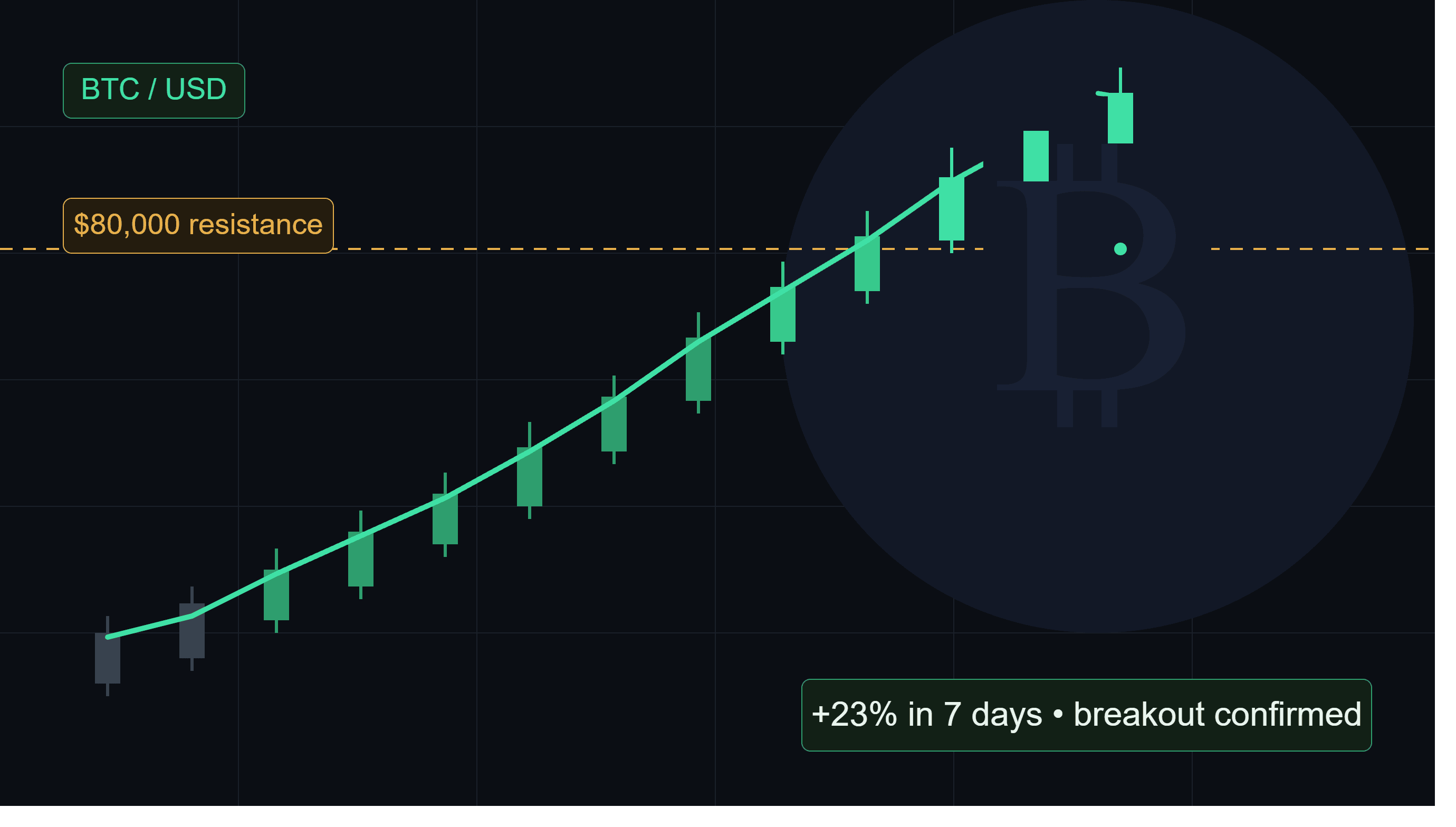
Bitcoin Just Hit $80,000: Last Week WEEX's Prediction Came True — What's Next?
Bitcoin hit $80,000 as WEEX predicted last week. See what drove the breakout, current key levels, and whether $90,000 is next.
Mining Artificial Intelligence: Why Bitcoin Miners Are Changing Their Business Model
CFTC Considers the Viability of Perpetual Futures in GPU Computing
Bitcoin is once again being 'buried' on social media: what this could mean for its price
Bitcoin Spot Demand: The Signal That Hadn't Reappeared Since the October 2025 Record
Vietcombank Warns of AI-Driven Fraud
$1 Billion in 48 Hours: X Prepares Crypto Trading Function on Feed
The forex complex: How retail traders are adapting to volatile 2026 markets
Trump Beats the Fed: How Trading Boom Explodes in the UAE
Crypto investors should favor systematic strategies over Fed predictions, Moon Pursuit Capital says