
Cardano’s police evidence system could bring 1.5 million annual transactions

 Prefer us on Google


Cardano has highlighted plans to use its blockchain to secure criminal evidence records across India's police and judicial systems, as developer Trivolve Tech seeks treasury funding to expand an existing forensic management application.
Summary
- Cardano has highlighted Trivolve Tech's plans to expand blockchain evidence tracking across India's police and judicial systems, covering investigations, storage, prosecution and court proceedings.
- Trivolve Tech is seeking 9.6 million ADA in treasury funding to develop its Police Force Management System, with an initial deployment planned across approximately 3,500 facilities in Telangana.
- The proposed system could generate more than 1.53 million Cardano mainnet transactions in its first year, with approximately 113,000 personnel and 3.2 million evidence items covered.
- Trivolve Tech already operates a forensic evidence management application in Uttar Pradesh that has processed more than 156,000 Cardano mainnet transactions.
In a November 10 Governance Hour video, Trivolve Tech founder and CEO Rahul Konudula explained how the proposed Police Force Management System, or PFMS, would track evidence from the earliest stages of police work through investigations, storage, prosecution and courtroom proceedings.
Cardano Governance Hour:
Securing the Entire Chain of Evidence on Cardano | @Rahulkonudula Explains:
"PFMS is the Police Force Management System. What the Police Force Management System does is it secures the entire chain of evidence. The entire chain of evidence starts with... pic.twitter.com/9HnW5Y7GnO
--- Cardano (@Cardano) November 10, 2026
"The entire chain of evidence is now being tracked and secured on Cardano," Konudula said while describing the system's overall design.
The proposal builds on Trivolve Tech's existing Forensic Management System, which already operates with police in Uttar Pradesh. The company now wants to develop a common infrastructure that can connect separate stages of the criminal justice process without requiring authorities to replace their existing applications.
How Cardano would secure police evidence records
According to the Cardano Foundation's case study, the existing forensic application addresses a problem with how evidence is identified and handled as it moves between police stations and forensic laboratories.
Evidence boxes traditionally carry case numbers that remain visible to everyone handling them. Trivolve Tech's system replaces those shared identifiers with separate codes for each authorized participant, making it harder for individuals working at different stages to coordinate unauthorized changes.
Police officers record evidence through an application, while secure QR codes identify individual boxes. Laboratory personnel receive different identifiers when scanning the evidence, and each recorded action is linked to Cardano through a cryptographic hash.
The blockchain stores a digital fingerprint of the record, allowing authorities to check whether the underlying information has changed. Sensitive case files and personal information remain within government systems.
Trivolve Tech says the existing application has processed more than 156,000 mainnet transactions, with approximately 11,000 transactions generated monthly.
The proposed PFMS would take the same approach beyond forensic laboratories and cover five stages of criminal proceedings, including evidence collection before a crime, investigations, storage facilities, prosecution and courts.
Trivolve Tech seeks 9.6 million ADA for PFMS expansion
The company's treasury funding proposal requests 9.6 million ADA over 15 months to develop the infrastructure for deployment in Telangana, India.
Trivolve Tech estimates that the first deployment could generate more than 1.53 million Cardano mainnet transactions during its first year.
Its projections cover approximately 3,500 facilities, 113,000 personnel, 1.81 million devices and 3.2 million evidence items, with around 5.1 million decentralized identifiers expected across the system.
The developer has proposed making the core infrastructure open source under the Apache 2.0 license so other police departments and judicial authorities can adopt it.
Under the proposed arrangement, the government customer would pay ongoing blockchain transaction fees, infrastructure expenses and maintenance costs after deployment.
Trivolve Tech expects PFMS to generate revenue through an optional evidence verification service available to authorized parties, including defense lawyers and prosecutors.
Verification requests would start at $1.89, with higher charges for larger or more complicated datasets.
The proposed revenue distribution would return 70% to Cardano's treasury, allocate 20% to maintaining core Cardano libraries and provide the remaining 10% to Trivolve Tech.
Cardano treasury funding remains subject to community approval
The PFMS funding request comes as Cardano's governance community continues to review how treasury resources should support development and institutional adoption.
In October, Cardano's Project Catalyst selected 12 projects from 117 applications for a separate 2 million ADA funding program. The program ties most grant payments to adoption targets and sustained network activity.
Treasury spending has previously faced opposition from delegated representatives. As crypto.news reported in June, a 7.8 million ADA proposal for the Cardano Summit failed after receiving 65.2% support, below the required two-thirds threshold.
Cardano has meanwhile pursued other applications involving verifiable records in India.
In October, the Cardano Foundation reported that 100,000 farms had been registered through agricultural technology provider 5am.earth, which uses blockchain records alongside satellite observations and field information.
Trivolve Tech's earlier forensic project received support through Project Catalyst Fund 12, where the company and enterprise software provider Quixy requested 550,000 ADA to integrate Cardano into evidence management for Uttar Pradesh.
The original Catalyst proposal described a six-month development plan focused on securing evidence integrity through blockchain timestamps at the point of capture.
-- Price
This content is provided for general informational purposes only and doesn't constitute financial, investment, legal, or tax advice. Any events, rewards, online promotions, or related information mentioned herein should not be considered a recommendation, solicitation, or invitation to purchase, sell, trade, or otherwise deal in any crypto assets. Crypto assets are highly volatile and may result in loss. The availability of WEEX services, products, and related events may vary by region. You are responsible for ensuring that your participation is in accordance with applicable local laws and regulations.
You may also like

Algorithmic Trading and Cryptocurrencies: How Do Robots React to Volatility?

Confidence at Zero! Goldman Sachs Interprets Hedge Fund Positions: 'Surrender Liquidation', Largest Loss Since the Pandemic

47% Top Tax Rate Approaches: Seven Tax Reduction Strategies for Australian Crypto Investors
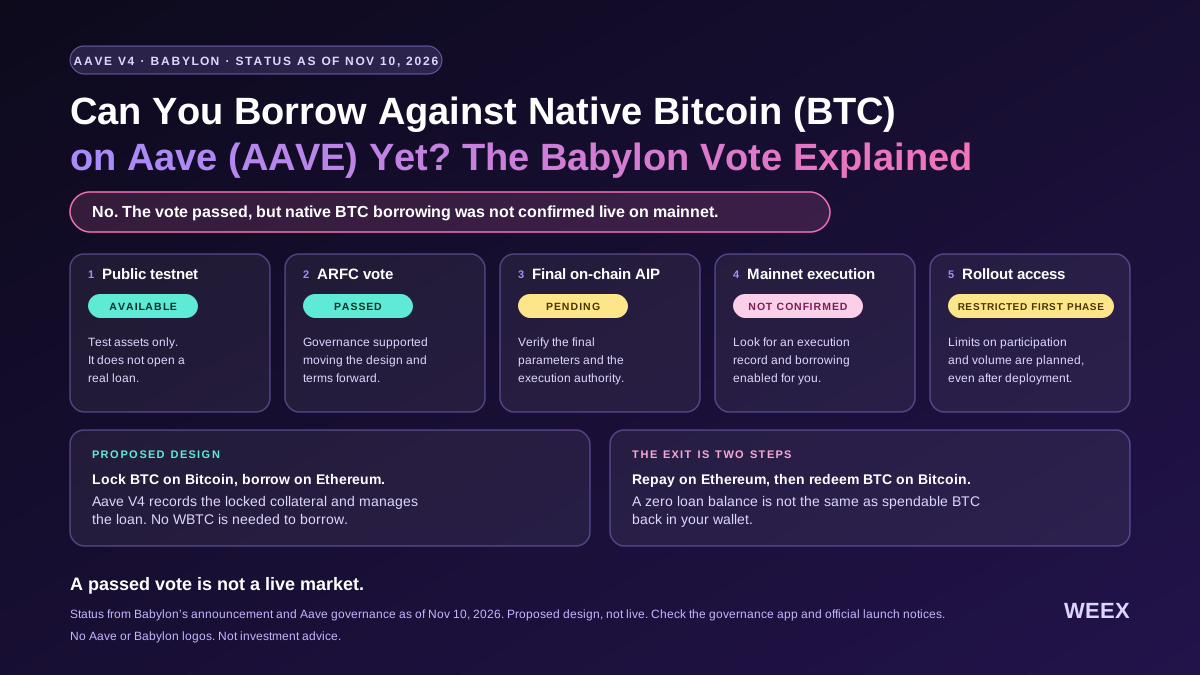
Can You Borrow Against Native Bitcoin (BTC) on Aave (AAVE) Yet? The Babylon Vote Explained
Can you borrow against native Bitcoin on Aave yet? See what the Babylon vote approved, what still needs to launch, and how BTC liquidation would work.

PIEVERSE Price Up Nearly 80% in a Week: Futures Activity, the November 14 Unlock and What Is Confirmed
PIEVERSE rose about 79% in seven days with futures volume far above spot. See what is confirmed about the November 14 unlock and the WEEX Lucky Eggs campaign.

Hong Kong Approves Crypto Asset Reporting Rules - Fintech World

NVDA Stock Falls 4.3% After Board Opens Investigation: What Is Confirmed and What Is Not
NVDA closed at $178.67 on November 9, 2026, down about 4.3%, after Nvidia’s board confirmed an independent investigation. Other claims come from media reports. WEEX’s Lucky Eggs campaign runs until November 25.

Chainalysis Report: Why Did Western Europe Withstand the Global Crypto Market Chill?

Four Security Strategies from the Wallet Theft Incident

Global Outage: Your Cryptos Are Not Disappearing

Did Strategy buy Bitcoin? Saylor reignites speculation

A New Chapter in the History of Rug Pulls in Crypto

From Binance Incubator to Nasdaq: Injective's Eight Years

tBTC Cross-Chain Bridge Resumes On-Chain Operations, Threshold Network Confirms Adequate Reserves

FinCEN Withdraws Proposed Crypto Travel Rule Expansion in Separate November Move

Finnish Startup Uses Heat from Bitcoin Miners to Heat 30 Homes

Analysis: The Logic of BTC's Periodic Recovery Remains Unshaken, Losses and Panic Have Been Fully Released
Undervalued Opportunities in the Crypto Market: Funding Rates Can Be Traded Separately

Centrifuge Launches Schroders Emerging Market Bond Fund Tokenization Product on Solana

FinCEN and the Federal Reserve Withdraw Proposal to Adjust Cross-Border Transfer Rules
US sanctions hit 41 companies accused of keeping Prince Group’s scam network running

Zcash’s new security fund is 99.7% old money

Despite the decline, Bitcoin has not lost the game against gold
U.S. Congresswoman Maxine Waters Announces Candidacy for Chair of House Financial Services Committee! Aims to Establish Strict Yet Fair Rules for Legitimate Cryptocurrency Businesses
Greece ends years of crypto tax uncertainty with new 10% levy on Bitcoin profits

U.S. Treasury and Federal Reserve Withdraw Proposal to Lower Cross-Border Travel Rule Threshold to $250

Beyond APY: Saying Goodbye to Black Box Trust and Reassessing the Security Logic of ETH Staking
South Korea’s GOPAX halts crypto trading, withdrawals after hacking threat

What is the real challenge for South Korean exchanges now that the regulatory framework is in place?

Cipher Agrees to Cover $359 Million Over Budget for Barber Lake Project
Algorithmic Trading and Cryptocurrencies: How Do Robots React to Volatility?
Confidence at Zero! Goldman Sachs Interprets Hedge Fund Positions: 'Surrender Liquidation', Largest Loss Since the Pandemic
47% Top Tax Rate Approaches: Seven Tax Reduction Strategies for Australian Crypto Investors
Can You Borrow Against Native Bitcoin (BTC) on Aave (AAVE) Yet? The Babylon Vote Explained
Can you borrow against native Bitcoin on Aave yet? See what the Babylon vote approved, what still needs to launch, and how BTC liquidation would work.
PIEVERSE Price Up Nearly 80% in a Week: Futures Activity, the November 14 Unlock and What Is Confirmed
PIEVERSE rose about 79% in seven days with futures volume far above spot. See what is confirmed about the November 14 unlock and the WEEX Lucky Eggs campaign.
Hong Kong Approves Crypto Asset Reporting Rules - Fintech World
Latest articles


Latest coin listings on WEEX


