
Coinbase, Kalshi, and Kraken Support CFTC in Court Dispute Over Perpetual Stock Contracts

 Prefer us on Google
Coinbase, Kalshi, Payward -- the parent company of the Kraken exchange -- and other companies from the digital asset market have supported the U.S. Commodity Futures Trading Commission (CFTC) in a dispute over the regulation of perpetual futures contracts linked to individual stocks. The case concerns the division of authority between the CFTC and the Securities and Exchange Commission (SEC), which opponents of these instruments argue should oversee them.
A motion for the admission of an amicus curiae opinion, which represents the views of parties not directly involved in the case, has been submitted to the U.S. District Court for the Southern District of New York. It was filed by representatives of Coinbase, Kalshi, Payward, DRW Holdings, Jump Trading, and Paradigm. The companies aim to support the CFTC in response to a request from the Capital Markets Alliance (CMA) for a ban on the further offering of these instruments. The motion also included a proposed opinion text. The first page of the submitted motion (source: CFTC)
Coinbase, Kalshi, and other cryptocurrency entities had previously begun efforts to introduce perpetual stock contracts to the U.S. market. The applications from Coinbase Derivatives, KalshiEX, and Bitnomial for the approval of such products for trading were deemed approved on November 2. We reported on Coinbase's exchange plans and investor reactions in this article.
According to the authors of the proposed opinion, perpetual stock contracts meet the statutory definition of futures contracts for securities. They argue that these contracts allow for exposure to the future price of an individual stock, are settled in cash, listed on exchanges, and subject to a margin mechanism. The absence of an expiration date should not automatically disqualify them from being classified as futures contracts.
The companies also point out that the SEC has participated in the work on the regulatory framework for such instruments. They argue that both agencies have collaborated from the beginning in determining the classification rules for contracts, and thus it cannot be said that the authority of the securities market regulator has been completely overlooked. They emphasize that futures contracts on individual stocks are subject to joint oversight by the CFTC and SEC in the United States.
CFTC and SEC at the Center of Oversight Dispute
The applications for single-stock contracts submitted by Coinbase Derivatives, KalshiEX, and Bitnomial were deemed approved by the CFTC on November 2. However, this mechanism did not mean that the agency issued a separate decision approving each product. The applications were considered approved after the deadline for their review expired without the CFTC taking any blocking actions. The classification of the instruments and the scope of the regulators' authority have become the subject of the court dispute.
The Capital Markets Alliance presents the matter differently. The organization believes that contracts without an expiration date do not meet the definition of futures because they do not provide for the delivery of the underlying instrument at a specified time. In its view, they should be classified as swaps based on securities, which fall under the SEC's jurisdiction.
CMA is an industry organization supported by entities from the traditional financial market, including Cboe and Citadel Securities. Therefore, the dispute concerns not only the interpretation of regulations but also which institutions and entities will be able to develop a new segment of derivative instruments in the United States.
Court Did Not Halt Trading but Questioned CFTC's Authority
The proceedings before the U.S. District Court for the Southern District of New York began in early November. On November 3, Judge Valerie E. Caproni rejected the CMA's request for a temporary ban on the further offering of contracts. However, this does not mean that the court sided with the CFTC.
In her reasoning, the judge indicated that the CMA has a strong chance of demonstrating that the CFTC exceeded its statutory authority by allowing perpetual contracts on individual stocks to be classified as futures for securities. In the court's view, instruments without an expiration date may not meet the statutory definition of such contracts and resemble swaps subject to SEC oversight.
At the same time, the court found that the CMA did not sufficiently demonstrate a specific and immediate risk of irreparable harm that would justify an immediate halt to trading. For this reason, the request for a temporary ban was denied. This means that the products were not blocked, but the fundamental dispute over the regulators' authority remains unresolved.
In this context, Coinbase, Kalshi, Payward, and the other companies have voiced their opinions. In the proposed opinion, they want to convince the court that the classification adopted by the CFTC is lawful, and maintaining it will allow for the development of the market for perpetual stock contracts in the United States. The final resolution may be significant not only for the mentioned platforms but also for the future division of authority between U.S. financial market regulators.
The content of the proposed opinion from the companies can be found in the document attached to the motion submitted to the court on November 9. Meanwhile, the court's ruling from November 3 shows why the request for an immediate halt to trading was rejected.
This content is provided for general informational purposes only and doesn't constitute financial, investment, legal, or tax advice. Any events, rewards, online promotions, or related information mentioned herein should not be considered a recommendation, solicitation, or invitation to purchase, sell, trade, or otherwise deal in any crypto assets. Crypto assets are highly volatile and may result in loss. The availability of WEEX services, products, and related events may vary by region. You are responsible for ensuring that your participation is in accordance with applicable local laws and regulations.
You may also like

D-Wave (QBTS) Earnings: Revenue Growth, Lower Bookings, and the Commercialization Test

Rigetti (RGTI) Stock Rebounds: Earnings, Backlog, and Commercial Progress

IonQ (IONQ) Stock Rallies: Q3 Results, Quantum Orders, and Business Expansion

CoreWeave (CRWV) Stock: Debt Pressure, Data Center Policy, and Earnings

Nebius Group (NBIS) Stock Rebound: AI Cloud Demand, Earnings, and Financing Risks

SK Hynix (SKHY) Stock Rebounds: AI Memory Demand, Cycle Risk, and Fab Plans

Core inflation excludes oil. Bitcoin investors still cannot ignore it

What Happened Today in the Crypto Market? A Review of the Most Important Cryptocurrency News (November 9, 2023)

US Congress Calls for Limiting NVIDIA Chip Exports to China Amid Spy Scandal

Bloomberg: With Democrats Regaining Control of Congress, Are Good Days Over for the Crypto Industry in Washington?

Cryptocurrency Anarchism Lacks Commitment, Coordination, and Reputation, Not New Tokens

Pharos Network Integrates Fireblocks for Institutional-Grade Custody Workflow for RealFi Assets

230,000-Follower 'Crypto Guru' Exposed: 30 Alt Accounts Uncovered for Fan Harvesting
Enza Closes $6 Million Funding Round to Develop Payment Infrastructure

AI Fills Gaps in the Crypto Industry: Fifteen Startup Opportunities to Watch

Trump Media adds 1,510 Bitcoin in Q3 as treasury reaches $1.17B

Bank of Korea: Consider Existing Financial Regulations When Introducing Stablecoins

Dormant Ethereum Wallet Moves $4.6 Million. Scammers Set a Trap in Three Minutes

47% Top Tax Rate Approaches: Seven Tax Reduction Strategies for Australian Crypto Investors

WEEX P2P now supports ILS, BHD, OMR & QAR —Merchant Recruitment Now Open

Hyperliquid Strategies Reports 38.5M HYPE Treasury After $802M Deployment

No Music App on Work Laptops: The Small Rules Behind WEEX Security

SoftBank Reports First Quarterly Net Loss in Two Years, Intel and Data Center Dragging Down Performance
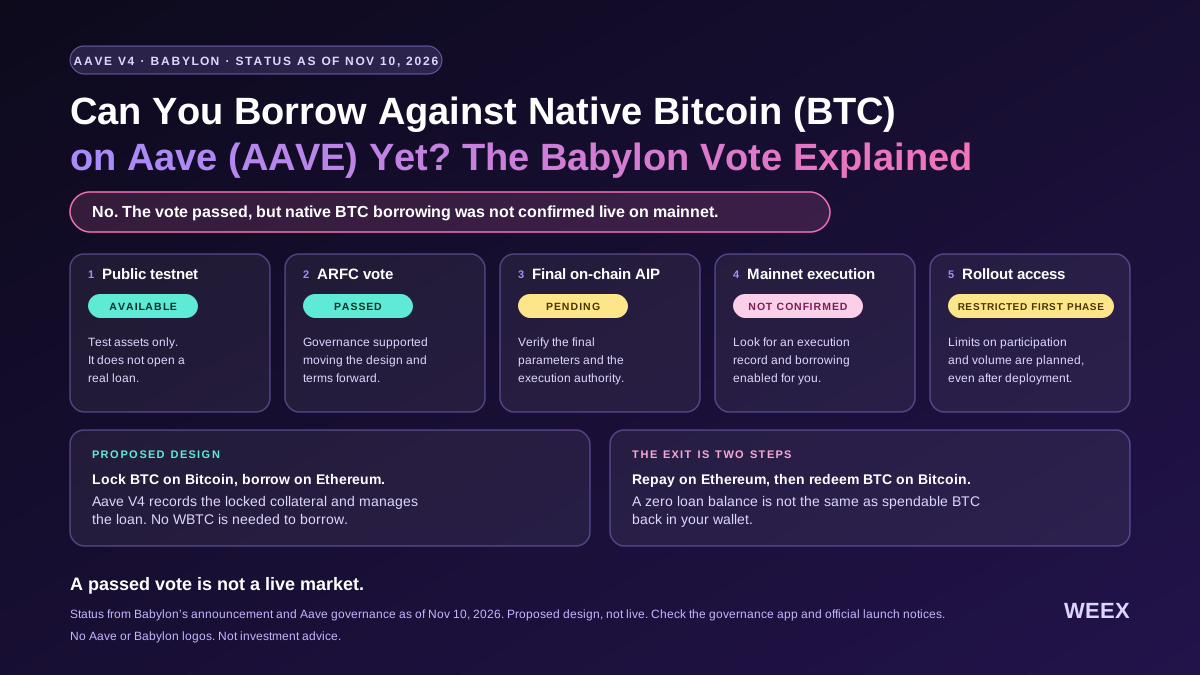
Can You Borrow Against Native Bitcoin (BTC) on Aave (AAVE) Yet? The Babylon Vote Explained
Can you borrow against native Bitcoin on Aave yet? See what the Babylon vote approved, what still needs to launch, and how BTC liquidation would work.
Why Doesn't Bitcoin Always Rise When Stocks Rally?
Financial Commission to Manage Stock Market Volatility with Sidecars and High-Frequency Trading Checks
IMF urges Kenya to make crypto firms share customer data under Travel Rule
Kim & Chang Lawyer: "Excessive Responsibility Should Not Be Imposed on Stablecoin Issuers"
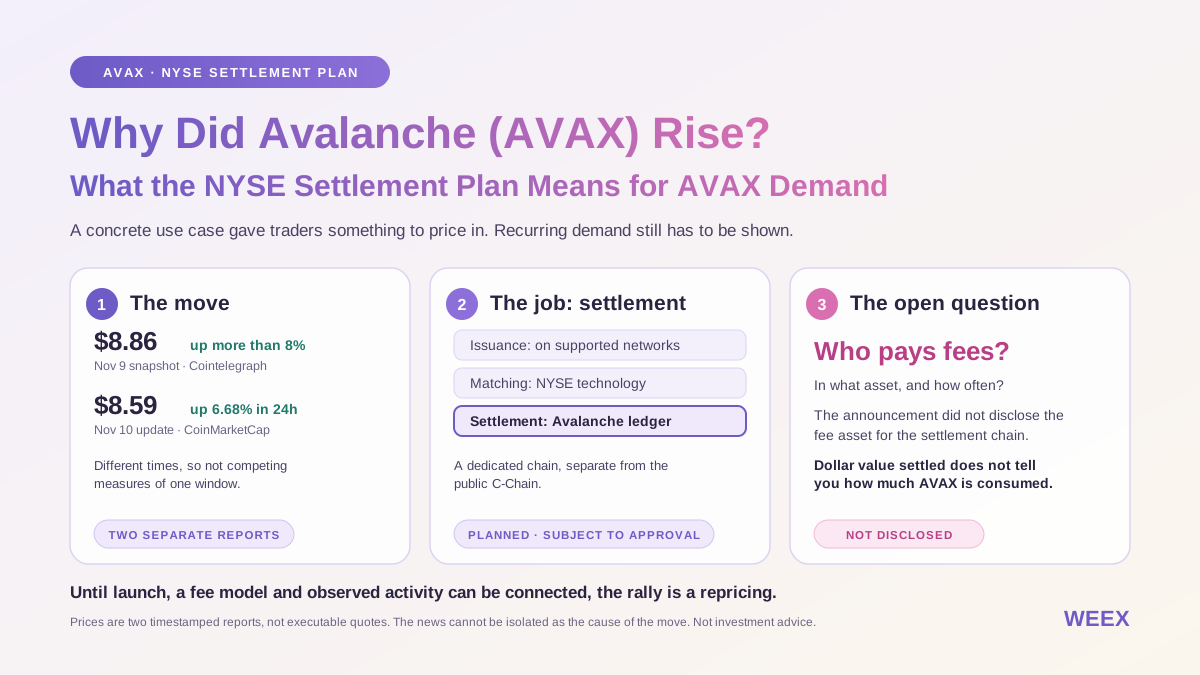
Why Did Avalanche (AVAX) Rise? What the NYSE Settlement Plan Means for AVAX Demand
See why Avalanche (AVAX) rallied after the NYSE settlement announcement, how the dedicated chain would work, and what could create demand for AVAX.

Cryptocurrency Security Checklist: Four Lessons from Phemex Safety Hub Vol. 05–08
D-Wave (QBTS) Earnings: Revenue Growth, Lower Bookings, and the Commercialization Test
Rigetti (RGTI) Stock Rebounds: Earnings, Backlog, and Commercial Progress
IonQ (IONQ) Stock Rallies: Q3 Results, Quantum Orders, and Business Expansion
CoreWeave (CRWV) Stock: Debt Pressure, Data Center Policy, and Earnings
Nebius Group (NBIS) Stock Rebound: AI Cloud Demand, Earnings, and Financing Risks
SK Hynix (SKHY) Stock Rebounds: AI Memory Demand, Cycle Risk, and Fab Plans
Latest articles
Latest coin listings on WEEX


