
Kim & Chang Lawyer: "Excessive Responsibility Should Not Be Imposed on Stablecoin Issuers"

 Prefer us on Google


There are claims from the legal community that excessive anti-money laundering responsibilities should not be imposed on issuers for the commercialization of won-based stablecoins, and that the scope of responsibility in the distribution process should be clarified.
On the 10th, Jeong Young-ki, a lawyer at Kim & Chang, made this statement while presenting on the topic of "Follow-up Tasks for the Commercialization of Stablecoins" at a discussion on the challenges following the Digital Asset Basic Act held at the Financial Investment Association's Financial Investment Education Center Leaders Hall.
Lawyer Jeong stated regarding stablecoin regulation, "Opinions are divided globally as well," and added, "We should not take an extreme position, but at least we need to understand the risks of the product and regulate accordingly."
He explained that the price stability, high liquidity, and borderless transaction characteristics of stablecoins pose a risk of being exploited for money laundering.
"While BTC (Bitcoin) can also be used for money laundering, it has high price volatility," he noted. "In contrast, stablecoins are stable in value, highly liquid, and borderless."
He further pointed out, "These characteristics are advantages of fiat currency, but they can turn into risks of being misused for illegal funds in the case of stablecoins."
In particular, he identified the scope of responsibility that issuers must bear in the distribution process as the most important issue in stablecoin regulation.
He explained, "Current regulations mainly focus on the issuance process and the final redemption process," adding, "Ultimately, the most burdensome and contentious issue will be regulation in the distribution process."
He raised the question, "If the issuer delivers the stablecoins to the initial acquiring institution and they are used for drug money through several intermediaries, how far should the issuer be held responsible?" and stated, "This issue is currently the most important one."
Lawyer Jeong emphasized the need to reasonably limit the issuer's responsibilities by comparing the regulatory approaches of the United States and Hong Kong.
According to him, while the U.S. imposes anti-money laundering obligations similar to those of financial institutions on stablecoin issuers, it does not require monitoring of all distribution processes after the initial transaction.
He explained, "The issuer only needs to verify the customer of the counterparty they are directly transacting with, and there is no need to verify customers for those who transfer in the second, third, or fourth rounds."
He added, "When the government identifies risky transactions and requests freezing or blocking, it is sufficient if technical measures can be taken. The key point is that there is no need to scrutinize every transaction."
In contrast, he assessed that Hong Kong requires issuers to have broad risk management responsibilities for stablecoins in circulation.
Lawyer Jeong stated, "In Hong Kong, if suspicious or criminal funds are discovered, the issuer must prove that they took the best possible measures," and noted, "There has been controversy over whether stablecoins can be properly circulated under such regulations in Hong Kong."
He also mentioned that regulations regarding personal wallet withdrawals and anti-money laundering have already been applied to virtual asset (digital asset) exchanges in South Korea.
He stated, "When withdrawing to a personal wallet from a domestic exchange, a whitelist method is applied to verify whether it is the same person's wallet," and added, "Since there are already some regulations on transfers between personal wallets, imposing excessive responsibilities on issuers in the distribution market should be avoided."
There were also calls to clarify the criteria for freezing and blocking stablecoins.
Lawyer Jeong explained, "If a government agency requests a freeze, the issuer can take action, but if the issuer tries to freeze based on their own judgment, it becomes very difficult because the frozen party can file a lawsuit."
He continued, "We need to clearly define the conditions and procedures for when to freeze, block, and burn, and if it is difficult to specify in the law, it should be clarified in subordinate regulations or guidelines."
Lawyer Jeong proposed follow-up legislative tasks including specifying the issuer's anti-money laundering obligations, detailing freezing and blocking procedures, sharing responsibilities among distribution participants, revising foreign exchange transaction regulations, and establishing a public-private information sharing system.
He stated, "It is necessary to verify whether the anti-money laundering system, including compliance monitoring, internal controls, and independent third-party audits, is in place during the issuer's licensing process."
He also explained, "If exchanges are involved in the distribution process, they will bear the anti-money laundering obligations, so participants will share some responsibilities."
He emphasized the importance of sharing information on illegal wallets between the government and the private sector.
Lawyer Jeong stated, "If the government identifies wallet addresses related to terrorism, that information should be shared with the issuer for blocking, and there should be a procedure for the issuer to provide information to government agencies when suspicious transactions are discovered."
Finally, he emphasized, "Clear regulations are better than strong regulations," stating, "While not everything can be included in the law, the criteria for sharing responsibilities in the distribution market and the conditions for freezing and blocking should be clarified through enforcement decrees and supervisory regulations.",
-- Price
This content is provided for general informational purposes only and doesn't constitute financial, investment, legal, or tax advice. Any events, rewards, online promotions, or related information mentioned herein should not be considered a recommendation, solicitation, or invitation to purchase, sell, trade, or otherwise deal in any crypto assets. Crypto assets are highly volatile and may result in loss. The availability of WEEX services, products, and related events may vary by region. You are responsible for ensuring that your participation is in accordance with applicable local laws and regulations.
You may also like

大冰要抄底(专注交易) Predicts Bitcoin and Ethereum Market Trends

Trump Media adds 1,510 Bitcoin in Q3 as treasury reaches $1.17B
47% Top Tax Rate Approaches: Seven Tax Reduction Strategies for Australian Crypto Investors
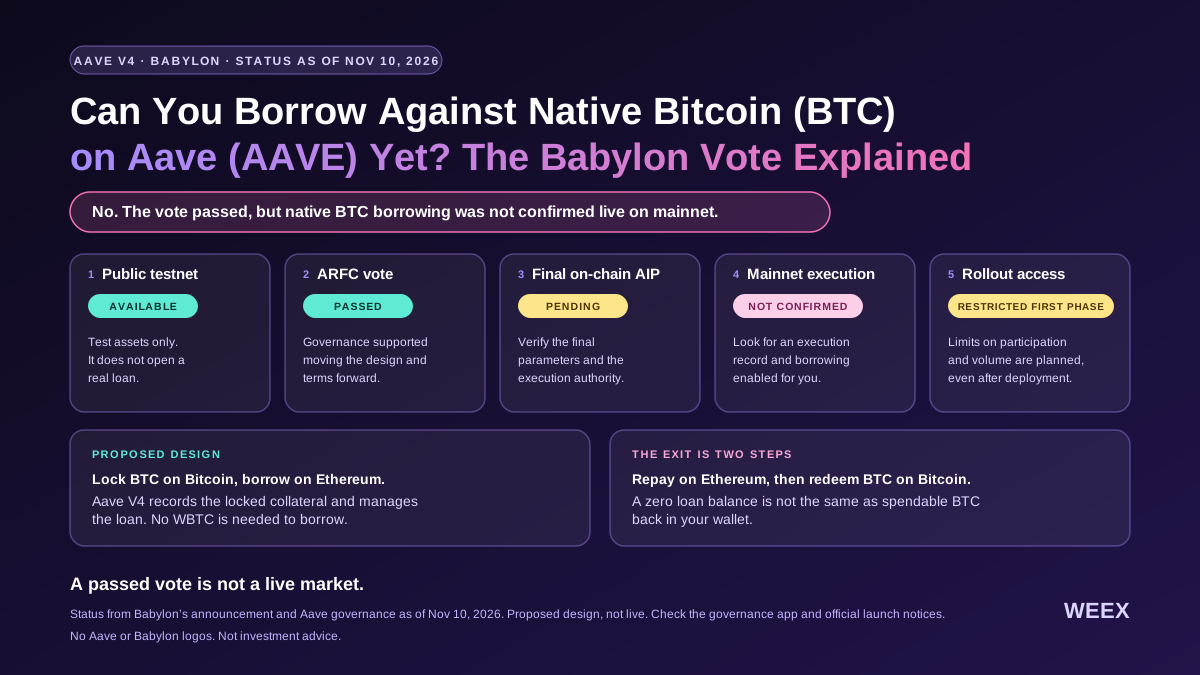
Can You Borrow Against Native Bitcoin (BTC) on Aave (AAVE) Yet? The Babylon Vote Explained
Can you borrow against native Bitcoin on Aave yet? See what the Babylon vote approved, what still needs to launch, and how BTC liquidation would work.

Mr&强 Analyzes Bitcoin and Ethereum Fluctuation Patterns

WEEX Exclusive:Middle East Easing Expectations Boost Stocks | WEEX Daily Brief (November 10, 2026)
On November 9 close, the S&P 500 and Dow both rose more than 2%. Middle East easing expectations pushed oil prices lower. Bitcoin and Ethereum spot ETFs saw net outflows last week. AVAX rose on reports of tokenized-stock clearing. PIEVERSE surged short-term. November 10 focus is October CPI, TSMC monthly sales data, CoreWeave earnings and others.

When is the launch date of Bitcoin Hyper? Testnet, tokens, and mainnet are separate milestones

Middle East Easing Expectations Boost Stocks | WEEX Daily Brief (November 10, 2026)
On November 9 close, the S&P 500 and Dow both rose more than 2%. Middle East easing expectations pushed oil prices lower. Bitcoin and Ethereum spot ETFs saw net outflows last week. AVAX rose on reports of tokenized-stock clearing. PIEVERSE surged short-term. November 10 focus is October CPI, TSMC monthly sales data, CoreWeave earnings and others.

Bitcoin non-empty wallets drop by 108700 amid retail capitulation

LNbits disables hosted Bitcoin services with no restart timeline

Bitcoin Spot ETF Sees Net Outflow of $201 Million for Three Consecutive Days

Ray Dalio Warns of Diminished Trust in U.S. Treasuries Amid Political Conflicts
BitPay Brings Apple Pay and Google Pay Checkout to Crypto Purchases

Four Security Strategies from the Wallet Theft Incident

Glassnode: Altcoin Trading Volume Returns to Normal Levels

Crypto: BlackRock Predicts Billions More in Its Crypto ETFs

Bakkt Aims for $6 Billion in Transaction Volume in Six Months, Doubling Annual Target; $10.4 Million Investment in Bitcoin Japan Recorded as of End of September

CoinShares: Data Center Ban Increases Value of Bitcoin Mining Companies' Power Assets
CoinShares: Data Center Ban Increases Value of Bitcoin Mining Companies' Power Assets

MARA Q3 Net Profit Rises to $632 Million, Sells 13,597 BTC in October to Repay Loans
Circle VP highlights AI agents driving demand for non-dollar stablecoins

Strive CIO advises BTC treasury firms on funding strategies

Barkin Highlights Inflation as Major Risk and Emphasizes Need for Cautious Monetary Policy Adjustment
Coldcard’s $116M exploit sparks fresh clash over NVK’s defense
The missing step in the warning that Japan could trigger Bitcoin’s next selloff
Two Bitcoin miners reported nearly $2 billion in profit. The biggest boost wasn’t cash

Super League buys 16 BTC for $1.23m as purchase sizes double
Bitcoin Lightning’s security update shuts one door. A critical Linux flaw remains

BlackRock: Bitcoin Whales Are Swapping Self-Custody For IBIT At Record Pace

Kraken Co-CEO Says Bitcoin Has Emerged from Bear Market
大冰要抄底(专注交易) Predicts Bitcoin and Ethereum Market Trends
Trump Media adds 1,510 Bitcoin in Q3 as treasury reaches $1.17B
47% Top Tax Rate Approaches: Seven Tax Reduction Strategies for Australian Crypto Investors
Can You Borrow Against Native Bitcoin (BTC) on Aave (AAVE) Yet? The Babylon Vote Explained
Can you borrow against native Bitcoin on Aave yet? See what the Babylon vote approved, what still needs to launch, and how BTC liquidation would work.
Mr&强 Analyzes Bitcoin and Ethereum Fluctuation Patterns
WEEX Exclusive:Middle East Easing Expectations Boost Stocks | WEEX Daily Brief (November 10, 2026)
On November 9 close, the S&P 500 and Dow both rose more than 2%. Middle East easing expectations pushed oil prices lower. Bitcoin and Ethereum spot ETFs saw net outflows last week. AVAX rose on reports of tokenized-stock clearing. PIEVERSE surged short-term. November 10 focus is October CPI, TSMC monthly sales data, CoreWeave earnings and others.
Latest articles


Latest coin listings on WEEX


