
From Web3 to the Real Economy: Erable° Becomes an Essential Player in Impact Financing

 Prefer us on Google




For years, the crypto and Web3 ecosystem has been filled with promises: disruptive infrastructures, tokenization, decentralized finance. Many initiatives have remained trapped in a speculative loop, far from the economic fabric. Erable has taken the opposite path. The French group uses technology as an operational lever to serve a specific goal: financing companies in the real economy whose profitability is inseparable from their positive impact. Since the acquisition of WE DO GOOD, it claims to have received over 3,000 applications, financed 39 companies, and already surpassed the entire year of 2025 in the first half of 2026.
In Brief
- Erable finances companies through revenue sharing: the investor receives a share of the revenue of the companies they support, rather than a capital gain upon resale.
- The acquisition of WE DO GOOD in 2024 brought technology, operational expertise, and a community: over 20 million euros raised, 11,000 investors, and 300 projects, according to Erable.
- Of the more than 3,000 applications received since the acquisition, 2.6% (39 companies) have been selected and placed in fundraising.
- Capital raised increased by 45% in 2025; in the first half of 2026, the volume of the entire previous year has already been surpassed, and the company claims to be profitable.
From Tokenization to Revenue Sharing: What Has Changed at Erable?
Erable was born with an ambition: to invent new financing models for the real economy. The group initially explored blockchain and various tokenomics schemes applied to the circular economy, at a time when asset tokenization was still the domain of pioneers, as we wrote during the acquisition of WE DO GOOD in April 2024.
These initial experiments financed assets through community treasuries, with the remuneration of subscribers directly linked to the revenues generated by their sale or rental. Two concrete cases: HomeCycle, for washing machines offered for rent, and H2O Care, for wastewater recycling machines, whose operation concluded positively at the end of 2025.
To make the mechanism simpler, clearer, and accessible to a broader audience, Erable then retained its central principle, revenue sharing, while changing its framework. Financing no longer focuses on tokenized assets but on the companies that develop them, prioritizing mature companies already established in their market. This is how Axsol, a specialist in accessibility solutions for people with reduced mobility, and SATOR, which develops new forms of knowledge transmission related to major transitions, were financed.
What Changes with the Acquisition of WE DO GOOD?
The acquisition of the Nantes-based fintech WE DO GOOD, announced on April 29, 2024, marked a new milestone. It brought together Erable's experience in new financing models, the technology developed by the platform, and operational expertise in revenue sharing financing. WE DO GOOD is registered as a crowdfunding intermediary (ORIAS n° 17002712) and payment services agent (REGAFI n° 73473), according to its website. The entire entity now claims to have raised over 20 million euros, 11,000 investors, and supported more than 300 projects (erable.com).
At the time of the operation, Yannis Baala, CEO of Erable, set the course:
Together, we want to become a true accelerator of positive impact. Yannis Baala, CEO of Erable, acquisition announcement of WE DO GOOD, April 29, 2024.
The group now intends to put this infrastructure at the service of other actors. Through a dedicated platforms offering, Erable aims to enable companies, sectors, institutions, foundations, or communities of investors to design and manage their own financing programs for the real economy. In other words, sell the tool, not just use it.
-- Price
How does the platform sort 3,000 files to finance 39?
In a sector of alternative financing still hindered by manual operations, Erable claims to have completely rebuilt its platform. This overhaul was carried out with the strategic support of Adrien Hubert, co-founder of Erable, Serge Balatre, and the teams from Regenerative Ltd and Moonside, who contributed to introducing a high level of automation in file qualification, data analysis, and opportunity sourcing.
The flow has followed. Of the more than 3,000 files received since the takeover, more than half arrived in the recent period, since the deployment of the new architecture. Where others would yield to the temptation of volume, Erable bets the opposite: only 2.6% of projects, or 39 companies, have been selected and placed in fundraising.
The stated goal is not to replace human analysis with algorithms but to enhance the analytical capacity of teams to retain only the projects suitable for this type of financing. A selection rate of 2.6% places the platform in a filtering logic rather than a marketplace.
What do the 2025 and 2026 figures say?
|------------------------------------------|------------------------------------------------|----------------------------------------------|------------| | Indicator | Value | Period | Source | | Files received | More than 3,000 | Since the takeover of WE DO GOOD (April 2024) | Erable | | Companies retained and placed in fundraising | 39, or 2.6% of files | Same period | Erable | | Capital raised | +45% | 2025 vs 2024 | Erable | | Capital raised | 2025 volume exceeded in six months | 1st half of 2026 | Erable | | Result | Profitable company | 2026 | Erable | | Cumulative history | €20 million raised, 11,000 investors, 300 projects | Since 2013 (WE DO GOOD) and Erable | erable.com |
Figures communicated by Erable, not audited by Cointribune. Consultation on October 6, 2026.
After a 45% increase in capital raised in 2025, the pace accelerates further in 2026: in the first six months, the group claims to have exceeded the total volume of the previous year. And the company now declares itself profitable, which remains rare in French crowdfunding, where most platforms rely on successive fundraising.
What to know before investing in revenue sharing
Revenue sharing is neither a stock nor a bond. The investor does not hold a share of the capital and has no fixed rate: they receive a percentage of the company's revenue, paid periodically, up to a defined ceiling in the contract. If activity slows down, payments slow down with it; if the company fails, the capital may be lost. There is no organized secondary market to resell one's position.
This model, sometimes referred to as revenue-based financing, is aimed at investors who agree to tie their returns to the actual activity of an SME rather than to the valuation of an asset. It is the same movement, seen from the perspective of retail savings, as that which institutional finance is leading with the tokenization of real assets.
By combining analytical rigor, algorithmic leverage, data, and a strategic vision surrounded by seasoned advisors, Erable aims to demonstrate that alternative impact financing has found its infrastructure for scaling. Proof will come from upcoming publications: the number of programs opened by third parties on its dedicated platforms, and the effective repayment rate of the 39 financed companies. To measure the progress made since the early days of Web3, one can revisit the current value of tokenized assets on Solana.
To consult the projects open for investment in revenue sharing, starting from 100 euros, visit WE DO GOOD by Erable. Investment is reserved for adults residing in an eligible country; there is a risk of capital loss.
To discover the companies currently being financed through revenue sharing on the Erable platform, click here.
FAQ
What is revenue sharing financing? A contract by which a company grants its investors a percentage of its future revenue, for a set duration or until a predetermined cap, without opening its capital or incurring fixed-rate debt.
What is the difference with equity crowdfunding? In equity crowdfunding, you become a shareholder and profit from resale or dividends. In revenue sharing, you hold no shares: your return directly follows the company's sales, quarter after quarter.
What is the minimum ticket at Erable? The WE DO GOOD campaigns are accessible starting from 100 euros, depending on the platform. Each project specifies its duration, its percentage of shared revenue, and its repayment cap.
This content is provided for general informational purposes only and doesn't constitute financial, investment, legal, or tax advice. Any events, rewards, online promotions, or related information mentioned herein should not be considered a recommendation, solicitation, or invitation to purchase, sell, trade, or otherwise deal in any crypto assets. Crypto assets are highly volatile and may result in loss. The availability of WEEX services, products, and related events may vary by region. You are responsible for ensuring that your participation is in accordance with applicable local laws and regulations.
You may also like

Michaël van de Poppe sees four crypto trends: AI, Ethereum, Sui, and digital assets

Coppock Curve and Crypto Trading: How to Use the Trend Reversal Indicator

Bitcoin Records U.S. Constitution Again... This Time with a Mysterious Code

Hedge funds hold $2 trillion in US debt, but their next trade could require fewer bonds

Weekly: $68,000 Theft from Ukrainian in Trust Wallet, Circle's Lawsuit Against Trump Over $2 Billion in UAE, and Historic Solana Update

ZachXBT Accuses CoinDCX of Losing $16 Million in Client Funds

NYSE’s owner is backing 24/7 stock tokens without Wall Street’s usual price rules

JPMorgan Now Offers Two Tokenized Money Market Funds on Solana
Follow the Money: $630 Million for Strive, Tether Activity and Attention to CeFi

HTX Research Analyst Chloe: Despite Significant Net Inflows into Bitcoin Spot ETFs, Macroeconomic Data Suppresses Rebound Potential

Killa: Frequent Short-term Trading Risks Missing Major Market Movements, Patience in Holding Positions is Important

China's fiscal revenue rose 5.1% by September, but land sales continue to decline

90% of Revenue from Meme Coins, Yet Valuation Rivals Pump: What Should Meteora Be Worth?
Former FTX Executive Slams Netflix's New Series: Turning Financial Fraud into a 'Romantic Film' is Absurd

Ripple teams up with $10B payments firm Arf to expand RLUSD use on XRPL

One billion dollars in three days is not enough. Bitcoin faces a significant challenge

WEEX Exclusive:Major Indexes Close Higher; Focus on TSLA, META Stock Earnings | WEEX TradFi Daily(October 22, 2026)

Major Indexes Close Higher; Focus on TSLA, META Stock Earnings | WEEX TradFi Daily(October 22, 2026)
The three major indexes closed higher on October 21, led by the Nasdaq. SpaceX beat earnings expectations and disclosed AI-business revenue; merger discussions with Tesla also helped lift AI and crypto-related stocks. Bitcoin traded near $84,000 and Ethereum near $2,470. LIT led majors on compliance-license expectations. On October 22, investors will watch Procter & Gamble, Southern Copper and Union Pacific before the open, followed by Western Digital and Newmont after the close.

Irish drug lord’s lost Bitcoin fortune comes back to life as $41 million moves to Coinbase

ZachXBT Reports on Cryptocurrency Laundering via FreedomXMR on Hyperliquid

Willy Woo: Good Time to Accumulate Bitcoin

Tech and AI: Hedge Funds Reduce Exposure at Unprecedented Rate in Ten Years

The Qubic network is back in operation after the hacking of users
Crypto rallies point to slower USDC growth and faster USDT growth, study finds
North Korea-linked SquidSquad suspected in $2.84M BNB Chain theft

Putting Childhood on the Trading Table: TCG May Be the Closest Moment for Young People to Get Rich
Kraken’s $80 stablecoin fee gap exposes hidden costs

Justin Sun Sells 80-90% of His ETH: Bitcoin Warning
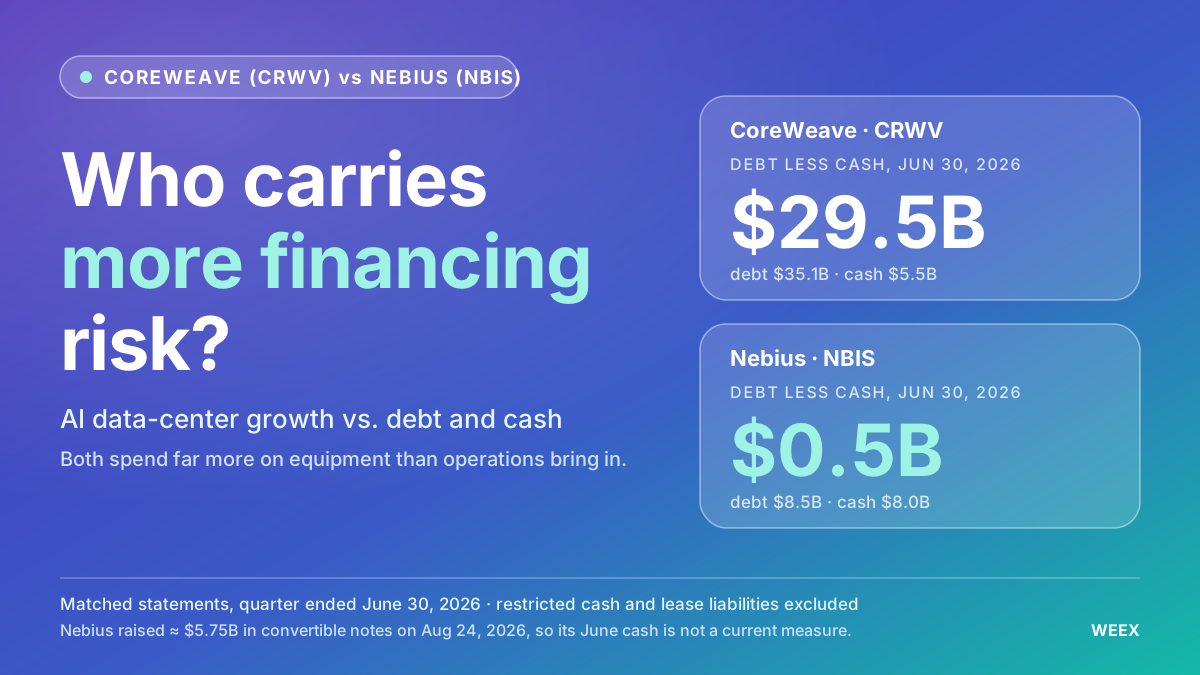
CoreWeave vs. Nebius Stock: Which AI Cloud Business Faces Greater Financing Risk?
Compare CoreWeave and Nebius stock through debt, cash flow, customer prepayments and dilution to assess which AI cloud business faces greater financing risk.
EU bans cash payments over €10,000 starting July next year
Michaël van de Poppe sees four crypto trends: AI, Ethereum, Sui, and digital assets
Coppock Curve and Crypto Trading: How to Use the Trend Reversal Indicator
Bitcoin Records U.S. Constitution Again... This Time with a Mysterious Code
Hedge funds hold $2 trillion in US debt, but their next trade could require fewer bonds
Weekly: $68,000 Theft from Ukrainian in Trust Wallet, Circle's Lawsuit Against Trump Over $2 Billion in UAE, and Historic Solana Update
ZachXBT Accuses CoinDCX of Losing $16 Million in Client Funds
Contents
Latest articles


Latest coin listings on WEEX


