
Google Launches Gemini Decisions API Charging $0.10 per Million Input Tokens with 150-250 ms End-to-End Latency

 Prefer us on Google



Google has launched the Gemini Decisions API, a new endpoint powered by its Gemini Decision1 model, designed to help AI agents make quick preset decisions without generating lengthy text responses. {#quote_GOOG}
The interface allows developers to evaluate up to 1,000 independent questions against shared multimodal inputs that include text, images, audio, video, and PDFs. Gemini Decision1 does not generate responses token by token; instead, it scores preset options in a single forward pass, returning probabilities and confidence scores with an end-to-end latency of 150 to 250 milliseconds.
Google states that the model is built for bounded tasks, such as selecting tools, checking policy compliance, routing queries to the correct model, and evaluating context. Developers can submit "yes or no" checks, multiple-choice questions with up to 255 options, or scoring requests based on preset criteria in a single API call.
Faster, Lower-Cost Decisions
According to Google, the median model computation time for the API is 50 to 100 milliseconds, with performance remaining nearly constant when processing 1 to 100 questions per request.
The model supports a context window of up to 256,000 tokens and can handle multiple types of data simultaneously. This allows developers to combine inputs such as audio recordings, images, and documents without relying on separate processing systems.
Google also claims that in benchmark tests covering agent routing, reasoning, ranking, and multimodal understanding, the model outperformed competing systems while achieving the lowest calibration error.
The company states that Gemini Decision1 is nearly five times cheaper than using the Interactions API with Gemini 3.5 Flash-Lite in its shared benchmark suite.
This release comes amid increasing competition in specialized AI decision-making tools. OpenAI launched its Decisions API in October, powered by its GPT-6 Luna model. The company claims that the decision speed of this service is ten times faster than its Responses API and supports up to 400 questions per request. Similar to Google's product, it offers probability-based checks, multiple-choice selections, and scoring based on criteria, priced starting at $0.10 per million input tokens.
The Decisions API charges $0.10 per million input tokens, with no fees for output tokens. Developers pay a single fee for shared input data regardless of how many questions are evaluated, although each question adds tokens related to instructions and criteria.
Empowering Real-World AI Applications
Google has already deployed this technology in several products, demonstrating how dedicated decision models can enhance the speed and efficiency of automated systems.
In Gemini Notebook, the API routes incoming queries to the appropriate model tier and reasoning level. According to Google, this approach can reduce the latency of everyday queries by up to 40%, while reserving more powerful reasoning models for complex tasks.
The technology also supports rapid design experiments on Google Stitch, allowing users to generate interactive product wireframes and make changes via voice commands or touch input.
Meanwhile, Google’s CC Assistant uses the API to select emoji reactions from over 200 options in a fraction of a second.
Google Search is also utilizing this technology as a safety layer to detect adversarial behavior involving Model Context Protocol (MCP) tools.
In addition to these applications, the API can help developers build systems that automatically select the appropriate tools, evaluate incoming information, and determine when human intervention is needed.
The Decisions API is now available through Google AI Studio, which includes a free tier for prototyping. Google is also launching integrations with developer platforms such as OpenRouter, LangChain, Vercel, LiteLLM, and Pydantic AI.
-- Price
This content is provided for general informational purposes only and doesn't constitute financial, investment, legal, or tax advice. Any events, rewards, online promotions, or related information mentioned herein should not be considered a recommendation, solicitation, or invitation to purchase, sell, trade, or otherwise deal in any crypto assets. Crypto assets are highly volatile and may result in loss. The availability of WEEX services, products, and related events may vary by region. You are responsible for ensuring that your participation is in accordance with applicable local laws and regulations.
You may also like

$LIBRA: One of the defendants seeks to remove Judge Ledesma and halt the review that could reactivate the case

OpenAI Partners with Four Organizations for AI Safety Assessment

U.S. Supreme Court rejects Custodia appeal on Fed master account

Trezor found implants in reseller wallets. What protects the buyer?

UK convicts two Iranians for spying on Tehran's critical journalists

Banks Push Hard on Artificial Intelligence, But Profits May Not Follow
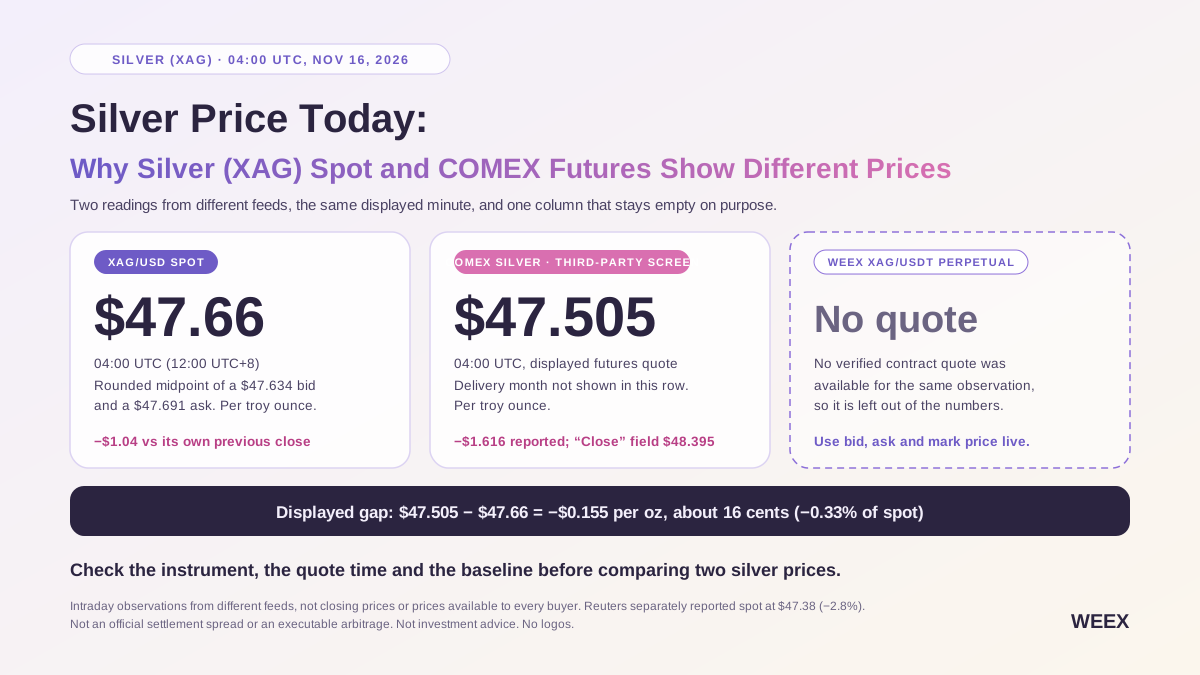
Silver Price Today: Why Silver (XAG) Spot and COMEX Futures Show Different Prices
Silver traded near $47–$48 on November 16. Compare XAG/USD spot, COMEX silver futures, and XAG/USDT perpetuals, and learn why their prices differ.

Proposal for Freezing Virtual Assets to Strengthen Response to Multi-Victim Fraud Crimes

Tether wants its gold token to rival ETFs

Perpetuals on Stocks: SEC Comes to CFTC's Aid Against Cboe and Citadel

German Customs to Administer Seizures of Suspiciously Sourced Cryptocurrencies Starting in 2027

*ST Wentai Appeals Dutch Court Ruling, Withdraws Part of Litigation Claims
A forced Bitcoin Lightning exit can be cheap and still leave you waiting days

Solana Confidential Compute Enters Beta, Mainnet Launch Date Undetermined

Crypto: The UK Assessed by FATF Before Its Rules Come Into Effect

Elizabeth Warren could reopen crypto’s banking fight without changing a single law

AI Agent Payments Reach 15 Million... Expanding XRP Ledger Ecosystem

Solana launches private AI tools with on-chain hardware checks
Trump Administration Sued Over Restoration of Arctic Offshore Drilling Leases
Amazon says no human wrote or reviewed the code for its new cloud testing tool

Bitcoin Core reveals Tor flaw that trusted thousands of nodes

Polymarket's New Matching Engine Nex Set to Launch in Mid-December, Delays Reduced by 412 Times

CFTC, DOJ sue Arkansas to stop Kalshi gambling lawsuit

OpenAI GPT-6 Astra Error Termination Alignment Evaluation

Unocoin Submits Investigation into BitGo Ethereum Address Withdrawals

Trump-linked stablecoin replaced by USDC on FIFA partner's site

The Next Battle in Crypto Security: How to Rebuild the Authorization System Beyond Smart Contracts?

Intel and SK Hynix Launch Solution to Break AI Inference Bottleneck

Judge Rejects Novig's Injunction Request, Criticizes CFTC Order for Implying Collusion
Dutch Court Rejects Jaguar Land Rover's Evidence Preservation Request, BYD Achieves Interim Victory in Overseas Intellectual Property Defense
$LIBRA: One of the defendants seeks to remove Judge Ledesma and halt the review that could reactivate the case
OpenAI Partners with Four Organizations for AI Safety Assessment
U.S. Supreme Court rejects Custodia appeal on Fed master account
Trezor found implants in reseller wallets. What protects the buyer?
UK convicts two Iranians for spying on Tehran's critical journalists
Banks Push Hard on Artificial Intelligence, But Profits May Not Follow
Latest articles




Latest coin listings on WEEX


