
Hack of 2,100 Wallets Due to an Old Bug; "Ill Bloom" Vulnerability Wipes Out Millions in Cryptocurrency!

 Prefer us on Google


An old vulnerability in the CryptoJS programming library has allowed hackers to guess the recovery phrases of some cryptocurrency wallets using ordinary computers, draining users' assets. This vulnerability, dubbed "Ill Bloom," has affected over 2,100 addresses across Bitcoin, Ethereum, Tron, Rootstock, and Polygon networks, with damages exceeding $5.7 million.
The main danger of this attack is that the issue is not limited to a single wallet or a specific network. CryptoJS has been used for years as a hidden component in hundreds of other software and libraries, and some wallet developers have utilized its random number generation capability to create recovery phrases; a feature that lacked necessary security in vulnerable versions.
How Did the CryptoJS Bug Compromise Wallet Recovery Phrases?
A typical 12-word recovery phrase is cryptographically secure enough that breaking it through standard trial and error methods is practically impossible. However, in some versions of the 3.x CryptoJS library, including version 3.1.2 and versions after it except for 3.2.0 and 3.2.1, the random number generation function was flawed.
In simple terms, this function produced predictable patterns instead of completely random numbers. As a result, the number of possible combinations for wallet recovery phrases was drastically reduced, allowing attackers to check potential options one by one using the processing power of ordinary computers.
The problem became more serious when CryptoJS was not directly visible in many software applications and was used as a software dependency in the background. Consequently, wallet developers might have been unaware of this flaw in their underlying infrastructure.
The First Wave of Theft; $3.14 Million in One Day
The first widespread wave of thefts occurred on May 27, 2026. Attackers targeted 431 accounts in just one day, extracting approximately $3.14 million in cryptocurrency.
Bitcoin accounted for the largest share of this loss, with about $2.57 million of the stolen assets related to this network. Ethereum followed with around $286,000, Rootstock with $177,000, Tron with $81,000, and Polygon with $23,000.
As investigations continued, the number of potentially affected wallets and software also increased.
Why Updating Wallets Is Not Enough to Save Assets?
One of the most important points about the Ill Bloom vulnerability is that updating software does not necessarily save users' assets.
If a wallet's recovery phrase was generated when the software was using a vulnerable version of CryptoJS, that recovery phrase has been weak from the start. Therefore, even if the developer later fixes the bug, the previous recovery phrase will still be predictable.
By August, the names of several wallets, including RWallet, Bexo Wallet, NanChat, Bitcoin Libre, and Milo Wallet, were mentioned among the affected software. Some of these projects, including Milo and RWallet, have even ceased operations.
However, the developers of Bitcoin Libre have fixed the flaw in older versions, and NanChat has released a new security patch. The new update for Bexo Wallet is still awaiting approval from app stores.
-- Price
What Should Users of Old Wallets Do?
Experts recommend that users who suspect their wallet's recovery phrase was generated with the vulnerable version of CryptoJS should not just settle for installing the latest software version. They should first check the public addresses associated with the wallet, and if any signs of danger are observed, assets should be transferred to a completely new wallet.
The important point is that users should not wait for a theft to occur to transfer their assets. If the previous recovery phrase can be guessed due to weaknesses in the random number generation process, an attacker can access the corresponding private key at any time.
For this reason, experts advise against keeping significant amounts in wallets whose recovery phrases were generated in a browser or using unreliable software infrastructure.
An Old Flaw, A Threat to Today's Wallet Security
The Ill Bloom saga once again shows that the security of a wallet is not solely dependent on its proprietary codes. Using a third-party library that seemingly has no direct relation to asset management can jeopardize the security of millions of users' private keys.
On the other hand, this attack has a significant difference from many common hacks: there is no need for direct penetration into the exchange server or the user's device. If the recovery phrase was generated insecurely from the start, an attacker can access the user's assets by reconstructing possibilities without physical access to the device.
For users, the message is clear; if a wallet has used a vulnerable infrastructure to generate its recovery phrase, creating a completely new wallet and transferring assets to it is the safest way to discard suspicious keys.
This content is provided for general informational purposes only and doesn't constitute financial, investment, legal, or tax advice. Any events, rewards, online promotions, or related information mentioned herein should not be considered a recommendation, solicitation, or invitation to purchase, sell, trade, or otherwise deal in any crypto assets. Crypto assets are highly volatile and may result in loss. The availability of WEEX services, products, and related events may vary by region. You are responsible for ensuring that your participation is in accordance with applicable local laws and regulations.
You may also like

We Need To Change Our Management: Ricardo Salinas On Mexico's Future, Bukele And Bitcoin

FinCEN Withdraws Crypto Travel Rule Proposal: What Still Applies

Dec. 9 Expected to Impact S&P 500 as Rate Hike Looms

This Magnificent Growth Stock Just Entered the Artificial Intelligence (AI) Cloud Race, and It Looks Dirt Cheap

Former New York Fed President Dudley: The Fed's 'Painless Disinflation' Strategy Is Doomed to Fail

Solana Foundation AI Agents Account for 76% of OpenRouter Token Usage
FTX 'Old Team' Secures US Futures License, 24/7 Trading on the Horizon

Where Will AMD Stock Be in 5 Years?

Stablecoin holders lose 12000 million USD annually in Treasury interest

CoinGecko Acquired: Two People Started with $200, Once Valued at $500 Million

Micron Has Plunged 36% From Its Peak. Here’s the Price at Which I’d Buy.

Controversial AI Explainability Research Draws Attention from Sam Altman
The Next Hyperliquid Will Emerge from These 6 Companies
A Super Empire on a Fragile Foundation: How Jensen Huang Has Controlled NVIDIA for 33 Years

Microsoft Ignite Conference Kicks Off Today! Focus on Copilot Monetization and AI Computing Returns, Can the Enterprise AI Flywheel Deliver?

Wall Street Sees 'Gazumping' Phenomenon as Hedge Funds Compete for Top Talent

Aave Labs Reports: A 97-Person Team Supporting What Kind of DeFi Business?

唐华斑竹 Suggests Optimizing WEEX Platform Token Functionality
Intesa Sanpaolo raises XRP and Solana ETF holdings, cuts Bitcoin and Ethereum
Why Are Tokenized Stocks Seeing Strong Buying Pressure While Prices Keep Falling?

WEEX P2P now supports CAD —Merchant Recruitment Now Open

SpaceX (SPCX) Stock Price Prediction 2027: How Much Can Starlink Growth Offset AI Spending?
SpaceX stock price prediction for 2027: See the $118–$148 base case, how much Starlink could offset AI spending, and what it would take to reach $200.
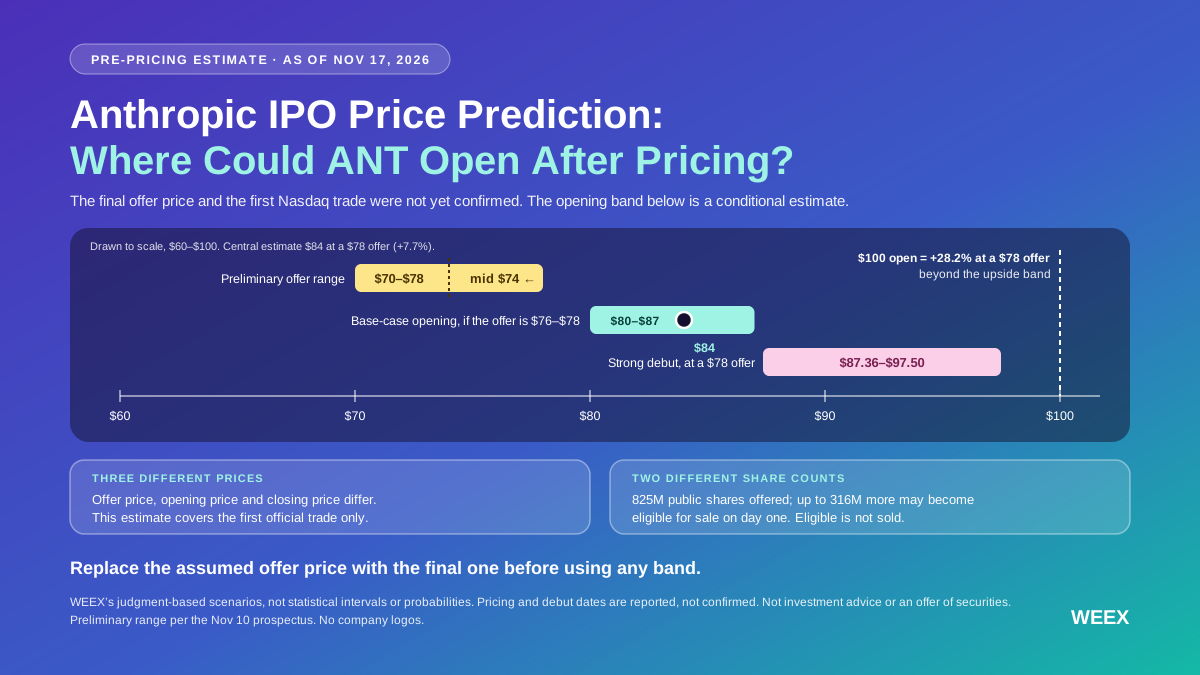
Anthropic IPO Price Prediction: Where Could ANT Open After Pricing?
Anthropic IPO price prediction: See ANT’s $80–$87 base-case opening range, how the final offer price changes it, and what could push shares above $90.
Will the $50 billion request materialize? The U.S. transportation system urgently needs funding for upgrades, but Congress has become a "lame duck"
Bitcoin Profit Supply Ratio Drops to 52%, Largest Decline in a Year

Reasons Why Cryptocurrency Kiosks Face Increasing Regulation
The Q3 Market in Turmoil: How Much is Circle Worth?

A Decade of a Crypto Neutral Fund Manager: A High-Pressure Way of Life

Cardano vs Solana: Which Blockchain is Superior?

One Hundred Million Dollars in Floating Profit Goes to Zero: A Contract Trader's Dilemma
We Need To Change Our Management: Ricardo Salinas On Mexico's Future, Bukele And Bitcoin
FinCEN Withdraws Crypto Travel Rule Proposal: What Still Applies
Dec. 9 Expected to Impact S&P 500 as Rate Hike Looms
This Magnificent Growth Stock Just Entered the Artificial Intelligence (AI) Cloud Race, and It Looks Dirt Cheap
Former New York Fed President Dudley: The Fed's 'Painless Disinflation' Strategy Is Doomed to Fail
Solana Foundation AI Agents Account for 76% of OpenRouter Token Usage
Latest articles


Latest coin listings on WEEX


