
Kaspa developer targets ownerless prediction market by end-2026

 Prefer us on Google
Kaspa developer Manyfest has outlined plans for an ownerless prediction market on the network's base layer, with tradable outcome tokens and a mainnet release targeted for the end of 2026.
Summary
- The proposed market would let anyone create contracts, trade outcome tokens, and participate in settlement.
- A lottery would reward holders of losing tokens who vote with the majority on outcomes.
- Manyfest has warned that smaller markets could be manipulated and participants could lose money.
Manyfest, identified as Sivan Helfer on Kaspa's developer forum, said in a Nov. 11 X post that he has spent the past few months working with Bit Cat (@maxibitcat) to turn the proposal into an Argent application. He described a system with no owner or beneficiary, where only network miners would benefit from its operation.
TLDR- A fully open, decentralized and permissionless prediction market application on Kaspa.
In the last few months I have been working with @maxibitcat mapping and coding his proposal for a permissionless prediction market into an Argent app.
He proposed a voting resolution... pic.twitter.com/r8mhLj9Moy --- Manyfest (@manyfest_) November 11, 2026
Participants would be able to create and join markets while running their own application code, according to Helfer. His year-end release target remains a development plan, with the announcement describing work underway.
Kaspa prediction market would use tradable outcome tokens
In the implementation Helfer described, a prediction would be represented by a tradable, fungible KCC20 token with extra logic supporting voting. He said Argent has made it easier to code the covenant system as a series of states within Kaspa's UTXO transaction model.
Although the idea could be written as a single Ethereum Virtual Machine program, Helfer said its state-based design felt natural to implement through UTXO covenants.
Separate development on Kaspa has used an EVM-compatible second layer. As crypto.news previously reported, Gate's Kasplex Layer 2 integration enabled KAS transfers through the exchange in April. Kasplex's documentation describes offchain execution, with Kaspa providing transaction ordering and data availability.
The prediction-market proposal sets out its own creation and trading process. In Bit Cat's July 10 forum sketch, anyone could post a question and expiry date. Minting would create equal numbers of YES and NO tokens, backed by funds committed to the market, with trading available through compatible decentralized exchanges.
After expiry, token holders would vote during a defined window before holders on the winning side could claim payouts.
Lottery rewards would encourage losing holders to vote
The settlement mechanism grew out of a July discussion about how to encourage participants to report an outcome honestly when their financial position gives them a reason to dispute it.
Helfer initially asked whether a separate stake could reward honest voting and penalize answers outside the majority. Bit Cat favored rewards: losing tokens could enter a lottery, but only when their holders voted with the majority.
His July 11 reply proposed making voting necessary to receive any payout. Winning holders would have a reason to participate, while losing holders could still qualify for the lottery by reporting the result accepted by the majority.
Bit Cat acknowledged that the mechanism would not be immune to manipulation, saying he expected liquid markets with uncontroversial questions to be better suited to it.
An Aug. 27 revision changed the treatment of unclaimed winning rewards, proposing that they be burned instead of redistributed. Bit Cat said the amendment supported a more general result covering participants who hold both token types and vote differently with individual tokens.
His stated conditions included participation that is not too concentrated and a shared belief that the true outcome is slightly more likely to prevail.
Developers describe risk-management uses and limits
In a separate X post, Bit Cat described event-linked contracts as tools for managing risks, including a bar owner seeking protection against a lockdown or a winemaker concerned about an unusually hot summer.
Although "prediction markets" is the standard way people refer to such systems, it has a gambling connotation that I believe is very reductive.
Contracts that pay when a specific event comes true can be extremely beneficial for all sorts of risk management activities. You want... https://t.co/XYEcLKUkUp --- Bit Cat (@maxibitcat) November 11, 2026
"It's fundamentally a protocol, a set of open rules," he wrote, describing participants finding one another and agreeing on useful terms.
The forum proposal supports binary questions. In August, he clarified that an inflation contract could ask whether a particular CPI reading would exceed a threshold, while emphasizing that settlement questions should leave as little room for ambiguity as possible.
US regulators have addressed manipulation in event contracts through requirements placed on exchanges. A September warning on mention contracts covered outcomes tied to an individual's speech, attendance or interactions. The CFTC's Sept. 22 advisory reminded designated markets to list contracts that are not readily susceptible to manipulation.
Polymarket's regulated US operations run through QCX, which the CFTC lists as a designated contract market. Its original designation dates to July 2025.
Helfer's own warning focused on market size: smaller markets would be easier to manipulate under the current design. "Inevitably, people would lose money in this social experiment," he wrote.
This content is provided for general informational purposes only and doesn't constitute financial, investment, legal, or tax advice. Any events, rewards, online promotions, or related information mentioned herein should not be considered a recommendation, solicitation, or invitation to purchase, sell, trade, or otherwise deal in any crypto assets. Crypto assets are highly volatile and may result in loss. The availability of WEEX services, products, and related events may vary by region. You are responsible for ensuring that your participation is in accordance with applicable local laws and regulations.
You may also like
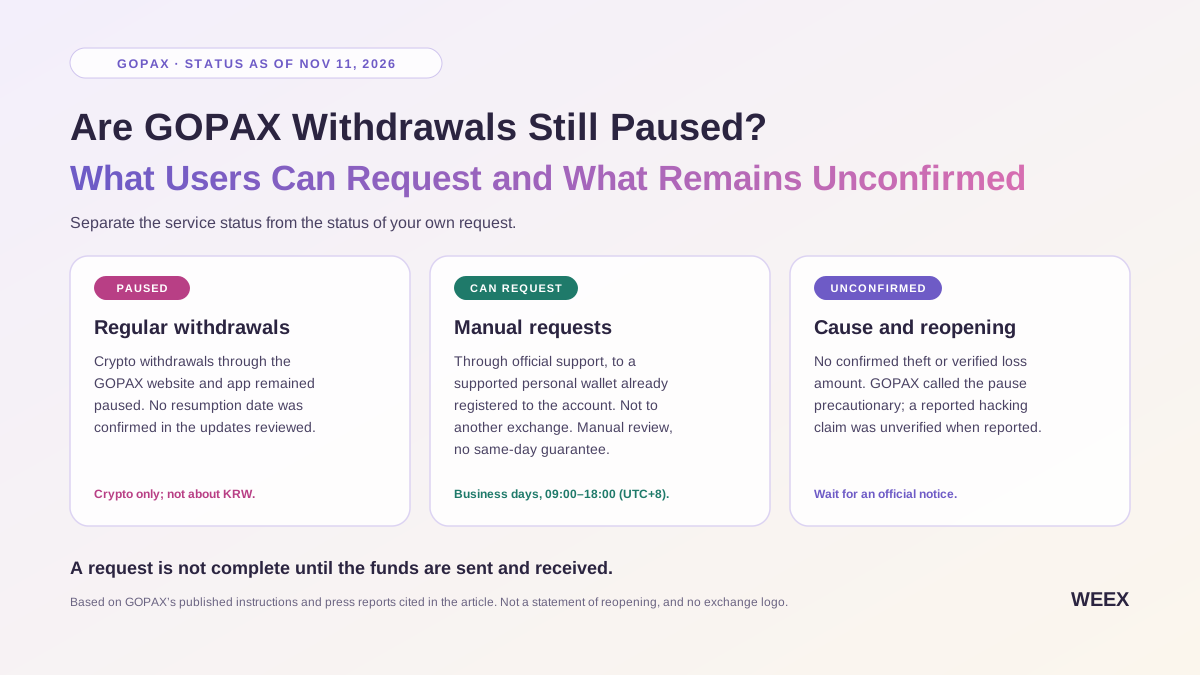
Are GOPAX Withdrawals Still Paused? What Users Can Request and What Remains Unconfirmed
Check the latest GOPAX withdrawal status, which wallets qualify for manual requests, and how to tell whether your crypto withdrawal has been sent.
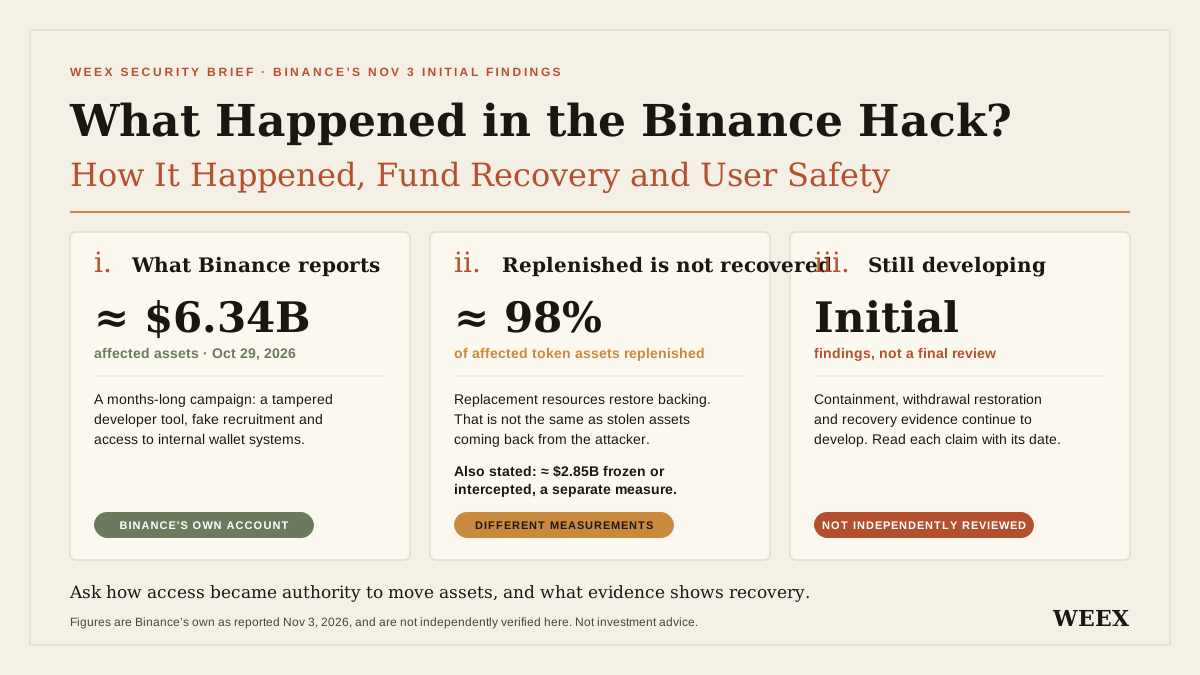
What Happened in the Binance Hack? How It Happened, Fund Recovery and User Safety
What happened in the Binance hack? Review the attack timeline, latest fund replenishment, recovery limits and practical steps to protect your account.

Hoskinson says he cannot run Cardano like a CEO. Who is accountable for its growth?
Why Pronostyx Is Building Prediction Markets for Questions the Big Platforms Ignore

Former Cointelegraph CEO Joins Phase as Co-Founder and CEO

Alta raises $47.5M for blockchain backed by crypto skeptic Jack Zhang

Decrypt Becomes First News Publisher to Offer Perps Trading, Powered by Solana's Phoenix

How Far Can AI Trading Go Amid the Anti-Data Center Wave? It Depends on GPU Leasing Prices
XRPL lending protocol gains validator support as vault vote advances

Tech Veteran: Anthropic IPO Will Be the Peak of AI Market in US Stocks, Will 'Aggressively Buy Chinese AI' If Conditions Allow

Moody's Projects Global Credit Deterioration by 2027 and Warns of the Impact of Rates and AI

CPI Higher Than Expected in the U.S.: What It Means for Investors

EWY ETF Volatility: Semiconductor Concentration, Rebound, and Fund-Flow Risks

AI Agents Do More Than Just Place Orders: The Next Entrepreneurial Opportunity Lies in Matching and Trust
Exodus Reports $8.3M Quarterly Loss as Wallet Platform Expands Payments Business

USAR Stock: Rare-Earth Commercialization, Quarterly Losses, and Funding Risks

Hims & Hers (HIMS) Falls After Earnings: Margins, Subscribers, and Guidance

IWM ETF Outlook: Small-Cap Rebound, Fund Positioning, and Credit Risk

SOXL Sell-Off and Rebound: 3x Leverage, Fund Flows, and Semiconductor Risk

Something strange is happening with Bitcoin. It is neither digital gold nor a tech company for Wall Street

TQQQ Outlook: Triple-Leverage Swings, Rebound Potential, and Decay Risk

US card debt hits $1.29 trillion as Bitcoin loans expose a collateral divide
QQQ Outlook: Tech Sell-Off, Rebound, and Nvidia Earnings

FTX’s former Anthropic stake could now be worth over $30 billion

Former Polychain President Launches Venture to Create a Tradable Index for U.S. Housing Prices

How Much CPO Demand Will NVIDIA's Rubin Ultra Generate? Bernstein: Optical Value of Single Pod Increases Fivefold
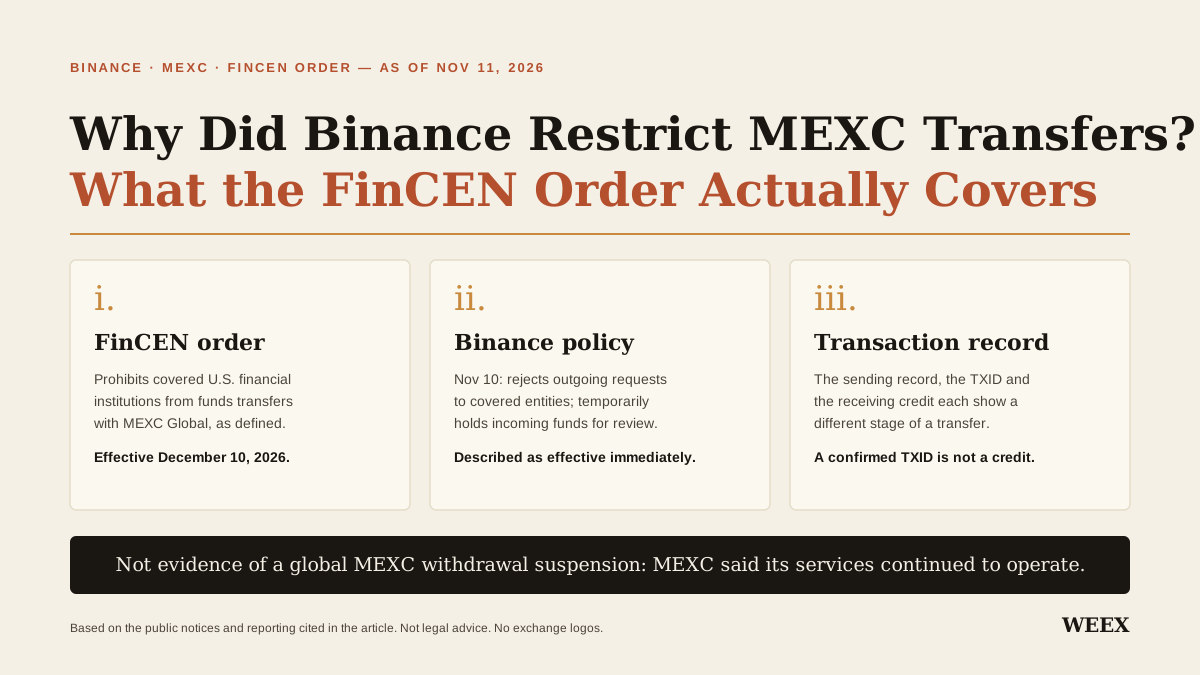
Why Did Binance Restrict MEXC Transfers? What the FinCEN Order Actually Covers
Find out why Binance restricted MEXC transfers, when the FinCEN order takes effect, and what to check if your crypto deposit is held for review.
Pump.fun Data Review: Why the Current Meme Market Has Become a 'Harvesting Game'?
As Protocols Move Back to the Mainnet, How Does Ethereum's Value Logic Change?

What Is Elysium Crypto? The Hyperliquid Layer 2, Gas Fees, and Token Confusion Explained
Learn what Elysium is, why it uses HYPE for gas, how KNTQ buybacks are designed, and how to distinguish bridge TVL from actual DeFi activity.
Are GOPAX Withdrawals Still Paused? What Users Can Request and What Remains Unconfirmed
Check the latest GOPAX withdrawal status, which wallets qualify for manual requests, and how to tell whether your crypto withdrawal has been sent.
What Happened in the Binance Hack? How It Happened, Fund Recovery and User Safety
What happened in the Binance hack? Review the attack timeline, latest fund replenishment, recovery limits and practical steps to protect your account.
Hoskinson says he cannot run Cardano like a CEO. Who is accountable for its growth?
Why Pronostyx Is Building Prediction Markets for Questions the Big Platforms Ignore
Former Cointelegraph CEO Joins Phase as Co-Founder and CEO
Alta raises $47.5M for blockchain backed by crypto skeptic Jack Zhang
Latest articles





Latest coin listings on WEEX


