
Mozilla prepares default JPEG-XL support in Firefox 157

 Prefer us on Google
Mozilla plans to enable JPEG-XL decoding by default in Firefox 157, while Google is also pushing for its adoption in Blink, with both browsers contrasting their advantages against AVIF.
- Firefox 157, expected at the end of September, will enable JPEG-XL by default across all its platforms.
- Mozilla highlights the performance of JPEG-XL in lossless images, progressive rendering, and recompression of JPEG files.
- Google has also formalized its intention to enable JPEG-XL decoding by default for all Blink users.
Mozilla is making a significant change in image handling within Firefox: the default activation of JPEG-XL decoding starting with Firefox 157. The release is scheduled for the end of September 2026, and according to the plan presented by the organization, the feature will be enabled across all available platforms of the browser, following several versions with experimental support.
JPEG-XL is a format designed to reduce image sizes without sacrificing quality, while also retaining capabilities that are important for certain professional uses and large files. Its adoption in Firefox could expand the available alternatives against formats like AVIF, especially in scenarios where progressive loading, visual fidelity, or compatibility with existing JPEG images are crucial.
Mozilla brings JPEG-XL closer to a stable version
Firefox 152 and later versions already offer experimental support for JPEG-XL, allowing for testing of the decoding before it becomes a general feature of the browser. Mozilla reported that Firefox Nightly currently has this capability enabled by default, a strategy aimed at gathering additional validation before bringing it to the stable channel.
The organization believes that the support has reached a sufficiently solid level to officially debut with Firefox 157. The goal is not to add a hidden option for advanced users but to allow JPEG-XL images to be processed by default, without requiring manual changes in Firefox's settings.
The announcement also places Mozilla's decision within a broader evolution of web browsers. The source noted that Chrome already includes JPEG-XL, while Google Research is developing jxl-rs, a Rust-based decoder that aims to combine speed with security in image processing.
The use of Rust is relevant because decoders work with files coming from the Internet, a surface that can expose browsers to memory errors and other risks. In this context, the combination of performance and security represents an additional technical argument for integrating JPEG-XL into widely used browsing engines.
JPEG-XL and AVIF have distinct strengths
Mozilla explained that JPEG-XL and AVIF do not compete in all scenarios under the same conditions. According to the organization's publication, JPEG-XL excels in lossless images, progressive rendering, and the ability to further compress JPEG files without quality loss, features that can benefit photographic repositories and workflows where preserving the original is essential.
AVIF, on the other hand, presents advantages in web-oriented photographic images and in compositions that mix sharp edges with flat surfaces. This differentiation suggests that the choice of format will depend on the type of content, file sizes, and the priority between compression, quality, and viewing speed.
Mozilla's comparison acknowledges that AVIF tends to generate smaller files when seeking adequate quality for the web. However, the organization warns that AVIF only has basic support for progressive rendering, a limitation that can become apparent when the browser needs to display particularly large images.
In such circumstances, JPEG-XL could justify a larger file size in exchange for presenting the image gradually while the download completes. For users with variable connections or for pages handling high-resolution photographs, this capability can enhance the perception of loading even if the format does not always produce the smallest file.
A Step Towards Wider Adoption
The default activation in Firefox 157 would have an effect that goes beyond the technical function within the browser. When a format receives integrated support across multiple engines, web developers gain more incentives to evaluate its use, while editing, conversion, and distribution tools can expand their own implementations.
Adoption, however, will depend on whether websites and content platforms incorporate JPEG-XL practically. The fact that Firefox and Chrome are advancing in decoding makes it easier for users to consume those images, but it does not solely determine which format site administrators will choose when balancing storage, bandwidth, and compatibility.
Google's announcement of its intention to include JPEG-XL decoding in the Blink engine for all users reinforces the signal that the format seeks to consolidate itself in the web infrastructure. The timing of Mozilla's and Google's announcements adds visibility to a technology that has competed with other compression proposals for years.
Mozilla still presents its decision as a plan subject to final validation of support before the stable release. If Firefox 157 meets the expected timeline for late September, JPEG-XL will be available by default on all compatible platforms, and users will be able to access its benefits without activating experimental features.
The next milestone will be to see how sites, publishing tools, and development teams respond to a wider availability of the format. Competition with AVIF is likely to continue, but the arrival of JPEG-XL in Firefox's default settings may shift the discussion from technical feasibility to concrete use cases.
-- Price
This content is provided for general informational purposes only and doesn't constitute financial, investment, legal, or tax advice. Any events, rewards, online promotions, or related information mentioned herein should not be considered a recommendation, solicitation, or invitation to purchase, sell, trade, or otherwise deal in any crypto assets. Crypto assets are highly volatile and may result in loss. The availability of WEEX services, products, and related events may vary by region. You are responsible for ensuring that your participation is in accordance with applicable local laws and regulations.
You may also like

Term Labs Completes Fixed Rate Loan Position Recovery, No Impact on V1/V2 Contracts Found

South Korea's Media Giants Etoday and Nexblock Partner with RootData to Strengthen Web3 Data Content Collaboration

ECB Governing Council Member Mahrouf Calls for Readiness for Further Rate Hikes

Joint Imaging Completes Hundreds of Millions in Financing

Aajil Capital Obtains Investment Management License from the Capital Market Authority

QA and Intelligent Automation: Banks and Insurers Drive Demand in Brazil

MSX Pre-IPO Subscription Starts on the 31st, Including Neuralink and Anduril
Poland Launches 'Economy 2.0', GDP Exceeds $1 Trillion

Public Debt in the Americas: Risk Premium Triples with Expanding Fiscal Deficit

Trump Media Cancels Crypto Projects
Web3 AI infrastructure AIW3 announces strategic investment from Liquid Capital
Benchmark has lowered the target price for Strategy from $705 to $570

The number of Starlink users has increased about fourfold in four years, but the revenue per user continues to decline

GameStop has staked 4,709 BTC on Coinbase for a covered call option strategy

On-chain Active Market Making Experiment: More Profitable than AMM, Is it Retail Investors Placing Orders?
Bitcoin's AI-driven rally faces a hidden danger if the machines get richer but workers don't

‘Is Korea Facing a Second IMF Crisis? The Solution Lies in XRP?’... The Leap of the Crisis Theory by BeInCrypto

Ethereum, Solana, and BNB Chain: The 3 Favorite Blockchains for Tokenization According to Grayscale

ICO, VC Tokens, and Alpha Models: Why They Can't Save the Current Crypto Market?

What is Soda Labs? A Private Trading Infrastructure on Blockchain with Bubble

Developers Slam Lightning Network: 80% of Payments Depend on Custodians, Is the Community Weaving a Dream?
WEEX Review 2026: Fees, Security and Trading Features

Ransom of $1,011 in Bitcoin: The Leak Shaking Israel Twelve Days Before Elections
One Order Book for Dollars and Stablecoins. How It Works

When AI Entities Start Borrowing: How Machine Credit Prices Trust?
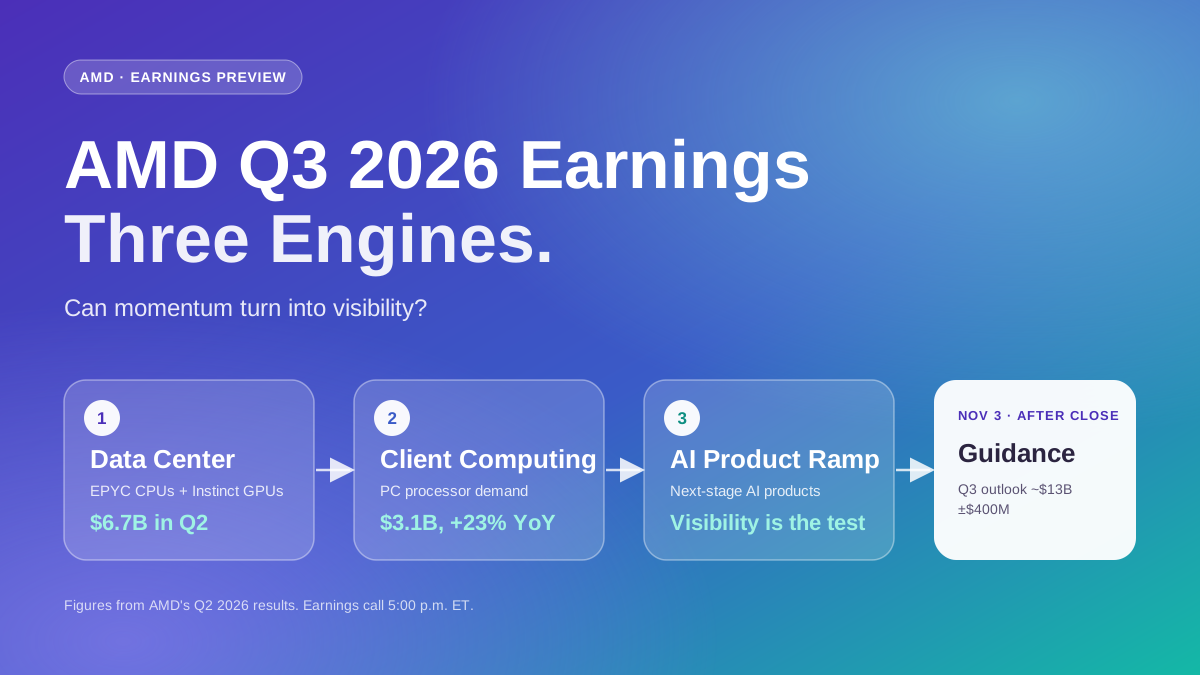
AMD Stock Ahead of Q3 2026 Earnings: Revenue, AI Demand, and Key Risks to Watch
AMD reports Q3 2026 results on November 3. See the data-center, AI demand, margin, and guidance signals that could shape AMD stock.

Bitwise CIO: Choose Your Own Adventure, All Paths Lead to Bitcoin
Tether launches offline AI speech model for smart glasses and robots

"Japan's Barrier is Not Culture but Local Investment" - Huobi Co-founder Du Jun Discusses Regulations, Stablecoins, and Expansion in Asia

Cyberattack on the ports of Marseille and La Rochelle? Hackers paid 1 dollar in crypto
Term Labs Completes Fixed Rate Loan Position Recovery, No Impact on V1/V2 Contracts Found
South Korea's Media Giants Etoday and Nexblock Partner with RootData to Strengthen Web3 Data Content Collaboration
ECB Governing Council Member Mahrouf Calls for Readiness for Further Rate Hikes
Joint Imaging Completes Hundreds of Millions in Financing
Aajil Capital Obtains Investment Management License from the Capital Market Authority
QA and Intelligent Automation: Banks and Insurers Drive Demand in Brazil


