
Report: AI Industry Leaders Divided Over Whether Humans Should Surrender Autonomous Decision-Making Power

 Prefer us on Google
Media reports, citing sources, indicate that there is a viewpoint within Anthropic that humans should delegate some decision-making power to superintelligent AI systems, while an increasing number of executives from leading AI companies are opposing this idea. Critics warn that this could lead humanity to gradually lose its free will.
The debate continues to escalate, as major AI companies are developing models that some employees believe are too powerful and should not be released to the public. Many view Anthropic as the first company to confront such issues, as it is at the forefront of AI research and development.
Critics have not yet named this company, but they publicly defend human autonomy and emphasize the importance of human control, directly targeting the philosophy held by Anthropic's CEO Dario Amodei, as perceived by the outside world. Amodei has repeatedly stated that once AI intelligence surpasses human intelligence, delegating decision-making power to AI in "life-or-death" scenarios would be a better choice; he has also suggested that AI could oversee scientific research and even participate in the allocation of economic resources. A product vision slide from years ago, revealed during a previous lawsuit, described Anthropic's "better world vision" as a "utopia ruled by a god in a box."
The core logic of Amodei and his supporters is that if AI can reliably cure diseases, prevent self-harm, and avert disasters, and overall perform better than humans, then refusing to relinquish control would be an irrational choice, even immoral. Supporters often cite autonomous driving as an example: once statistics prove that self-driving vehicles are safer than human drivers, it would be logical for humans to significantly reduce or even completely give up driving themselves.
Sources familiar with internal discussions reveal that a broad consensus has formed among some employees at Anthropic: humans will ultimately, and in many scenarios should, prudently delegate decision-making power to superintelligent systems rather than stubbornly cling to control. In response, an Anthropic spokesperson stated that Amodei has advocated for human control over AI in numerous public speeches, and that the goal of training Claude is to ensure it does not undermine human oversight.
As significant breakthroughs in mathematics and reasoning are achieved, and the industry widely believes that the era of superintelligence is imminent, executives from competing firms increasingly refute the idea of "humans surrendering autonomous decision-making power." Alexandr Wang, head of AI at Meta, posted on X platform, stating, "We cannot accept handing over society to AI." This statement came after Anthropic tackled a "holy grail-level problem" in mathematics, reflecting his thoughts on the superintelligent era. OpenAI CEO Sam Altman also rebutted this viewpoint earlier this month, saying, "I want humans to have autonomy over the future... I think advocating for this is crucial."
Dean Ball, head of strategic future affairs at OpenAI, referred to the willingness to relinquish control as a "silent consensus." He told the media that this is "an extremely common view in the AI safety community," adding, "Not everyone agrees this is a good thing; some support it, while others oppose it."
For years, Amodei has cited multiple fields in podcasts, public interviews, and personal articles where he believes humans should step back; however, he also mentioned that there are still many scenarios where, even if human decision-making quality is inferior, we must retain leadership. On safety issues, he discussed in a February interview that in "life-critical scenarios, we should indeed hand over to AI," and society just needs time to adapt to this change. Regarding defense issues, he suggested in the same month that if adversaries deploy fully autonomous weapons first, humans may ultimately need to rely on autonomous weapons to defend democratic systems. In education, he proposed in November 2024 that the traditional model of professors guiding graduate students may be reversed, with "AI becoming the principal investigator, leading and directing humans or other AI systems to work." In his 2024 article "The Kind Machines," he envisioned a future economic model where superintelligent AI allocates resources based on "criteria that AI believes are suitable for rewarding humans," while also explaining that these allocation rules could stem from human values.
Privately, some AI executives express dissatisfaction with the rhetoric of relinquishing decision-making power, fearing that such statements could exacerbate public and political resistance to AI technology. Maryland Governor Wes Moore, viewed as a strong contender for the 2028 Democratic presidential nomination, also expressed a similar stance this week. He referenced the Book of Genesis, stating that God granted humans dominion over the earth, "not robots, not agents."
The divisions continue: aside from Anthropic, other AI executives do not have a unified public stance on the issue of human free will in the era of superintelligence. Elon Musk recently reiterated his long-held view that when superintelligence arrives, humans will become like "pet Labradors"; yet at the same time, he supports the development of brain-machine interfaces and other technologies to enhance human brains with machine computing power, allowing humans to maintain a competitive edge.
In summary, the debate surrounding superintelligence is no longer limited to how to prevent uncontrolled AI from destroying humanity; the core discussion has shifted to whether humans should proactively choose to relinquish leadership.
This content is provided for general informational purposes only and doesn't constitute financial, investment, legal, or tax advice. Any events, rewards, online promotions, or related information mentioned herein should not be considered a recommendation, solicitation, or invitation to purchase, sell, trade, or otherwise deal in any crypto assets. Crypto assets are highly volatile and may result in loss. The availability of WEEX services, products, and related events may vary by region. You are responsible for ensuring that your participation is in accordance with applicable local laws and regulations.
You may also like

Will On-Chain BTC Lending Become Mainstream? Data and Institutional Trends Point to Traditional Finance

Is BTC Different This Time?

Tonight, the last major inflation report before the Federal Reserve's December decision is released!
Why Is Bitcoin Dropping Below $60K After the Nasdaq’s 6.5% Rally?
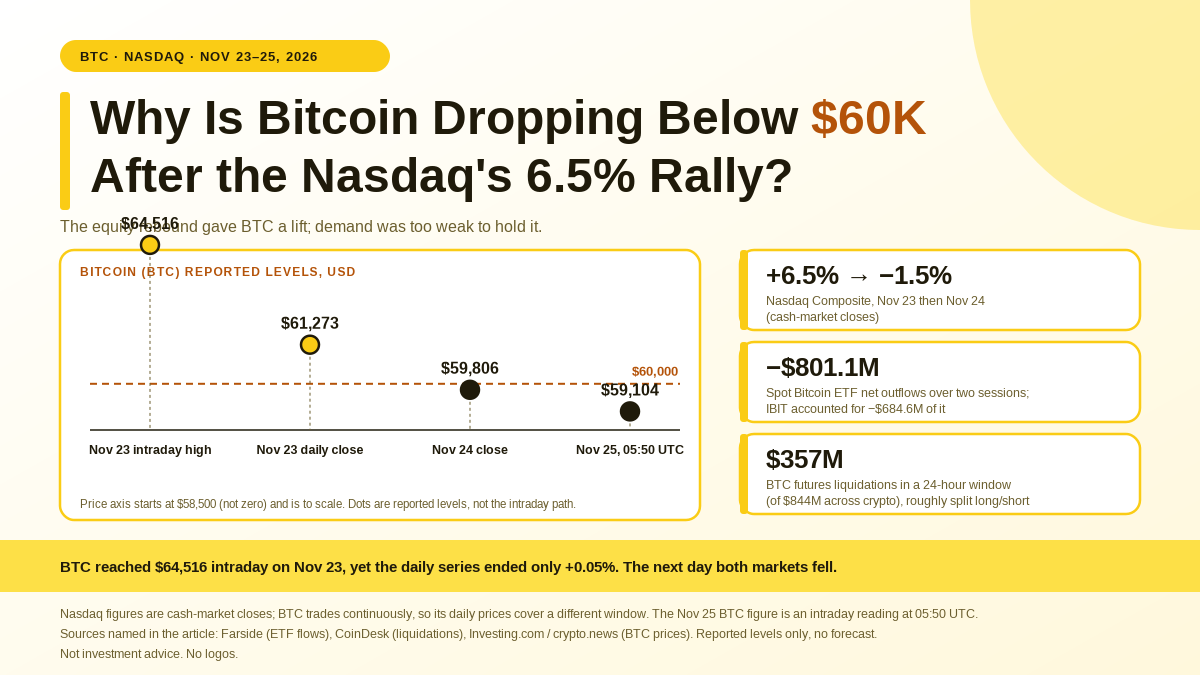
Why is Bitcoin dropping below $60,000 after the Nasdaq rallied 6.5%? See what $801.1 million in ETF outflows, exchange flows, and liquidations reveal.

Remy Cointreau Group's Stock Price Soars Amid Transformation Progress

Warren Buffett's Successor, Greg Abel, Has Quietly Purchased 3 Stocks Since the Start of the Fourth Quarter, Including Shares of a Legal Monopoly

Not Tesla. Not Nvidia. This "Magnificent Seven" Stock Could Be Overdue for a Big Rally.

Iliad Partners Announces Final Close of Its First Fund at $33.4 Million

Fidelity Lists AAVE, LINK and UNI: How Do Crypto Trading Fees Compare?

Jensen Huang's Situation May Be Even More Challenging Now

BlackRock Launches Tokenized Fund in Hong Kong! Reaches $100 Million, Supports HKD Stablecoin HKDAP for Subscription

Private Financing Market Mirrors IPO Market: Leading Companies Dominate

The Huge Concern for AI Stocks: Oversupply of Chips
Diverging Market Views on Wall Street for 2026: Tom Lee vs. Castle Securities, Caution Against a Repeat of 2018 Market Risks

Bitcoin, US Stocks, and Gold: Which Will Bottom First?

SBI Solana Global Launches: Joint Venture with Sumitomo Mitsui FG and Solana Foundation for Stablecoin Payments and RWA Projects

Controllable Freezing, Unregulated Refunds: The On-Chain Power and Rule Vacuums of Stablecoin Duopoly

Prediction: Here's What Anthropic's Valuation Will Be in 2027, According to History

Interpretation of the Report 'Reporting Suspicious Crypto Activity: Bridging Supervisory Expectations and Operational Realities'

Mercedes-Benz Shifts Electric Vehicle Strategy: Focusing on Core Models, Phasing Out EQ Series

Bank of America Warns of Underestimated 'Hard Landing' Risk in 2027! Recommends 'GRAB' to Hedge Against Volatility, Consider Chips After Dollar Peaks

Meta and Amazon Negotiate to Lift Block on Muse Shopping AI Agent, Advertising and Search Become Core Disputes

The Next Stablecoin: A Potential Market of Nearly $300 Billion with 50 Times Growth Opportunity

Cautious Korean Investment in Anthropic, Less Popular than SpaceX IPO

Grubhub Expects to Lose $100 Million in 2026
OpenAI Prepares 'Athena' Data Tool to Enhance AI Agent Accuracy

Anthropic Launches on Same Day as GTA VI, Video Game Transactions Currently Prevail

Dell: Token Demand to Increase 87 Times by 2030, No Downward Trend in Memory Prices by 2027

Bitcoin Retests $60,000 Support, AI Stocks Give Back Previous Gains | WEEX TradFi Daily Market Brief (November 25, 2026)
Dragged by stock market sell-offs, Bitcoin and Ethereum fell to the $60,000 and $1,700 integer levels respectively. The head of research at 21Shares believes that if the current pullback pattern continues, Bitcoin may probe lower. The three major stock indices mixed, with Neocloud and optical module sectors plunging collectively. On November 25 ET, focus on October core PCE data and Deere earnings.

Do RWA Tokens Grant Claims to Underlying Assets? A Comparison of ONDO, OUSG, and PAXG
Will On-Chain BTC Lending Become Mainstream? Data and Institutional Trends Point to Traditional Finance
Is BTC Different This Time?
Tonight, the last major inflation report before the Federal Reserve's December decision is released!
Why Is Bitcoin Dropping Below $60K After the Nasdaq’s 6.5% Rally?
Why is Bitcoin dropping below $60,000 after the Nasdaq rallied 6.5%? See what $801.1 million in ETF outflows, exchange flows, and liquidations reveal.
Remy Cointreau Group's Stock Price Soars Amid Transformation Progress
Warren Buffett's Successor, Greg Abel, Has Quietly Purchased 3 Stocks Since the Start of the Fourth Quarter, Including Shares of a Legal Monopoly
Latest articles
Latest coin listings on WEEX


