
Will On-Chain BTC Lending Become Mainstream? Data and Institutional Trends Point to Traditional Finance

 Prefer us on Google
The path of BTC on-chain collateralized lending suggests limited on-chain scale after sorting out four types of custody models, with traditional finance likely to dominate.
Written by: Rejamong
Compiled by: AididiaoJP, Foresight News
As asset prices continue to decline, those looking to accumulate at lower levels may find themselves short on cash. This is when they might remember the Bitcoin that has long been forgotten in their hardware wallets, which can be used as collateral to borrow stablecoins on-chain for further purchases.
The problem is that Bitcoin itself does not support general smart contracts, and DeFi protocols cannot directly use BTC on the Bitcoin network as collateral. The common practice is to first lock BTC on the Bitcoin network and then issue corresponding tokens on a chain that supports smart contracts. Therefore, the real decision to be made is who to trust with the custody of BTC and how to issue the wrapped tokens. Currently, on-chain fixed-rate lending is not mature, with rates fluctuating rapidly with the market, and before comparing rates, one must first confirm which custody arrangement they can accept.
Who is Really Custodying Your Bitcoin?
Currently, there are mainly four models.
Custodial tokens are the simplest. Companies (custodians or exchanges) hold BTC and issue tokens 1:1 on a smart contract chain. WBTC, launched in 2019, is a representative example, while Coinbase is set to launch cbBTC in September 2024, and Circle will introduce cirBTC on Ethereum on June 8, 2026.
These tokens currently account for about 85% of cross-chain BTC. In the cbBTC market on Base, Morpho has about $2.5 billion in collateral, with borrowers having borrowed approximately $1.4 billion in USDC. The downside is clear: one must trust a single company. Those who believe in self-custody with the mantra “not your keys, not your coins” find it hard to accept such arrangements.
Multi-signature collections distribute control among multiple signers. tBTC requires 51 out of 100 randomly selected operators to sign in order to move BTC; sBTC is jointly controlled by Stacks signers. Compared to single custody, this is an improvement—unauthorized transfers require collusion or breach by multiple independent signers.
Currently, such solutions protect about 23,000 BTC, accounting for about 6% of cross-chain BTC. The specific thresholds vary by project: UBTC on Hyperliquid requires only two out of three guardians to agree; LBTC is controlled by about 15 institutions convened by Lombard; sBTC requires approval from about 70% of ten selected signers.
On-chain native custody goes a step further. If you have already borrowed through a DeFi protocol on a certain chain, you have essentially trusted the validators of that chain. Handing over BTC to the same validators does not introduce new trust parties.
This is essentially still multi-signature, but the signers are also responsible for validating the layer of the network where the tokens reside. Internet Computer (ICP) was the first to try this with ckBTC in 2023, and Hashi, which launched on Sui on November 19, 2026, adopts a similar design.
Trust-minimized bridges and vaults lock BTC using Bitcoin scripts, relying on proofs occurring on other chains to release them. Designs in the style of BitVM assume that as long as there is one honest participant, BTC can remain secure. Citrea's Clementine bridge launched on its mainnet on January 27; Babylon vault is another example. On November 9, Aave DAO supported accepting BTC from these vaults as collateral for Aave V4. The downside is slow withdrawals and limited liquidity.
According to Babylon's design, retrieving BTC from the vault takes several days, including a challenge period. On November 23, David Tse's team, co-founder of Babylon, proposed witness encryption technology that would allow BTC to be released based solely on withdrawal proof, potentially shortening the wait time.
Protocols often promote these arrangements as “native BTC,” where “native” usually just means that no single company issues wrapped tokens. Regardless of the model, BTC always remains on the Bitcoin network, and DeFi protocols only receive tokens representing it.
How to Choose DeFi Protocols?
Once you have wrapped tokens, the selection range narrows. Different tokens are issued on specific chains, and the liquidity of protocols varies. Currently, about $11 billion worth of BTC tokens are deposited in DeFi lending markets, with Aave accounting for about $4.7 billion and Morpho for about $3.8 billion, together making up 77%.
For users holding WBTC or cbBTC on Ethereum, Aave is the natural choice. All depositors share a single pool, which has the deepest liquidity. Its annualized borrowing rate for USDC is relatively low, around 3.7%. Borrowers can borrow up to 81% of the collateral value, with a loan-to-value ratio exceeding 85% triggering liquidation.
If BTC is on Coinbase, Morpho is more likely to be used. The Bitcoin collateral loans provided within the Coinbase app utilize this market. Morpho sets up a separate market for each pair of collateral and borrowing assets, ensuring that bad debts from other asset markets do not spread. The liquidation threshold for the cbBTC market on Base is 86%.
On the BNB chain, BTCB can be used to collateralize stablecoins on Venus; on Sui, hBTC can be used with Fluid, which launched simultaneously with Hashi, although the supply of hBTC is currently only about 276 tokens. Aave V4 is expected to support Babylon's trust-minimized vaults, but mainnet integration has not yet launched.
How Much Bitcoin is Actually On-Chain?
As of November 23, 2026, approximately 20.12 million BTC have been issued, of which only about 360,000 (1.8% of total supply) have been mapped to smart contract chains.
Even within this 1.8%, custodial tokens dominate. WBTC, cbBTC, BTCB, kBTC, and FBTC together account for 85% of the 360,000 tokens. Approximately 180,000 tokens, which are actually deposited as collateral in DeFi lending markets, represent half of the cross-chain total, but only 0.9% of total supply. Ethereum and Base account for 82% of these lending deposits, primarily concentrated in Aave and Morpho.
In contrast, Bitcoin ETFs hold about 1.44 million tokens, and publicly traded companies hold about 1.23 million tokens, totaling 2.67 million tokens, which is 13.3% of total supply and more than seven times the cross-chain amount.
New usage methods are constantly emerging, but the total cross-chain amount has hardly changed. The supply of WBTC peaked at about 285,000 tokens in May 2022 and then dropped to about 116,000; some of it flowed into cbBTC, which is set to launch in September 2024 and has now increased to about 103,000 tokens. Together, they total about 219,000 tokens, still below the peak of WBTC alone in 2022. Bitcoin's status as a store of value and internet currency is unquestionable, but the assets that are truly liquid and used are pitifully few.
Will More Holders Start Moving Their Bitcoin?
The holder structure is changing, and idle BTC is likely to start flowing. In the past, Bitcoin holders were reluctant to trust other chains. Now, ETFs and publicly traded companies have become the largest incremental buyers. Even if they want to hold long-term, they still need cash and revenue channels. As long as a small portion of them put BTC to use, the market size will significantly expand.
Multiple projects are actively reaching out to these institutions. Circle emphasizes its identity as a regulated issuer; Sui is designing to allow validators to control BTC while also investing considerable effort in building institutional access for Hashi; Anchorage Digital provides Hashi access through institutional wallets; a tripartite settlement arrangement expected to launch in early 2027 will allow institutions to stake BTC while maintaining custody. Hashi has also obtained legal advice from Fenwick, which believes that deposits and withdrawals should be considered non-taxable events under U.S. tax law. Aave is working with Babylon to accept BTC as collateral in V4 without going through custodians.
As crypto adoption expands, BTC as collateral may also be accepted by traditional finance. In December 2025, the U.S. Commodity Futures Trading Commission (CFTC) will launch a pilot program allowing BTC, ETH, and USDC as margin for derivatives; JPMorgan reportedly plans to accept BTC and ETH from institutional clients as loan collateral.
If BTC is widely accepted as collateral in traditional finance, the demand for on-chain wrapping may further decline. Those who view Bitcoin as an alternative to fiat currency and fundamentally refuse to hand it over to anyone will not easily part with their coins, regardless of the path taken. The growth in demand for BTC collateralized lending may come more from traditional financial institutions rather than on-chain markets.
Can On-Chain Lending Really Become Mainstream?
When people talk about fully committing to an investment, they often mention using severance pay or even mortgaging property. The appeal of Bitcoin as a “last resort collateral” indicates that it is very suitable for this role. In the past, choices were few and hard to trust; now there are multiple paths available.
However, I suspect that most of this lending will ultimately not remain on-chain. Lenders can easily accept BTC as collateral without putting the loans themselves on-chain. Anyone on-chain can borrow without permission at any time, positions are public, and liquidations are executed by code. Large traditional investors may find these characteristics unappealing: they cannot identify counterparties, their own positions are visible to everyone, and there is no one to negotiate with during margin calls. The borrowed money is likely to be spent outside of crypto. Public companies may use it to pay operating expenses or repay debts, while individuals may use it for home purchases or tax payments. For these purposes, it is simpler to directly deposit dollars into a bank account through traditional lenders.
Currently, on-chain loans supported by BTC mainly attract those who want to use borrowed funds to continue buying crypto assets. At least, they do not have to mortgage their homes for this purpose.
This content is provided for general informational purposes only and doesn't constitute financial, investment, legal, or tax advice. Any events, rewards, online promotions, or related information mentioned herein should not be considered a recommendation, solicitation, or invitation to purchase, sell, trade, or otherwise deal in any crypto assets. Crypto assets are highly volatile and may result in loss. The availability of WEEX services, products, and related events may vary by region. You are responsible for ensuring that your participation is in accordance with applicable local laws and regulations.
You may also like

Is BTC Different This Time?

Tonight, the last major inflation report before the Federal Reserve's December decision is released!
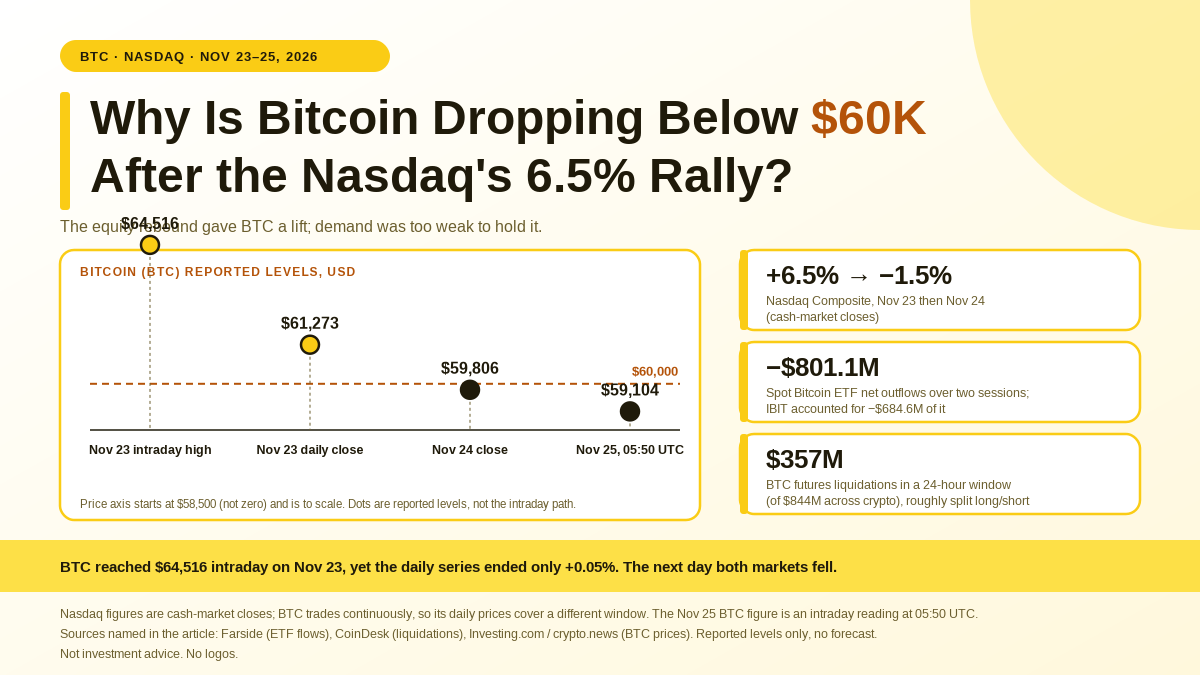
Why Is Bitcoin Dropping Below $60K After the Nasdaq’s 6.5% Rally?
Why is Bitcoin dropping below $60,000 after the Nasdaq rallied 6.5%? See what $801.1 million in ETF outflows, exchange flows, and liquidations reveal.

Report: AI Industry Leaders Divided Over Whether Humans Should Surrender Autonomous Decision-Making Power

Remy Cointreau Group's Stock Price Soars Amid Transformation Progress

Warren Buffett's Successor, Greg Abel, Has Quietly Purchased 3 Stocks Since the Start of the Fourth Quarter, Including Shares of a Legal Monopoly

Not Tesla. Not Nvidia. This "Magnificent Seven" Stock Could Be Overdue for a Big Rally.

Iliad Partners Announces Final Close of Its First Fund at $33.4 Million

Fidelity Lists AAVE, LINK and UNI: How Do Crypto Trading Fees Compare?
Jensen Huang's Situation May Be Even More Challenging Now

BlackRock Launches Tokenized Fund in Hong Kong! Reaches $100 Million, Supports HKD Stablecoin HKDAP for Subscription

Private Financing Market Mirrors IPO Market: Leading Companies Dominate

The Huge Concern for AI Stocks: Oversupply of Chips
Diverging Market Views on Wall Street for 2026: Tom Lee vs. Castle Securities, Caution Against a Repeat of 2018 Market Risks

Bitcoin, US Stocks, and Gold: Which Will Bottom First?

SBI Solana Global Launches: Joint Venture with Sumitomo Mitsui FG and Solana Foundation for Stablecoin Payments and RWA Projects

Controllable Freezing, Unregulated Refunds: The On-Chain Power and Rule Vacuums of Stablecoin Duopoly

Prediction: Here's What Anthropic's Valuation Will Be in 2027, According to History

Interpretation of the Report 'Reporting Suspicious Crypto Activity: Bridging Supervisory Expectations and Operational Realities'

Mercedes-Benz Shifts Electric Vehicle Strategy: Focusing on Core Models, Phasing Out EQ Series

Bank of America Warns of Underestimated 'Hard Landing' Risk in 2027! Recommends 'GRAB' to Hedge Against Volatility, Consider Chips After Dollar Peaks

Meta and Amazon Negotiate to Lift Block on Muse Shopping AI Agent, Advertising and Search Become Core Disputes

The Next Stablecoin: A Potential Market of Nearly $300 Billion with 50 Times Growth Opportunity

Cautious Korean Investment in Anthropic, Less Popular than SpaceX IPO

Grubhub Expects to Lose $100 Million in 2026
OpenAI Prepares 'Athena' Data Tool to Enhance AI Agent Accuracy

Anthropic Launches on Same Day as GTA VI, Video Game Transactions Currently Prevail

Dell: Token Demand to Increase 87 Times by 2030, No Downward Trend in Memory Prices by 2027

Bitcoin Retests $60,000 Support, AI Stocks Give Back Previous Gains | WEEX TradFi Daily Market Brief (November 25, 2026)
Dragged by stock market sell-offs, Bitcoin and Ethereum fell to the $60,000 and $1,700 integer levels respectively. The head of research at 21Shares believes that if the current pullback pattern continues, Bitcoin may probe lower. The three major stock indices mixed, with Neocloud and optical module sectors plunging collectively. On November 25 ET, focus on October core PCE data and Deere earnings.

Do RWA Tokens Grant Claims to Underlying Assets? A Comparison of ONDO, OUSG, and PAXG
Is BTC Different This Time?
Tonight, the last major inflation report before the Federal Reserve's December decision is released!
Why Is Bitcoin Dropping Below $60K After the Nasdaq’s 6.5% Rally?
Why is Bitcoin dropping below $60,000 after the Nasdaq rallied 6.5%? See what $801.1 million in ETF outflows, exchange flows, and liquidations reveal.
Report: AI Industry Leaders Divided Over Whether Humans Should Surrender Autonomous Decision-Making Power
Remy Cointreau Group's Stock Price Soars Amid Transformation Progress
Warren Buffett's Successor, Greg Abel, Has Quietly Purchased 3 Stocks Since the Start of the Fourth Quarter, Including Shares of a Legal Monopoly
Latest articles


Latest coin listings on WEEX


