
RWA Weekly: Ant Group and HSBC Test Agent Tokenized Payments; Robinhood Explores Tokenized Actively Managed ETFs

 Prefer us on Google
Highlights of This Issue
This week's report covers the period from October 9, 2026, to October 16, 2026.
This week, the RWA sector rebounded to $39.18 billion, with a week-on-week increase of 1.06%, returning to an expansion phase. The number of asset holders increased to 5.2637 million, a week-on-week growth of 16.3%, indicating continued user base expansion. The total market capitalization of stablecoins remained resilient at $292.4 billion, with holders and monthly active addresses steadily increasing, although monthly transaction volume continued to contract, reflecting a temporary cooling in on-chain capital flow activity.
On the regulatory front, the EU's ESMA has issued a public consultation on the use of tokenized collateral by central clearing houses, while the EBA has recognized USDC as the first significant electronic money token under the MiCA framework and transferred some regulatory powers. The Dutch central bank has granted an EMI license to Qivalis, supporting the launch of a MiCA-compliant euro stablecoin backed by multiple European banks.
In terms of projects, Ant Group has completed the subscription for the Huaxia RMB Digital Currency Fund, facilitating the cross-border allocation of digital RMB to offshore asset investments. Ant Group and HSBC have completed a test for AI-powered tokenized deposit micro-payments. Robinhood, Bybit, Perpetuals.com, and others are advancing the development of tokenized stock products, with Perpetuals.com becoming the second institution after OKXICE to plan to build a tokenized trading platform for U.S. stocks using SEC innovation exemptions. Standard Chartered, Ripple, Visa, Stripe, and others are accelerating their layouts in stablecoin custody, collateralization, cross-border payments, and multi-currency payment card commercial scenarios.
In financing, Fission and Multiliquid have both secured funding, while Tether has increased its investment in RWA payment infrastructure in Latin America.
Data Insights
RWA Sector Overview
According to the latest data from RWA.xyz, as of October 16, 2026, the total on-chain market capitalization of RWA reached $39.18 billion, reflecting a 1.06% increase compared to the same period last month, indicating a recovery in expansion sentiment. The total number of asset holders climbed to 5.2637 million, a 16.3% increase from the same period last month, showing significant expansion in the holder base and presenting a sector pattern of "asset scale returning to an upward trend, with accelerated growth in the number of holders."
Stablecoin Market
The total market capitalization of stablecoins reached $292.4 billion, a slight week-on-week increase of 0.24%. The monthly transaction volume was $6.44 trillion, a significant week-on-week decline of 17.75%. The total number of monthly active addresses reached 59.09 million, a week-on-week increase of 2.35%. The total number of holders rose to 298 million, a week-on-week growth of 2.9%. Overall, the monthly stablecoin stock market capitalization remains resilient, with user addresses and holder scale continuing to expand, while monthly transaction volume has shown a temporary contraction, indicating a short-term cooling in on-chain capital flow activity.
The leading stablecoins are USDT, USDC, and USDS, with USDT's market capitalization increasing by 0.44% compared to the same period last month; USDC's market capitalization remained flat compared to last month; and USDS's market capitalization slightly increased by 0.02% compared to last month.
Regulatory News
ESMA Seeks Opinions on the Use of Tokenized Collateral by Central Clearing Houses
The European Securities and Markets Authority (ESMA) has released a consultation paper seeking opinions on whether and under what conditions EU central counterparties (CCPs) can safely and effectively use tokenized collateral. The consultation covers traditional asset "digital twins," on-chain native issued assets, and hybrid models, focusing on the liquidity of tokenized collateral in the event of clearing member defaults, customer asset segregation, and settlement finality issues. The consultation period ends on January 15, 2027, and ESMA will assess feedback and decide on next steps in the first quarter of 2027.
EBA Recognizes USDC as the First Significant Electronic Money Token under MiCA
According to the European Banking Authority (EBA) website, EBA has recognized USDC issued by Circle Internet Financial Europe SAS as a significant electronic money token (EMT) under the Markets in Crypto-Assets Regulation (MiCA). Currently, there are 45 EMTs in the EU that have completed declarations under MiCA, with USDC being the first token recognized as a significant EMT.
Starting from November 12, 2026, the prudential regulatory responsibilities for USDC's own funds, reserve assets, liquidity requirements, and recovery and redemption plans will be transferred from the French Prudential Supervisory Authority (ACPR) to the EBA, while ACPR will continue to oversee corporate governance, qualified holdings, outsourcing, and conflicts of interest. Additionally, EBA has signed a memorandum of understanding with the New York State Department of Financial Services (NYDFS) to strengthen cross-border stablecoin regulatory cooperation.
Dutch Central Bank Approves Qivalis Electronic Money Institution License, Plans to Launch MiCA-Compliant Euro Stablecoin
According to CoinDesk, the Dutch central bank has granted an electronic money institution (EMI) license to Amsterdam-based Qivalis, allowing it to issue euro-denominated electronic money tokens compliant with the EU's Markets in Crypto-Assets Regulation (MiCA). Qivalis is backed by 37 major European banks, including BBVA, BNP Paribas, ING, and DZ Bank, covering 15 countries. The company plans to launch a 1:1 pegged euro stablecoin for on-chain euro settlement infrastructure in the coming months. Before the official launch, Qivalis must meet the remaining MiCA requirements, including publishing a white paper. The tokens will primarily be distributed through banks, cryptocurrency exchanges, and payment service providers, rather than directly to consumers. After obtaining the license, Qivalis will be subject to ongoing supervision by the Dutch central bank.
South Korea Plans to Open Tokenization of Bonds and Funds, Annual Net Purchase Limit for Retail Investors May Be Set at 100 Million KRW
According to South Korean media EToday, the Financial Services Commission has disclosed that the consultation period for the related amendments to the "Electronic Securities Act" and "Capital Markets Act" regarding securities tokenization will end on November 11, with plans to implement them in conjunction with the law's effective date of February 4, 2027.
The amendments are expected to expand the scope of tokenization to traditional securities such as stocks, bonds, and funds, adopting a phased introduction mechanism. The first phase is expected to cover private money market funds (MMFs) for institutional investors, private bonds, trust-based unlisted stocks, and publicly issued fractional investment securities, while public bonds and funds for ordinary investors will gradually open after assessing initial market operation conditions and demand.
South Korean regulators also plan to establish approval criteria for over-the-counter trading venues for ordinary investors' bonds and propose to limit the annual net purchase amount for ordinary investors at a single exchange to 100 million KRW. Additionally, the settlement mechanism remains a key focus, initially using the existing cash settlement system of South Korean securities depository and settlement institutions, while on-chain securities settlement based on stablecoins will require further legislative progress.
B3 in Brazil Plans to Launch Tokenized Stock Platform in the First Half of 2027, Delayed from Original Schedule
According to Bitcoin.com, the Brazilian stock exchange B3 expects to launch a tokenized asset platform in the first half of 2027, delayed from the previously planned second half of 2026. Initially, tokenized stocks will share trading books, prices, and liquidity with traditional stocks, using T+2 settlement; around-the-clock trading and instant settlement will still require regulatory approval. B3 also plans to launch stablecoins and will apply to the Brazilian central bank for digital asset operation and custody licenses.
Bank of England: No Urgency to Launch Digital Pound "Britcoin"
According to Bloomberg, Bank of England Deputy Governor Sarah Breeden stated during the International Monetary Fund (IMF) annual meeting that the UK is currently not in a hurry to launch a publicly accessible central bank digital currency, namely the digital pound "Britcoin." Whether to advance the digital pound project will depend on whether other innovative payment solutions, such as commercial stablecoins and bank tokenized deposits, can achieve the benefits of tokenization. She emphasized the hope that UK businesses can develop successful pound stablecoins, avoiding the situation where UK residents and businesses can only use dollar stablecoins for innovative payment services.
Local Insights
HSBC and Ant Group Complete AI-Powered Tokenized Deposit Micro-Payment Test
According to a press release from PR Newswire, Ant Group and HSBC announced the completion of a technical validation test for AI-powered micro-payment technology. The AI agent can discover and invoke digital services on behalf of users and complete payments in one step, typically for amounts under $2, with real-time settlement. In the test, HSBC's Tokenized Deposit Service (TDS) provided settlement and real-time risk control via the MCP interface, while Ant Group's Anvita Flow was responsible for service invocation and micro-payment settlement, with on-chain transactions completed on the Layer 2 blockchain Jovay testnet. Both parties stated that this test is exploratory in nature and not for commercial launch.
Ant International Completes Subscription for Huaxia RMB Digital Currency Fund
Ant International and Huaxia Fund (Hong Kong) jointly announced that Ant International has recently completed the subscription for the Huaxia RMB Digital Currency Fund, which has been included in Ant International's treasury allocation. This fund allocation was initiated by Ant International at the Shanghai Pudong branch of China Construction Bank, with digital RMB assets transferred in real-time from Shanghai to Hong Kong, and subsequently deposited into relevant accounts at Standard Chartered Bank (Hong Kong), completing the fund subscription in offshore RMB. This operation thus achieves a full link of "cross-border allocation of digital RMB + offshore RMB asset investment."
Project Progress
Morgan Stanley to Support Tokenized Stocks on Alternative Trading System in Q1 Next Year
According to The Block, Amy Oldenburg, head of digital asset strategy at Morgan Stanley, stated that the firm expects to begin supporting tokenized stocks on its alternative trading system (ATS) in the first quarter of 2027, a timeline later than the previously announced second half of 2026. "The first quarter may be more realistic as it can align with other activities in the broader ecosystem, but the team is undoubtedly actively advancing related construction work."
BNY Mellon and Citadel Securities Complete Tokenized U.S. Treasury Triparty Repo Transaction
According to an official press release from BNY Mellon, the bank and Citadel Securities have completed a triparty repo transaction using tokenized U.S. Treasury securities. This marks the first time tokenized assets have been used on a major triparty repo platform. Citadel Securities purchased a 2-year U.S. Treasury bond through BNY on the Tradeweb platform, with the tokenized representation recorded on BNY's private digital ledger and settled within minutes, rather than the standard T+1 settlement cycle. Subsequently, Citadel Securities used it as collateral for overnight triparty repo financing, with cash provided by BNY. BNY plans to launch more digital cash and tokenized deposit features to support on-chain settlement and financing, and expects to extend the operating hours of traditional settlement platforms to European and Asian trading sessions next year.
Asset Management Giant Federated Hermes Enters Asset Tokenization, Plans to Launch On-Chain Fund Shares Next Year
According to CoinDesk, asset management company Federated Hermes, with $911 billion in assets under management, plans to launch its first batch of on-chain fund shares in early next year, further participating in Wall Street's push to bring traditional assets on-chain.
Federated Hermes has partnered with digital securities infrastructure company Prometheum to bring blockchain-based fund shares into traditional brokerage accounts and financial advisor channels. The company has not disclosed the specific types of tokenized funds or the blockchain network used, but Kevin Barr, head of its digital asset products and platform, indicated that money market funds could be among the first tokenized products.
This move positions Federated Hermes alongside institutions like BlackRock, Franklin Templeton, and JPMorgan Chase in the trend of asset tokenization. Proponents believe that blockchain can enhance the efficiency of asset issuance, transfer, and settlement, enabling more flexible financial product offerings.
Unlike previous tokenized products issued through third-party platforms, Federated Hermes plans to issue on-chain fund shares directly, allowing for more direct participation in the tokenization process of fund products.
Alpaca Plans to Launch Prime Brokerage Services in 2027, Connecting Tokenized Stocks with Underlying Assets
According to Bloomberg, stock, options, and cryptocurrency API broker Alpaca announced plans to launch prime brokerage services in the first quarter of 2027. Prime brokers can provide financing, asset custody, and securities lending services to large investment institutions like hedge funds, targeting the institutional financing needs arising from the integration of cryptocurrency and traditional securities markets. The company currently holds over $3.5 billion in U.S. underlying stock assets and supports tokenized products for more than ten issuers, including Binance, Coinbase, and Crypto.com, with its custody asset scale growing approximately eightfold compared to a year ago.
Robinhood Explores Launching Stock Tokens Linked to Actively Managed ETFs on Robinhood Chain
Robinhood Crypto announced on the X platform that it is exploring the launch of stock tokens linked to actively managed ETFs on Robinhood Chain in collaboration with global asset management giant T. Rowe Price Digital Assets, which manages $1.9 trillion in assets.
Robinhood Crypto added that if the project is successful, it could become the first of its kind for stock tokens, while emphasizing that the collaboration is still in the exploratory stage. Any potential product launch would require legal due diligence, approval from the issuer's board, final terms announcement, and regulatory approval from relevant jurisdictions. There is currently no guarantee that this collaboration will proceed or that related products will ultimately launch, and their specific forms, timelines, and applicable regions have yet to be determined.
Bybit to Collaborate with Mantle to Launch Tokenized Stock Product mStocks
Bybit CEO Ben Zhou announced during the "Make Your Move" global keynote that Bybit will collaborate with Mantle to launch a tokenized stock product called mStocks. This product is fully backed by real assets on a 1:1 basis, supports 24/7 two-way exchanges, and will be integrated into all AMM liquidity pools within the Mantle ecosystem for users to trade via decentralized exchanges.
Additionally, Bybit has launched Bybit Direct Stock, allowing users to hold and trade real stocks directly through Bybit, accessing over 1,000 trading pairs and assets in the U.S. market while obtaining actual ownership of the stocks.
Former FTX Europe Head's Company Perpetuals.com Plans to Launch Tokenized U.S. Stock Trading Platform
According to CoinDesk, Nasdaq-listed Perpetuals.com plans to operate a tokenized securities trading platform under the SEC's five-year "innovation exemption" policy. This policy allows specific trading venues to conduct U.S. stock trading on public chains without registering as traditional stock exchanges. The company is led by former FTX Europe head Patrick Gruhn as CEO, making Perpetuals.com the second company after OKXICE to seek to operate a trading platform under this exemption policy.
Perpetuals has not yet determined a specific launch date, with trading potentially starting in mid-November, depending on market data, compliance arrangements, smart contract security reviews, and the completion of other preparatory work, provided the 30-day public notice period is completed.
Standard Chartered Bank's Dubai Branch Launches RLUSD Custody Service, Aiming to Support It as Collateral for LMAX Trading
According to The Block, Standard Chartered Bank has launched institutional custody services for Ripple's USD stablecoin RLUSD based on the XRP Ledger through its Dubai International Financial Centre (DIFC) branch, regulated by the Dubai Financial Services Authority (DFSA). Standard Chartered is also collaborating with Ripple and LMAX Group to enable clients to use RLUSD held in custody at Standard Chartered as eligible collateral for certain LMAX products through a "collateral mirroring" model, without the need to transfer assets to the trading platform. This arrangement still requires final documentation, testing, regulatory requirements, and internal approvals, and the launch date has not yet been announced. Previously, Standard Chartered announced plans to provide custody services for crypto assets, stablecoins, and tokenized RWAs at its Singapore branch.
Brokerage Service Provider DriveWealth to Use Ripple's RLUSD for Stablecoin Settlements and Cross-Border Payments
According to The Block, brokerage service provider DriveWealth has partnered with Ripple to integrate its stablecoin settlement, cross-border payment, and digital asset custody services into its brokerage platform. The two parties will initially conduct settlement operations in Europe, with plans to expand services to the U.S.
This integration will utilize Ripple's RLUSD stablecoin on the XRP Ledger, allowing DriveWealth clients to use a stablecoin that can be nearly instantly converted to fiat currency to fund and manage collateral accounts. Additionally, both parties are exploring opportunities for equity financing through Ripple Prime.
Singapore's Gulf Bank Launches Stablecoin Exchange Service for Individual Customers
Singapore's Gulf Bank (SGB) announced that individual customers can conduct two-way exchanges between USD and USDT, USDC through the mobile banking app without transferring funds to a cryptocurrency exchange, and can hold USDT, USDC, and other fiat currencies in the same bank account. The service supports exchanges 24 hours a day from Monday to Friday.
Visa Direct Launches Stablecoin-Based Fund Transfer Service, Pilot Project Moves Toward Commercial Application
Visa announced that the stablecoin functionality of Visa Direct has moved from the pilot phase to commercial deployment. Inyo Global has become the first service provider to put Visa Direct's stablecoin pre-funding feature into commercial operation. With Visa Direct, businesses can complete user onboarding, fraud prevention and compliance management, collections, and domestic and cross-border payments to over 180 countries and regions through a single interface on the Inyo Global platform.
In 2025, Visa launched stablecoin pre-funding and payment pilot projects through Visa Direct. These pilot projects demonstrated how stablecoins can provide cross-border funding support, liquidity management, and global fund transfer services to eligible customers.
Stripe Partners with Plasma to Launch Multi-Currency Stablecoin Card, Supporting Payments in USD, EUR, and More
Stripe announced a partnership with Plasma to develop a multi-currency stablecoin card aimed at helping individuals and businesses reduce unnecessary currency exchange and foreign exchange costs when making cross-border purchases. This expansion will support payments in USD, Brazilian Real, Euro, Mexican Peso, Colombian Peso, as well as stablecoins like USDC and OUSD. The related infrastructure currently covers over 30 countries and regions, with plans to expand to over 100 countries and regions by 2027. In the future, Stripe also plans to support cardholders in using multiple currency balances for payments and automatically selecting the appropriate currency during transactions.
U.S. Stock Token Trading Platform MSX Launches 3 New U.S. Stock Tokens
The U.S. stock token trading platform MSX has launched spot and contract trading for Wall Street's old investment banks GS, MS, and commercial banking giant $WFC.
Financing Dynamics
Tether Invests in EFY Finance to Accelerate USD₮ Adoption in Latin American Institutional Payment Scenarios
Stablecoin issuer Tether announced an investment in Latin American financial infrastructure company EFY Finance's seed round financing to promote the application of USD₮ and USA₮ in the institutional sector.
Tether stated that this investment aims to strengthen the connection between stablecoins and the traditional financial system, supporting EFY Finance in developing stablecoin-based cross-border payments, account services, and digital asset custody infrastructure.
Tether CEO Paolo Ardoino noted that several regions in Latin America are facing inflation and capital control pressures, and U.S. dollar stablecoins are becoming tools for accessing dollar liquidity, while compliant infrastructure and banking connections are key to expanding applications. EFY Finance currently offers deposit/withdrawal services for USD₮ and USA₮, over-the-counter (OTC) trading, wallet, and payment card services, covering more than 12 currencies and local settlement channels in 17 countries. The company has obtained a digital asset service provider license in El Salvador and serves over 25,000 individual and corporate accounts.
Tokenized Fund Liquidity Company Fission Completes $10 Million Series A Financing Led by Pantera Capital
According to Fortune, tokenized fund liquidity startup Fission announced the completion of a $10 million Series A financing round led by Pantera Capital, with participation from Circle Ventures, Borderless Capital, and Ari Rubenstein. The financing was completed in September 2026, and the platform allows investors to sell tokenized fund shares, a process that would typically take about 200 days, in under 90 seconds by connecting digital wallets, charging a fee for instant liquidity. Its main clients are institutional investors, including hedge funds holding tokenized private credit or equity, crypto organizations, and stablecoin issuers.
Tokenized Asset Settlement Platform Multiliquid Completes $8 Million Financing Led by Polychain
According to The Block, the developer of the tokenized asset settlement platform Multiliquid, Uniform Labs, has raised a total of $8 million in seed and pre-seed financing rounds, with the latest seed round led by Polychain and participation from Strobe Ventures, CMT Digital, Metalayer Ventures, Generative Ventures, and Circle Ventures. Multiliquid supports institutions in converting between tokenized assets and stablecoins through single atomic transactions and is currently deployed on Ethereum and Solana.
Insights Highlights
Franklin Templeton Executive: Tokenization, AI, and Capital Allocation, What’s Next for On-Chain Finance?
PANews Overview: Executives from Franklin Templeton stated in a podcast that institutional funds prefer fundamentally sound assets over meme coins. The industry is currently in a tokenization supercycle, with their tokenized money market fund, Benji, running smoothly since 2021, now becoming a standard infrastructure for institutions. Stocks and U.S. Treasuries are expected to be the biggest beneficiaries of tokenization, with value derived from all-weather liquidity and composability, allowing for the restructuring of financial products based on corporate profit flows in the future.
A Wave of Stablecoin Acquisitions: Mastercard Acquires Visa's Partner
PANews Overview: Stripe, Circle, and Mastercard collectively invested approximately $3.3 billion to acquire three stablecoin infrastructure companies: Bridge, BVNK, and Tazapay. The focus of these acquisitions is not on on-chain technology but rather on licenses, banking partnerships, and local payment channels, which are difficult to quickly establish through software for off-chain withdrawal and settlement capabilities.
The original on-chain transaction volume of stablecoins is massive, but the actual payment scale accounts for only about 1%, with B2B payments experiencing a rapid growth of 733%. Independent infrastructure targets are continuously being acquired by giants, forcing Visa to seek new partners. The stablecoin market is highly concentrated around Tether and Circle, and acquisition returns depend on payment scale, per-transaction revenue, and customer conversion effectiveness.
Mobile Phone Manufacturers Entering the Stablecoin Space
PANews Overview: Samsung has partnered with Coinbase, Bastion, Solana, and Sui to launch USDC functionality on the Samsung Wallet in the U.S. by the end of October, potentially covering 82 million Galaxy devices. This will support USDC transactions and cross-border remittances to over 60 countries, with Bastion responsible for custody compliance, Coinbase providing sub-custody, and Solana and Sui handling network support. Samsung will not hold user funds.
Samsung has been laying the groundwork for Web3 for years, from mobile crypto wallets and NFT explorations to investing in Upbit operator Dunamu, participating in tokenized securities and stablecoin process validation. This move to bring stablecoins into consumer-grade mobile wallets will be crucial in determining whether it can convert ordinary users.
This content is provided for general informational purposes only and doesn't constitute financial, investment, legal, or tax advice. Any events, rewards, online promotions, or related information mentioned herein should not be considered a recommendation, solicitation, or invitation to purchase, sell, trade, or otherwise deal in any crypto assets. Crypto assets are highly volatile and may result in loss. The availability of WEEX services, products, and related events may vary by region. You are responsible for ensuring that your participation is in accordance with applicable local laws and regulations.
You may also like

Scammers First Deceive, Then Offer to Help Recover Losses

Ripple opens Wall Street’s door to Hyperliquid’s $59 billion trading market

MSCI New Rules Implemented, 14 Crypto Companies Enter Potential Impact List

G7, AI and Stablecoins: The 3 Stablecoin Issues Ignored by Finance Ministers

What Do the New Tesla Roadster Specs Mean for Tesla (TSLA) Stock?
Explore the new Tesla Roadster specs, reservation payments and 2028 production plan, plus what the reveal could mean for Tesla stock and future profits.
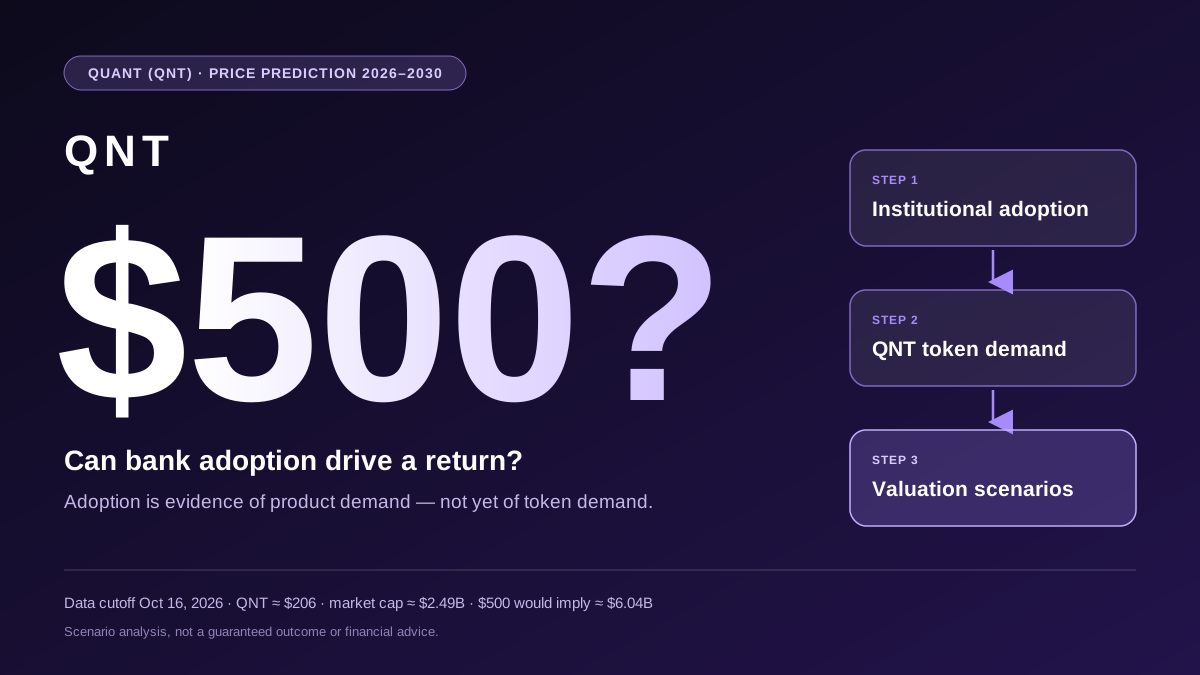
Quant (QNT) Price Prediction 2026–2030: Can Bank Adoption Drive a Return to $500?

Spout raises $2M to offer 0% interest loans on Solana

Chips, AI and Bitcoin: Reading Cross-Market Risk Appetite After a Volatile Week

Is a Bitcoin record closer than you think? This one indicator reveals everything

$600 Million in Fake Trading Volume Exposes the Myth of the Prediction Market 'Truth Machine'

The Other Side of Artificial Intelligence: Why Wall Street Is Starting to Distrust Chips

Asia Recovers After Tech Sell-off: What Changed in 24 Hours

WEEX TradFi Weekly Review: Semiconductor Contracts Lag While Apple and Coinbase Rise
WEEX TradFi weekly review: chip contracts lag SPY as Apple and Coinbase rise. Compare returns, buying activity, and leveraged ETF product risks.

Altcoin Season? Why 63% Beat Bitcoin (BTC) While WEEX Median Returns Stayed Flat
WEEX altcoin weekly review: 63% beat Bitcoin while median returns stayed flat. Explore relative strength, leaderboard limits, and altcoin season signals.

Bitcoin (BTC) Weekly Outlook: Price Slips as WEEX Spot and Futures Buying Readings Diverge
Bitcoin weekly outlook from WEEX data: compare completed and partial weeks, spot versus futures buying readings, and the limits of trader positioning.

$5 Billion Bitcoin Seized: Should the Gains Belong to Victims or the UK Government?
A Project Aiming to Live for 100 Years Hands Over Its Exam to the Community

Payward, Parent Company of Kraken, Acquires Parent Company of Saldo Bank to Obtain EU Banking License

Native Bitcoin collateral on Aave triggers WBTC pool deficit
ANAP Reports Bitcoin Valuation Loss of 4.37 Billion Yen, Reversing Previous Period's Valuation Gain of 1.2 Billion Yen

TSLA Stock Rises After the Roadster Reveal: What Matters Before Tesla’s October 21 Earnings
TSLA stock rose about 4.6% in premarket trading on October 16 after Tesla showed its second-generation Roadster, but analysts say the car adds little to near-term revenue and the premarket move also reflects SpaceX merger talk. Tesla’s October 21 earnings report is the next real test.

The Kobeissi Letter: Today's 'Invisible' Bear Market is 'One of the Most Significant Opportunities'
The Past and Present of Currency in the Age of Exploration

Gold Rush Handbook | New Player in the DEX Track Metric: Backed by Uniswap Veteran

Solana event in China canceled, CZ questions organizers

唐华斑竹 Analyzes FIL Supply Changes, Significant Price Fluctuations

Bank Terminated Account of Crypto Company. Court Threatened 10,000 PLN for Each Day of Delay

Next FOMC Meeting 2026: October 28 Fed Decision Time & Schedule
BlackRock CEO Larry Fink Flags a Different AI Risk, and It Isn’t the Bubble

Kenson Investments Publishes New Education Series on the SEC’s Proposed Crypto Offering Framework
Scammers First Deceive, Then Offer to Help Recover Losses
Ripple opens Wall Street’s door to Hyperliquid’s $59 billion trading market
MSCI New Rules Implemented, 14 Crypto Companies Enter Potential Impact List
G7, AI and Stablecoins: The 3 Stablecoin Issues Ignored by Finance Ministers
What Do the New Tesla Roadster Specs Mean for Tesla (TSLA) Stock?
Explore the new Tesla Roadster specs, reservation payments and 2028 production plan, plus what the reveal could mean for Tesla stock and future profits.
Quant (QNT) Price Prediction 2026–2030: Can Bank Adoption Drive a Return to $500?


