
SOXL Semiconductor ETF Jumps as Trading Volume Surges: What's Driving the Rebound

 Prefer us on Google


SOXL closed at $103.97 on September 17, up from $102.32 two days earlier, with 24-hour gains of 1.61% and trading volume running meaningfully above its recent average. That's a genuine rebound, but it's worth being precise about what it's actually a rebound from: SOXL's net asset value has still fallen 19.15% over the trailing month, meaning this week's gains are recovering ground from a much steeper decline rather than pushing the fund to new highs.
A leveraged product like this one blurs two separate things that are worth pulling apart directly: what's actually happening to the underlying semiconductor sector, and how SOXL's own structure amplifies that movement in ways that don't behave the way a simple "3x the index" intuition would suggest.
What SOXL Actually Is
SOXL, formally the Direxion Daily Semiconductor Bull 3X Shares, is a leveraged exchange traded fund designed to deliver three times the daily performance of the NYSE Semiconductor Index, a benchmark tracking the 30 largest US listed semiconductor companies. Its top holdings include Micron, AMD, Nvidia, Broadcom, Intel, Applied Materials, Marvell, KLA, and Lam Research, a concentrated bet on the chip sector rather than a broadly diversified technology fund.
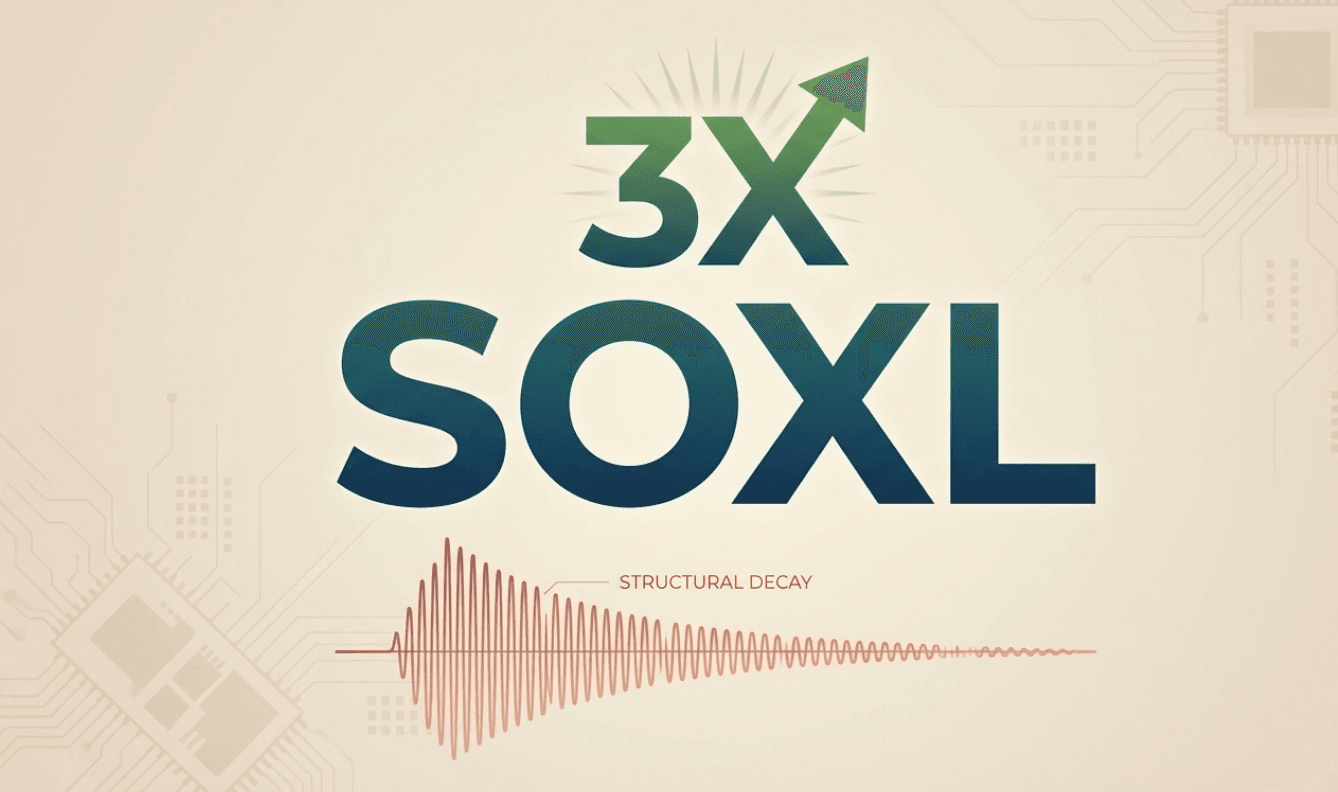
The "3x daily" part of that description matters more than it might first appear. SOXL rebalances its leverage every single trading day, meaning the fund aims to deliver three times whatever the index does on that specific day, not three times the index's return over any longer stretch of time. Because of how daily compounding works, SOXL's actual return over weeks or months can diverge meaningfully from simply multiplying the underlying index's return by three, particularly during choppy, back and forth markets where daily gains and losses partially offset each other. That structural feature is central to reading this week's bounce correctly, since a fund built this way tends to produce sharper, faster moves in both directions than the sector it tracks.
What Actually Happened This Week
The specific numbers behind this rebound are worth laying out clearly. SOXL traded at $102.32 on September 15, opened at $107.44, and touched a range between $101.07 and $109.32 that session, according to Yahoo Finance data. Trading volume that day reached over 73 million shares against an average of roughly 63 million, a meaningful jump in activity. By September 17, the fund had settled at $103.97, according to Investing.com, holding onto a portion of that earlier strength rather than giving it all back.
That price action followed a considerably rougher stretch. According to Tickeron's analysis, SOXL fell approximately 37% over the trailing 30 days heading into this rebound, with a roughly 31% decline over the most recent quarter, reflecting a semiconductor sector selloff that the fund's 3x leverage amplified in the downward direction just as sharply as it now appears to be amplifying the recovery. A 52 week range spanning from $28.12 to $302.00 gives some sense of just how volatile this specific fund has been over the past year, a range far wider than the underlying semiconductor sector itself experienced.
Why the Underlying Sector Is Actually Moving
SOXL's rebound isn't happening in isolation from what's driving the individual chip stocks it holds. This week's bounce lines up with broader semiconductor sector strength tied to AI infrastructure demand remaining resilient even amid a hawkish shift in Federal Reserve policy, with chip and optical networking names among the specific pockets of the market that traded higher even as the broader market reacted to the Fed's September rate hike. Since SOXL's ten largest holdings, names like Nvidia, AMD, Broadcom, and Micron, are precisely the stocks benefiting from that AI infrastructure spending story, strength across those individual names shows up amplified inside SOXL's own price action.
That connection matters for reading this rebound accurately. SOXL itself has no independent catalyst driving its price. It simply reflects, at three times the daily magnitude, whatever is happening across its underlying holdings, which means understanding why SOXL is up requires looking at why Micron, AMD, Nvidia, and the rest of the semiconductor complex are up, not treating the ETF as its own separate story.
-- Price
The Three Risks Direxion Itself Flags
Direxion's own product materials, updated as of September 16, specifically identify three risk factors currently weighing on the semiconductor sector that SOXL tracks. The first is geopolitical tension tied to the Israel-Iran conflict, which the fund manager notes is causing market volatility and raising fears that a broader Middle East conflict could disrupt global trade and semiconductor supply chains. The second is China's rapid AI advancement, which Direxion frames as approaching US capabilities closely enough to threaten American technology dominance, a dynamic that could influence semiconductor demand and competitive positioning going forward. The third is ongoing tariff and trade policy uncertainty, particularly involving China, which poses risks to semiconductor supply chains and broader market stability.
These aren't hypothetical concerns layered on for disclosure purposes. They're the specific factors the fund's own issuer considers live enough to name directly, and they represent exactly the kind of catalysts that could reverse this week's rebound as quickly as it developed, given how sharply SOXL's leverage cuts in both directions.
Why the Volatility Itself Is Worth Understanding Before Trading This
Barchart's tracking recently placed SOXL's implied volatility at 123%, a level the outlet specifically described as making it one of the riskiest ETFs on the market to hold outright. That figure isn't a minor technical detail. It reflects genuine uncertainty about how sharply this specific fund could move in either direction over a short window, a direct consequence of combining an already-volatile sector, semiconductors, with a 3x daily leverage structure on top of it.
This is worth sitting with directly rather than treating as a footnote: SOXL had a total return of 276.82% over the trailing year, according to StockAnalysis.com, alongside an average annual return of 37.65% since the fund's 2010 inception. Those headline numbers can look attractive in isolation, but they coexist with the same fund falling roughly 37% in a single recent month. A product capable of both outcomes within the same calendar year isn't behaving like a standard equity holding, and treating it as one, rather than as a short-term tactical instrument, is where the daily-rebalancing structure tends to catch investors off guard.
What Would Actually Confirm This Rebound Has Legs
Rather than assuming this week's bounce marks a durable turn, it's more useful to identify what would need to hold for the rebound to extend rather than fade the way sharp reversals sometimes do within a longer downtrend. Continued strength specifically across SOXL's largest holdings, Nvidia, AMD, Broadcom, and Micron among them, tied to AI infrastructure spending proving durable rather than sentiment-driven, would need to persist beyond this single week. The three risks Direxion itself named, Middle East tensions, China's AI progress, and tariff uncertainty, would need to avoid escalating into the kind of concrete negative catalyst that could trigger renewed selling. And trading volume would need to remain elevated on further gains rather than fading back toward average levels, since declining volume alongside a rising price often signals weaker conviction behind a move.
None of these are confirmed by this week's price action alone. They're the specific developments worth tracking over the coming sessions to distinguish a genuine sector recovery from a sharp, temporary bounce within a semiconductor downturn that had already erased more than a third of SOXL's value over the prior month.
Where To Track The Chip Names Driving SOXL
SOXL's own price doesn't move independently. It's amplified exposure to what Nvidia, AMD, Broadcom, and Micron are actually doing on any given day, which means tracking those individual names directly can tell you more about where the rebound is headed than watching the leveraged fund alone.
WEEX is a global multi-asset trading platform serving 10M+ users across 170+ countries and regions, offering access to 1,700+ trading pairs alongside selected traditional markets, all through a single account. For anyone trying to separate genuine strength in SOXL's underlying holdings from the daily-rebalancing noise leveraged funds are prone to, having deep liquidity and fast execution across both crypto and equity-adjacent markets matters more than usual, and WEEX's asset protection is backed by a publicly disclosed 1,000 BTC Protection Fund.
Conclusion
SOXL's rise from $102.32 to $103.97 over the past several sessions, accompanied by trading volume running above its recent average, reflects genuine strength in its underlying semiconductor holdings tied to resilient AI infrastructure demand. But that rebound follows a roughly 37% decline over the prior month, and Direxion's own risk disclosures specifically flag Middle East tensions, China's AI advancement, and tariff uncertainty as live threats to the sector SOXL tracks. Given the fund's 3x daily leverage structure and 123% implied volatility, this week's bounce is better understood as a recovery within an ongoing volatile stretch than confirmation that the broader downtrend has ended.
FAQ
1. What does SOXL actually track?
SOXL is designed to deliver three times the daily performance of the NYSE Semiconductor Index, which tracks the 30 largest US-listed semiconductor companies, including Nvidia, AMD, Micron, and Broadcom among its largest holdings.
2. Why did SOXL rise this week?
The rebound tracks broader strength across its underlying semiconductor holdings, tied to resilient AI infrastructure spending, alongside a jump in trading volume above the fund's recent average.
3. Does SOXL's 3x leverage mean it always moves three times the sector's return?
Only on a daily basis. Because the fund rebalances its leverage every trading day, its return over weeks or months can differ meaningfully from simply multiplying the underlying index's return by three, especially in choppy markets.
4. What risks does SOXL's own issuer currently flag?
Direxion specifically names Middle East geopolitical tensions tied to the Israel-Iran conflict, China's rapid AI advancement, and ongoing tariff and trade policy uncertainty as current risks facing the semiconductor sector SOXL tracks.
5. Is SOXL suitable for long-term holding?
Its structure, particularly daily leverage rebalancing and high implied volatility, makes it more commonly used as a short-term tactical instrument rather than a long-term holding, given how sharply its value can swing in both directions.
This content is provided for general informational purposes only and doesn't constitute financial, investment, legal, or tax advice. Any events, rewards, online promotions, or related information mentioned herein should not be considered a recommendation, solicitation, or invitation to purchase, sell, trade, or otherwise deal in any crypto assets. Crypto assets are highly volatile and may result in loss. The availability of WEEX services, products, and related events may vary by region. You are responsible for ensuring that your participation is in accordance with applicable local laws and regulations.
You may also like

Nvidia Wants to Fund the Same Company Warning About AI's Pace: A Real Contradiction, or Not?
Anthropic warns the world to slow down AI. Nvidia wants to fund its IPO anyway, a tension that says more about hedging than hypocrisy.

Nvidia Is in Talks to Invest $10 Billion in Anthropic's IPO: Here's What That Means for NVDA Stock
Nvidia is reportedly weighing a $10 billion anchor stake in Anthropic's IPO. An extension of a relationship that already runs far deeper than the headline number suggests.

WEEX Exclusive:NVIDIA Raises Guidance, Lifting Semiconductors and AI Stocks | WEEX TradFi Daily (August 27, 2026)
U.S. Inflation Data in Focus, AI Earnings Enter Validation Phase, TSMC, Unitree and Semiconductor Chain Take Center Stage.WEEX TradFi Weekly Market Preview (August 10-August 14, 2026)

WEEX Daily Market Highlights | 2026.08.03

Four Central Banks in Eight Days: Bitcoin Stays Strong

Morpho Opens Borrowing Against Coinbase's Tokenized Stocks

Ethereum Institutional backs plan to cut block times to 10 seconds
Fraud Detection with AI SEON: Signals Rise from 900 to Over 1,100
WEB3 Digital Nomads Don't Need a U Card That Only Allows Payments

Your crypto hardware wallet can stay secure while everything around it fails

How to Spend Crypto on Apple Pay in 2026 (No Selling)

ZEC Coin Nears $1,500 as a Leveraged Short Trader Faces a $7.66 Million Paper Loss
ZEC coin nears $1,500 as two large leveraged short traders face a combined paper loss north of $34 million, the squeeze sits on top of genuine institutional demand through Grayscale's ZCSH.

AMD Stock Soars 5%: Reports Say It's Raising GPU and CPU Prices
AMD stock rose on unconfirmed reports of a 10% price hike on GPUs and chipsets tied to rising TSMC costs, Ryzen CPUs are notably absent from the list.
The US Stock Exchange on Blockchain: 3 Points to Understand the SEC's Major Initiative

AMD Stock Price: Why Free Cash Flow Fell From $2.6B to $1.6B Even as Shares Rally
AMD's free cash flow fell 39% in Q2 as capex nearly tripled and supplier payments got delayed, even as revenue hit a record $11.5 billion.
CLARITY Act needs 3 more senators and a race against the clock for a 2026 revival
Stablecoins Force Banks to Adapt, 24/7 Cross-Border Payments Are Here

Deutsche Bank to Launch Cryptocurrency Custody Services by Year-End for Corporate and Institutional Investors
![[SCAN 2026 Final Interview] IBarelyKnowHer: ⑱ Blockchain and Cryptography... A Diverse Team of Indian Security Experts](/public-static/15_8b3431959d.png?format=avif)
[SCAN 2026 Final Interview] IBarelyKnowHer: ⑱ Blockchain and Cryptography... A Diverse Team of Indian Security Experts
The Surge of ZEC: Causes and Questions Raised by the BIP-110 Incident
Can GSTOCK Reach $25M After Its 190x BNB Chain Rally?

Hedera: 3 million Filipino farmers to monetize their carbon

Why risk a smart contract exploit when safe US Treasuries pay better crypto yields?
What Is GSTOCK? How to Buy Gstock After Its 190x BNB Chain Rally
NDV Jason: How My Investment Approach Has Been Changed by the Market and AI from Bitcoin to Global Macro
Can ONDO Reach $0.50 as RWA Grows? How to Buy ONDO in 2026

South Korea to Build a Chain That Only Recognizes Korean Won, Maroo Incorporates Compliance into Infrastructure

AI On-Chain Finance Summit Features Hiroshi Taira and Executives from Mega Banks
Can UNI Reach $10 as Tokenized Stock AMMs Gain Traction?
Nvidia Wants to Fund the Same Company Warning About AI's Pace: A Real Contradiction, or Not?
Anthropic warns the world to slow down AI. Nvidia wants to fund its IPO anyway, a tension that says more about hedging than hypocrisy.
Nvidia Is in Talks to Invest $10 Billion in Anthropic's IPO: Here's What That Means for NVDA Stock
Nvidia is reportedly weighing a $10 billion anchor stake in Anthropic's IPO. An extension of a relationship that already runs far deeper than the headline number suggests.
WEEX Exclusive:NVIDIA Raises Guidance, Lifting Semiconductors and AI Stocks | WEEX TradFi Daily (August 27, 2026)
U.S. Inflation Data in Focus, AI Earnings Enter Validation Phase, TSMC, Unitree and Semiconductor Chain Take Center Stage.WEEX TradFi Weekly Market Preview (August 10-August 14, 2026)
WEEX Daily Market Highlights | 2026.08.03
Four Central Banks in Eight Days: Bitcoin Stays Strong
Contents
Latest articles


Latest coin listings on WEEX


