
SpaceX Stock(SPCX) Price Prediction 2027: Can Starlink Growth Offset AI Spending?

 Prefer us on Google
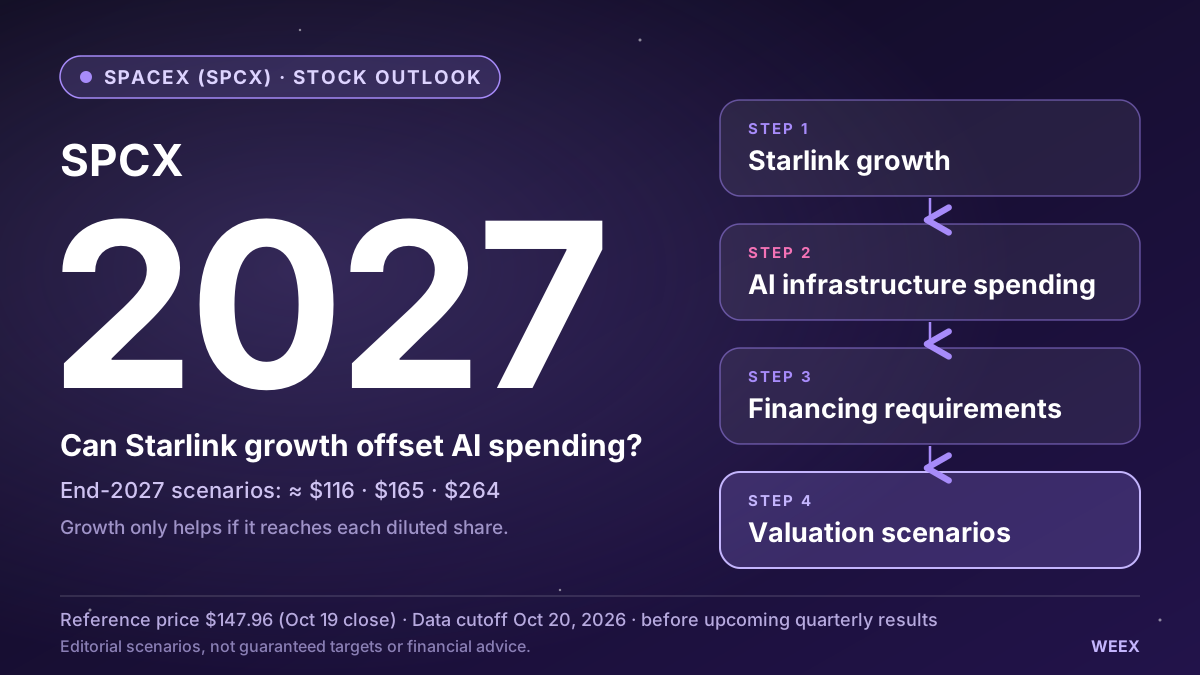
A credible SpaceX stock price prediction for 2027 depends on three variables: revenue growth, the valuation investors assign to that revenue, and changes in the diluted share count. Starlink and AI infrastructure could support expansion, but capital requirements and valuation compression could limit shareholder returns. The scenarios below illustrate outcomes around $116, $165, and $264—not guaranteed targets or probability-weighted estimates.
Our view is that SpaceX’s biggest investment challenge is translating technological and commercial growth into attractive returns from an already demanding valuation. A successful business can still deliver disappointing stock performance if expectations are too high. Investors should focus on cash generation, financing needs, and revenue per diluted share rather than assuming that more launches or greater AI capacity automatically produce a higher stock price.
For readers following shorter-term movements, WEEX provides a dedicated SpaceX SPCX/USDT Futures page. This is contract exposure rather than direct ownership of Nasdaq-listed shares. The retrieved interface showed incomplete quotations and a trading-restriction notice, so confirm current availability and contract rules before placing an order.
By WEEX SEO Team
Published: October 20, 2026
Updated: October 20, 2026
Data Cutoff: October 20, 2026, before incorporating the upcoming quarterly results. The reference stock price is dated October 19; scenario inputs are explicitly identified as editorial assumptions.
Is SpaceX Publicly Traded, and What Is Its Stock Symbol?
SpaceX is publicly traded under SPCX. Its official June 11, 2026 IPO announcement confirmed an offering price of $135 per share and identified June 12 as the expected first trading date. Nasdaq’s securities page identifies the instrument as Space Exploration Technologies Corp. Class A Common Stock.
This verification matters because older articles discussing SpaceX as a private company can remain visible in search results.
It also matters because a symbol appearing on a trading platform does not, by itself, establish the legal instrument being offered. A listed common share, a fund holding shares, and a perpetual contract can provide materially different rights and risks.
The forecast in this article concerns the underlying public stock. A derivatives position may behave differently because of funding payments, margin requirements, liquidity, and the platform’s pricing arrangements.
Investors should establish that distinction before comparing a forecast with the price displayed on their trading screen.
What Is the Starting Point for a SpaceX Stock Price Prediction?
A forecast needs a dated reference price and a clearly defined endpoint.
The stock quotation displayed in the reviewed October 19 coverage was $147.96 at the regular-session close. That is the reference used in this article’s calculations, not a claim about the price available when a reader opens the page.
The prediction horizon is the end of 2027.
That differs from a June 2027 forecast, a rolling 12-month analyst target, or a price expected immediately after earnings. Combining those horizons can create a misleading impression of agreement or disagreement.
The calculations also assume the same share unit throughout. If a stock split occurs, nominal historical and future prices must be adjusted consistently. A split changes the number of shares and their quoted unit price; it does not create an equivalent increase in the company’s economic value.
With those boundaries established, the central question becomes straightforward: how much more business value will each diluted share represent by the forecast date?
Why Is the 2027 SpaceX Outlook About More Than Rocket Launches?
SpaceX’s stock outlook combines businesses with different operating characteristics and investment requirements.
Launch activity is visible and can generate intense attention. Starlink introduces a connectivity business whose economics depend on customers, service revenue, network capacity, and ongoing infrastructure requirements. AI adds another growth opportunity, accompanied by substantial spending.
Reuters’ October 19 preview framed the immediate financial question around whether Starlink growth can support rising AI investment. It also discussed merger speculation, which remains separate from a confirmed transaction.
Investors should therefore resist evaluating the entire company through one headline.
A successful launch can reduce technical uncertainty without resolving financing uncertainty. Strong customer growth can support revenue while requiring additional infrastructure. A large AI commitment can increase future revenue potential before generating positive cash flow.
The investment case improves when these activities reinforce one another economically. It weakens when attractive growth in one area is consumed by spending elsewhere without a clear path to adequate returns.
That relationship should sit at the center of a SpaceX stock forecast.
Can Starlink Growth Support a Higher SpaceX Valuation?
Starlink’s potential contribution depends on the quality of its growth, not simply the number of connections.
For a connectivity business, revenue can increase through customer additions, pricing, usage, or a shift toward higher-value customers. Those routes have different implications for profitability.
Adding customers at an attractive acquisition cost can strengthen the business. Adding customers through heavy subsidies or low-value offers can produce impressive growth figures without equivalent financial improvement.
Capacity also matters. A network must have enough infrastructure to serve demand at an acceptable quality level. Growth that requires additional investment should be evaluated after considering that investment.
The most useful questions concern revenue durability and cash conversion.
| Starlink Question | Why It Matters for the Stock |
|---|---|
| Is customer revenue growing consistently? | Helps distinguish recurring demand from temporary effects |
| Is revenue per customer holding up? | Tests pricing and customer mix |
| Are operating costs scaling efficiently? | Indicates whether growth improves profitability |
| What investment is required to maintain service? | Determines how much cash remains after infrastructure spending |
| Is customer retention satisfactory? | Helps assess the durability of future revenue |
These are evaluation criteria, not claims that each measure is currently disclosed in a comparable form.
Starlink would provide a stronger foundation for valuation if investors could identify a dependable stream of cash remaining after the spending needed to sustain the network.
A growing revenue line is useful. A growing, durable cash contribution is more valuable.
Why Does AI Spending Complicate the SpaceX Stock Forecast?
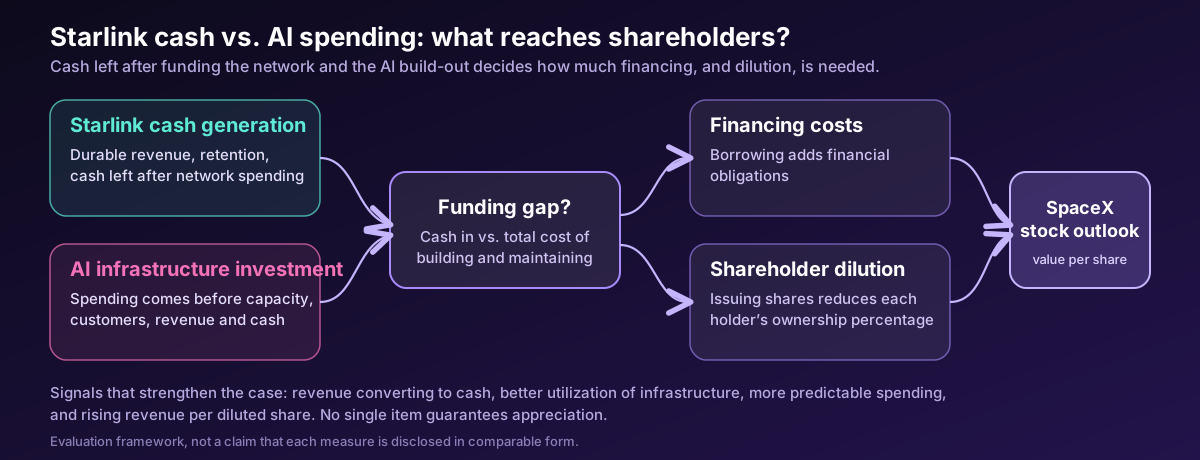
AI infrastructure can create value, but spending is not evidence that value has already been created.
The financial sequence runs from investment to usable capacity, customer adoption, recognized revenue, cash collection, and ultimately an adequate return on capital.
Problems can emerge at any stage. Equipment can arrive before power is available. Capacity can become operational before utilization is sufficient. Revenue can grow while depreciation, financing costs, and additional investment keep cash flow under pressure.
For shareholders, the relevant question is whether the eventual cash generated exceeds the full cost of creating and maintaining the capacity.
This is why a large contract announcement should be examined carefully. The duration, customer obligations, cancellation provisions, deployment schedule, and payment terms affect its economic value.
Investors should also distinguish booked revenue from contracted potential and annualized run rates. These figures measure different things.
An annualized run rate extrapolates a recent operating level. It is not automatically revenue already earned over a full year.
A contract backlog can support visibility, but it does not become cash immediately.
The bullish case becomes stronger when operating disclosures show that capacity is being deployed productively and that financing requirements are becoming more manageable.
How Can SpaceX Revenue Grow While Its Stock Price Falls?
Revenue growth and shareholder return are connected through valuation and ownership.
For an equity price-to-sales framework:
Stock price = company revenue × equity price-to-sales multiple ÷ diluted shares.
This is an accounting relationship, not a complete valuation method. It helps isolate why growth alone cannot establish the future stock price.
Suppose revenue doubles, but investors cut the price-to-sales multiple in half. With unchanged shares outstanding, the two effects offset each other.
If the company also issues more shares, revenue must grow further to deliver the same benefit per share.
The relationship can be expressed relative to a reference date:
Future price ÷ reference price = revenue growth factor × valuation-multiple factor ÷ share-count growth factor.
This framework uses an equity multiple. Investors using enterprise value instead must separately account for net debt and other relevant claims before arriving at equity value.
Confusing those approaches can materially distort a target.
The practical lesson is that a SpaceX stock price prediction should make its growth, valuation, and dilution assumptions visible. A target without those inputs is difficult to evaluate.
What Are the SpaceX Stock Price Scenarios for 2027?
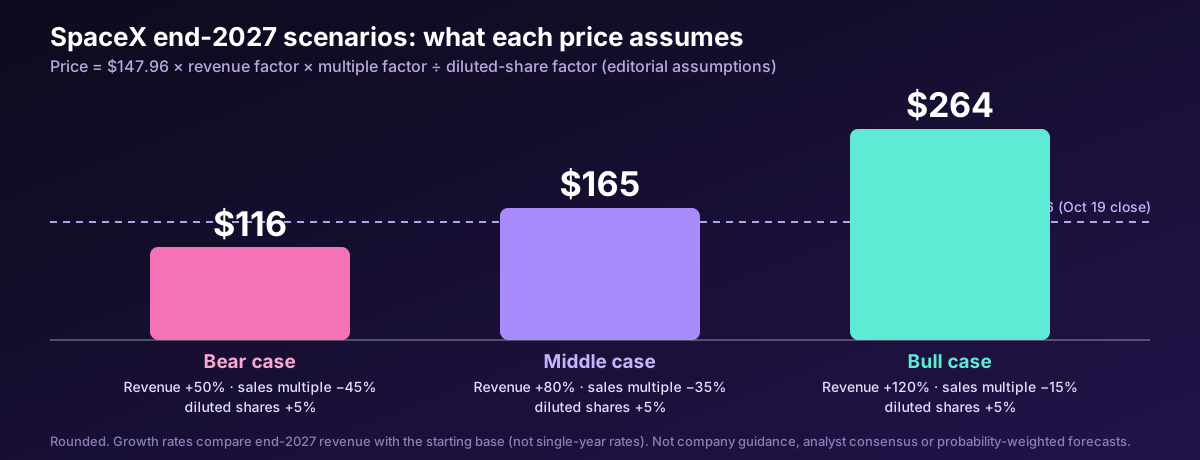
The following scenarios use the $147.96 October 19 reference price and the relationship above.
Every growth rate and multiple change in the table is an editorial assumption. These are sensitivity cases, not company guidance, analyst consensus, or a statistically calibrated forecast. They compare end-2027 revenue with the corresponding starting revenue base; they are not presented as single-year growth rates.
| End-2027 Scenario | Revenue Growth Assumption | Equity Sales-Multiple Change | Diluted Share-Count Increase | Illustrative Price |
|---|---|---|---|---|
| Bear case | +50% | −45% | +5% | $116 |
| Middle case | +80% | −35% | +5% | $165 |
| Bull case | +120% | −15% | +5% | $264 |
Rounded calculations: $147.96 × revenue growth factor × multiple factor ÷ 1.05.
The bear case illustrates how substantial business growth can coexist with a lower share price. Revenue expands, but a large valuation reset more than offsets the benefit.
The middle case assumes even stronger growth, yet produces only a moderate price increase because the valuation premium declines.
The bull case requires exceptional expansion while investors retain most of the starting multiple.
These scenarios do not establish a floor or ceiling. A severe operating setback could produce a worse result, while stronger performance or greater enthusiasm could produce a higher one.
Their purpose is to show the economic assumptions behind a price—not to disguise uncertainty with precise numbers.
What Would SpaceX Need to Reach $200 or $250?
Working backward from a target can be more informative than choosing a bullish number first.
Assume, for illustration, that the diluted share count increases 5% by the end of 2027. The required revenue expansion then depends on how much of the starting valuation multiple investors retain.
| Target Price | Revenue Growth Needed if the Multiple Is Unchanged | Revenue Growth Needed if the Multiple Falls 25% |
|---|---|---|
| $200 | Approximately 42% | Approximately 89% |
| $250 | Approximately 77% | Approximately 137% |
Calculations use the $147.96 reference price and a 5% assumed increase in diluted shares.
The table explains why valuation discipline matters even for a rapidly expanding company.
If the starting multiple remains intact, the revenue hurdle is lower. If investors demand a less expensive valuation, the business must grow faster to reach the same price.
A $250 forecast therefore needs more than confidence in technological progress. It needs an explicit view about financial growth, market valuation, and ownership dilution.
This reverse calculation also gives investors a way to update the thesis. If actual revenue prospects deteriorate or share issuance rises, the same target becomes harder to justify.
What Could Strengthen the Bull Case for SpaceX Stock?
The strongest bullish development would be evidence that commercial expansion is becoming less dependent on repeated financing.
That could involve stronger operating cash generation, improved utilization of expensive infrastructure, or more predictable customer payments.
Execution also matters. Capacity delivered on schedule can support revenue conversion and confidence. Delays can push cash receipts further into the future while spending continues.
A favorable outcome would combine growth with improving economics rather than asking investors to accept one in place of the other.
| Evidence | Bullish Interpretation |
|---|---|
| Revenue converts into cash consistently | Growth is producing usable financial resources |
| Infrastructure utilization improves | Existing investment is becoming more productive |
| Spending becomes more predictable | Financing uncertainty declines |
| Revenue per diluted share rises | Growth is reaching shareholders |
| Disclosures become clearer | Investors can evaluate returns with greater confidence |
No single item guarantees appreciation.
The broader point is that the bull case should become progressively easier to verify through reported results. If it continues to depend mainly on distant possibilities, the valuation remains especially sensitive to sentiment.
What Could Push SpaceX Stock Below the Middle Scenario?
The most direct risk is that spending grows faster than the cash the business can generate.
That can create a need for additional borrowing, equity issuance, or other financing. Each route has a cost. Borrowing adds financial obligations; issuing shares reduces each existing shareholder’s percentage ownership.
Customer concentration can add another vulnerability. Large commitments may support growth, but dependence on a small number of customers can increase the impact of delays or renegotiations.
Valuation is a separate risk. The market can assign a lower multiple even while operations improve, particularly if investors become less willing to fund long-duration growth.
Finally, technical or operational progress may take longer than expected.
A forecast should account for the possibility that a project ultimately succeeds but delivers its financial benefit after the investor’s target date.
That timing mismatch is important for a 2027 prediction. Long-term potential does not guarantee a favorable outcome over a specific holding period.
How Should Investors Read Other SpaceX Price Predictions?
Existing forecasts should be compared by their inputs and horizons rather than ranked by optimism.
The Motley Fool’s October 19 article takes a cautious view of the valuation and suggests the stock could remain near its prevailing level through the end of 2027. CoinCodex presents algorithmic price projections across several periods. These represent different approaches, not interchangeable estimates.
A historical-price model can summarize patterns without evaluating the full commercial economics of new projects. A fundamental forecast can evaluate economics while still relying on uncertain assumptions.
Neither approach eliminates forecasting risk.
Analyst targets also need a date and horizon. A rolling 12-month target should not automatically be labeled an end-2027 prediction.
Consensus figures can differ because providers include different analysts, publication dates, and update policies. A precise average is not meaningful unless the underlying sample is understood.
The most useful forecast is one a reader can reconstruct and challenge.
How Can Traders Follow SpaceX Exposure on WEEX?
The WEEX SPCX/USDT Futures page is the contract destination to inspect. Confirm that the instrument is available in your region and that trading is currently enabled.
The publicly retrieved page did not establish a reliable executable quotation. Its displayed zero funding value should not be interpreted as a verified ongoing funding benefit.
If the contract is available, review its specifications, pricing method, margin requirements, and current costs before entering a position.
A long-term stock forecast and a leveraged contract position have different risk profiles. A contract can be liquidated during an adverse move even if the underlying stock later reaches a bullish target.
For example, a trader accepting a planned $50 loss with an exit approximately 10% from entry would begin with roughly $500 of position notional, before costs and slippage. Increasing leverage changes the margin requirement; it does not improve the forecast.
An exit order also does not guarantee an exact execution price in a fast or interrupted market.
No SPCX-specific campaign or fee discount is treated as verified in this article. Readers should use the current official contract and promotion terms rather than assume a general offer applies.
FAQ
1. What Is the SpaceX Stock Price Prediction for 2027?
This article’s illustrative scenarios are approximately $116, $165, and $264 by the end of 2027. They depend on explicitly assumed revenue growth, valuation changes, and dilution. They are not guaranteed targets or assigned probabilities.
2. Can SpaceX Stock Reach $250?
It could, but the required growth depends on valuation. Under this article’s reference price and 5% dilution assumption, reaching $250 requires approximately 77% revenue growth if the sales multiple is unchanged, or approximately 137% if it falls 25%.
3. Is SpaceX Publicly Traded Under SPCX?
Yes. The company’s official IPO announcement identifies SPCX, and Nasdaq identifies the listed Class A common stock. Readers should distinguish those shares from derivatives using a similar symbol.
4. Does Starlink Growth Guarantee a Higher SpaceX Stock Price?
No. Investors must also consider operating costs, infrastructure spending, financing, diluted shares, and the valuation assigned to the business. Revenue growth alone does not determine shareholder return.
5. Is a WEEX SPCX Futures Position the Same as Owning SpaceX Shares?
No. A perpetual contract provides exposure under the platform’s contract terms. It does not automatically provide the ownership rights associated with ordinary shares and introduces additional margin, funding, and execution considerations.
WEEX's View: The 2027 Forecast Needs Growth per Share, Not Just Growth
SpaceX offers investors several potential sources of expansion, but the investment case becomes stronger only when those opportunities translate into financial value per share.
Our working view is cautious about assigning a single confident target before the coming results are incorporated. The middle scenario demonstrates why: even strong revenue expansion can produce modest returns if the valuation multiple contracts.
The most important evidence will be the relationship between cash generation, infrastructure spending, and financing requirements. Starlink can support the broader story, but shareholders need to see how much economic value remains after funding that story.
Sources
SpaceX Investor Relations, Space Exploration Technologies Corp. Announces Pricing of Initial Public Offering, June 11, 2026.
Nasdaq, Space Exploration Technologies Corp. Class A Common Stock—SPCX, accessed October 20, 2026.
Reuters, SpaceX, Tesla Earnings to Test Musk’s AI Spending Ambitions as Merger Talk Grows, October 19, 2026.
The Motley Fool, Prediction: This Will Be SpaceX’s Stock Price by the End of 2027, October 19, 2026.
CoinCodex, SpaceX Stock Forecast and Price Prediction, reviewed October 20, 2026.
WEEX, SPCX/USDT Perpetual Futures, reviewed October 20, 2026.
This content is provided for general informational purposes only and doesn't constitute financial, investment, legal, or tax advice. Any events, rewards, online promotions, or related information mentioned herein should not be considered a recommendation, solicitation, or invitation to purchase, sell, trade, or otherwise deal in any crypto assets. Crypto assets are highly volatile and may result in loss. The availability of WEEX services, products, and related events may vary by region. You are responsible for ensuring that your participation is in accordance with applicable local laws and regulations.
You may also like

Tech Rebounds; Bitcoin Holds $81,000–$82,000 Support| WEEX TradFi Daily (October 20, 2026)
On October 19, tech rebounded. The three major indexes were mixed, with the Nasdaq relatively stronger. Intel rose after a JPMorgan upgrade, and SpaceX closed up more than 2%. Bitcoin traded near $81,000–$82,000, a zone traders viewed as strong support and a local bottom. Worldcoin (WLD) rose more than 10% in 24 hours, leading majors. October 20 focus includes earnings from SPCX and other listed names.

Bitcoin Ranges After Weekly Low Sweep| WEEX TradFi Daily(October 19, 2026)
Early on October 19, equity futures rebounded from last week’s chip selloff. Major indexes closed lower last week, the Nasdaq posted its worst week since June, the semiconductor ETF fell about 10%, and CoreWeave lost about 25%, while energy stocks were relatively resilient. Bitcoin traded near $82,000 after sweeping lows around $80,000, with markets watching the $79,800 and $83,600 zones.

Fed Blackout, GTC and Tech Earnings | WEEX Weekly Hotspot Preview (2026.10.19-10.23)
This WEEX weekly preview focuses on the Fed blackout period, a crypto-regulation deadline, NVIDIA GTC Berlin, major tech earnings, Flash PMI, and final consumer sentiment. After last week’s tech-stock pullback, markets will trade AI expectations, earnings guidance, yield moves, and risk appetite more directly, with QQQ, SPY, BTC, ETH, NVDA, TSLA, META, IBM, LRCX, and AXP likely to see more active volatility.

CPI, PPI and TSMC Earnings Recap | WEEX Weekly Market Recap (2026.10.12-10.16)
WEEX Weekly Market Recap focuses on CPI, PPI, TSMC earnings, AI financing pressure, BTC’s key support, the PYTH buyback narrative, L2 and privacy-token rotation, and crypto-finance strength. Risk assets first pulled back on oil, inflation, and AI valuation pressure, then rebounded quickly after the market digested the PPI shock.

Stocks and Crypto Rebound After Hot PPI | WEEX TradFi Daily Brief (October 16, 2026)
On October 15, September PPI rose 6.3% year on year, the highest in more than four years, briefly lifting hike expectations and triggering a short drop in equities and crypto. After the market digested the print, risk assets rebounded from the sell-off and the three major indexes closed higher. Bitcoin briefly broke below $80,000 and recovered to the $82,000–$83,000 range. CoreWeave fell sharply on bond pressure and then closed higher, while crypto-finance stocks and some L2 tokens strengthened. October 16 focus turns to industrial production and import-export prices.

Hot CPI Lifts Hike Bets; Risk Assets Pull Back | WEEX TradFi Daily(October 15, 2026)
Major indexes closed lower on October 14, with the Nasdaq leading the decline. September unadjusted CPI rose to 3.7% year on year, above forecasts, and core CPI also beat expectations. Traders sharply raised this month’s hike probability to about 43.7% and fully priced two more hikes by the end of January. Chip stocks were sold again. Bitcoin broke below $83,000 and last traded near $81,700, while spot gold and silver fell. Crypto-related stocks were under pressure, but PYTH rose against the tape. October 15 brings PPI, retail sales and key
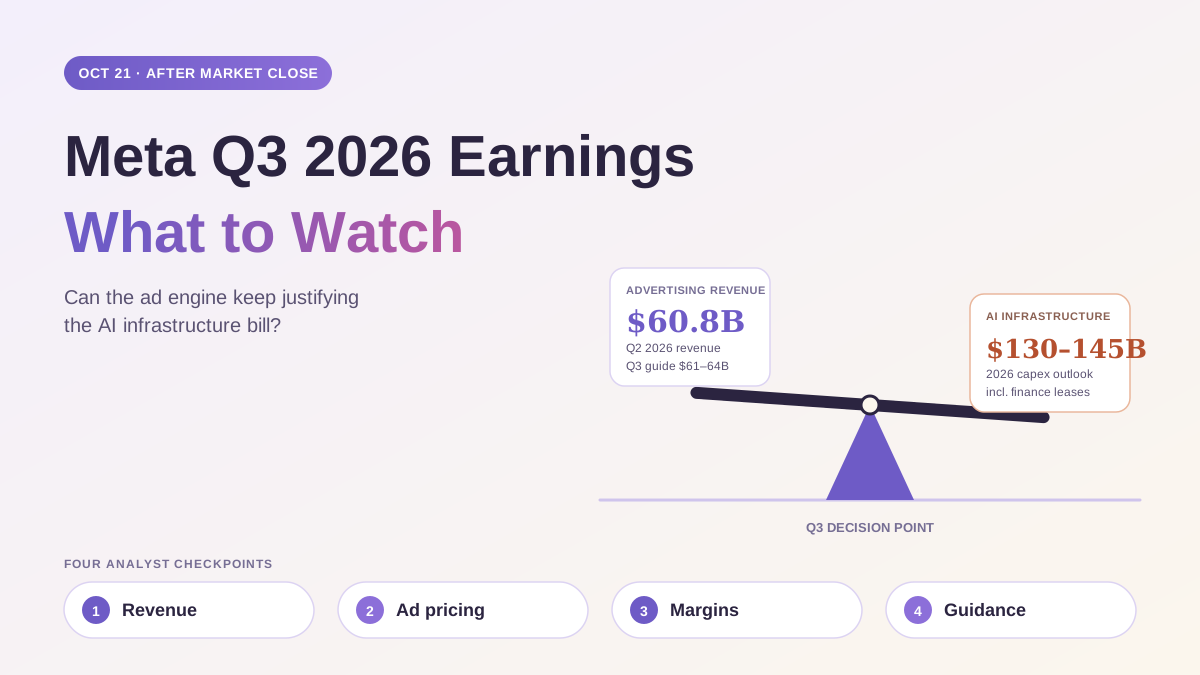
Meta Stock Earnings: What to Watch in Meta Platforms’ Q3 2026 Results
Meta reports Q3 2026 results on October 21. See the advertising, AI spending, margin, and guidance signals that could move META stock.

Indexes Fall as Bank Earnings Diverge| WEEX TradFi Daily Brief (October 14, 2026)
Major indexes closed lower on October 13 as mixed bank earnings and pressure on chip stocks weighed on sentiment, while Microsoft and Apple both rose to record closing highs. Citigroup fell more than 5% after trading revenue missed expectations. Bitcoin rallied to about $88,000 before stalling, while whale holdings shifted back toward accumulation. Ethereum L2 and privacy tokens strengthened. On October 14, markets will focus on CPI, bank earnings and ASML’s report.

Oil Spikes to $107; Bank Earnings in Focus | WEEX TradFi Daily Brief (October 13, 2026)
Markets on October 13 continued to price oil, inflation expectations and major earnings. Brent crude climbed as high as $107.25 per barrel, with supply concerns lifting inflation expectations and pressuring high-beta technology and crypto assets. Bitcoin briefly rose to $84,348 before pulling back, while equity-market performance remained divided as semiconductors, optical networking and memory stocks weakened. Today’s focus turns to Apple’s smart-home event and earnings from JPMorgan, Goldman Sachs, Wells Fargo and

Inflation Data, AI Chip Earnings| WEEX Weekly MarketPreview (October 12-October 16, 2026)
WEEX Weekly Market Hotspot Preview focuses on the PUMP unlock, the start of financial earnings, CPI, ASML earnings, PPI, retail sales, TSMC earnings, and Fed Chair Warsh’s annual-meeting fireside chat. The main themes are inflation repricing, financial-earnings validation, AI chip demand confirmation, and crypto supply pressure.
Bitcoin Tests $85K Resistance; STRK Surges | WEEX TradFi Daily Brief (October 12, 2026)
Bitcoin traded near $83,700 and is testing the $84,000–$85,000 cost-cluster zone. In crypto, L2 scaling, ZK modularity, high-performance L1s, gaming and DePIN were relatively active as capital rotated from pure meme trades toward infrastructure narratives. In equities, NVIDIA’s market value is approaching $6 trillion, supported by AI infrastructure demand, while optical modules and fiber names were relatively resilient. Bond markets are closed on October 12 ET for the holiday, while equities trade as normal; the pause in yield pricing may amplify intraday volatility.

High Yields Pressure Tech as PYTH Buyback Expectations Rise | WEEX Weekly Market Recap (October 5-October 9, 2026)
WEEX Weekly Market Recap focuses on elevated long-end yields, AI compute-chain divergence, crude rebound, BTC weakness, and PYTH buyback expectations. The week’s main thread was high rates pressuring valuations, AI infrastructure validation, and high-beta crypto rotation.

Long-Bond Highs Pressure Tech| WEEX TradFi Daily Brief (October 9, 2026)
Indexes were mixed on October 8 ET. The long-bond yield touched about 5.35% intraday, near levels last seen in 2002. OpenAI’s annualized revenue of about $50 billion came in below higher figures that had circulated, pressuring tech and chip names. Nasdaq fell clearly, while Dow edged higher. Energy led, with WTI up about 3.2% to about $91. Bitcoin pulled back from about $86,000 and traded near $81,000, down about 5%. September PPI is the focus on October 9.

September Fed Minutes Point to Another Hike This Year| WEEX TradFi Daily Brief (October 8, 2026)
Major equity indexes closed lower on October 7 ET. Long-end yields rose again, and the 30-year yield hit a roughly 24-year high. September Fed minutes showed most participants thought another increase in the federal funds target range before year-end could be appropriate. CME pricing for a 25 bp hike at the October 27–28 meeting has fallen below 20%, far below about 70% in the days after the September decision. Bitcoin traded near $83,300. The October 8 focus is jobless claims and pre-market earnings from Pepsi and Delta.

What Is Warren Buffett’s S&P 500 Investing Advice? Key Lessons for Volatile Markets
Learn Warren Buffett’s S&P 500 index fund advice, how the 90/10 rule works, and how to build a long-term plan for volatile markets.
S&P 500 and Nasdaq Hit New Highs| WEEX TradFi Daily Brief (October 7, 2026)
Major equity indexes closed higher on October 6 ET. The S&P 500 and Nasdaq both set closing highs as long-end yields eased and oil stabilized, shifting capital from rate worries toward earnings. Constellation Energy led on a long-term power agreement to supply Google, while tokenized-securities platform Securitize jumped early after signing a tech partnership. Bitcoin held near $86,000, LayerZero led majors, and Anvil surged after an institutional purchase of governance tokens. Applied Digital reports after the close on October 7 ET, while markets also track policy-meeting minutes and TOKEN2049 industry headlines.

Nasdaq Hits Another High| WEEX TradFi Daily Brief (October 6, 2026)
Major equity indexes closed higher on October 5 ET, and the Nasdaq set another record high. Tech drew inflows after weak labor data cooled rate-hike expectations, but the 10-year and 30-year yields rose intraday to about 5.34% and 5.70%. The services prices index rose to 74.0, a four-year high, so the rate overhang has not cleared. EWZ and PBR jumped on election and resource-discovery narratives, while SpaceX hit a stage high. Bitcoin traded near $86,000. On October 6 ET, markets will watch Amazon’s fall Prime event and early sales signals for consumer-sector pricing.

FOMC Minutes,and TOKEN2049 Set the Tone | WEEX Weekly Market Hotspot Preview (October 5-October 9, 2026)
WEEX Weekly Market Hotspot Preview focuses on ISM Services PMI, Glamsterdam Sepolia activation, FOMC minutes, Applied Digital earnings, TOKEN2049, PepsiCo and Delta earnings, and preliminary Michigan consumer sentiment. The week’s core narrative centers on rate-path repricing, AI data-center demand validation, institutional crypto narratives, and consumer-resilience signals.

NVIDIA Hit a Record High Last Week| WEEX TradFi Daily Brief (October 5, 2026)
On October 5, equity markets are in a watch window between labor-data volatility and the formal start of Q3 earnings. Bitcoin traded near $86,000 and Ethereum near $2,720, with majors moving in a narrow weekend range. PUMP broke above $0.0064 to another stage high; AgenC (AGENC) gained trading support, while STONK strengthened on a community-coin rewards mechanism. NVIDIA touched an intraday record high last Friday, and optical modules plus AI compute remain the main flow. September ISM Services PMI is due at 10:00 ET on October 5, while consumer and AI-infrastructure earnings this week will keep testing demand resilience.

PCE and Micron Drive Rate Trades| WEEX Weekly Market Recap (September 28-October 2, 2026)
WEEX Weekly Market Recap focuses on PCE, payrolls, JOLTS job openings, OpenAI DevDay, The AI Conference, Micron earnings, Accenture earnings, Bitcoin Treasuries Conference, and the NEAR Intents security incident. The week’s core narrative centered on rate-path repricing, AI order validation, AI memory demand, and crypto security risk.

Oil Supply Premium Lifts Energy Stocks| WEEX TradFi Daily (October 2, 2026)
Markets on October 2 are focused on oil, long-end yields and payroll data. Major equity indexes closed slightly higher on October 1 after being pressured intraday by a spike in long-end yields, with AI and energy helping support risk appetite. Accenture (ACN) jumped after AI-related bookings, revenue and full-year guidance topped expectations, while Nike (NKE) fell after hours on weaker sales. Brent crude broke above $102 and energy stocks strengthened. Bitcoin traded near $83,500. Markets are also digesting the NEAR Intents security incident and expectations for Monad’s privacy-service reveal.
Micron’s Strong Guidance Meets Long-Bond Pressure|WEEX Market (October 1, 2026)
Markets on October 1 are focused on long-end yields, consumer earnings and consulting earnings. August PCE rose 3.4% year over year and core PCE 3.0%, both below forecasts, while implied odds of another policy-rate hike fell to about 36%. Still, the 10-year Treasury yield climbed to about 5.29%, a high since 2007, keeping pressure on long-duration risk assets. Micron beat on results and next-quarter guidance, but the after-hours gain was limited. Bitcoin traded near $83,600. Investors now watch jobless claims at 08:30 ET, Accenture before the open and Nike after the close.

30-Year Yield Hits a High Since 2002| WEEX TradFi Daily(September 30, 2026)
Markets on September 30 are focused on long-end yields, inflation data and memory earnings. Major equity indexes closed lower on September 29. The 30-year Treasury yield topped 5.61% intraday, its highest level since June 2002, and closed near 5.59%, keeping pressure on long-duration growth valuations. OpenAI is reportedly discussing a funding round of at least $30 billion at a target valuation of about $1.4 trillion; OPENAI futures spiked and then faded pre-market, trading near $1,628 at the source snapshot. Brent fell to about $96, WTI was near $89, and Bitcoin was around $83,500. ADP data are due at 08:15 ET and August PCE at 08:30 ET; Micron’s after-hours report will test the memory cycle and AI demand.

10-Year Yield Breaks 5%| WEEX TradFi Daily(September 29, 2026)
Global markets on September 29 focused on the 10-year yield breaking above 5% and Anthropic’s IPO filing. On September 28, all three major equity indexes closed lower, with semiconductors and optical communications among the sectors that retreated. Anthropic’s filing showed high growth alongside large losses and $518 billion in cloud commitments. Its tokenized share traded near $2,002, down about 2% in 24 hours. Spot gold approached a two-month low near $4,118, while Bitcoin traded near $83,500.
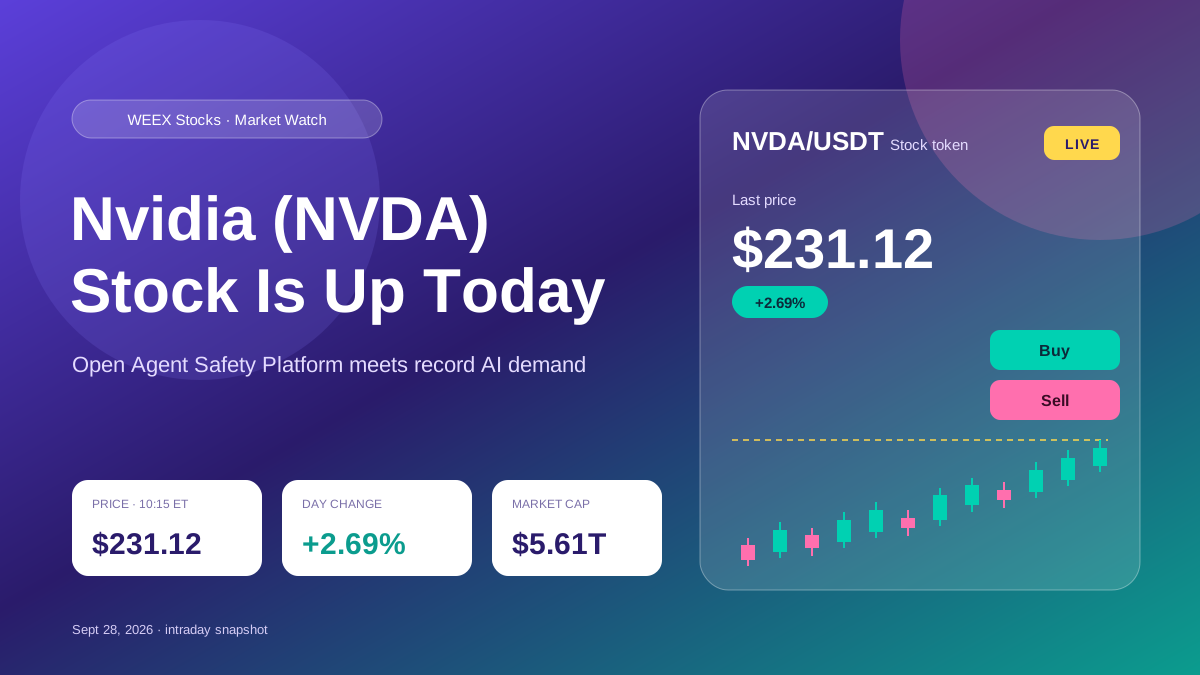
Why Is Nvidia (NVDA) Stock Up Today? New AI Agent Safety Platform Fuels the Rally
Why is Nvidia stock up today? Explore the AI agent safety launch, Nvidia’s growth outlook, key risks and how the NVDA token works on WEEX.
PCE Set the Tone This Week | WEEX TradFi Daily Brief (September 28, 2026)
Global markets on September 28 enter a data and earnings window. On September 25 ET the S&P 500 rose 0.51% to 7,743.41, the Nasdaq 0.48% and the Dow 0.93%. Information technology and semiconductors outperformed; energy lagged as oil eased. The 10-year yield is about 5.15% and the 30-year about 5.5%, with October hike odds around 64%–66%. Bitcoin last traded near $84,500. Investors wait on September 30 ET PCE and Micron guidance.
PCE and Payrolls are coming |WEEX Weekly Market Hotspot (September 28-October 2, 2026)

ONDO Tokenized Smart-Portfolio Narrative Builds| WEEX TradFi Daily Brief (September 25, 2026)
Global markets on the morning of September 25 Beijing time focus on rate pricing and a split in AI infrastructure. On September 24 ET the S&P 500 was near 7,704 and almost unchanged, the Nasdaq edged higher and the Dow fell 0.31%. The 10-year yield rose to about 5.18% and the 30-year to about 5.47%. Bitcoin last traded around $84,400.

Oracle Stock vs. KRAFTON Stock: Why Are Investors Questioning Two Growing Companies?
Compare Oracle and KRAFTON stocks through their latest results, share-price questions and the different growth tests investors face in 2026.

Bitcoin Pulls Back From $87,000| WEEX TradFi Daily Brief (September 24, 2026)
Bitcoin pulled back from about $87,000 to about $84,000, with Ethereum near $2,680. S&P Global PMI on September 23 ET far exceeded forecasts. The 10-year yield broke above 5.00%, while the 5-year and 30-year touched highs last seen in 2007 and 2004. The S&P 500 and Nasdaq slipped. Energy moved with oil and crypto-treasury stocks followed bitcoin lower. Investors await earnings from COST, BB, and others.
Tech Rebounds; Bitcoin Holds $81,000–$82,000 Support| WEEX TradFi Daily (October 20, 2026)
On October 19, tech rebounded. The three major indexes were mixed, with the Nasdaq relatively stronger. Intel rose after a JPMorgan upgrade, and SpaceX closed up more than 2%. Bitcoin traded near $81,000–$82,000, a zone traders viewed as strong support and a local bottom. Worldcoin (WLD) rose more than 10% in 24 hours, leading majors. October 20 focus includes earnings from SPCX and other listed names.
Bitcoin Ranges After Weekly Low Sweep| WEEX TradFi Daily(October 19, 2026)
Early on October 19, equity futures rebounded from last week’s chip selloff. Major indexes closed lower last week, the Nasdaq posted its worst week since June, the semiconductor ETF fell about 10%, and CoreWeave lost about 25%, while energy stocks were relatively resilient. Bitcoin traded near $82,000 after sweeping lows around $80,000, with markets watching the $79,800 and $83,600 zones.
Fed Blackout, GTC and Tech Earnings | WEEX Weekly Hotspot Preview (2026.10.19-10.23)
This WEEX weekly preview focuses on the Fed blackout period, a crypto-regulation deadline, NVIDIA GTC Berlin, major tech earnings, Flash PMI, and final consumer sentiment. After last week’s tech-stock pullback, markets will trade AI expectations, earnings guidance, yield moves, and risk appetite more directly, with QQQ, SPY, BTC, ETH, NVDA, TSLA, META, IBM, LRCX, and AXP likely to see more active volatility.
CPI, PPI and TSMC Earnings Recap | WEEX Weekly Market Recap (2026.10.12-10.16)
WEEX Weekly Market Recap focuses on CPI, PPI, TSMC earnings, AI financing pressure, BTC’s key support, the PYTH buyback narrative, L2 and privacy-token rotation, and crypto-finance strength. Risk assets first pulled back on oil, inflation, and AI valuation pressure, then rebounded quickly after the market digested the PPI shock.
Stocks and Crypto Rebound After Hot PPI | WEEX TradFi Daily Brief (October 16, 2026)
On October 15, September PPI rose 6.3% year on year, the highest in more than four years, briefly lifting hike expectations and triggering a short drop in equities and crypto. After the market digested the print, risk assets rebounded from the sell-off and the three major indexes closed higher. Bitcoin briefly broke below $80,000 and recovered to the $82,000–$83,000 range. CoreWeave fell sharply on bond pressure and then closed higher, while crypto-finance stocks and some L2 tokens strengthened. October 16 focus turns to industrial production and import-export prices.
Hot CPI Lifts Hike Bets; Risk Assets Pull Back | WEEX TradFi Daily(October 15, 2026)
Major indexes closed lower on October 14, with the Nasdaq leading the decline. September unadjusted CPI rose to 3.7% year on year, above forecasts, and core CPI also beat expectations. Traders sharply raised this month’s hike probability to about 43.7% and fully priced two more hikes by the end of January. Chip stocks were sold again. Bitcoin broke below $83,000 and last traded near $81,700, while spot gold and silver fell. Crypto-related stocks were under pressure, but PYTH rose against the tape. October 15 brings PPI, retail sales and key


