
SPY, QQQ, and TQQQ: Three Equity ETFs, Three Different Investment Logics

 Prefer us on Google
When investing in equities, many people first encounter SPY, QQQ, and TQQQ. These three ETFs are all related to large technology and leading companies, but their underlying assets, risk levels, and suitable use cases are different.
The key to understanding their differences is not memorizing ticker symbols, but distinguishing three questions: what they invest in, where returns come from, and under what conditions risk may be amplified.
SPY: Using One ETF to Allocate to Large Companies
SPY, formally known as the SPDR S&P 500 ETF, tracks the S&P 500 Index.
The S&P 500 Index consists of about 500 large listed companies and covers multiple sectors, including technology, financials, healthcare, industrials, consumer goods, and energy.
Therefore, buying SPY is not about judging whether a single company will rise. It is more like allocating to the overall development of large companies. Economic expansion, corporate earnings growth, and higher capital market valuations may all become sources of SPY’s long-term returns.
An important feature of SPY is diversification. Even if individual companies perform poorly, other companies in the index may provide some balance. However, diversification does not mean there is no risk: when the overall equity market declines, SPY may also experience drawdowns.
For investors who want long-term participation in the equity market without frequently selecting individual stocks, SPY is often viewed as a basic allocation tool.
Trade now: https://www.weex.com/stocks/SPY-USDT
QQQ: A More Concentrated Bet on Technology and Growth Stocks
QQQ, formally known as the Invesco QQQ ETF, tracks the Nasdaq-100 Index.
Compared with the S&P 500, the Nasdaq-100 Index is more tilted toward large non-financial companies listed on Nasdaq, with higher weights in technology, communication services, and consumer discretionary sectors. Companies such as major technology platforms, semiconductor firms, internet businesses, and electric vehicle companies often have a noticeable impact on QQQ’s performance.
This means that although QQQ and SPY both hold many well-known companies, their styles are different. SPY is closer to a broad representation of the large-cap equity market, while QQQ is more concentrated in technological innovation and growth companies.
When themes such as artificial intelligence, semiconductors, cloud computing, and internet platforms are favored by the market, QQQ may often perform strongly. Conversely, when interest rates rise, market concerns over high valuations increase, or earnings expectations for the technology sector weaken, QQQ’s volatility is usually more pronounced than that of more diversified broad-based indexes.
It can be understood this way: SPY is for “allocating to large-cap equities,” while QQQ is for “increasing exposure to technology growth stocks.”
Trade now: https://www.weex.com/stocks/QQQ-USDT
TQQQ: Not a “Stronger QQQ,” but a Leveraged Tool
TQQQ, formally known as ProShares UltraPro QQQ, is a triple-leveraged ETF. Its objective is not simply to track the Nasdaq-100 Index, but to seek approximately three times the daily performance of the Nasdaq-100 Index.
For example, if the Nasdaq-100 Index rises 1% in a day, TQQQ’s target performance is about +3%; if the index falls 1% in a day, TQQQ’s target performance is about -3%.
The keyword most easily overlooked here is: daily.
Many investors may mistakenly believe that if the Nasdaq-100 Index rises 10% in a year, TQQQ will definitely rise 30%. In reality, this is not the case. TQQQ adjusts its leverage exposure every day, so long-term returns are affected by the daily path of gains and losses.
Assume the index falls 10% on the first day and rises 11.1% on the second day, roughly returning to its original level after two days. However, the corresponding triple-leveraged product may fall about 30% on the first day, and even if it rises about 33.3% on the second day, it may still struggle to fully return to its original net asset value. The more violently the market fluctuates, the more obvious this “volatility drag” may become.
Therefore, TQQQ should not simply be understood as “QQQ with higher long-term returns.” It is a high-volatility, high-risk leveraged trading tool, more suitable for investors who fully understand how it works and can withstand significant drawdowns.
Trade now: https://www.weex.com/stocks/TQQQ-USDT
| ETF | Main Tracking Target | Investment Style | Risk Characteristics |
|---|---|---|---|
| SPY | S&P 500 Index | Large-cap stocks, relatively diversified across sectors | Relatively diversified, but still affected by the overall equity market |
| QQQ | Nasdaq-100 Index | Higher weight in technology and growth stocks | Higher sector concentration and usually greater volatility |
| TQQQ | About 3x the daily performance of the Nasdaq-100 Index | Leveraged trading tool | Volatility and drawdowns are amplified, with volatility drag |
How to Understand Their Positioning
From an asset allocation perspective, SPY, QQQ, and TQQQ are not simply arranged from low risk to high risk.
The core value of SPY is broad allocation to large companies; the core value of QQQ is increasing exposure to technology and growth sectors; the core of TQQQ is amplifying short-term market movements through leverage.
Therefore, when choosing among them, investors should focus on their own goals and risk tolerance, rather than only comparing which one rose more during a certain past period. Long-term investors need to pay more attention to whether their assets are sufficiently diversified, whether they can withstand drawdowns, and whether the product can be held over the long term. Investors using leveraged ETFs need to additionally understand daily rebalancing, path dependency, and the risks of extreme market conditions.
ETFs can reduce the difficulty of selecting individual stocks, but they cannot eliminate market risk. The more attractive a product’s potential returns appear, the more important it is to first understand the risk mechanisms behind it.
This content is provided for general informational purposes only and doesn't constitute financial, investment, legal, or tax advice. Any events, rewards, online promotions, or related information mentioned herein should not be considered a recommendation, solicitation, or invitation to purchase, sell, trade, or otherwise deal in any crypto assets. Crypto assets are highly volatile and may result in loss. The availability of WEEX services, products, and related events may vary by region. You are responsible for ensuring that your participation is in accordance with applicable local laws and regulations.
You may also like

Single-Stock 2x Long Semiconductor ETF Guide: INTW, MUU, and MVLL
INTW, MUU, and MVLL are single-stock leveraged ETFs tied to Intel, Micron Technology, and Marvell Technology. They aim to deliver about 2x the daily positive performance of the corresponding stock, making them short-term, high-risk tools rather than ordinary long-term semiconductor ETFs.

Energy and Industrial Metals ETF Guide: USO, UNG, URA, and COPX
USO, UNG, URA, and COPX all relate to energy or industrial metals, but their structures differ significantly. USO and UNG mainly use futures contracts, while URA and COPX mainly hold related company stocks, so their risks may come from very different sources.
Precious Metals ETF Guide: What Are the Differences Between IAU, SLV, PPLT, and PALL?
IAU, SLV, PPLT, and PALL are all precious metals ETFs, but they track different metals and follow different price drivers. Gold is more tied to safe-haven and monetary demand, silver combines precious metal and industrial demand, while platinum and palladium are more closely linked to auto and industrial cycles.
A Guide to Semiconductor ETFs: SOXL, SOXS, SMH, and SOXX
Semiconductor ETFs cover the semiconductor value chain, including chip design, manufacturing, equipment, and memory, offering diversified exposure to the sector.SMH and SOXX are unleveraged ETFs, while SOXL and SOXS are daily 3x leveraged products for bullish and bearish exposure, with greater risks from volatility, compounding, and holding periods.
$BTC at $84K, Institutions Buying SOL & TradFi Heating Up: What WEEX Daily Lucky Eggs S2 Offers Traders

WEEX AI Wars II: Round 3 Recap — Humans Owned the Leaderboard. AI Won the War.
Round 3 of WEEX AI Wars II delivered the first reversal of the season: Team Human held every Top 10 seat, but Team AI took the round. Here's the full breakdown, and how to join Round 4's live 25,000 USDT prize pool.

The WEEX License Story: Why ISO/IEC 27001 Certification Is the Proof Behind Every Security Claim
From a BSP license in El Salvador to a global ISO/IEC 27001 certification — here's what's actually being verified, and why it matters

WEEX Trade & Win Ends Sept 27: Join the Sept 29 GoGoGo Live & Apple Prize Draw

SAGA Price Prediction 2026: Can the Token Reach $0.05?
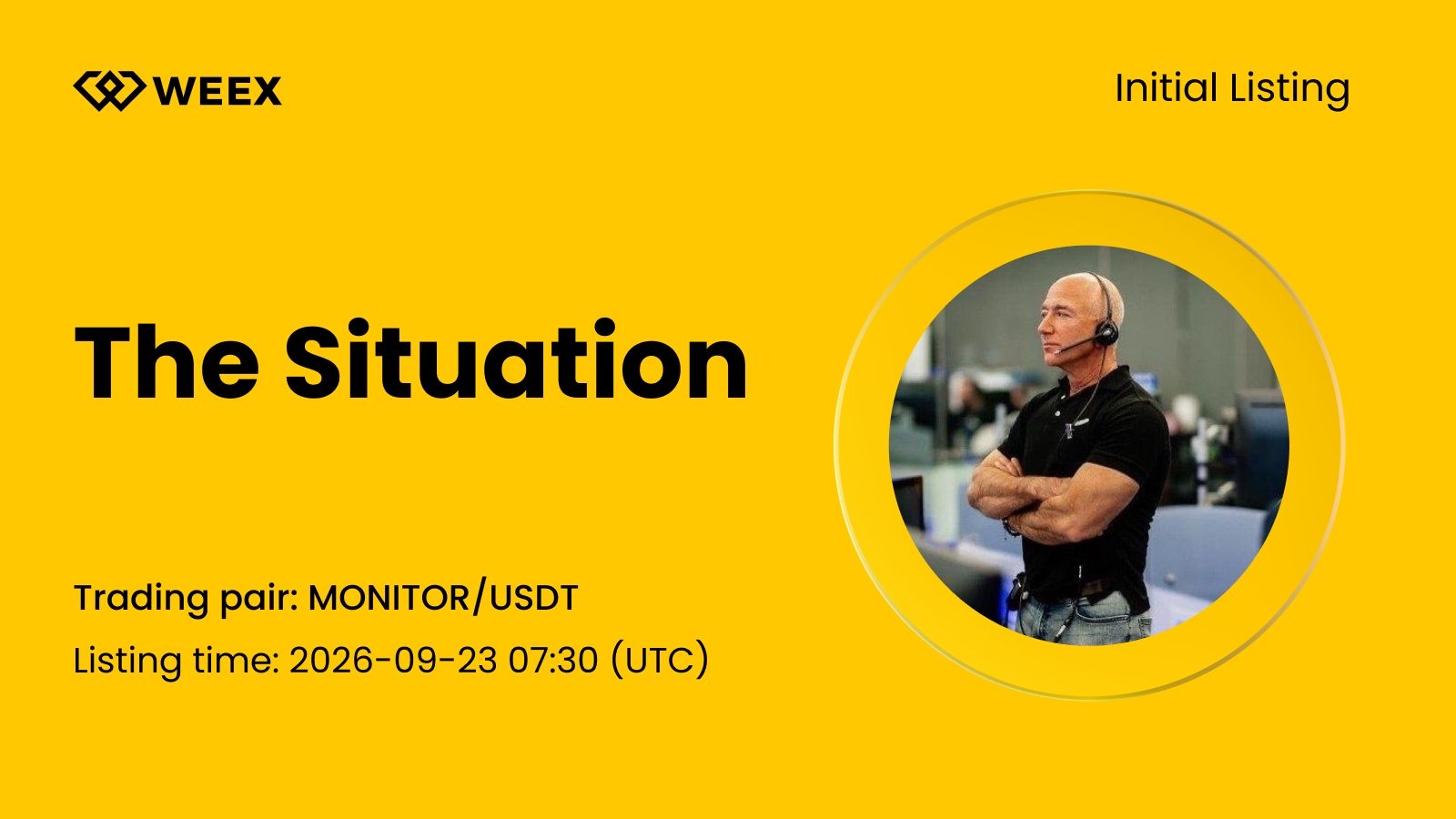
MONITOR Price Prediction 2026: Can The Situation Reach $0.01?
MONITOR Price Prediction 2026: Explore The Situation crypto price trends, Robinhood Chain meme narrative, technical analysis, and whether MONITOR can reach $0.01.

Can SOXL Reach $160 as AI and Semiconductor Stocks Rally?

Can PEPE Reach $0.000006 as Meme Coin Momentum Returns?

Uniswap (UNI) Price Jumps Toward $10 as CME Futures Launch Nears: What Traders Need to Know
Can SPX Reach $0.60 as Risk Appetite Returns to Meme Coins?
Can SPX reach $0.60 as meme coin momentum returns? Explore SPX6900 price levels, market catalysts, risks, and how to trade SPX on WEEX.

Can UNI Reach $12 After CME Announces Uniswap Futures?
Can UNI reach $12 after CME announces Uniswap futures? Explore UNI price levels, market catalysts, risks, and how to buy and trade UNI on WEEX.
SEC Clarity Meets Fed Rate Hike: How WEEX TradFi Lucky Eggs S2 Taps Into Cross-Market Opportunities

Can Bitcoin Reach $90K After $999M in ETF Inflows?
Can Bitcoin reach $90K after $999M in spot ETF inflows? Explore BTC price levels, ETF demand, market risks, and how to trade Bitcoin on WEEX.
Can DGrid AI Break Above $1? DGAI Price Prediction 2026
Can DGrid AI break above $1 in 2026? Explore DGAI price trends, AI inference growth, key support and resistance levels, risks, and how to trade DGAI on WEEX.

Bitcoin Reclaims $85K: ETF Flows Return as BTC Momentum Builds
Bitcoin has reclaimed $85,000 as spot ETF flows turn positive and institutional demand returns. Here’s what is driving BTC’s rebound, what WEEX traders should watch next, and why liquidity and execution matter in a fast-moving market.
WEEX AI Wars II: Round 2 Recap — Humans Just Broke the Leaderboard (Literally)
Round 2 of WEEX AI Wars II has closed, and Team Human didn't just win again — they posted returns north of 50,000%. Here's the full breakdown, how the gap to Team AI widened even further, and how to join Round 3's live $20,000 USDT prize pool.

WEEX Attains ISO/IEC 27001:2022 Certification, Reinforcing Its Commitment to World-Class Security
This certification highlights the rigorous information security management system WEEX has built to protect its 10 million users across every market it offers.
Can GSTOCK Reach $25M After Its 190x BNB Chain Rally?
What Is GSTOCK? How to Buy Gstock After Its 190x BNB Chain Rally

Can ONDO Reach $0.50 as RWA Grows? How to Buy ONDO in 2026

Can UNI Reach $10 as Tokenized Stock AMMs Gain Traction?

Fed Hikes Rates to 4% for the First Time in Three Years — And Why WEEX's "One Account, All Markets" Is Built for This Exact Moment
A hawkish dot plot, a Wall Street sell-off, a chip-stock split — and one platform where you don't have to choose between crypto and TradFi
Why Is Bitcoin Reacting to the September 2026 Fed Rate Hike?
Why did Bitcoin hold near $76,000 after the September 2026 Fed rate hike? See how expectations, yields, the dollar, and liquidity shaped BTC.

Can Dell Stock Reach $650 After Its Record-Breaking AI Rally?
Can ARB Reach $0.20 as Robinhood Chain Drives Arbitrum Growth?

The Fed Hikes Rates 25 Basis Points to 3.75%–4% — Here's What It Means for Bitcoin's Next Move
Kevin Warsh's inflation warning, a more hawkish dot plot, and three roads ahead for crypto
Single-Stock 2x Long Semiconductor ETF Guide: INTW, MUU, and MVLL
INTW, MUU, and MVLL are single-stock leveraged ETFs tied to Intel, Micron Technology, and Marvell Technology. They aim to deliver about 2x the daily positive performance of the corresponding stock, making them short-term, high-risk tools rather than ordinary long-term semiconductor ETFs.
Energy and Industrial Metals ETF Guide: USO, UNG, URA, and COPX
USO, UNG, URA, and COPX all relate to energy or industrial metals, but their structures differ significantly. USO and UNG mainly use futures contracts, while URA and COPX mainly hold related company stocks, so their risks may come from very different sources.
Precious Metals ETF Guide: What Are the Differences Between IAU, SLV, PPLT, and PALL?
IAU, SLV, PPLT, and PALL are all precious metals ETFs, but they track different metals and follow different price drivers. Gold is more tied to safe-haven and monetary demand, silver combines precious metal and industrial demand, while platinum and palladium are more closely linked to auto and industrial cycles.
A Guide to Semiconductor ETFs: SOXL, SOXS, SMH, and SOXX
Semiconductor ETFs cover the semiconductor value chain, including chip design, manufacturing, equipment, and memory, offering diversified exposure to the sector.SMH and SOXX are unleveraged ETFs, while SOXL and SOXS are daily 3x leveraged products for bullish and bearish exposure, with greater risks from volatility, compounding, and holding periods.
$BTC at $84K, Institutions Buying SOL & TradFi Heating Up: What WEEX Daily Lucky Eggs S2 Offers Traders
WEEX AI Wars II: Round 3 Recap — Humans Owned the Leaderboard. AI Won the War.
Round 3 of WEEX AI Wars II delivered the first reversal of the season: Team Human held every Top 10 seat, but Team AI took the round. Here's the full breakdown, and how to join Round 4's live 25,000 USDT prize pool.
Contents
Latest articles


Latest coin listings on WEEX


