
They Thought They Were Talking to Apple: $195,000 in Cryptos Vanished in Singapore

 Prefer us on Google


A pop-up window, a call, and the wallet empties. The Singapore Police Force has issued a public alert regarding a scam impersonating Apple to siphon cryptocurrencies. At least five victims have been reported, with over 195,000 Singapore dollars going up in smoke (nearly 130,000 euros), and a modus operandi that requires no technical prowess: a well-placed notification, a reassuring voice on the phone, a six-digit code extracted at the right moment.
The Singapore police statement cites two domain names used by the scammers, << chat-apple.com >> and << case-apple.com >>, as well as a recurring phone code: << +1 >>, that of North America.
Key Points {#h-key-points}
- At least five victims in Singapore and over 195,000 Singapore dollars in cryptos stolen through an impersonation of Apple support.
- The scenario combines fake security notification, calls from a << +1 >> code, and fake sites << chat-apple.com >> and << case-apple.com >>.
- The compromised Apple ID grants access to the iCloud keychain and notes, where many imprudently store their seed phrase.
- Passkeys, whitelisting withdrawal addresses, and offline key storage cut the chain before the transfer.
A notification, a call, and the mechanism closes {#h-a-notification-a-call-and-the-mechanism-closes}
It all starts with an unexpected alert on the victim's Apple device: unauthorized access attempts have targeted their account, and they need to change their Apple ID password without delay. Moments later, the phone rings. On the line, a supposed technician from Apple support confirms the bad news and takes control of the conversation.
The victim is then directed to one of the fake support sites, where they are asked for their Apple credentials, those of their crypto account, and then the famous OTPs (One-Time Passwords, these one-time codes meant to validate each sensitive operation). With this complete keychain, the scammers log into the linked trading accounts or wallets and transfer the funds in a matter of minutes. Most victims only realized what had happened when they discovered the history of outgoing transactions.
The detail of the << +1 >> code is not trivial. In Singapore, all incoming calls from abroad are marked by a << + >> displayed before the number, a measure imposed on operators specifically to defuse this type of impersonation. A safeguard that weighs little when the screen has just displayed a security alert and the interlocutor speaks the language of technical support.
<< Apple will never ask you to provide your Apple ID password, your one-time codes, or any other login identifiers via unsolicited phone calls, pop-up windows, or links. Never disclose this information to anyone. >>
Public Affairs Department, Singapore Police Force -- Source
The Apple ID, this master key that scammers covet {#h-the-apple-id-this-master-key-that-scammers-covet}
No line of blockchain code was forced in this case. The attackers target the layer before: the user account and its owner. A compromised Apple ID opens access to the iCloud keychain, synchronized notes, and the photo library. This is exactly where many investors, for convenience, store a screenshot of their seed phrase or a note containing their twelve words. Once the Apple ID falls, the wallet follows without resistance.
The OTP layer remains the last lock before withdrawal. It does not yield to a cyber attack, but rather to a well-conducted phone conversation: the victim themselves dictates the code that authorizes the transfer. And unlike credit card fraud, no chargeback procedure will rectify the mistake. A confirmed on-chain transfer is final, making these accounts a far more lucrative target than a checking account.
Singapore is not new to alerts. The city-state recorded over 51,000 cases of fraud in the year 2024 alone, with approximately 1.1 billion Singapore dollars stolen, a record. The Parliament responded with the Protection from Scams Act, which allows the police to temporarily freeze the banking operations of a person deemed to be under duress. This is an effective tool against a bank transfer, but significantly less so against a crypto withdrawal executed from a platform located on the other side of the world.
ADD, CHECK, TELL: Police Recommendations
The Singaporean police outline their recommendations in three steps, summarized by the acronym ACT:
- ADD: Install the government app ScamShield to block fraudulent calls, enable two-factor authentication on the Apple ID and all crypto accounts, and set transaction limits when the option exists.
- CHECK: Verify the legitimacy of any call, pop-up window, or link through official Apple channels, and monitor wallet activity via the provider's app, never through a received link.
- TELL: Inform your crypto service provider, your relatives, and the police via the line 1800-255-0000 or the iWitness portal.
A few additional adjustments close the door even earlier. Replacing SMS OTP with a passkey or a physical security key removes the very object of the scammers' call, as there is no longer a code to dictate. Activating the withdrawal address whitelist on your exchange, with a 24 to 48-hour grace period applied after any addition or connection from a new device, allows time to react. And a seed phrase has no place in the cloud, a note, or a photo: its place remains an offline medium, ideally a hardware wallet.
A single point of reference is often enough to stop everything: Apple support only exists on apple.com and support.apple.com, and they never call first to request an identifier. << chat-apple.com >> and << case-apple.com >> have never belonged to the Cupertino firm. In case of doubt, the ScamShield line 1799 is available 24/7, and the portal scamshield.gov.sg lists the circulating variants.
-- Price
This content is provided for general informational purposes only and doesn't constitute financial, investment, legal, or tax advice. Any events, rewards, online promotions, or related information mentioned herein should not be considered a recommendation, solicitation, or invitation to purchase, sell, trade, or otherwise deal in any crypto assets. Crypto assets are highly volatile and may result in loss. The availability of WEEX services, products, and related events may vary by region. You are responsible for ensuring that your participation is in accordance with applicable local laws and regulations.
You may also like
Bitcoin Spot Demand: The Signal That Hadn't Reappeared Since the October 2025 Record

Vietcombank Warns of AI-Driven Fraud
$1 Billion in 48 Hours: X Prepares Crypto Trading Function on Feed

The forex complex: How retail traders are adapting to volatile 2026 markets

Trump Beats the Fed: How Trading Boom Explodes in the UAE
Crypto investors should favor systematic strategies over Fed predictions, Moon Pursuit Capital says

Crypto: Solana ETFs Record Their Biggest Day of the Year

Xbox and PlayStation Reassess Their Multiplatform Strategy, Emphasizing Exclusivity Again

Interview: Aptos CEO on AI Agents, Stablecoins, and Machine Commerce
BlackRock Lowers Minimum Investment for Bitcoin ETF to $1 Million
Previously Bearish on Crypto Market, Jiang Zhuoer Quickly Turns Bullish: Ethereum is the Engine of the Bull Market

Michael Saylor Targets Bitcoin Orthodoxy: 'Satoshi Is Not a Prophet'

Strive by Vivek Ramaswamy Becomes the 7th Largest Public Holder of Bitcoin

The Best AI Models for Trading: A Comparison of the Top 10 Models
Enflame, the Chinese competitor of Nvidia in AI chips, goes public

AI is in a Credit Expansion Phase: The Stronger AI Becomes, the More the Federal Reserve Needs to Cut Rates
Short-Term U.S. Treasury Holdings Decrease by $29 Billion, Testing Demand for Stablecoins

Analysis of Mining Machine Asset Depreciation and Tax Cost Recovery
Bitcoin Transfer by Metaplanet: Sale or Just Custody on Coinbase?
Opinion: The Bull Market Has Arrived, How to Position in This Cycle?
80% of Gas Stations in Russia Face AI-95 Gasoline Shortage
Bitcoin Bull Run: Arthur Hayes Sees Crypto Market Soaring Higher

Goldman Sachs Optimistic About Crypto Brokerage Trading Platforms: Can the Market Support a New Cycle?
Strive CEO: The Bitcoin Bull Market Has Just Begun, ASST Has Passed Its Bottom
Ravencoin (RVN) Price Forecast for 2026–2050

AI Agent's 'Coming of Age': What Step Is Missing from Simulation Training to Real Trading?
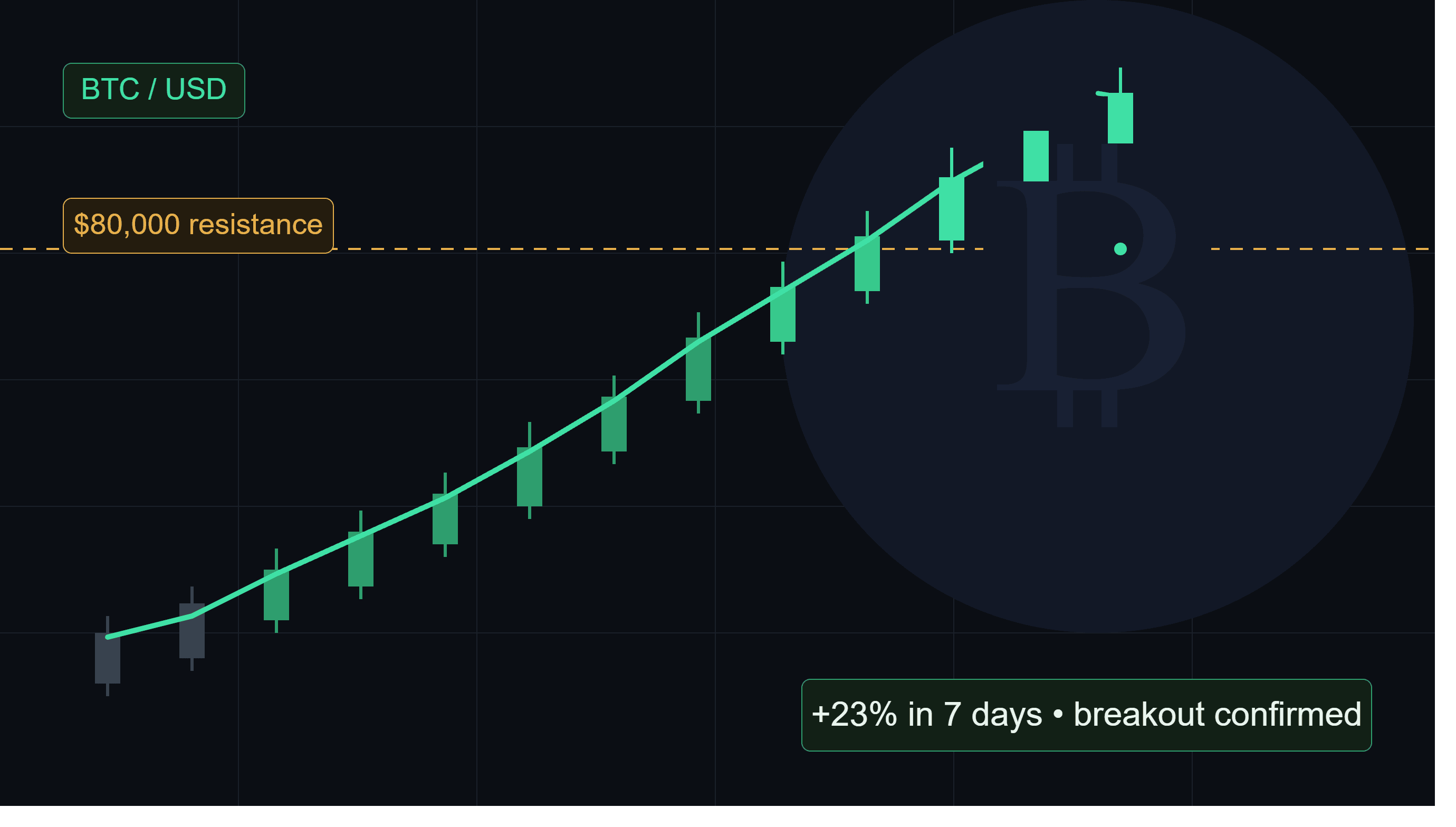
Bitcoin Just Hit $80,000: Last Week WEEX's Prediction Came True — What's Next?
Bitcoin hit $80,000 as WEEX predicted last week. See what drove the breakout, current key levels, and whether $90,000 is next.
Mining Artificial Intelligence: Why Bitcoin Miners Are Changing Their Business Model
CFTC Considers the Viability of Perpetual Futures in GPU Computing
Bitcoin is once again being 'buried' on social media: what this could mean for its price
Bitcoin Spot Demand: The Signal That Hadn't Reappeared Since the October 2025 Record
Vietcombank Warns of AI-Driven Fraud
$1 Billion in 48 Hours: X Prepares Crypto Trading Function on Feed
The forex complex: How retail traders are adapting to volatile 2026 markets
Trump Beats the Fed: How Trading Boom Explodes in the UAE
Crypto investors should favor systematic strategies over Fed predictions, Moon Pursuit Capital says