
Wall Street Morning Briefing: Middle East Tensions Ease and AI Rebound Boosts U.S. Stocks, Can Nvidia Break the Earnings Drop Curse?

 Prefer us on Google


Every Monday to Friday morning, we focus on macroeconomics, U.S. stocks, AI, precious metals, and crude oil, using data to review the market and trends to seize opportunities, produced by PANews.
Middle East Tensions Ease, WTI Crude Falls Below $80
All three major U.S. stock indices closed higher, with the Dow Jones Industrial Average up 0.30%, the S&P 500 up 0.32%, and the Nasdaq Composite up 0.66%, leading the indices.
The most significant change in the market last night was the sudden easing of risks in the Middle East. Russian media reported that the U.S. and Iran have reached a consensus on ceasefire terms, which include free navigation in the Strait of Hormuz, with both sides expected to announce and initiate negotiations based on a memorandum from Islamabad in the coming days. Additionally, Iran and Oman have reached a temporary agreement on shipping routes, allowing only commercial vessels to pass while prohibiting military ships, with plans to discuss a permanent solution within 30-60 days.
The Iranian Deputy Foreign Minister also denied U.S. claims that "mines have been cleared from the strait," reiterating that the reopening of the strait is contingent upon a complete end to the conflict in Lebanon, lifting the blockade, and resolving the Yemen issue, demanding that the U.S. fulfill all commitments; otherwise, the strait will remain closed. Oil prices plummeted in response, with WTI crude falling 4.57% to below $80; Brent crude dropped over 5% to below $85.
Falling Oil Prices Combined with Weak Economic Data Provide Relief for U.S. Treasuries
The decline in oil prices directly alleviates inflation concerns, while U.S. consumer confidence fell to 89.4 in August, a seven-month low, and July new home sales were also weaker than expected, leading the market to further bet on cooling domestic demand. The yield on the 10-year U.S. Treasury bond fell about 7 basis points to around 4.62%, while the 30-year yield also dropped about 6 basis points to around 5.17%.
The impact of Treasury Secretary Yellen's expanded long-term bond repurchase plan is also beginning to take effect. Since the announcement of the plan, U.S. Treasuries have performed significantly better than interest rate swaps of the same maturity, with the spread between the 30-year Treasury and swaps narrowing to its lowest level since February of this year, leading the market to view the Treasury as a potential "put option" for long-term bonds.
However, this bond rally remains controversial. Stanley Druckenmiller, a billionaire investor and early mentor of Yellen, publicly criticized the expansion of long bond repurchases, arguing that the Treasury should not artificially suppress yields, as the real drivers of rising long-term rates are the U.S. structural fiscal deficit, debt levels, and inflation above targets. His core warning is that if the government continues to defend bond prices, it may ultimately erode the long-term credibility of the U.S. Treasury market.
Thus, the current long bond rally appears more like a "policy floor + falling oil prices + weak data" phase of repair rather than a fundamental change in the U.S. fiscal outlook. The 10-year yield remains above 4.6%, and the 30-year is still close to 5.2%, with long-term risks far from disappearing.
Gold Remains High, Copper Prices Hit Record, Trade War Heats Up
Gold has not shown a significant pullback but has instead seen a slight increase. Spot gold touched $4,697 during trading, closing up 0.15%; on August 26, during the Asian morning session, New York gold briefly rose to around $4,730. Silver and gold stocks also strengthened, with Coeur Mining, Kinross Gold, and Endeavour Silver rising over 3%, while Newmont and AngloGold Ashanti rose over 2%.
Among commodities, copper performed even stronger. COMEX copper rose 1.67%, hitting a new closing high; LME copper also set a record. Potential U.S. tariffs on copper have led to an early concentration of inventory in the U.S., tightening LME spot supply, while demand from AI data centers, power grids, electrification, and defense continues to provide long-term support.
Additionally, the trade war is heating up. Canada announced that starting September 8, it will impose tariffs of 15%-50% on approximately $20 billion worth of U.S. goods, with steel and aluminum tariffs rising to 50%, including motorcycles, home appliances, food, clothing, video game consoles, and smartphones. The White House is also discussing further countermeasures against Canada.
AI Hardware Sees Technical Rebound, Storage and Optical Communication Lead, Energy Under Pressure
Risk appetite in U.S. stocks overnight concentrated on the AI hardware sector, with the AI-related ecosystem in the S&P 500 rising over 1%. Excluding AI concepts, the S&P 500 was nearly flat, as funds reallocated to semiconductors, storage, optical communication, and computing infrastructure ahead of Nvidia's earnings report.
Nvidia rose 2.19%, ending a seven-day losing streak. The company launched the Jetson Orin Nano 2 robotic computer, aimed at robotics, drones, and edge AI applications, with inference performance doubled compared to the previous generation and lower power consumption.
Market focus has shifted to Nvidia's second-quarter earnings report, which will be released after the market closes tonight. The market generally expects revenue to reach $92 billion to $92.3 billion, nearly doubling year-on-year. Investors are not only looking to see if it can exceed expectations but are also concerned about gross margins, China business, next-generation chip progress, and whether AI demand can continue to support valuations. Mark Malek, Chief Investment Officer at Siebert Financial, stated that Nvidia's business is now operating at full speed, but the issue is that the market has already anticipated strong performance, so "good" may not be enough, and any flaws could trigger volatility.
The financing scale for AI infrastructure continues to grow uncontrollably. Morgan Stanley data shows that the five largest cloud providers, along with Nvidia and Broadcom, have collectively committed over $3.1 trillion for third-party AI infrastructure construction through guarantees, leases, and procurement commitments; among them, Google has committed $890 billion, with the overall un-discounted commitments from cloud providers exceeding $2.7 trillion, approaching their operating cash flow for the next three years.
Another main line in the AI sector is the rising prices of storage. South Korean DRAM export prices surged 401% year-on-year in August, as AI servers require a large amount of HBM high-bandwidth memory, squeezing ordinary DRAM production capacity. Goldman Sachs predicts that the DRAM supply gap will widen from 5.0% this year to 5.9% next year. TrendForce also warns that by 2027, DRAM and NAND may account for 68% of major cloud providers' capital expenditures, with server DRAM prices expected to cumulatively rise about 270% by 2026, and HBM may rise another 70%-140% by 2027. This means that the bottleneck for AI servers is spreading from GPUs to memory, packaging, power, and optical communication.
Specific Project Actions and Stock Price Fluctuations:
Nvidia rose 2.19%: Launched the new entry-level robotic computing platform Jetson Orin Nano 2 ahead of earnings, with inference performance doubled, extending computing capabilities to edge AI and robotics. This move ended the stock's previous seven-day decline.
The optical communication sector led the gains last night: Lumentum rose nearly 7%, Applied Optoelectronics rose over 5%, and Coherent, Mellanox Technologies, and Ciena rose over 4%.
AMD surged 4.91%: Wall Street firm Raymond James upgraded its rating directly to "Strong Buy," raising the target price from $565 to $641, optimistic about its opportunities in the AI server CPU market.
Micron rose 2.48%: Despite Micron's CEO recently disclosing a $38.8 million stock sale, the market remains bullish under Goldman Sachs' forecast that the global memory shortage will continue until 2028. Among related storage stocks, Seagate, Western Digital, and Rambus rose over 3%.
SpaceX rose 2.19%: Announced plans to invest $100 billion to build a giant Starship launch site in Louisiana, aiming to support thousands of Starship flights annually.
Moderna surged 14.36%: Successful Phase III clinical trial of mRNA cancer therapy, Bank of America raised the target price from $40 to $170, while Piper Sandler, Goldman Sachs, JPMorgan, and Barclays also raised their target prices. Among related pharmaceutical stocks, Merck rose nearly 4%, and Pfizer rose over 2%.
Energy stocks were dragged down by falling oil prices, with Apache Corporation down nearly 4%, Occidental Petroleum and Devon Energy down nearly 3%, ExxonMobil down over 2%, and Chevron and ConocoPhillips down over 1%.
Dick's Sporting Goods (DKS) plummeted 30.68%: Second-quarter earnings fell short of expectations across the board, significantly lowering the full-year earnings per share guidance to $11-12 (previously expected at $14.2). Company executives warned that high living costs are severely suppressing the consumption capacity of American middle-class families. Among related consumer stocks, Nike fell over 3%, and Target fell 3.8%.
Large tech stocks showed divergence: Microsoft rose 0.90%, Meta rose 1.97%, and Tesla rose 0.37%; Apple fell 0.14%, Google fell 0.32%, and Amazon fell 0.39%. The market is more willing to buy companies with "clear AI growth," while remaining cautious about consumer hardware and e-commerce.
Upcoming Focus:
August 26 (Wednesday)
The Gamescom in Cologne, Germany, will be held from August 26 to 30: Companies such as Microsoft, Nintendo, Tencent, NetEase, and CDPR will make appearances. The market will pay attention to new game releases, AI gaming tools, cloud gaming, and hardware ecosystem news, which may affect sentiment in gaming, graphics cards, consoles, and content platforms.
20:30 U.S. July Core PCE and revised Q2 GDP: PCE is the inflation indicator most closely watched by the Federal Reserve. If inflation exceeds expectations, U.S. Treasury yields may rise, putting pressure on the Nasdaq; if below expectations, gold and tech stocks may receive support.
Deutsche Bank's California Technology Conference will be held from August 26 to August 27 in Dana Point, California.
The Shenzhen AGIC General Artificial Intelligence Exhibition will be held from August 26 to August 28, coinciding with the Data Expo (August 28 to August 30), with a dense schedule of AI industry conferences focusing on embodied intelligence and AI application progress.
August 27 (Thursday)
04:00 Nvidia Earnings Report: The market will focus on data center revenue, Blackwell shipments, Rubin progress, gross margins, and future guidance. If guidance is strong, the AI sector may reignite; if gross margins or order quality fall short of expectations, semiconductors may continue to adjust.
The Jackson Hole Global Central Bank Conference will be held from August 27 to August 29: Global central bank officials will discuss financial innovation, inflation, and policy paths. The market will prepare for Waller's speech in advance, and fluctuations in bonds and the dollar may be amplified.
-- Price
This content is provided for general informational purposes only and doesn't constitute financial, investment, legal, or tax advice. Any events, rewards, online promotions, or related information mentioned herein should not be considered a recommendation, solicitation, or invitation to purchase, sell, trade, or otherwise deal in any crypto assets. Crypto assets are highly volatile and may result in loss. The availability of WEEX services, products, and related events may vary by region. You are responsible for ensuring that your participation is in accordance with applicable local laws and regulations.
You may also like

Cyberattack on the ports of Marseille and La Rochelle? Hackers paid 1 dollar in crypto
![[Exclusive] Coinbase Transaction Data Shows 100 Million Trades Misrepresented... Data Analysis Firm Corrects Errors](/public-static/20_9098579959.png?format=avif)
[Exclusive] Coinbase Transaction Data Shows 100 Million Trades Misrepresented... Data Analysis Firm Corrects Errors

Wall Street Morning Report: U.S. Inflation Resurfaces, AI Credit Risks Spread, Chip Stocks Fall for Six Consecutive Days
Arthur Hayes: Focus on Established DeFi Projects with Cash Flow

Anthropic Reports $16.8 Billion Revenue in Q3, IPO Feasibility Strengthened
Hot CPI Lifts Hike Bets; Risk Assets Pull Back | WEEX TradFi Daily(October 15, 2026)
Major indexes closed lower on October 14, with the Nasdaq leading the decline. September unadjusted CPI rose to 3.7% year on year, above forecasts, and core CPI also beat expectations. Traders sharply raised this month’s hike probability to about 43.7% and fully priced two more hikes by the end of January. Chip stocks were sold again. Bitcoin broke below $83,000 and last traded near $81,700, while spot gold and silver fell. Crypto-related stocks were under pressure, but PYTH rose against the tape. October 15 brings PPI, retail sales and key
WEEX Exclusive:Hot CPI Lifts Hike Bets; Risk Assets Pull Back | WEEX TradFi Daily(October 15, 2026)

Sam Price Observes Changes in Bitcoin ETF Net Inflows

G20 warns that stablecoins may lose value even if fully backed
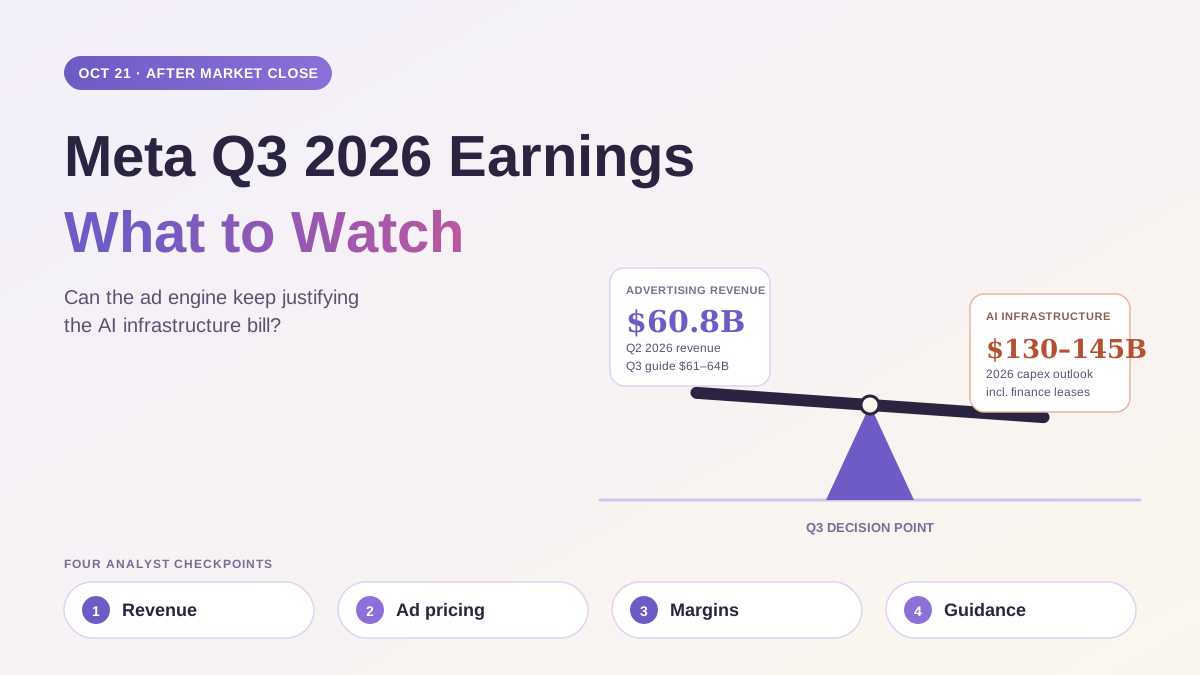
Meta Stock Earnings: What to Watch in Meta Platforms’ Q3 2026 Results
Meta reports Q3 2026 results on October 21. See the advertising, AI spending, margin, and guidance signals that could move META stock.

Starting a Business with Crypto Payments: What Changes in 2027

September CPI in the US: What Inflation Tells the Investor
Why Only 2% of $10 Billion in US Treasury Bonds Enter DeFi?

Ethereum ETF Funds Break Out of Outflow Series with Inflows of $24.8 Million

Arca: Four Investment Directions for Crypto Assets

When Will Bitcoin Surpass Its Previous High? Insights from ChatGPT, Claude, and Gemini

When Currency Becomes Programmable, the Next Stop for the Crypto Industry May Be to Rewrite Token Rules

The Hook Ecosystem Begins to Stir! Who Will Be the Next Dark Horse?
"CARF Introduced Before Virtual Asset Taxation... Need for Review of Implementation Basis"

Liquidity Structure of Domestic Cryptocurrency Exchanges and Conditions for Introducing LP – Bitplanet

Tencent Tests Personal Investment Analysis Assistant Rena, Supports WeChat Connection
Financial Stability Board Highlights Unclear Bankruptcy Laws for Stablecoin Failures

Why Most Public Chains Are Doomed to Fail, According to Real Vision Founder
The Era of Industry: Q3 2026 Virtual Asset Industry Investment Status Report – Tiger Research

Paul Tudor Jones Expects Challenges for US Stocks in 2027, Shorting US Stocks Throughout the Year While Holding Long Positions in Oil

唐华斑竹 Reports Han Lin to Speak at Oxford Union

We Overestimate the Value of Stablecoin Issuance While Underestimating the Power of Localized Financial Services
Mesh Acquires Bluvo to Accelerate Global Payment Network Development

A Generation's P2P

Ethereum Staking: Interactive Brokers Launches Service for Eligible Clients via ZeroHash
Cyberattack on the ports of Marseille and La Rochelle? Hackers paid 1 dollar in crypto
[Exclusive] Coinbase Transaction Data Shows 100 Million Trades Misrepresented... Data Analysis Firm Corrects Errors
Wall Street Morning Report: U.S. Inflation Resurfaces, AI Credit Risks Spread, Chip Stocks Fall for Six Consecutive Days
Arthur Hayes: Focus on Established DeFi Projects with Cash Flow
Anthropic Reports $16.8 Billion Revenue in Q3, IPO Feasibility Strengthened
Hot CPI Lifts Hike Bets; Risk Assets Pull Back | WEEX TradFi Daily(October 15, 2026)
Major indexes closed lower on October 14, with the Nasdaq leading the decline. September unadjusted CPI rose to 3.7% year on year, above forecasts, and core CPI also beat expectations. Traders sharply raised this month’s hike probability to about 43.7% and fully priced two more hikes by the end of January. Chip stocks were sold again. Bitcoin broke below $83,000 and last traded near $81,700, while spot gold and silver fell. Crypto-related stocks were under pressure, but PYTH rose against the tape. October 15 brings PPI, retail sales and key
Contents
Latest articles


Latest coin listings on WEEX


