
WSJ Reveals Scheme for NVIDIA Chip Supply to China Bypassing US Restrictions

 Prefer us on Google


- Jensen Huang built a network of partners in Southeast Asia to service Chinese clients, reports WSJ.
- Megaspeed organized the supply of NVIDIA chips to China worth nearly $12 billion.
- US authorities are preparing to restrict remote access for Chinese companies to advanced processors.
Former NVIDIA CEO Jensen Huang has built a multibillion-dollar business providing Chinese companies access to advanced American chips, circumventing US export restrictions. This was reported by The Wall Street Journal (WSJ).
According to the publication, Huang formed a network of partners in Southeast Asia who supplied Chinese artificial intelligence (AI) developers with computing power. At the same time, the entrepreneur lobbied for the easing of export restrictions in Washington.
In the six months leading up to July 26, 2026, NVIDIA's revenue in China amounted to $12.4 billion—7% of the total figure.
However, according to estimates from the analytical company Culper Research cited by WSJ, in the previous financial year, Chinese clients accounted for over 20% of the manufacturer's revenues, considering indirect supplies.
How Chinese Companies Gained Access to NVIDIA Chips
According to the investigation, Chinese developers used two main mechanisms—illegal importation of processors and renting computing power from foreign data centers.
In particular, from March 2024 to June 2025, the Singaporean company Megaspeed organized the supply of advanced NVIDIA chips to Chinese contractors worth nearly $12 billion.
Documents examined by journalists contain information about orders for several hundred thousand processors. However, they do not allow for determining the actual volume of supplies and the origin of the equipment.
One of the leaders of Megaspeed was Alice Huang, with whom the former head of NVIDIA was in a romantic relationship. American authorities suspect her of collaborating with Chinese intelligence.
According to WSJ sources, Huang and her business partners leveraged their connections with the head of NVIDIA to gain cloud partner status with the company. A key client for Megaspeed became Alibaba.
Megaspeed denied allegations of violating export restrictions and announced the initiation of an internal investigation involving independent lawyers.
Another way to access American technologies was through the use of foreign infrastructure. This direction is particularly active in Malaysia.
According to researcher James Chai from the Singapore Institute ISEAS—Yusof Ishak Institute, the country attracted over $34 billion in investments in data centers, mainly from American and Chinese companies.
Among the participants in this market:
- Aolani Cloud—secured funding for equipment purchases in Malaysia amounting to $2.5 billion. Its key client became ByteDance;
- DayOne—building data centers in Malaysia and Indonesia. According to sources, about 70% of the operator's business comes from ByteDance;
- Vena Group—supported by BlackRock, is building a data center in Malaysia, one of the potential users of which is Alibaba.
Huang opposed isolating the Chinese market, believing that such a policy fosters the development of NVIDIA's competitors, including Huawei.
At NVIDIA itself, it was emphasized that the US cannot win the AI race without the global spread of American technological infrastructure.
US Prepares to Tighten Export Control
The scandal surrounding NVIDIA intensified pressure on President Donald Trump's administration. Earlier, Democratic Senator Elizabeth Warren and Republican Jim Banks called on Congress to tighten restrictions on the export of advanced American processors to China.
On November 12, NVIDIA announced the resignation of Jensen Huang. The company was temporarily led by CFO Colette Kress.
According to WSJ, the US Department of Commerce is developing new rules that will impose export restrictions on Malaysia, Indonesia, and Singapore.
Suppliers of advanced processors, including Blackwell series chips, will need to obtain licenses, the conditions of which will prohibit granting Chinese clients remote access to the corresponding computing power.
The Malaysian authorities, for their part, have launched an investigation into Megaspeed and its local subsidiary regarding possible re-export of processors.
The Information journalist Jing Yang noted that against the backdrop of the scandal, Washington is moving to close one of the main loopholes that allowed Chinese companies to access Blackwell chips.
At the same time, representatives of the technology industry reacted ambiguously to Huang's resignation.
Binance founder Changpeng Zhao called NVIDIA's decision to let the CEO go a mistake.
Sequoia Capital partner Sean Maguire also emphasized the significance of Huang's contribution to the development of American innovation and the US leadership in artificial intelligence.
-- Price
This content is provided for general informational purposes only and doesn't constitute financial, investment, legal, or tax advice. Any events, rewards, online promotions, or related information mentioned herein should not be considered a recommendation, solicitation, or invitation to purchase, sell, trade, or otherwise deal in any crypto assets. Crypto assets are highly volatile and may result in loss. The availability of WEEX services, products, and related events may vary by region. You are responsible for ensuring that your participation is in accordance with applicable local laws and regulations.
You may also like

Anthropic's Wall Street Operator: CFO Krišna Rao
Stellar Bell Vote on November 23: What It Means for XLM Holders

Win an iPhone 18 Pro Max on WEEX? 201 Lucky Eggs Explained
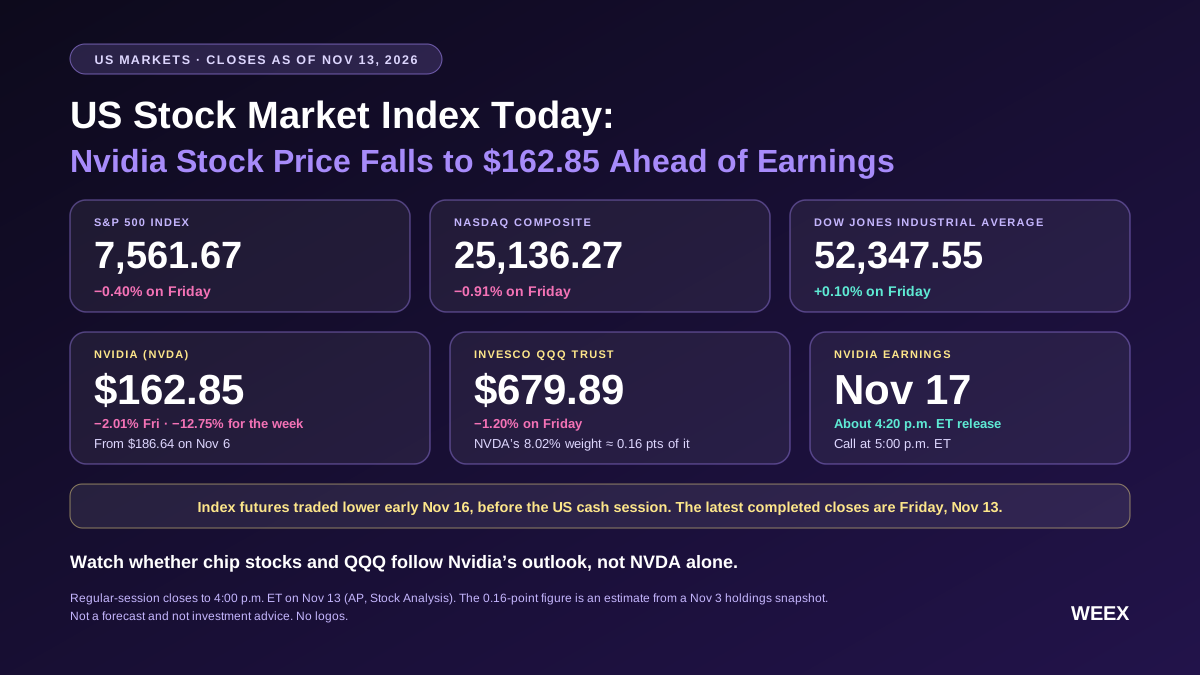
US Stock Market Index Today: Nvidia Stock Price Falls to $162.85 Ahead of Earnings(S&P 500 and QQQ )
Track US stock index futures, the S&P 500 and Dow, and see how Nvidia’s $162.85 close and November 17 earnings could shape QQQ and the broader market.
Huawei Cloud Releases Open Source CloudRobo-WM1.2 Model

Pornhub Creator Payouts: Why Tether (USDT) Was Replaced With USD Coin (USDC)

UMX Internal Letter Signed by Suspected Du Jun Returns, User Funds Exceed $1 Billion

Tether wants its gold token to rival ETFs

Solana’s “retired” validators still vote with 15% of active stake

Telegram curbs new in-chat apps amid a no-tap hacking scare

Crypto’s $168 million election: 78 winners, 13 newcomers and one costly defeat

3 Consumer Compounders That Fit Warren Buffett's Playbook. I'd Hold Them Forever.

Trump Administration Sued Over Restoration of Arctic Offshore Drilling Leases
Amazon says no human wrote or reviewed the code for its new cloud testing tool

Hack Coldcard: NVK invokes 15 audits, Luke Dashjr speaks of lies

Company or Bitcoin Fund? The Disagreement Costing Strategy Its Place at MSCI

Yichun Lithium Energy's Controlling Shareholder Pledges 5.75 Million Shares to Repay Debt

Changes in the Shareholding Structure of Gree Group, Indirect Controlling Shareholder of Zhuhai Mian Group

Chainlink and Moody’s Complete Testnet Pilot for Cross-Chain Credit Ratings
Canton Coin ETF and November 13: What the SEC Filing States and Does Not State

CARF Customer Transaction Information Report: What Data Processing is Required from On-Chain Transactions to Tax Reporting?

Zetrix Market Value Drops Over 90%, Facing Islamic Bond Default Risk

USDC Enters Dual EU Supervision as EBA Oversight Takes Effect

2 Chip Stocks to Buy Instead of Nvidia Right Now
Anchorage Digital Stablecoins Settle Payments on Visa Network

SpaceX Starship's 15th Test Flight to Challenge Two-Stage Capture, Aiming for Humanity's First Fully Reusable Orbital Rocket

Aave Proposes to Limit the Use of Several Crypto Assets as Collateral Worth $1.33 Billion

Bitcoin faces a $25B Treasury test after demand for US debt weakens

Binance Hack Exposes Cybersecurity Gaps at Crypto Exchanges
What Does Fidelity Verify on the Ondo Bridge? Ondo (ONDO) and Tokenized Stocks Explained
Learn what Fidelity’s FCAT verifies on the Ondo Bridge, how to check a tokenized stock transfer, and why Ondo Stocks differ from the ONDO token.
Anthropic's Wall Street Operator: CFO Krišna Rao
Stellar Bell Vote on November 23: What It Means for XLM Holders
Win an iPhone 18 Pro Max on WEEX? 201 Lucky Eggs Explained
US Stock Market Index Today: Nvidia Stock Price Falls to $162.85 Ahead of Earnings(S&P 500 and QQQ )
Track US stock index futures, the S&P 500 and Dow, and see how Nvidia’s $162.85 close and November 17 earnings could shape QQQ and the broader market.
Huawei Cloud Releases Open Source CloudRobo-WM1.2 Model
Pornhub Creator Payouts: Why Tether (USDT) Was Replaced With USD Coin (USDC)
Latest articles


Latest coin listings on WEEX


