
3 Consumer Compounders That Fit Warren Buffett's Playbook. I'd Hold Them Forever.

 Prefer us on Google



Coca-Cola (KO +1.86%) is an almost perfect example of Warren Buffett's investment approach. For starters, Buffett owned it for decades while he was CEO of Berkshire Hathaway (BRKA +0.47%)(BRKB +0.53%). But there's more to the story, and it helps explain why you might also want to consider Procter & Gamble (PG +1.05%), a stock I own, and Kimberly Clark (KMB +2.09%) today. The key is that they all have strong businesses that sell products consumers want and need in good times and bad. Here's a look at each one.
Coca-Cola isn't cheap, but it's still worth buying
Buffett liked to buy companies with pricing power, steady cash flow, and a long record of growing value. Coca-Cola, one of the world's most important beverage makers, essentially sells expensive flavored water. While it would be easy enough for consumers to switch to free tap water during hard times, Coca-Cola's brand loyalty is impressive. Notably, despite today's increasingly budget-conscious consumers, Coca-Cola was able to increase organic sales by a huge 7% in the third quarter of 2026. That's impressive consistency in the face of adversity.
Image source: Getty Images.
As for building value for shareholders, the best example is Coca-Cola's status as a Dividend King, with more than 50 years of annual dividend increases. That speaks both to the company's consistency as a business and its focus on returning value to shareholders over time. The one problem with Coca-Cola today is its valuation, with its 28x price-to-earnings ratio slightly above its 26x five-year average. Still, for more conservative dividend investors, the stock, with its well above-market yield of 2.2%, could be a good addition.
Procter & Gamble is a solid middle ground
Procter & Gamble, which I own, sells consumer products from toilet paper to over-the-counter cough medicine. It increased its organic sales by 4% in the first quarter of fiscal 2027. That's notable strength in the face of a tough consumer market. And, like Coca-Cola, P&G is a Dividend King. Right now, the stock's 25x P/E ratio is in line with its five-year average.
One of the things that sets Procter & Gamble apart from the competition, however, is that its products tend to sit at the high end of the market. Normally, you would expect higher-cost products to see trade down during periods like today, when customers are tightening their budgets. And yet P&G is still growing its organic sales, largely because it is focused on leading through innovation. The company believes the best way to increase prices is to provide benefits that consumers are willing to pay for. If that sounds like the kind of business you'd like to own for the long haul, you might want to add this Dividend King and its 2.5% yield to your shopping list.
Kimberly Clark is a good fit for more aggressive investors
The last stock here will be the hardest sell. Kimberly Clark is a direct competitor to P&G in the paper products sector, with products such as toilet paper, towels, and sanitary products. However, it recently bought Kenvue, which sells consumer products ranging from over-the-counter medicines to skin care. That marks a dramatic business shift and one that makes it look a lot more like P&G than it did before. And it could also change the business's direction, turning Kimberly Clark into a more Buffett-like company.
The stock has a 4.5% yield, and its 21x P/E is in line with its five-year average. However, that P/E is lower than P&G's 25x (and Coca-Cola's 28x). For more aggressive investors who believe Kimberly Clark is charting a new and better course, this could be the value option on this list. And you can take some solace in the fact that, like both of the companies above, Kimberly Clark is a Dividend King. So even though it is probably a higher-risk option, you wouldn't be throwing caution to the wind if you bought it.
-- Price
Three choices that are Buffett-like for long-term investors
The real story here, however, is that Buffett bought and held for the long term to benefit from the growth of the businesses he owned. That worked out very well with Coca-Cola, and given the strong business and long dividend track records of P&G and Kimberly Clark, it could work out well for their shareholders too. And all three will pay you reasonably well via reliable dividends if you have to wait out a difficult period or two along the way.
This content is provided for general informational purposes only and doesn't constitute financial, investment, legal, or tax advice. Any events, rewards, online promotions, or related information mentioned herein should not be considered a recommendation, solicitation, or invitation to purchase, sell, trade, or otherwise deal in any crypto assets. Crypto assets are highly volatile and may result in loss. The availability of WEEX services, products, and related events may vary by region. You are responsible for ensuring that your participation is in accordance with applicable local laws and regulations.
You may also like
$LIBRA: One of the defendants seeks to remove Judge Ledesma and halt the review that could reactivate the case
Mazama Energy Finds New Solution to the Biggest Challenge in Geothermal Drilling
Is Apple Losing Its Memory?

Energy Transfer vs. Enbridge: Which High-Yield Pipeline Stock Could Make You Richer Over the Next 10 Years?
Jefferies Raises Spotify Price Target to $710, Expects Over 20% Growth in Free Cash Flow
The Application is Landing, Wealth is Evaporating: Analyzing the Painful Roots of the Crypto Industry through Three Financial Statements
Baidu Q3 Net Profit Exceeds Expectations, AI Cloud Revenue Soars 94%, Token Call Revenue Grows 1159%
Twenty One Capital’s $1.09 Billion Profit Is Mostly a Bitcoin Accounting Story

What Licenses Are Needed for Crypto Payments in Hong Kong?
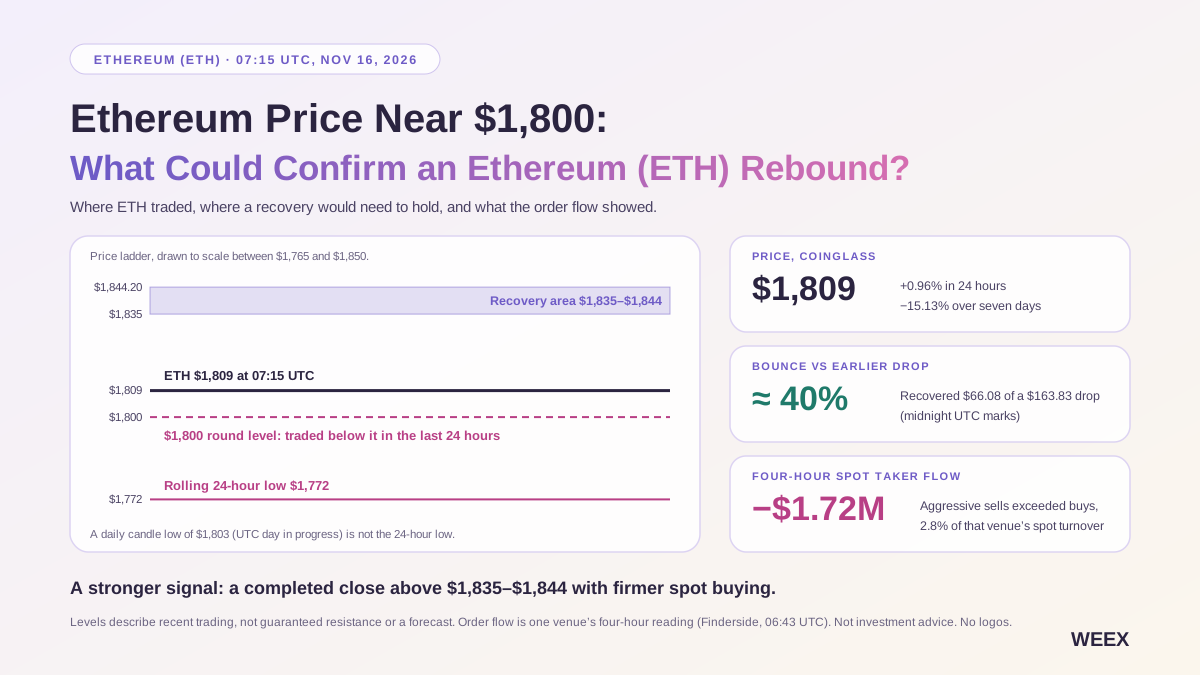
Ethereum Price Near $1,800: What Could Confirm an Ethereum (ETH) Rebound?
Ethereum traded near $1,800 on November 16. See what four-hour spot order flow, futures positioning, and Friday’s ETF flows say about an ETH rebound.

Nakamoto Extends Part of $60 Million Loan to Kraken Until 2027

Global Cryptocurrency 'Audit' Trend Emerges
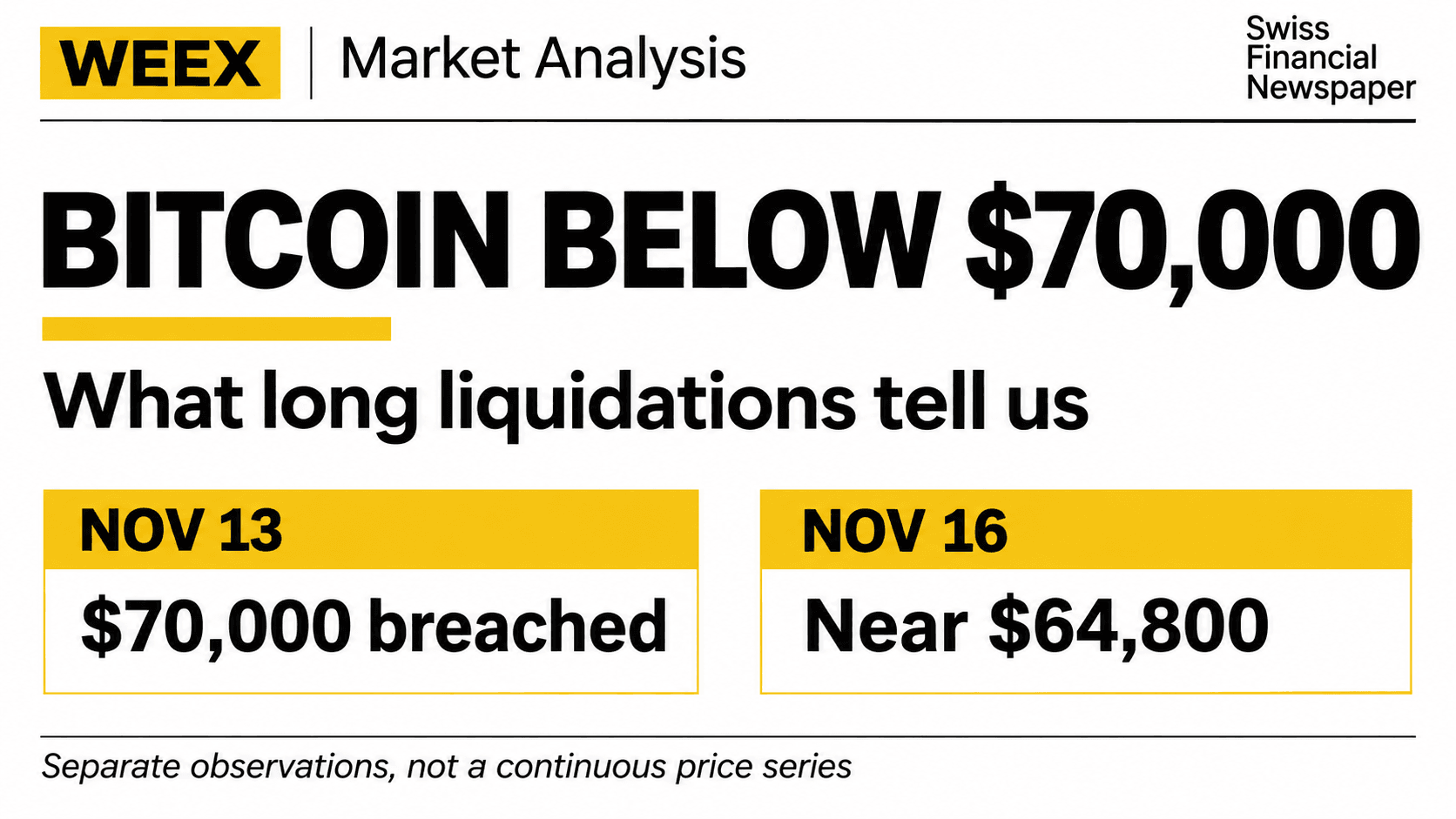
Why Did Bitcoin (BTC) Drop Below $70,000? What Long Liquidations Tell Us
See why Bitcoin fell below $70,000 on November 13, how long liquidations amplified the decline, and what to watch before calling a rebound. If you already plan to trade, you can check whether your activity qualifies for the WEEX Lucky Eggs event, scheduled to run through November 25, 2026 (UTC+8).
Wall Street Wants 24/7 Trading, But Weekend Cash Needs to Be Covered

Bank of America’s Hartnett: The Dollar is 'Destroying Everything', Remains Risk-Averse Before Dollar Decline
Nasdaq Futures vs. Dow Futures: Key Points for Cryptocurrency Traders Before the US Market Opens
When the Crypto Engine Enters Traditional Finance: A Conversation with Bitget's CFD Head on How to Achieve a 10 Billion Cross-Border Sample in Ten Months?
Crypto VC May Only Have 1 to 2 Investment Cycles Left as AI and Robotics Take Over as New Capital Battlegrounds
The Cryptocurrency Circle No Longer Exists
Is Meta Stock Still a Buy After Borrowing About $25 Billion This Month?
Archer Aviation and Joby Aviation: Speculative Plays With Upside Potential and Downside Risk
Wall Street Tests the AI Boom: What the Industry's Balances Reveal After the Democratic Victory
How These 6 Natural Gas Stocks Make Money
Is Credo Technology a Better AI Networking Buy Than Broadcom?
Wintermute Spends $824,000 on Front-Running Trades in the Last 30 Days
Yishi Advises to Stay Away from Leverage and Altcoins, Survival is the Top Priority
From 'Patching' to 'Eliminating Entire Classes of Bugs': How to Build Internet Resilience?
One Year of JPYC Stablecoin: First Gas-Free User is Quail Egg Merchant; Single Transaction Limit Set at 1 Million Yen
[Analysis] Two Barriers Preventing Bitcoin from Rising

Is CoreWeave Stock a Buy After Its Latest Earnings?
$LIBRA: One of the defendants seeks to remove Judge Ledesma and halt the review that could reactivate the case
Mazama Energy Finds New Solution to the Biggest Challenge in Geothermal Drilling
Is Apple Losing Its Memory?
Energy Transfer vs. Enbridge: Which High-Yield Pipeline Stock Could Make You Richer Over the Next 10 Years?
Jefferies Raises Spotify Price Target to $710, Expects Over 20% Growth in Free Cash Flow
The Application is Landing, Wealth is Evaporating: Analyzing the Painful Roots of the Crypto Industry through Three Financial Statements
Latest articles


Latest coin listings on WEEX


