
Zeno's Digital Twin Paradigm and DeSci's Tech Democratization

 Prefer us on Google


Original Title: "Zeno's Digital Twinning Vision and DeSci's Technological Democratization"
Original Author: Eric, Foresight News
Over a week ago, DeSci platform Orama Labs successfully completed the OramaPad's first project, Zeno's token launch. This Zeno launchpad provided 500 million ZENO tokens, half of the total supply. OramaPad requires users to stake their PYTHIA tokens to participate, and this "opening act" attracted a total of $3.6 million in PYTHIA staking.
Orama Labs aims to address the inefficiencies in fund allocation and resource distribution in traditional scientific research. The solution is to fund scientific experiments, achieve intellectual property verification, solve data silos, and implement community governance, establishing a path from research to commercialization.
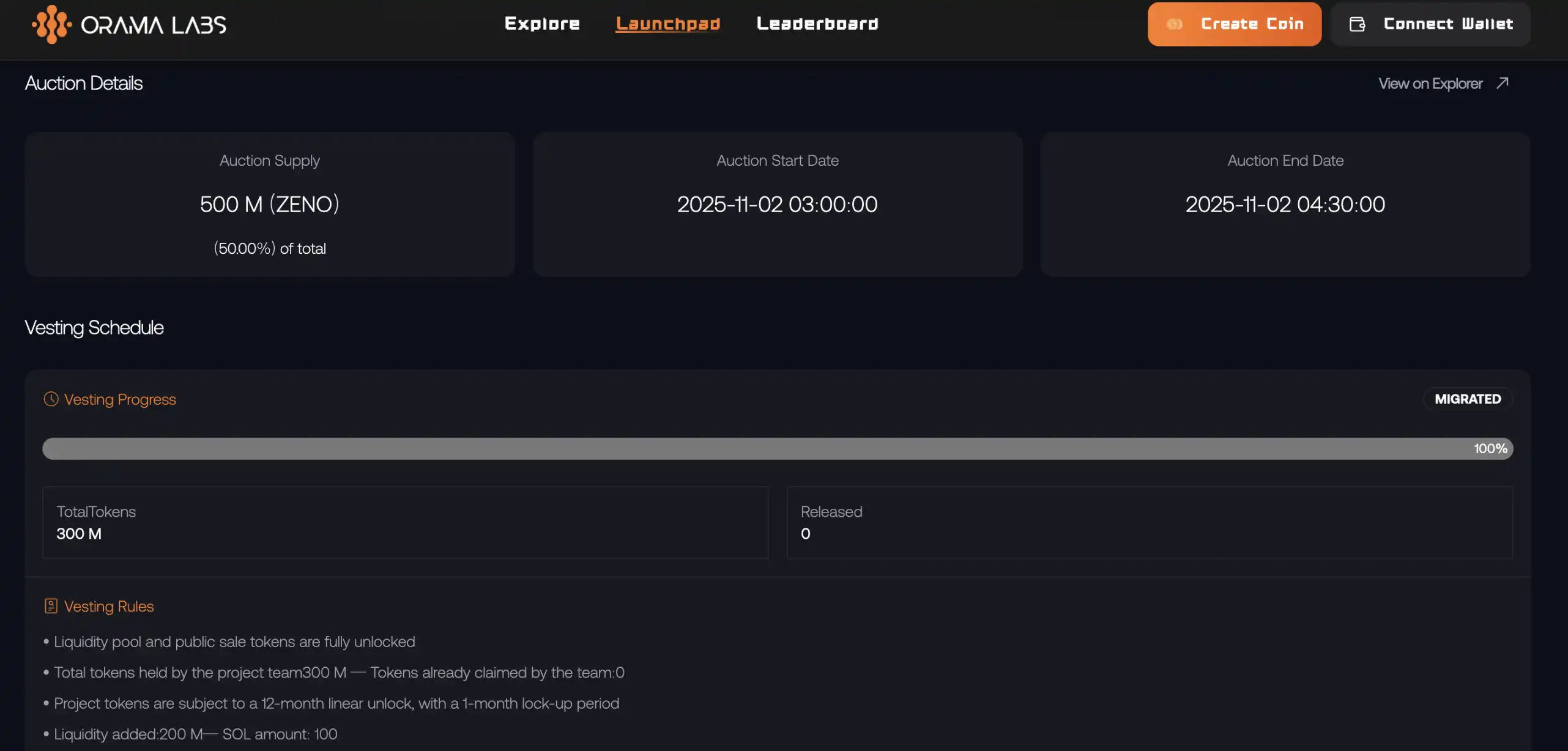
OramaPad's first project adopts the Crown model, where the project needs to have a sound business logic system and/or strong Web2 domain technical development capabilities. Additionally, its product must be highly practical, which Orama refers to as OCM (Onboarding Community Market). Unlike simple meme issuance, Orama essentially provides a replicable on-chain transformation path for Web2 enterprises or teams with mature business models and technical capabilities, and the first mover Zeno is no exception.
The Hardcore Tech of the Unreadable Document
Zeno is a project with a grand vision, so much so that if you only look at Zeno's documentation, you may not fully understand what the team is trying to achieve. It was only after the author communicated with the team that the full picture of this cyberpunk-style story became clear:
In short, Zeno aims to overlay a multi-layer virtual space for intelligent entities such as AI and robots in the physical space of human life, allowing all "intelligent entities," including humans, to live in the same space.
Imagine a scenario like this: One afternoon in the future, you are enjoying a leisurely time on the balcony in a lounge chair, with an AI butler connecting all the household appliances and a humanoid robot busy with household chores. Suddenly, feeling a bit bored, you want to play a virtual passing game with your other two brothers at home. So, you put on your VR/AR glasses, and in the world of glasses, the robot looks like a human, and the AI existing only in the network transforms into a humanoid. The robot sits on the sofa, and the AI sits on the floor. The three of you pass the virtual basketball while discussing what to eat tonight.
This is Zeno's ultimate vision, allowing carbon-based sentient beings and silicon-based intelligences to coexist in the same physical space.
The cyberspace many of us imagine may be a purely virtual space, such as the one depicted in the movie "Ready Player One," where people enter a new world through VR. Even our current interactions with AI, including the one with Zeno, are conducted through flat carriers like computers or smartphone screens. Zeno aims to directly bring these virtual spaces into real life, creating a state where the physical world and the digital world exist in an "overlay in the same spacetime." This integration allows digital content to be as "real and tangible" as physical existence, enabling humans, robots, and AI to achieve natural interaction in real scenes, building a mixed reality ecosystem where the virtual and the real coexist harmoniously.
Of course, the world we see may not be exactly the same as the one seen by robots and AI. For example, you may not want a robot to wander into your study room casually. In the world perceived by the robot, you can instead lock the door to the study room. Only when you "unlock" this "lock" would the robot be granted permission to enter.
Core to Spatial Anchors
Living under the same roof as Artificial Intelligence may sound very high-tech, but there is a significant premise: you need to establish a model of the real world in the virtual environment to achieve programmability.
First and foremost, you need to possess real-world reality data, a challenge currently being researched by many companies, including those in the autonomous driving sector. Take autonomous driving, for instance. With real-world map data of an entire city, autonomous driving AI does not need to roam the streets following cars to learn how to handle various situations. It can directly simulate on-road scenarios in the lab to evolve continuously.
Although the above does not represent what we call "spatial overlap," it is still a crucial application for building a model of the real world. Zeno's ultimate vision cannot be achieved in one step. The first thing to do is to collect real-world reality data.
Zeno has launched a program that allows users to use their everyday devices to help enter spatial data, supporting two types of devices: robots and glasses. As for smartphones, the team stated that Google's ARCore is mature enough and does not require secondary development. Users can directly use it with reference to compatible models. The data collected is used to build space algorithms developed independently by the Zeno team.
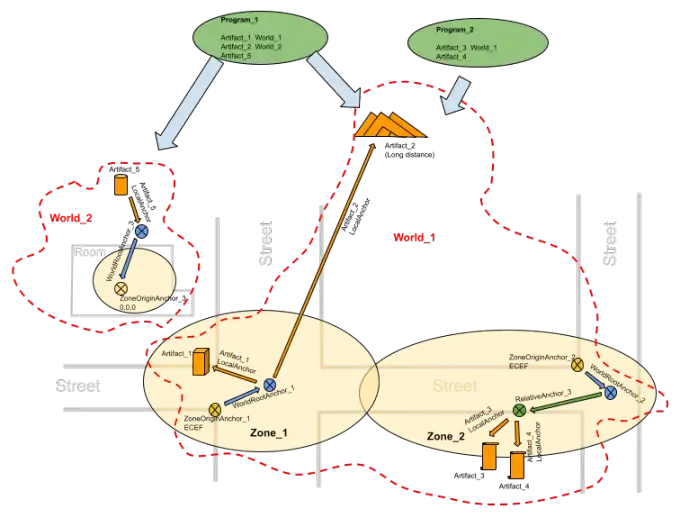
The core of building coexistence between the real world and the virtual world revolves around spatial anchors. From a technical realization perspective, the real world cannot be directly programmed. The connection between the real and virtual worlds is made by associating anchors in the real world and mapping out a virtual space based on physical space. In metaphorical terms, for robots and AI, the real world is like the ocean in the night, and these anchors are individual lighthouses that illuminate every area for silicon-based intelligences in the real world.
Zeno's first step in achieving its "ultimate goal" is to establish a full-stack platform. In addition to everyday electronic devices such as smartphones, the platform also utilizes professional equipment such as LiDAR, 360-degree cameras, and RGB cameras on mobile devices or XR headsets for data collection. The team stated that the Zeno platform will feature a powerful cloud-based visual world model and compute system capable of processing gigabytes of raw sensor data for large-scale areas (city-level / global-level) daily, building indexes for fast spatial queries. It will also parallel process data for small-scale areas (room-level / anchor-level) to achieve high-throughput real-time processing.
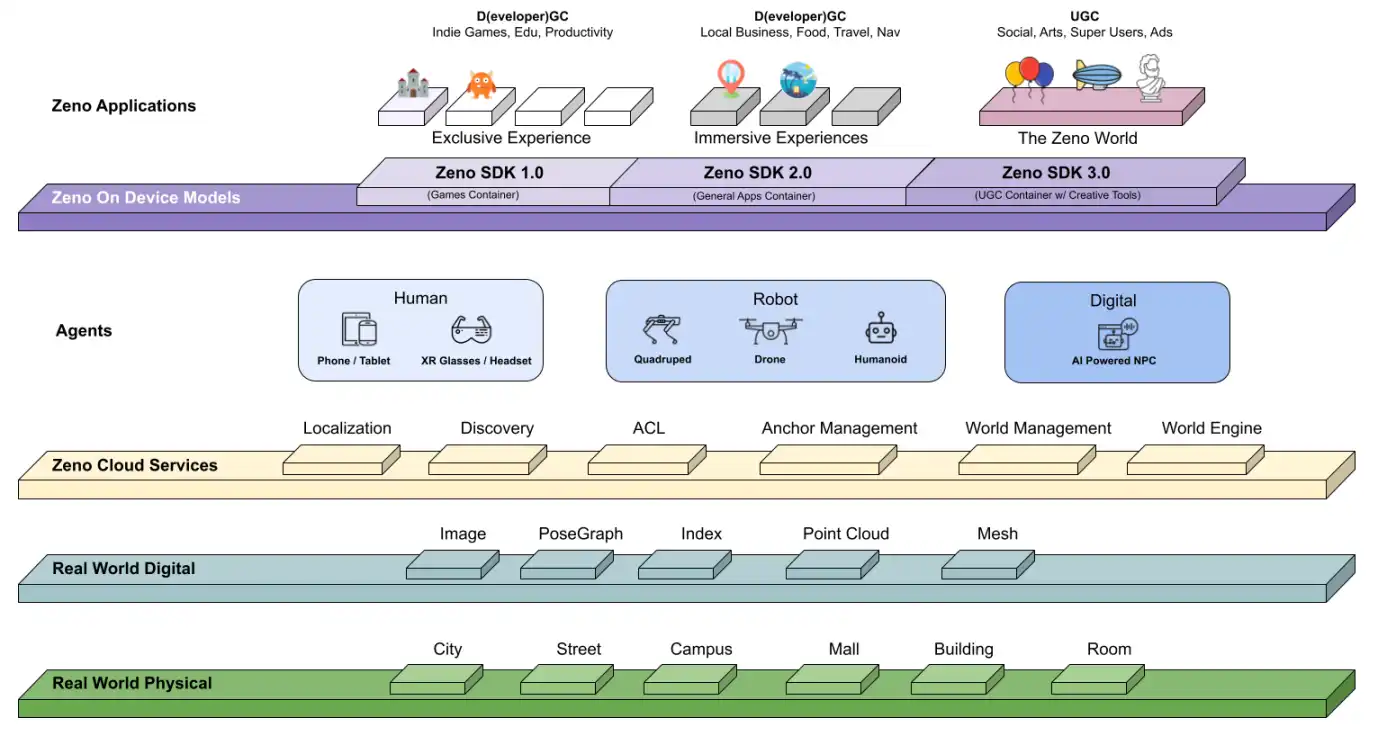
Furthermore, the system is equipped with self-learning capabilities to continually optimize through high-quality and third-party data. In the future, it will support hundreds of spatial queries per second, providing precise six degrees of freedom (6-DOF) positioning results, shared spatial anchor creation, rapid 3D visual reconstruction, real-time semantic segmentation, and other scene understanding functions. It is highly scalable and can be widely applied in various scenarios such as AR games, navigation, advertising, or productivity tools.
The validated spatial data and the built spatial intelligence infrastructure layer can be called by various decentralized applications for autonomous driving route planning, end-to-end model data training for robots, generating verifiable smart contracts for autonomous execution, spatial-form ad distribution, ultimately achieving spatial data-driven decision-making and higher-level applications.
Who is Behind Zeno?
Compared to some Web3 projects with vague visions, Zeno's goal, although sounding complex, is very practical. The reason why the technical implementation is described in such detail in the project documentation is that team members have been deeply involved in this field for many years.
Zeno's team members all come from DeepMirror, which is Chameleon Technology. If you are not familiar with Chameleon Technology, you may have heard of Pony.ai, a company listed on the Nasdaq with a market capitalization of $7 billion. Harry Hu, CEO of Chameleon Technology, was the former COO/CFO of Pony.ai.
Zeno's CEO, Yizi Wu, was an early member of Google X and was involved in the development of products such as Google Glass, Google ARCore, Google Lens, and the Google Developer Platform. At Chameleon Technology, he led the overall AI architecture and the development of the World Model.
The Zeno core team also includes Taoran Chen, who previously served as a research scientist at Horizon Robotics, holding dual doctoral degrees in mathematics from MIT and Cornell University, and Kevin Chen, who previously served as the CFO of Horizon Robotics and held executive positions at Fosun Group, JPMorgan Chase, and Morgan Stanley.
For the Zeno team, venturing into Web3 is more like a bold attempt by a tech-savvy Web2 team. The team described that the ZENO token will be used to incentivize users providing spatial data and teams or individuals adopting Zeno to build infrastructure development tools, applications, and games. In addition to the 5 billion tokens distributed in the launchpad, the team reserved 3 billion tokens, while the remaining 2 billion tokens will have liquidity pairs with 100 SOL obtained from the launchpad activity on Meteora.
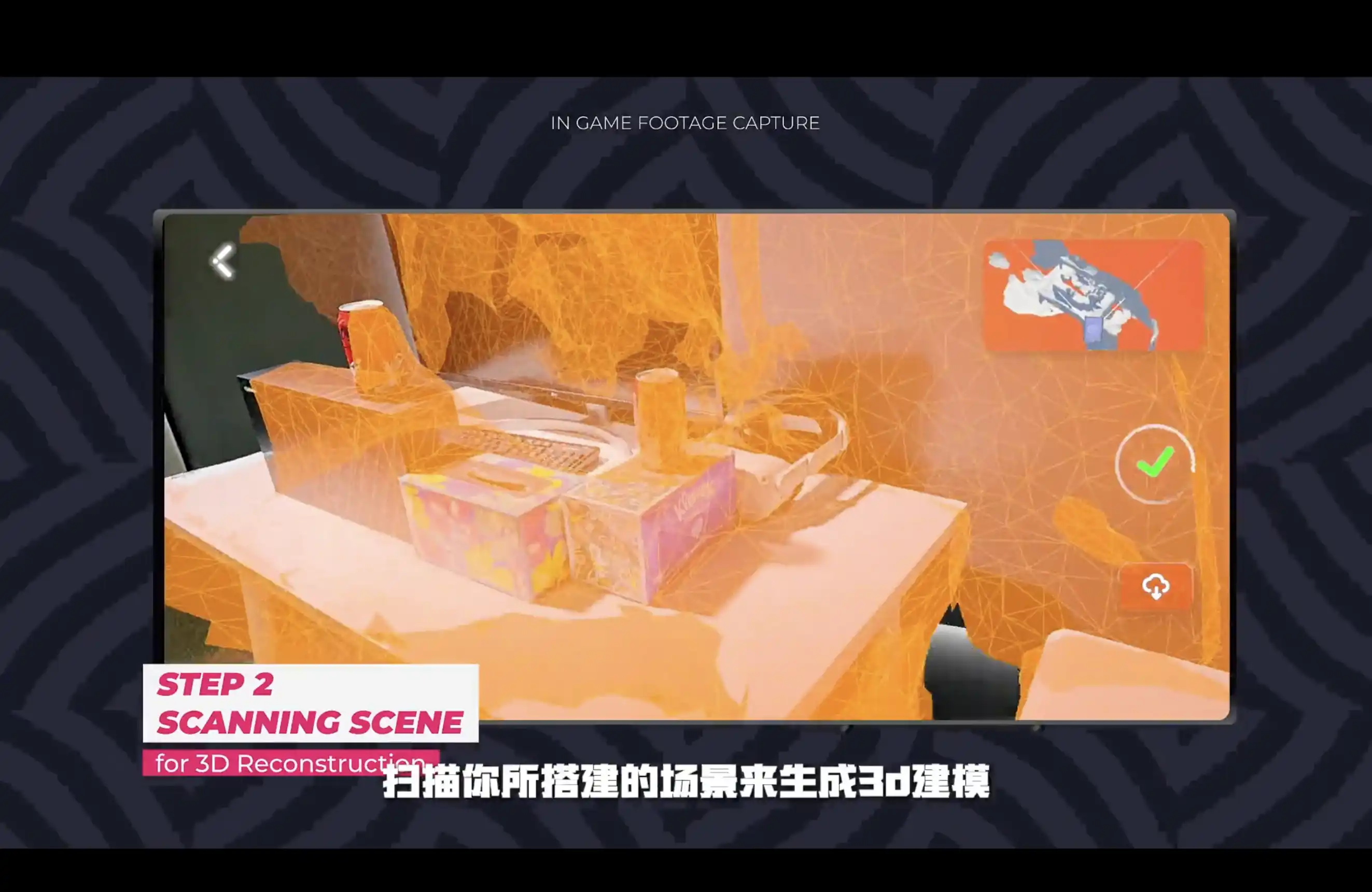
Horizon Robotics' AR and game-integrated spatial application RealityGuard
When asked why they chose Web3 as their battlefield, Zeno told the author that spatial data itself is a highly decentralized digital asset that naturally fits into the Web3 environment. The spatial data collected by Zeno itself will also be securitized in the future and expanded through transactions using the ZENO token as currency within the ecosystem, with buyers being tech companies in need of spatial data. As for more applications of ZENO, they will be "further explored as the project progresses."
Through Zeno, it is believed that the DeSci platform has achieved concretization, where science is not necessarily an obscure and purely theoretical discipline, but rather a democratization of technology similar to Xiaomi, lowering the threshold for technology value investment, which is also one of the significant values of DeSci's existence.
-- Price
This content is provided for general informational purposes only and doesn't constitute financial, investment, legal, or tax advice. Any events, rewards, online promotions, or related information mentioned herein should not be considered a recommendation, solicitation, or invitation to purchase, sell, trade, or otherwise deal in any crypto assets. Crypto assets are highly volatile and may result in loss. The availability of WEEX services, products, and related events may vary by region. You are responsible for ensuring that your participation is in accordance with applicable local laws and regulations.
You may also like

Analyst: The Bitcoin daily Bollinger Bands have narrowed to a new low since early 2024, which may indicate a volatility of about 40%
Paradigm Invests $13.5 Million in the Brazilian Real Stablecoin Issuer Crown

On-chain Active Market Making Experiment: More Profitable than AMM, Is it Retail Investors Placing Orders?
Bitcoin's AI-driven rally faces a hidden danger if the machines get richer but workers don't

‘Is Korea Facing a Second IMF Crisis? The Solution Lies in XRP?’... The Leap of the Crisis Theory by BeInCrypto

Ethereum, Solana, and BNB Chain: The 3 Favorite Blockchains for Tokenization According to Grayscale

ICO, VC Tokens, and Alpha Models: Why They Can't Save the Current Crypto Market?

What is Soda Labs? A Private Trading Infrastructure on Blockchain with Bubble

Developers Slam Lightning Network: 80% of Payments Depend on Custodians, Is the Community Weaving a Dream?
WEEX Review 2026: Fees, Security and Trading Features

Ransom of $1,011 in Bitcoin: The Leak Shaking Israel Twelve Days Before Elections

One Order Book for Dollars and Stablecoins. How It Works
When AI Entities Start Borrowing: How Machine Credit Prices Trust?
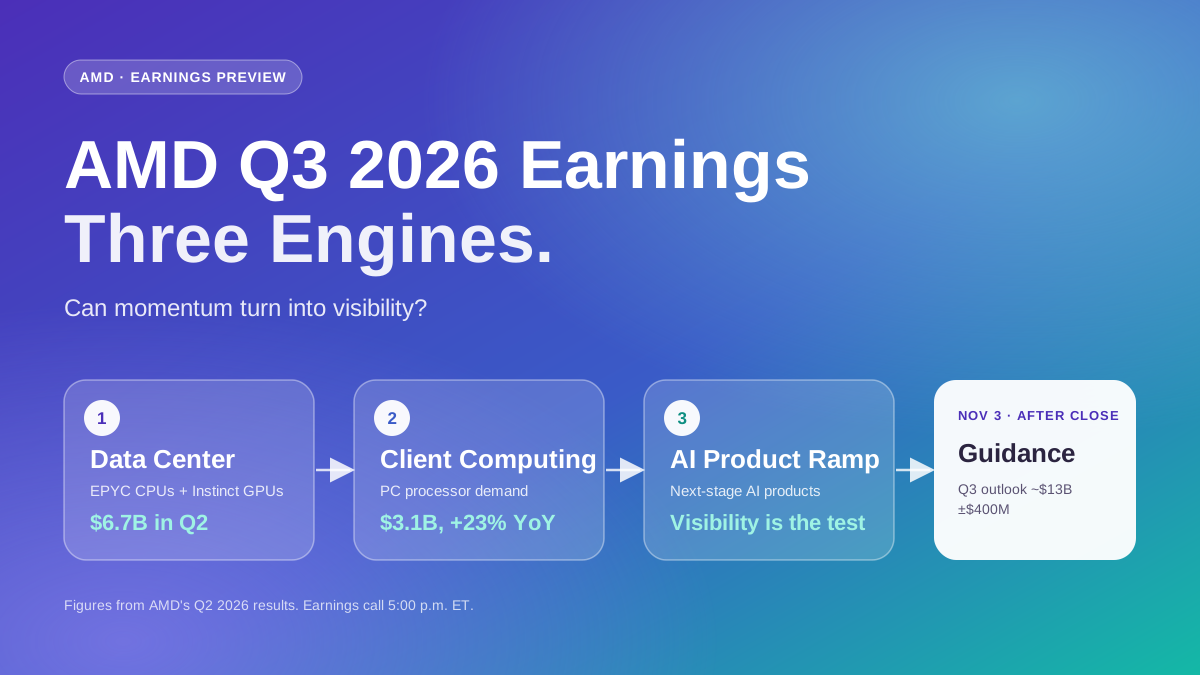
AMD Stock Ahead of Q3 2026 Earnings: Revenue, AI Demand, and Key Risks to Watch
AMD reports Q3 2026 results on November 3. See the data-center, AI demand, margin, and guidance signals that could shape AMD stock.
Bitwise CIO: Choose Your Own Adventure, All Paths Lead to Bitcoin
Tether launches offline AI speech model for smart glasses and robots

"Japan's Barrier is Not Culture but Local Investment" - Huobi Co-founder Du Jun Discusses Regulations, Stablecoins, and Expansion in Asia

Cyberattack on the ports of Marseille and La Rochelle? Hackers paid 1 dollar in crypto
Goldman Sachs Analysis: Interest Rate Cuts Expected in Second Half of 2027, How Long Will High Rates Last?
Analyst Who First Predicted September Rate Hike: Fed to Hold Steady in October, May Hike 50 Basis Points in December
Slash Card Now Available for Payment with USDC, Open to the Public
Crypto Security Basics: How to Protect Your Assets Across Wallets and Exchanges
AI Agents Pay for Services in Crypto via x402 Protocol
Will Stablecoins Become 'Financial Infrastructure'? - A Discussion with Circle on Arc and the Current State of Digital Payments in Japan (10/21 19:30 @ Gentosha)

Crypto: BlackRock's ETFs Bounce Back 63%, Far from 2025 Peak

Moderna's INTerpath-001 ESMO 2026 Presentation Date and Q3 Call
Moderna presents its late-breaking INTerpath-001 data at ESMO 2026 on 24 October 2026 at 16:30 CEST.

Tether paid $6.3M to firm tied to former Trump crypto adviser Bo Hines: report
[Exclusive] Coinbase Transaction Data Shows 100 Million Trades Misrepresented... Data Analysis Firm Corrects Errors

Wall Street Morning Report: U.S. Inflation Resurfaces, AI Credit Risks Spread, Chip Stocks Fall for Six Consecutive Days

BingX gets EU crypto license in Austria, eyes 29 countries
Analyst: The Bitcoin daily Bollinger Bands have narrowed to a new low since early 2024, which may indicate a volatility of about 40%
Paradigm Invests $13.5 Million in the Brazilian Real Stablecoin Issuer Crown
On-chain Active Market Making Experiment: More Profitable than AMM, Is it Retail Investors Placing Orders?
Bitcoin's AI-driven rally faces a hidden danger if the machines get richer but workers don't
‘Is Korea Facing a Second IMF Crisis? The Solution Lies in XRP?’... The Leap of the Crisis Theory by BeInCrypto
Ethereum, Solana, and BNB Chain: The 3 Favorite Blockchains for Tokenization According to Grayscale


