
Stock Market Today: Dow Holds Above 52,000 as Wall Street Braces for a Jobs-Heavy Week

U.S. stocks enter Tuesday, June 30, 2026, perched at record territory after a powerful start to the week — but the mood is shifting from celebration to caution. The Dow Jones Industrial Average closed above 52,000 for the first time on Monday, and now traders are turning to a compressed run of labor-market data that could decide whether the rally has another leg or runs into the wall of a more hawkish Federal Reserve.
Here is where the market stands today, what drove Monday's record, and the catalysts that matter before the long Independence Day weekend.
Where the Market Stands Right Now
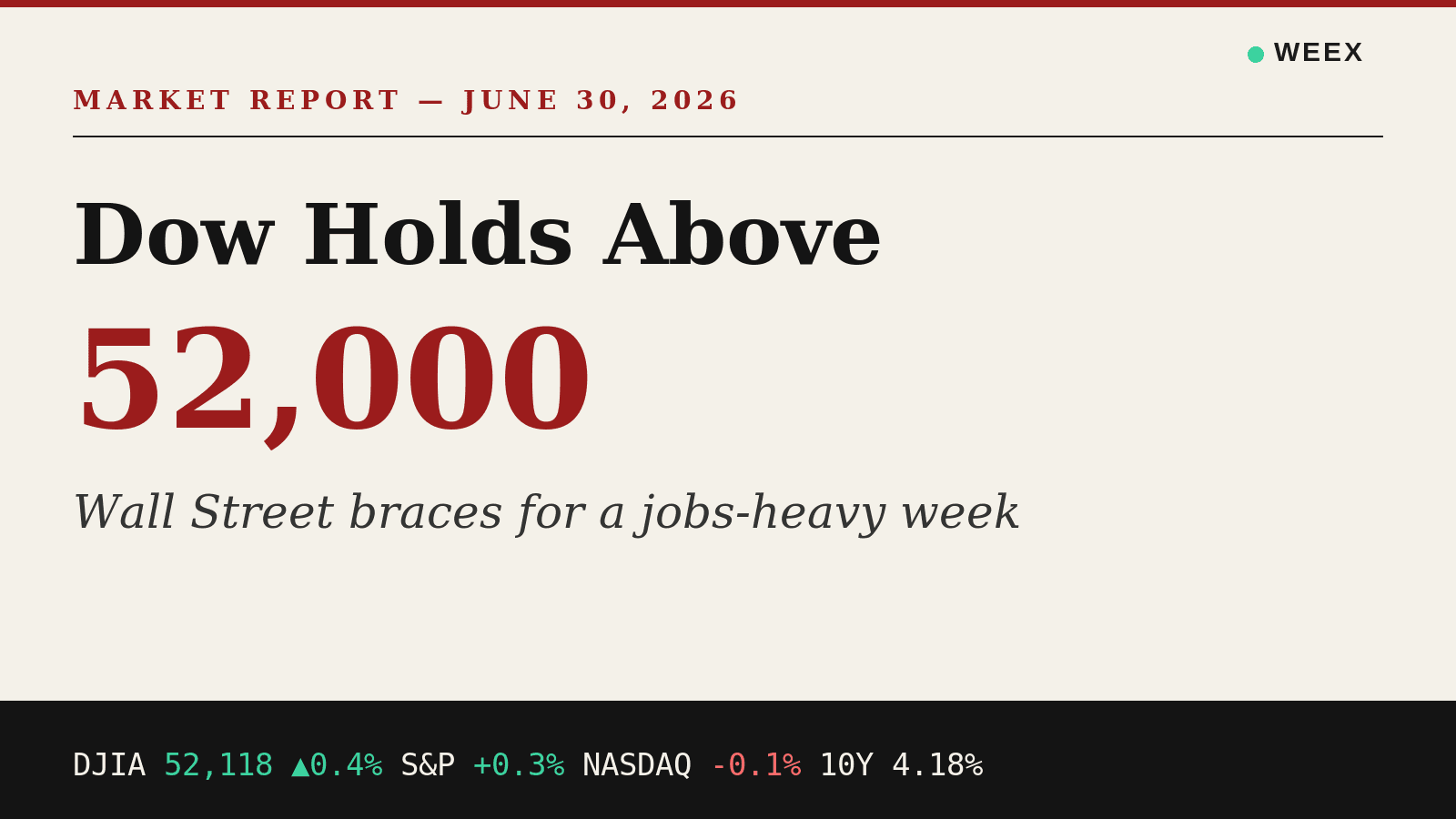
Monday, June 29, delivered a broad rally led by megacap technology. The headline story was the Dow crossing 52,000 for the first time, helped by Alphabet's debut as a Dow component. Tech did the heavy lifting: the Nasdaq Composite outpaced both the Dow and the S&P 500 with a gain north of 2%.
| Index | June 29 close | Daily move | Note |
|---|---|---|---|
| Dow Jones Industrial Average | 52,182.74 | +306.63 (+0.59%) | First close above 52,000 |
| S&P 500 | 7,440.43 | +1.18% | Fresh record high |
| Nasdaq Composite | 25,820.14 | +2.07% | Tech-led outperformance |
Today's session is a different animal. With the May JOLTS job-openings report due at 10:00 a.m. ET and a holiday-shortened week ahead, intraday moves are likely to be driven less by momentum and more by how each data point reshapes the rate-cut-versus-rate-hike debate.
What Powered Monday's Record
Three threads came together to push stocks higher.
First, Alphabet officially joined the Dow Jones Industrial Average, replacing Verizon. The stock rose sharply on its blue-chip debut, and because the Dow is price-weighted, adding a high-priced megacap name reshaped the index's composition in favor of technology. That mechanical shift, plus the symbolism of one of the market's largest companies entering the 130-year-old benchmark, gave the Dow an extra push toward the 52,000 milestone.
Second, megacap tech broadly caught a bid. Amazon, Meta, Nvidia, and Tesla all advanced, and semiconductor names were strong, with chip-sector ETFs gaining roughly 3%. When the largest companies in the S&P 500 move together, the index-level gains can look larger than the average stock's performance — a dynamic worth remembering when a "record high" is concentrated in a handful of names.
Third, the macro and political backdrop turned friendlier over the weekend. Reports of easing U.S.–Iran tensions removed a layer of geopolitical risk, and a Supreme Court decision allowing Federal Reserve Governor Lisa Cook to remain in her post was read by markets as a defense of Fed independence. Both developments reduced uncertainty — and markets tend to pay up when the tail risks recede.
Beyond the mega-caps, deal news added energy: Rocket Lab announced an roughly $8 billion acquisition of Iridium, and industrial bellwether Honeywell was among the day's strongest large-cap gainers.
The Catalyst That Matters: A Jobs-Heavy, Holiday-Shortened Week
The single most important feature of this week is the calendar. Because U.S. markets are closed Friday, July 3, for the Independence Day holiday, the usual first-Friday payrolls report has been pulled forward. That stacks three consequential labor reports into three straight sessions:
| Date | Report | Why it matters |
|---|---|---|
| Tue, June 30 | JOLTS job openings (May) | Gauges labor demand; April's 7.6M was the highest since late 2024 |
| Wed, July 1 | ADP private payrolls | First read on private hiring momentum |
| Thu, July 2 | Nonfarm payrolls (June) | The headline jobs print, released a day early |
The reason this matters so much right now is that the inflation picture has turned less friendly. Recent data showed inflation accelerating above 4% for the first time in nearly three years, and that has flipped part of the rate conversation on its head. Instead of debating how many cuts the Fed will deliver, some strategists — including voices at Bank of America — are now openly discussing the possibility of rate hikes later in 2026.
That sets up an unusually two-sided reaction function for this week's data. Strong jobs numbers, which normally cheer the market, could deepen rate-hike fears if they arrive alongside hot inflation. Soft numbers might ease rate worries but raise questions about growth. In other words, "good news is good and bad news is bad" no longer cleanly applies.
Market View: A Record That Rests on a Narrow Base
The more important point behind Monday's headline is breadth, or the lack of it. A Dow record powered by a single high-priced new member and a Nasdaq rally led by a handful of megacaps tells you the index is at a high — it does not tell you the average stock is healthy. Concentrated leadership has been the defining feature of this cycle, and it cuts both ways: the same names that lift the tape on relief days can drag it just as fast when sentiment turns.
The cleaner read here is that the market is pricing in relief — on geopolitics, on Fed independence — but has not yet priced in the harder problem, which is an inflation rate back above 4% with a central bank that may be done cutting. This week's labor data is the first real test of which narrative wins.
What Traders Usually Miss in Weeks Like This
Holiday-shortened weeks tend to bring thinner liquidity, and thin liquidity exaggerates moves in both directions. A data surprise on a low-volume session can produce an outsized swing that partially reverses once full participation returns the following week. Pre-holiday positioning — traders squaring books before a three-day weekend — can also distort Thursday's afternoon action in ways that have little to do with the fundamentals.
The practical takeaway is to weight the data more than the price reaction this week. The JOLTS, ADP, and payrolls readings carry real signal; a sharp 30-minute move into a holiday close often does not.
Key Levels and Names to Watch Today
Watch whether the Dow can hold the 52,000 line on a closing basis — round-number levels often act as psychological support or resistance in the sessions immediately after a breakout. On the S&P 500, the question is whether participation broadens beyond technology or whether the index keeps leaning on the same megacap leaders. And keep an eye on rate-sensitive corners of the market — regional banks, homebuilders, and small caps — because they tend to react first and hardest when the hike-versus-cut debate shifts.
The Bottom Line
The market is starting June 30 at record highs, but the easy part of the week may already be behind it. Monday's rally rested on a Dow reshuffle, megacap strength, and a welcome drop in geopolitical and policy uncertainty. From here, direction hinges on hard data — three labor reports in three days against a backdrop of inflation running above 4%. Records are nice, but the next move belongs to the numbers.
Frequently Asked Questions
1. Did the stock market hit a record today? U.S. indexes entered Tuesday, June 30, 2026, at or near record levels after Monday's rally. On June 29, the Dow closed above 52,000 for the first time, the S&P 500 set a fresh record at 7,440.43, and the Nasdaq Composite rose more than 2%. Intraday levels for June 30 itself depend on the session's data and trading.
2. Why did the Dow cross 52,000? Two forces combined: Alphabet's debut as a Dow component (replacing Verizon) added a high-priced, heavily weighted technology name to the price-weighted index, and a broad megacap tech rally lifted the overall market. Easing geopolitical tensions and a Supreme Court ruling seen as protecting Fed independence improved sentiment.
3. What economic data is moving the market this week? A compressed run of labor reports: JOLTS job openings on Tuesday, June 30; ADP private payrolls on Wednesday, July 1; and the June nonfarm payrolls report on Thursday, July 2 — pulled forward because markets are closed Friday, July 3, for Independence Day.
4. Is the Fed going to cut or hike rates? The picture is unsettled. With inflation recently accelerating above 4% for the first time in almost three years, some strategists have shifted from expecting cuts to discussing possible rate hikes later in 2026. This week's jobs data is a key input into that debate.
5. Is the stock market open on July 3 and July 4, 2026? U.S. equity markets are closed Friday, July 3, 2026, in observance of Independence Day (July 4 falls on a Saturday). That closure is why the June jobs report was moved to Thursday.
Risk Warning
This article is for general information and market context only and is not investment advice. Stock markets are volatile, and index records do not guarantee future gains; a market making new highs on narrow, megacap-led breadth can reverse quickly when leadership or sentiment shifts. This week's outcome is unusually sensitive to incoming labor and inflation data, and holiday-shortened sessions can carry thinner liquidity that exaggerates price swings in both directions. Rate expectations can change abruptly, repricing equities, bonds, and rate-sensitive sectors. Past performance does not predict future results. Do your own research and consider consulting a licensed financial professional before making any investment decision; you can lose money, including a substantial portion of your capital.