
Solana Alpenglow Upgrade: What Changes When Finality Hits 150ms

 Prefer us on Google

The Solana Alpenglow upgrade goes live on mainnet on Wednesday, October 21, 2026, and it replaces the consensus engine Solana has run since 2020. The headline number is finality: a confirmed transaction should become irreversible in roughly 150 milliseconds instead of about 12.8 seconds. Below is what Alpenglow actually changes, why Solana's transaction counts are about to look smaller without anything going wrong, what validators had to do, and what SOL holders do (nothing) and should watch (several things).
What Is the Solana Alpenglow Upgrade?
Alpenglow is a new consensus protocol for Solana, built by core developer Anza and first unveiled in May 2025. It retires TowerBFT, the voting system validators have used to agree on the state of the chain since Solana's mainnet beta in March 2020.
Consensus is the part of a blockchain that decides when a block is final. It is separate from execution, the part that actually runs your swaps and transfers. That split matters for reading this upgrade correctly: according to Solana's own upgrade page, the Solana Virtual Machine, transaction formats, programs and fees all stay the same. Alpenglow changes how fast the network agrees, not what the network does.
The activation is scheduled in two steps. Epoch 1064 begins around 13:20 UTC on October 21, TowerBFT keeps running for the first 5,000 slots of that epoch, and Alpenglow takes over at slot 459,653,000. Different trackers put that handoff between roughly 14:00 and 14:50 UTC, because the exact time depends on how quickly blocks are produced.
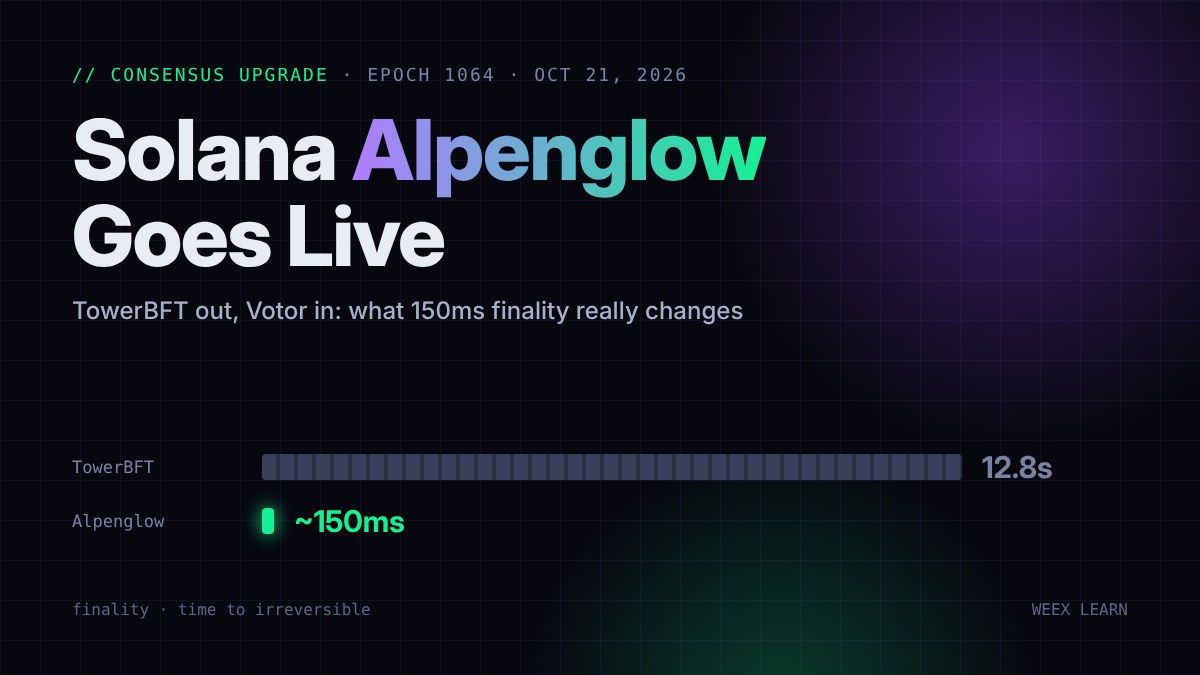
How Votor Cuts Solana Finality From 12.8 Seconds to 150ms
The first phase of Alpenglow ships a component called Votor. Its job is simple to describe and hard to build: let validators agree on a block quickly, without clogging the chain while they do it.
Under TowerBFT, every validator vote was an on-chain transaction. Votes competed for block space with user activity, and a block reached full finality only after a long chain of votes stacked up on top of it, which is where the 12.8-second figure comes from.
Votor works differently:
- Votes go peer to peer. Validators send votes directly to each other and aggregate them into certificates, instead of writing each vote into a block.
- A fast path for good conditions. If at least 80% of stake notarizes a block in the first round, it finalizes immediately.
- A slow path for bad conditions. If that threshold is missed, a second round with 60% thresholds can still finalize the block, or explicitly skip it.
The 150ms number is a target, not a guarantee. Solana's documentation describes it as an expectation that depends on how stake is distributed and on whether a block clears in one round or two. Treat the first weeks of live data as the real test.
There is also a security trade worth knowing. The Solana Foundation says Alpenglow tolerates up to 20% malicious stake plus another 20% offline stake at the same time. Coverage of the upgrade often summarizes that as fault tolerance rising from 33% to 40%, but the two numbers measure slightly different things, so the "20 + 20" framing is the more precise one.
A second component, Rotor, is meant to replace Turbine, Solana's block-propagation layer, with a single relay hop. Rotor is not part of the October 21 activation and has no release date yet. Anyone describing today's upgrade as "Votor and Rotor" is getting ahead of the schedule.
Why Solana TPS Will Look Lower After Alpenglow
This is the part most explainers skip, and it is the one most likely to mislead people over the next few weeks.
A large share of what Solana has historically counted as "transactions" were validator votes, not user activity. Under Alpenglow, votes are no longer transactions and no longer appear in blocks. Validator participation shows up in certificates in the block footer instead.
The practical result: dashboards that report total transactions or TPS will show a sharp drop after activation, even if the number of real swaps, transfers and mints does not change at all. If you see a headline about Solana activity "collapsing" in late October, check whether it is counting non-vote transactions before drawing any conclusion. The honest comparison going forward is non-vote transactions before versus after.
Developers have a related change to note. The confirmed and finalized commitment levels converge into a single state, and Solana's documentation says confirmed is slated for removal in a later release. Apps that relied on the gap between the two should review the migration checklist on solana.com.
-- Price
What Validators, Stakers and SOL Holders Need to Do
The answer depends on who you are.
SOL holders and stakers: nothing. No token swap, no migration, no wallet action. That makes this a common phishing window. Any message, airdrop page or "support agent" asking you to sign a transaction to "upgrade" your SOL for Alpenglow is a scam.
Validators: quite a lot, and the economics changed:
- Run version 4.3.2 of Agave, Jito-Solana or Harmonic Salsa. Firedancer and Frankendancer are not supported during the migration.
- Register a BLS key in the vote account, a step enabled on mainnet on July 8, 2026.
- Fund the Validator Admission Ticket. Instead of paying roughly 1 SOL per epoch in per-vote fees, validators now pay a flat 0.8 SOL per epoch from the vote account, which is burned and paid one epoch in advance. A validator that cannot cover it is shut out of voting and block production for the next epoch.
Readiness was not complete going into the switch. As of October 20, SolanaFloor flagged 151 validators, controlling about 20.3% of stake, as unprepared, down from roughly 45% a day earlier. That figure was moving fast and is a snapshot, not a final count. It is still worth watching for one reason: if unprepared validators stay offline, their delegators can miss staking rewards. If you stake through a specific validator, check that it upgraded.
How SOL Is Trading Into the Upgrade on WEEX
Network upgrades rarely move price in a straight line, and Alpenglow arrives in a soft market. As of October 21, 2026 at about 03:00 UTC, WEEX market data showed:
- SOL/USDT spot: about $106.18, up roughly 1% on the day, with 24h volume near 87.6 million USDT.
- SOLUSDT perpetual: about $106.06, with 24h volume near 367.3 million USDT and up to 300x leverage available.
- Funding rate: about -0.0043% per interval, meaning shorts were paying longs.
The more telling number is the funding rate. Slightly negative funding the morning of the largest upgrade in Solana's history says derivatives traders were leaning short or hedged rather than chasing a "sell the news" rally. Combined with futures volume running at more than four times spot, the setup favors sharp, leverage-driven moves around the activation window in either direction. A technically clean launch does not automatically lift SOL, and a short-lived wobble does not mean the upgrade failed.
If you want exposure, the plain route is the SOL/USDT spot market; first-time buyers can follow WEEX's step-by-step guide to buying Solana. Traders who want to hedge an existing SOL position through the activation window can use the SOLUSDT perpetual, keeping leverage low enough that a 10% intraday swing does not trigger liquidation.
What to Watch After Alpenglow Goes Live
The Solana Alpenglow upgrade is a consensus change that should make the network feel faster without changing anything users touch directly. In order of importance, the things worth tracking over the next two weeks are:
- Real finality numbers. Whether mainnet actually lands near 150ms, and how often blocks need the slower two-round path.
- Skipped slots and validator participation. Unprepared validators show up here first, and so do any consensus bugs.
- Non-vote transaction counts. The only fair way to compare Solana activity before and after October 21.
- Rotor's timeline. The second half of Alpenglow is where block propagation gets faster, and it is still unscheduled.
For SOL holders, the upgrade asks nothing of you except caution with anything that asks you to sign. For traders, the interesting signal is not the upgrade itself but how positioning, funding and volume react once real finality data replaces the 150ms promise.
FAQ
1. Do I need to do anything with my SOL for the Alpenglow upgrade?
No. Holders and stakers do not need to migrate, swap or sign anything. Requests to "upgrade" your SOL are phishing attempts.
2. When does Solana Alpenglow go live?
Epoch 1064 starts around 13:20 UTC on October 21, 2026, and Alpenglow consensus takes over at slot 459,653,000, expected roughly between 14:00 and 14:50 UTC depending on block speed.
3. Does Alpenglow make Solana transactions cheaper?
Not directly. Fees, programs and the Solana Virtual Machine are unchanged. Moving votes out of blocks frees block space, which can ease congestion, but there is no fee cut built into the upgrade.
4. Why will Solana's TPS drop after the upgrade?
Validator votes used to be counted as transactions. Under Alpenglow they move off-chain into certificates, so total transaction counts fall even when real user activity stays the same.
5. Is Rotor part of the October 21 upgrade?
No. Only Votor activates on October 21. Rotor, which replaces Turbine's block propagation, is planned for a later release and has not been scheduled.
This content is provided for general informational purposes only and doesn't constitute financial, investment, legal, or tax advice. Any events, rewards, online promotions, or related information mentioned herein should not be considered a recommendation, solicitation, or invitation to purchase, sell, trade, or otherwise deal in any crypto assets. Crypto assets are highly volatile and may result in loss. The availability of WEEX services, products, and related events may vary by region. You are responsible for ensuring that your participation is in accordance with applicable local laws and regulations.
You may also like

What Is Pearl (PRL) Crypto and How Does Its Mining Work?
Cyberleek Token Risks: Memecoins Tied to Leaks, Anonymous Wallets and Why Verification Matters
Staking APR vs Inflation: How Much of Your Crypto Yield Is Real?
Buy Limit Order: How to Buy Crypto Below the Market Price
Cyberleek: How the GTA 6 Leaker's Memecoin Turns Leaks Into Fees

How to Buy New Crypto Before Listing: 5 Routes and Their Traps
What Is Staking? 4 Myths to Clear Up Before You Stake Crypto
What Is Blockchain and How Does It Work? One Real Block Explained
XST Coin Explained: Two Tokens Share One Ticker, Check Which One
2Z Token Unlock on October 2: What 1.66B DoubleZero Tokens Mean

Solana Alpenglow Mainnet Date: Why Sept 28 Wasn't Launch Day

Phantom Wallet vs MetaMask: What's the Difference
How to Install and Set Up Phantom Wallet
What Is Phantom Wallet? A Complete Guide to the Solana Wallet
How to Buy USDT with EUR via SEPA Bank Transfer on WEEX
How to Buy Bitcoin with EUR in Europe on WEEX
How to Buy Crypto in Europe with EUR on WEEX OTC
How to Buy Crypto in Vietnam with VND on WEEX OTC
How to Buy USDT in Vietnam with VND via MoMo or Bank Account
How to Buy Bitcoin in Brazil with BRL on WEEX OTC
How to Buy Crypto in Australia with AUD on WEEX
How to Buy Bitcoin in Australia with Apple Pay, Google Pay or Card
How to Buy USDT in Japan with Apple Pay, Google Pay or Card

Pump.fun (PUMP) Price Prediction: Attributed Scenarios, Tokenomics and Risks
Hunter Biden's Laptop Token Is Now Live on Base: Watch Out for Copycat Tokens
XST Stock: Why This Ticker Points to Four Completely Different Companies
CyberLeek Crypto: The GTA 6 Token's Exit Liquidity Problem
XST ETF vs XST Coin (XSolut): Don't Confuse These Two Completely Different Assets
Anthropic Tokenized Stock: What ANTHROPIC Actually Gives You
Can PONS Reach $1? PONS Coin Price Analysis After WEEX
What Is Pearl (PRL) Crypto and How Does Its Mining Work?
Cyberleek Token Risks: Memecoins Tied to Leaks, Anonymous Wallets and Why Verification Matters
Staking APR vs Inflation: How Much of Your Crypto Yield Is Real?
Buy Limit Order: How to Buy Crypto Below the Market Price
Cyberleek: How the GTA 6 Leaker's Memecoin Turns Leaks Into Fees
How to Buy New Crypto Before Listing: 5 Routes and Their Traps


