
What Is Pearl (PRL) Crypto and How Does Its Mining Work?

 Prefer us on Google



Pearl is a Layer 1 blockchain that uses matrix-multiplication-based proof of work, aiming to let computing associated with AI workloads also contribute to blockchain security. Its native coin is commonly identified as PRL in mining tools and project materials. To understand Pearl crypto, separate three questions: how its mining proofs work, whether the computation serves actual AI customers, and whether mining revenue exceeds the operator’s full costs. These questions are connected, but they require different evidence.
Our assessment is that Pearl presents an interesting computing model, but the phrase “AI mining” can obscure its economics. A valid mining proof does not automatically demonstrate paid AI demand, and a profitable day does not establish a durable hardware investment. The strongest evaluation combines current software evidence, customer-facing integrations, actual pool payouts, and sensitivity to price and competition.
Before using a WEEX page to research or trade the asset, check its identity carefully. The WEEX Perle asset page identifies a separate project that also uses PRL. WEEX’s associated listing announcement describes Perle Labs, a Solana-based AI data platform—not Pearl’s mining blockchain. A matching ticker is therefore insufficient to establish that a market provides exposure to the coin discussed here. (WEEX Help Center)
What Is Pearl (PRL) Crypto?
Pearl is a blockchain network with its own node software, wallet infrastructure, mining system, and native asset.
Its central proposition concerns the work performed to earn block rewards. Traditional proof-of-work mining uses computation to establish that a participant expended resources. Pearl aims to connect that resource expenditure with matrix multiplication, a fundamental operation in modern AI systems.
The project’s repository contains the blockchain node, wallet components, a proving system, and GPU-oriented mining infrastructure. These provide concrete materials for technical investigation. Their existence does not, by itself, establish the profitability, decentralization, or commercial adoption of the network.
For beginners, the simplest distinction is between a blockchain coin and an AI company share.
Holding Pearl does not automatically provide ownership in a GPU business or a contractual entitlement to an AI provider’s revenue. Its investment characteristics depend on the network’s rules, asset demand, supply, security, and market liquidity.
Similarly, mining Pearl means participating in a competitive reward mechanism. It should not be confused with receiving a fixed payment for renting a computer to an identified customer.
That difference becomes important when assessing claims about “earning from AI.”
Is Pearl (PRL) the Same as Perle (PRL)?
No. Pearl’s mining network and Perle Labs are separate projects, despite overlapping names and ticker usage.
The WEEX announcement reviewed for this article describes Perle Labs as a platform connecting experts with organizations for AI data annotation and validation. That is a different activity from securing Pearl’s blockchain through mining. (WEEX Help Center)
Confusion can spread when a search engine returns a generic “PRL price” page without emphasizing the underlying project.
| Identity Check | Pearl Mining Network | Perle Labs |
|---|---|---|
| Project focus | Matrix-based mining and blockchain infrastructure | Expert contributions to AI data workflows |
| Relevant identity evidence | Pearl Research materials, node software, native explorer | Perle website, Solana-linked project information |
| Typical participation | Mining, holding, transferring the native coin | Project-specific data tasks or token participation |
| Common source of confusion | PRL used by mining services | PRL used by exchange listings |
Before transferring funds, match the project website, network, asset description, and destination’s supported deposit route.
For a native blockchain asset, looking only for a token contract on another network may be the wrong starting point. Conversely, a token with a familiar name on Solana or Ethereum is not automatically a wrapped representation of Pearl.
A ticker is a label. Asset identity requires several matching facts.
How Does Pearl (PRL) Mining Work?
Pearl’s approach starts with matrix multiplication.
AI models perform large numbers of these operations when processing inputs and generating outputs. Pearl’s proposal is to construct mining proofs around this type of computation rather than treating mining as an entirely separate workload.
The official technical paper describes an integer matrix-multiplication design and discusses limitations and possible future extensions. It also distinguishes the implemented approach from proposed upgrades. Readers should preserve that distinction when comparing promotional descriptions with deployed software. (pearlresearch.ai)
A useful conceptual sequence is:
- A participant runs compatible computing and mining software.
- The system performs work and searches for a qualifying proof.
- The network verifies a submitted block under its consensus rules.
- Successful blocks produce rewards according to the issuance schedule.
The critical word is “qualifying.” Doing a large amount of useful computing does not mean every operation independently earns coins. Rewards remain governed by a competitive blockchain process.
A miner’s results depend on accepted work, competing resources, network conditions, and the reward mechanism.
That is why a benchmark measured in isolation cannot establish actual daily income. The relevant evidence is sustained accepted work and credited payouts under current conditions.
-- Price
Does Pearl (PRL) Mining Actually Perform Useful AI Work?
This is the most important technical question, and it requires a dated answer.
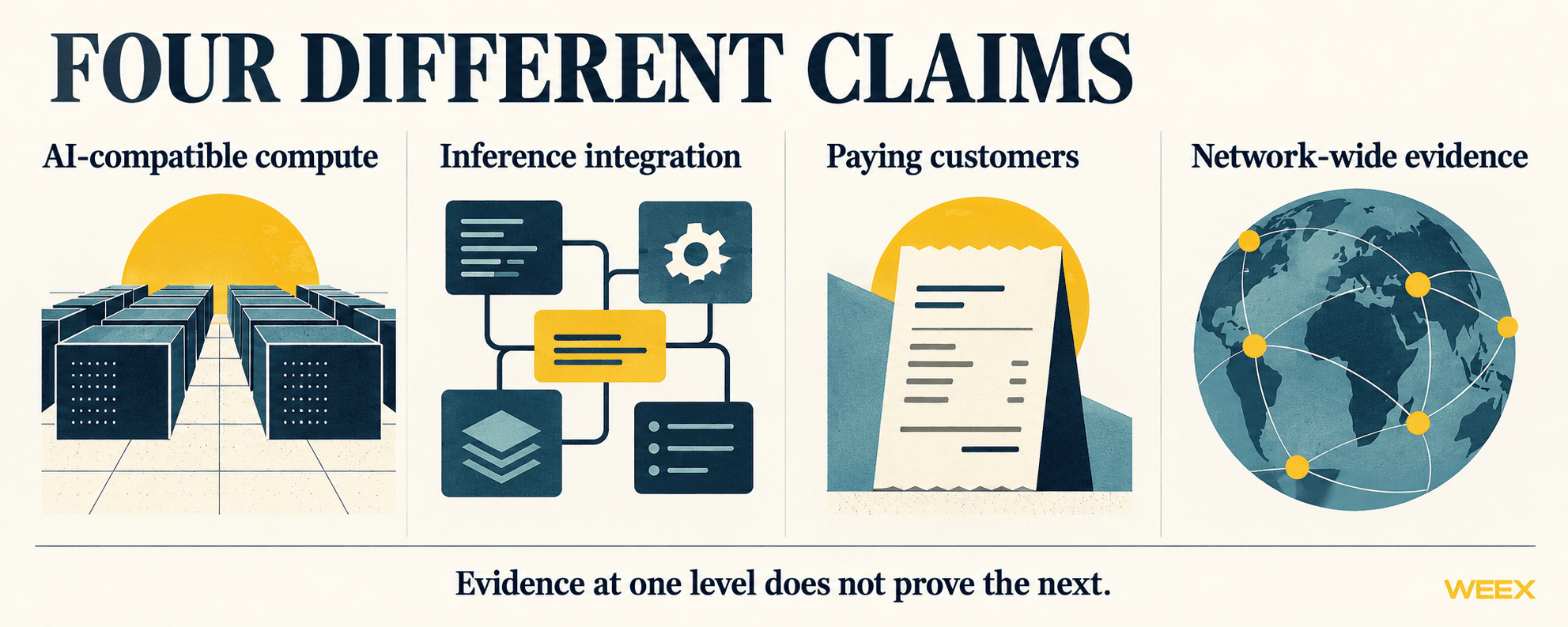
There are at least three levels of evidence: computation compatible with AI, software integrated into an inference process, and measured execution serving real customer requests. Demonstrating one level does not automatically establish the next.
A June 2026 arXiv preprint examined Pearl’s deployment and reported that, within its measurements, mining could proceed without useful AI inference. The reviewed version was revised on June 5, 2026. Its findings concern that study’s observed software and network conditions; they are not a continuously updated measurement of every current miner.
Current project evidence must also be considered. Pearl’s public repository includes inference-oriented mining components. Together AI published a May 15, 2026 announcement describing a Pearl-linked inference endpoint and a discount supported by mining emissions. These are meaningful implementation and commercial claims, but they do not quantify the percentage of all network work serving customers.
The evidence therefore supports a narrower conclusion than either “all mining is useful AI” or “nothing has changed.”
| Claim | Evidence Needed |
|---|---|
| The computation can support AI | Technical specification and reproducible implementation |
| Mining is integrated into inference software | Maintained code and successful execution tests |
| Customers are using the integration | Completed requests, service records, and usage measurements |
| Much of the network serves AI customers | Network-wide methodology and workload attribution |
| The economics are sustainable | Revenue, costs, subsidy dependence, and retention over time |
The unresolved measurement is not simply whether an endpoint exists. It is how much work it performs, who pays for it, and how representative it is of the network.
An investor should ask for those measurements rather than assume that total mining activity equals AI adoption.
How Can Pearl (PRL) Subsidize AI Inference?
The proposed economic link is that mining rewards can offset part of the cost of performing inference.
Together AI’s announcement described an endpoint priced at a discount of more than 25%, with the discount connected to the expected value of Pearl emissions. The same announcement identified this as an initial integration rather than proof that its entire product portfolio operated that way.
The model can be understood through a hypothetical example.
Suppose an operator spends $100 providing computing services. Customers pay $90, while the operator receives mined coins worth $15. Before other expenses, the combined receipts are $105.
The customer receives a lower price, and the operator potentially earns a margin.
However, if the coin proceeds fall to $5 while other conditions remain unchanged, receipts decline to $95. The operator would need a different price, lower costs, or another source of income.
This illustrates the distinction between technical efficiency and token-funded subsidy.
A technical improvement reduces the resources needed for a task. A subsidy supplies an additional source of value that helps pay for the resources. A system may offer both, but their contributions should be measured separately.
The durable question is whether the combined business remains competitive when token prices, block rewards, and mining competition change.
Can You Mine Pearl (PRL) With a GPU?
GPU mining is supported by the ecosystem, but hardware compatibility is software-specific.
The project’s repository describes GPU-oriented components and an inference-based mining setup. Mining services also publish separate pool connection instructions and hardware information. Those routes can involve different software, requirements, and risks.
Do not assume that every graphics card can run every miner efficiently.
Memory, supported drivers, operating system, algorithm implementation, and power limits can all affect results. A consumer-card benchmark should not be applied to a rented data-center GPU without testing.
A practical evaluation starts with the software version and configuration behind the benchmark. It then checks sustained performance at the pool, not just the local miner’s displayed speed.
The computer’s wall power also matters. A card reported at 300 watts may sit inside a system consuming substantially more once the CPU, fans, storage, and power-supply losses are included.
Finally, mining creates a software-security obligation. Downloading an executable that handles network access and payout configuration deserves more scrutiny than installing an ordinary price-tracking application.
How Do You Start Mining Pearl (PRL)?
The exact procedure depends on whether you use the project’s own infrastructure, a third-party miner, or a pool-supported setup.
A reasonable preparation process begins with official documentation and a verified receiving wallet. It should not begin with buying expensive hardware based on an undated earnings screenshot.
Establish a Valid Receiving Address
Use a wallet supported by the Pearl network and verify its source through established project references.
Back up recovery information securely. Check that the address belongs to the intended mainnet rather than a test environment.
Do not substitute a Perle exchange address merely because it is labeled PRL.
Select a Compatible Software Route
Determine whether the chosen setup supports your GPU, operating system, and intended workload.
Review software fees, release history, upgrade requirements, and known issues. A third-party miner’s advertised speed does not establish its safety.
This article does not provide executable installation commands because it did not test a particular release and configuration.
Review Pool Conditions
A pool can reduce payout variability compared with solo mining, but it adds its own rules.
Check the reward method, fees, minimum payout, payment frequency, rejected-share treatment, and operational record. Pool terms can differ even when the displayed network is the same.
Measure Before Scaling
Run a limited evaluation and record accepted work, payout credits, actual wall power, and downtime.
Compare received coins with the projected amount over a suitable observation period. Short tests may be noisy, particularly where pool payment rules introduce delays.
The purpose is to establish your own operating numbers before committing additional capital.
Is Pearl (PRL) Mining Profitable in 2026?
There is no single profitability figure that applies to all miners.
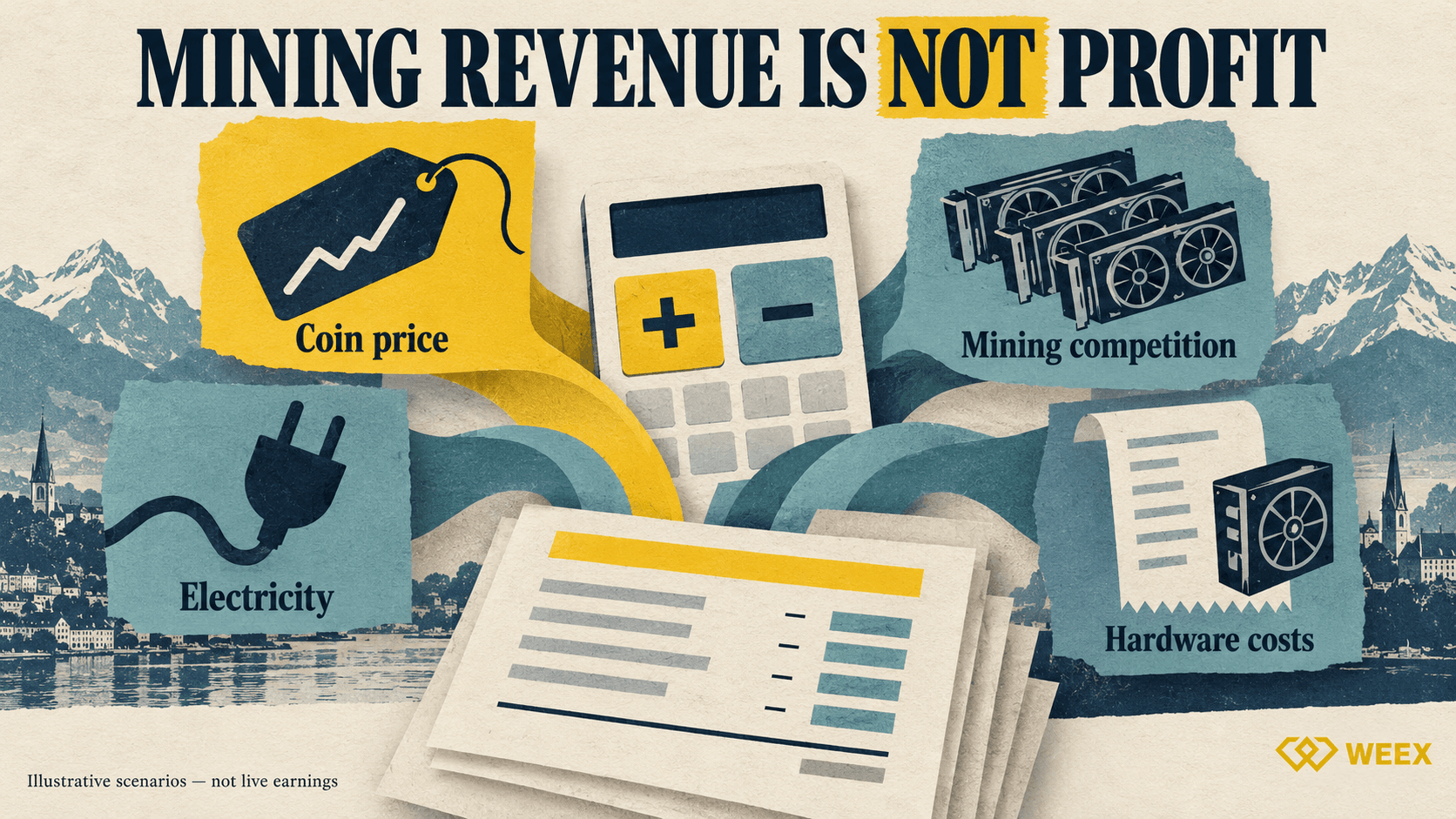
A dated pool snapshot can help illustrate the calculation, but results change with the network, hardware performance, electricity costs, and the price at which coins can actually be sold.
On its October 21, 2026 page, Kryptex reported approximately 79.92 EH/s of network hashrate, a 2,236.30 PRL block reward, roughly 157-second observed block spacing, and estimated daily issuance near 1,230,679 PRL. Its displayed price was $2.18. The page supplied a date, but not an exact intraday observation time.
These are one provider’s estimates. They should not be treated as perfectly synchronized measurements or guaranteed pool payouts.
A simplified steady-state estimate is:
Expected daily coins ≈ miner’s share of compatible network work × daily network issuance.
For illustration, assume a miner sustains 300 TH/s and the network estimate is 79.92 EH/s. Because 1 EH/s equals 1 million TH/s, its estimated share is:
300 ÷ 79,920,000 ≈ 0.000003754.
Multiplying by the reported daily issuance produces approximately 4.62 PRL per day. At the snapshot’s $2.18 reference price, that is about $10.07 gross.
This is a model, not a benchmark for a named GPU. It assumes comparable work units, continuous operation, no rejected work, and a reward share matching the network average.
Actual pool accounting may produce a different result.
How Much Could Pearl (PRL) Mining Earn After Costs?
Gross coin value is only the first line of the calculation.
The following scenario uses the estimated 4.62-coin output above, together with hypothetical operating assumptions. It is not a current earnings promise or a hardware recommendation.
| Daily Item | Illustrative Assumption | Estimated Amount |
|---|---|---|
| Gross mined-coin value | Approximately 4.62 coins at $2.18 | $10.07 |
| Combined mining-related fee allowance | 2% of gross value | −$0.20 |
| Electricity | 350 watts at the wall, 24 hours, $0.15/kWh | −$1.26 |
| Operating surplus | Before hardware and other expenses | $8.61 |
| Hardware-cost allowance | Assumed $2 per day | −$2.00 |
| Economic surplus | Under these assumptions | $6.61 |
The electricity calculation is:
0.35 kW × 24 hours × $0.15 = $1.26.
The hardware allowance is included because equipment is not free simply because it has already been purchased. Rental payments, depreciation, financing, repair, and resale value can change the result substantially.
A full calculation should also consider downtime and the costs of converting or transferring payouts.
The price used for accounting matters. Coins valued at $2.18 when mined may later sell at another price. Mining profitability and investment performance should be tracked separately rather than blending an operating loss with an unrealized holding gain.
What Happens if Pearl (PRL) Price Falls or Competition Rises?
A miner can face lower revenue even when the computer performs exactly as expected.
If competing work increases while issuance stays constant, the miner’s share declines. If the coin price falls, each unit earned converts into fewer dollars.
The sensitivity table below holds the earlier assumed daily costs constant: a 2% fee allowance, $1.26 electricity, and $2 hardware allocation.
| Illustrative Scenario | Estimated Daily Coins | Reference Price | Economic Surplus |
|---|---|---|---|
| Rounded baseline | 4.62 | $2.18 | $6.61 |
| Price falls 50% | 4.62 | $1.09 | $1.68 |
| Competing network work doubles | 2.31 | $2.18 | $1.68 |
| Both changes occur | 2.31 | $1.09 | −$0.79 |
These scenarios are arithmetic stress tests, not forecasts.
They show why a simple hardware payback estimate can be misleading. Dividing equipment cost by today’s daily surplus assumes that surplus persists throughout the recovery period.
It may not.
A stronger evaluation asks how long the equipment remains viable under unfavorable conditions and whether it retains value for another workload.
For rented hardware, compare the rental contract’s duration with the time needed to withdraw and sell rewards. Attractive projected revenue can disappear before a fixed rental commitment ends.
How Does Pearl (PRL) Supply Growth Affect Miners and Holders?
Mining distributes new coins, so issuance is both a miner’s revenue source and a holder’s supply consideration.
The reviewed source code sets a maximum supply of 2.1 billion coins and defines a cumulative issuance curve based on block height. The technical paper describes a smooth emission schedule rather than discrete halving events, with a target block interval of 194 seconds.
The distinction between block height and calendar time matters. If actual blocks arrive faster or slower than the target over a period, calendar-based issuance differs.
A smooth schedule does not mean low near-term supply growth. It means rewards change continuously under the specified rule.
Using the pool’s daily issuance snapshot solely as an illustration, roughly 1.23 million new coins at $2.18 represent about $2.68 million of reference market value.
That is not a claim that miners sell $2.68 million each day. Some may hold their rewards, and executable prices can differ. It quantifies the size of that day’s estimated distribution at the chosen price.
Investors should compare issuance with demand and market depth, while remembering that reported trading volume is turnover—not net buying power.
Where Can You Buy Pearl (PRL), and Is It on WEEX?
The first step is verifying the asset, followed by verifying a venue’s current support.
For Pearl mining rewards, confirm that the exchange identifies Pearl Research’s native network and supports the exact deposit route. A PRL label alone is inadequate.
During this review, WEEX’s PRL/USDT spot page described Perle Labs and linked to Solana-related resources. It therefore should not be presented as a route for selling native Pearl mining rewards. (Buy & sell PRL on WEEX)
Check Futures Identity Before Availability
WEEX has a PRL/USDT futures page, but its retrieved content displayed a trading-restriction notice and did not establish executable orders.
More importantly, the ticker does not establish that the contract references Pearl’s mining coin. No live WEEX futures market for this specific native asset was independently verified. (Start PRL futures trading on WEEX)
A derivative referencing another project is not a reliable hedge for Pearl mining income.
Use Product Pages to Resolve Confusion
The WEEX Perle information page is useful here because it helps identify the separate project behind WEEX’s PRL references.
That is a navigation benefit, not a recommendation to purchase it as a substitute.
If a correct Pearl market becomes available, check the product type, deposit network, withdrawal status, and fees before proceeding. The WEEX fee page provides the appropriate fee reference for supported products.
No Pearl-specific WEEX campaign or fee benefit was verified, so this article includes no reward assumption in the mining calculations.
Is Pearl (PRL) Crypto a Good Investment?
Pearl should be evaluated as a computing-and-blockchain thesis with several separate tests.
The technical test is whether the protocol and software perform as described. The commercial test is whether useful services attract repeat paying demand. The token test is whether demand and liquidity can support the asset as issuance continues.
A partnership announcement can strengthen the commercial context without answering the token valuation question.
Likewise, a criticism of an earlier mining implementation deserves attention without being automatically extrapolated to all later releases.
The investment case becomes stronger when evidence is specific and reproducible: dated software versions, customer-facing services, observable usage, transparent issuance, and functioning markets.
It becomes weaker when it relies on price appreciation as proof of computing adoption or assumes every mining reward represents revenue from an AI customer.
Mining and buying also create different exposures. A buyer primarily takes asset-price and custody risk. A miner adds equipment, operating, software, pool, and competition risks.
Before choosing between them, calculate whether mining acquires coins at a lower full cost than buying them through a verified market. If it does not, the hardware operation needs another justification.
FAQ
1. What Is Pearl (PRL) Crypto?
Pearl is a native blockchain project built around matrix-based proof of work. Its model aims to connect blockchain mining with computation relevant to AI.
2. Is Pearl (PRL) the Same as Perle (PRL)?
No. Perle Labs is a separate AI data project. Verify the network and project identity before selecting a wallet, market, or deposit address.
3. Can You Mine Pearl (PRL) With a Home Computer?
Some GPU setups can participate through compatible mining software. Whether a particular computer is suitable depends on hardware support, accepted performance, power use, and operating costs.
4. Is Pearl (PRL) Mining Profitable?
It can be under some conditions, but profitability is not fixed. Calculate expected payouts after electricity, software and pool fees, hardware costs, downtime, and conversion expenses.
5. Does Pearl (PRL) Mining Prove That AI Customers Are Paying?
No. A mining proof establishes compliance with the protocol’s work rules. Customer demand requires separate usage and revenue evidence.
WEEX Editorial View: Measure Useful Work and Full-Cost Returns Separately
Pearl’s most interesting proposition is the possibility of combining productive computation with blockchain security.
That proposition deserves a stronger standard of evidence than a rising coin price or a large network-hashrate figure.
Our conclusion is that readers should maintain two independent records: one measuring useful customer-facing work, and another measuring mining returns after all costs. A project can make progress on one while remaining weak on the other.
For miners, actual credited payouts and wall-power measurements should outweigh old benchmark screenshots. For investors, software development and partnerships should be connected to measurable demand rather than treated as automatic token value.
And before either group transfers funds, asset identity comes first. Pearl and Perle sharing a ticker is a practical risk that no profitability model can fix after the wrong deposit.
Sources
| Source | Document or Page | Relevant Date |
|---|---|---|
| Pearl Research Labs | Network overview and INT technical paper | Accessed October 21, 2026; exact page revision dates not established |
| Pearl Research Labs GitHub | Network repository and issuance source code | Accessed October 21, 2026; a specific software release was not tested |
| Together AI | Together AI and Pearl Research Labs Team Up to Reduce the Cost of AI Inference | Published May 15, 2026 |
| Abhinaba Basu, arXiv | The Usefulness Gap in Proof-of-Useful-Work | Submitted June 3, 2026; reviewed version revised June 5, 2026 |
| Kryptex Pool | Pearl network and mining information | Page dated October 21, 2026; exact intraday timestamp not provided |
| Phemex | Pearl project and mining overview | Updated September 17, 2026 |
| Pearl Coin Guide | Mining profitability analysis | Updated October 6, 2026; used to assess existing coverage, not as today’s earnings estimate |
| WEEX | Perle listing announcement, asset page, and PRL market pages | Accessed October 21, 2026 |
This content is provided for general informational purposes only and doesn't constitute financial, investment, legal, or tax advice. Any events, rewards, online promotions, or related information mentioned herein should not be considered a recommendation, solicitation, or invitation to purchase, sell, trade, or otherwise deal in any crypto assets. Crypto assets are highly volatile and may result in loss. The availability of WEEX services, products, and related events may vary by region. You are responsible for ensuring that your participation is in accordance with applicable local laws and regulations.
You may also like
What Happened to Aergo (AERGO) Crypto? Token Migration and What Holders Should Do
What Is HeyElsa (ELSA) Crypto and How Does It Work?

Stake ETH or Hold USDT on WEEX? The Price Move That Decides It
How Transparent Is a Crypto Exchange? Checking Proof of Reserves and Protection Funds
Token Unlocks This Week: How to Read AKE, ZRO and XPL Releases

World ID for Banks: What the New Suite Means for WLD Holders
Solana Alpenglow Upgrade: What Changes When Finality Hits 150ms
How to Use the WEEX Trust Center: Check Reserves, Protection Fund and Official Contacts
INJ Community BuyBack: What the $247K October Pool Really Means
What Is Leverage Trading in Crypto? A Beginner’s Guide With Simple Examples
What Is Crypto Margin Trading? How It Works, How It Differs From Futures and What Can Go Wrong
Crypto Leverage Trading Explained: How Perpetual Futures, Margin and Liquidation Work
Best Crypto Leverage Trading Platform: Things to Compare Before You Choose an Exchange
Nvidia Stock This Week: Why NVDA Fell Then Bounced and What AI Funding Worries Mean for Chip Stocks
Is My Pre-4.26.4 Qubic Wallet Unsafe? Recovery After the Network Restart

WXT Staking When Supply Shrinks: What Burns Add to Your Yield
Are Tokenized Stocks Backed by Real Shares? What Holders Own
ETH Funding Rate Today: 0.0087% per 8h as Ether Longs Re-Lever
Bitcoin Margin Trading: BTC Liquidation Math at 3x, 10x and 25x
Crypto Leverage Trading Platform: 6 Checks Before You Deposit

What Is Margin Trading? A $1,000 Example at 3x and 10x Leverage

The 17 October 2026 DBR Unlock: Six Allocations and deBridge's Vesting Schedule
Fake Crypto Payments: What to Check Before Handing Over Goods
What Is Leverage in Trading? How Leverage Ratios Like 5x and 10x Work and What They Do to Your Risk
What Is Leverage Trading? A Beginner’s Guide to Margin, Liquidation and Funding Fees
Is RSI a Good Indicator? How the Relative Strength Index Works, Its Limits and How Traders Use It
CXMT Stock Explained: What Is ChangXin Memory, Why It Fell on October 19 and What to Watch Next
Why Is CoreWeave (CRWV) Stock Falling? Debt, Bond Yields and What Analysts Say

KOSPI Whipsaw Explained: Samsung, SK Hynix and the AI Spending Doubts Behind the Swing
Is Bitget Leaving Russia? What Account Holders Should Check
What Happened to Aergo (AERGO) Crypto? Token Migration and What Holders Should Do
What Is HeyElsa (ELSA) Crypto and How Does It Work?
Stake ETH or Hold USDT on WEEX? The Price Move That Decides It
How Transparent Is a Crypto Exchange? Checking Proof of Reserves and Protection Funds
Token Unlocks This Week: How to Read AKE, ZRO and XPL Releases
World ID for Banks: What the New Suite Means for WLD Holders


