
SpaceX Stock (SPCX): Now Public, and Back Where It Started

 Prefer us on Google


For two decades, "SpaceX stock" was a trick question — the company was private, and only insiders and accredited investors could touch secondary shares. That ended on June 12, 2026, when SpaceX listed on the Nasdaq under the ticker SPCX. The more interesting story is what happened next: the stock spiked, then handed back every dollar of its opening gain. As of mid-July 2026, SPCX trades at roughly its $135 IPO price, which makes this a very different conversation than the "how do I get pre-IPO access" guides that still dominate most search results.
Is SpaceX stock public now?
Yes. SpaceX is a publicly traded company as of June 12, 2026, listed on the Nasdaq as SPCX. You no longer need to be an employee, an accredited investor, or a client of a private-markets platform to own it — any standard brokerage that lists Nasdaq equities can trade it, and several crypto venues offer SPCX-linked products. The scarcity that defined "SpaceX stock" for twenty years is gone. What replaced it is an ordinary problem: a very expensive stock that has to be judged on price, not access.
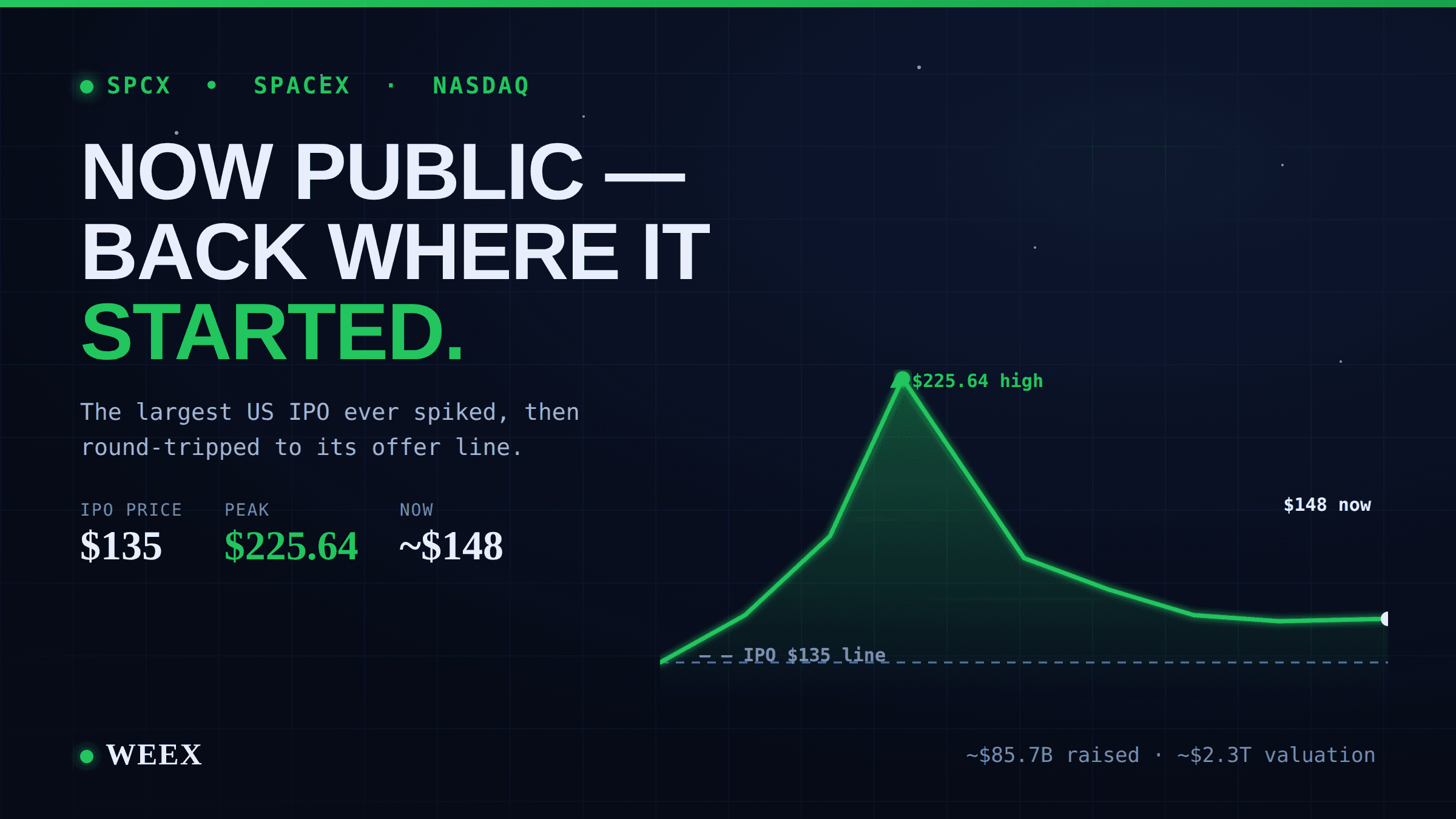
SpaceX stock price today and the post-IPO round trip
The IPO priced at $135 per share and drew more than $350 billion in total demand, one of the largest order books ever assembled for a listing. It opened indicated around $175 and closed its first day at about $161, up roughly 19%. Within the first week it ran to an intraday high of $225.64, briefly pushing SpaceX's market value above $2.6 trillion. Then gravity showed up. On July 15, 2026, SPCX slipped below its $135 offer price for the first time, touching an intraday low of $132.28, and it has hovered near the offer price since — down more than 40% from that first-week peak.
| SPCX milestone | Date | Level |
|---|---|---|
| IPO offer price | Jun 12, 2026 | $135.00 |
| Day-one close | Jun 12, 2026 | ~$161 (+19%) |
| First-week peak | Jun 2026 | $225.64 (mkt cap ~$2.6T) |
| First close below offer | Jul 15, 2026 | intraday low $132.28 |
| Late July level | Jul 2026 | ~$135 |
Data as of July 21, 2026; sources: CNBC, Investing.com, TradingKey.
The practical takeaway: anyone who bought the hype in week one is underwater, while the IPO price itself has so far acted as a rough floor. That $135 line is now the level the market is arguing about.
Why did SpaceX stock fall below its IPO price?
Nothing broke at the company. The pullback is textbook post-IPO mechanics stacked on a stretched starting valuation. Three forces did most of the work. First, the debut was priced for perfection — a $2 trillion-plus implied value on a business that is still deeply unprofitable, so any wobble in sentiment hit hard. Second, early buyers who flipped the pop took profits into the first-week spike, and momentum reversed once the marginal buyer disappeared. Third, the market began pricing in the eventual lockup expirations, when insider and pre-IPO shares become sellable and supply increases. Read this as digestion of an aggressive IPO price, not a referendum on Starship or Starlink.
Is SPCX overvalued? Market cap vs. analyst fair value
This is where SPCX gets genuinely contentious. Even after the slide, SpaceX carried a market capitalization near $1.77 trillion in mid-July 2026. Several analysts running a sum-of-the-parts model — valuing the launch business and Starlink separately — land closer to $900 billion, which would imply a share price around $131. In other words, the market is paying roughly twice the conservative fair-value estimate, and the stock is doing it while still posting large losses.
| Measure | Figure (as of Jul 2026) |
|---|---|
| Market cap | ~$1.77 trillion |
| Implied share price | ~$135 |
| Analyst sum-of-parts fair value | ~$900B (~$131/share) |
| 2025 net loss | $4.94 billion |
| Q1 2026 net loss | $4.28 billion |
| Forward price-to-sales | >30x |
Sources: Investing.com, TradingKey, July 2026.
The more useful framing than "overvalued or not" is this: the bull case is not about current earnings, it's about Starlink's cash generation scaling and a possible future spinoff. The bear case is that a >30x sales multiple on a business losing several billion dollars a year leaves no room for execution slips. Where you land on SPCX is really a bet on how fast Starlink monetizes.
How to buy and trade SpaceX stock, including on WEEX
There are now three broad routes to SPCX exposure. A standard brokerage that lists Nasdaq stocks lets you buy the shares outright — the cleanest way to own the equity, subject to market hours and your broker's access. Tokenized-equity and pre-IPO products, which grew loud during the pre-listing frenzy, now track the live SPCX price rather than a speculative private mark; they trade around the clock but add an issuer and custody layer you should understand before using. Third, crypto-settled derivatives let traders take long or short positions with leverage, which is how many active traders play a volatile, freshly-public name like this.
For crypto-native access, WEEX documents how to get SPCX exposure with stablecoin settlement in its walkthrough on how to buy and trade SpaceX stock after the IPO. If you want the mechanics behind the recent drop before you size a position, WEEX also breaks down why SPCX pulled back after its IPO. And if you are weighing tokenized exposure specifically, the primer on whether tokenized stocks are the next trend is worth reading first, because tokenized exposure is not the same as owning registered equity. Whichever route you pick, position size around the fact that SPCX has already shown it can move 40% in weeks.
What could move SPCX next: lockups, Starlink, Starship
The next few months are event-driven. The single most predictable pressure point is the lockup expiration schedule, which releases insider and pre-IPO shares and mechanically adds supply. The single biggest swing factor is Starlink — its subscriber growth, pricing, and any move toward a separate listing. Starship's flight cadence matters too, but mostly as a read on execution and how fast SpaceX burns capital.
| Factor | Why it matters | Likely pressure |
|---|---|---|
| Lockup expiry | Insider/pre-IPO shares unlock, raising float | Supply overhang |
| Starlink monetization | Primary revenue engine, possible spinoff | Two-way swing |
| Starship flight rate | Execution signal, heavy capex | Two-way swing |
| Valuation gap | Market cap ~2x conservative fair value | Downside risk |
The honest summary: SPCX is now a normal stock with an abnormal valuation and a well-telegraphed supply event ahead. That combination tends to produce more of the volatility traders just watched, not less.
FAQ
1. Can I buy SpaceX stock now?
Yes. Since June 12, 2026, SpaceX trades publicly on the Nasdaq as SPCX, so any brokerage with Nasdaq access can buy it, and several crypto platforms offer SPCX-linked products.
2. What is SpaceX's stock price today?
As of mid-to-late July 2026, SPCX trades around its $135 IPO price after peaking near $225.64 in its first week and falling below the offer price on July 15, 2026. Prices change constantly — check a live quote before trading.
3. Why did SpaceX stock fall after the IPO?
It was priced for perfection at a $2 trillion-plus valuation, early buyers took profits after the first-week spike, and the market started pricing in upcoming lockup expirations. The pullback reflects an aggressive IPO price digesting, not a company failure.
4. Is SpaceX stock overvalued?
At a ~$1.77 trillion market cap versus roughly $900 billion in analyst sum-of-parts fair value, SPCX trades at about twice a conservative estimate while still posting multi-billion-dollar losses. Whether that is justified depends almost entirely on how fast Starlink scales.
5. What is the difference between SPCX shares and a tokenized SpaceX stock?
SPCX shares are registered equity you hold through a broker. A tokenized SpaceX product tracks the price but adds an issuer, custody, and settlement layer, and generally does not give you the legal rights of a shareholder. Understand the structure before choosing.
Risk Warning
SPCX is a newly public, highly volatile equity trading at a large premium to conservative fair-value estimates, and it has already fallen more than 40% from its first-week peak. Prices, valuations, and the figures above are dated to July 2026 and will change. Specific risks include valuation compression if Starlink monetization disappoints, supply pressure from lockup expirations, and — for leveraged or crypto-settled positions — liquidation, funding-rate, custody, counterparty, and regulatory risk. Tokenized-equity products carry issuer and redemption risk and are not equivalent to owning registered shares. Trading equities and crypto derivatives can result in partial or total loss of capital. This article is educational information, not investment advice; do your own research and size positions accordingly.
Disclaimer: This content is provided for general branding and informational purposes only and doesn't constitute financial, investment, legal, or tax advice. Any events, rewards, online events, or related information mentioned herein should not be considered a recommendation, solicitation, or invitation to purchase, sell, trade, or otherwise deal in any crypto assets or to use any services. Crypto assets are highly volatile and may result in loss. WEEX services and online events may not be available in all regions and are subject to applicable laws, regulations, and eligibility requirements. You are responsible for ensuring that your use of WEEX services complies with local laws and for carefully assessing the risks before participating in any crypto-related activities.
You may also like

How Will the CLARITY Act and Bank-Grade Stablecoin KYC Rules Change Crypto Trading in 2026
Why Is BitMine Buying Millions of Ethereum Tokens and Staking $9 Billion in ETH in 2026
How to Protect Your Bitcoin from Physical Attacks: Lessons From the NYC Crypto Torture Case in 2026

What Is the NYC Crypto Kidnapping Case? The Soho Bitcoin Attack Explained — 2026 Case Analysis
USA Rare Earth (USAR): What It Is and How to Trade the Token
NVIDIA Stock in 2026: Real Shares, Tokenized NVDA, and Perpetuals Compared
How to Buy USAR Coin: Buying Tokenized USA Rare Earth Stock the Right Way
WEEX Poker Party Series 4: Draw Cards to Split a $1M USDT Pool
Who Really Makes Money on Prediction Markets? Smart Money vs Retail Traders
The Hidden Problem With Prediction Markets: Who Pays the Winners?
Prediction Markets Are the Future of Finance or Just Gambling?
How Polymarket and Kalshi Turned Predictions Into a Billion-Dollar Business
Why Prediction Markets Are So Hard to Regulate: The CFTC vs SEC Debate
Are Prediction Markets Legal? CFTC vs SEC Regulation Explained
Why Is TSMC Stock Down After a 77% Profit Jump? What Wall Street Is Actually Worried About
Is Samsung Stock a Buy at Its Lowest Level Since the AI Boom Began?
Samsung Stock and the KOSPI Bear Market: What the 30% Decline From Peak Tells Investors
Oil Price Above $90: What the US-Iran War Means for Your Portfolio Right Now
Iran War and Bitcoin: Why Crypto Is Not Acting Like a Safe Haven at $90 Oil
KOSPI Stock Market Enters Bear Market: What a 25% Drop From the Peak Means for Investors
KOSPI Stock Bear Market: What It Means for Samsung, SK Hynix and Korean Chip Stocks
Is the KOSPI Stock Market a Buy After Entering Bear Market Territory?
SK Hynix Leveraged ETFs SKHL SKHX SKHZ: What Each One Does and Who Should Use Them
Barclays Sees 70% Upside for SK Hynix Stock: What the Overweight Rating Means
Is SK Hynix Stock a Buy Now? What the 52 Week Low and IPO Price Break Tell Investors
Is This Really Messi's Last World Cup? What the 2026 Final Means for His Legacy
Who Is Ferran Torres? The Substitute Who Won the 2026 World Cup for Spain
2026 FIFA World Cup Winner: Spain Beats Argentina to Claim Second World Title
SK Hynix Stock: SKHY's Wild Nasdaq Debut and What Comes Next
JEPQ Stock in 2026: Price, Monthly Dividend, and Real Risks
How Will the CLARITY Act and Bank-Grade Stablecoin KYC Rules Change Crypto Trading in 2026
Why Is BitMine Buying Millions of Ethereum Tokens and Staking $9 Billion in ETH in 2026
How to Protect Your Bitcoin from Physical Attacks: Lessons From the NYC Crypto Torture Case in 2026
What Is the NYC Crypto Kidnapping Case? The Soho Bitcoin Attack Explained — 2026 Case Analysis
USA Rare Earth (USAR): What It Is and How to Trade the Token
NVIDIA Stock in 2026: Real Shares, Tokenized NVDA, and Perpetuals Compared
Contents
Popular coins
Latest articles


