
What Happened to Aergo (AERGO) Crypto? Token Migration and What Holders Should Do

 Prefer us on Google


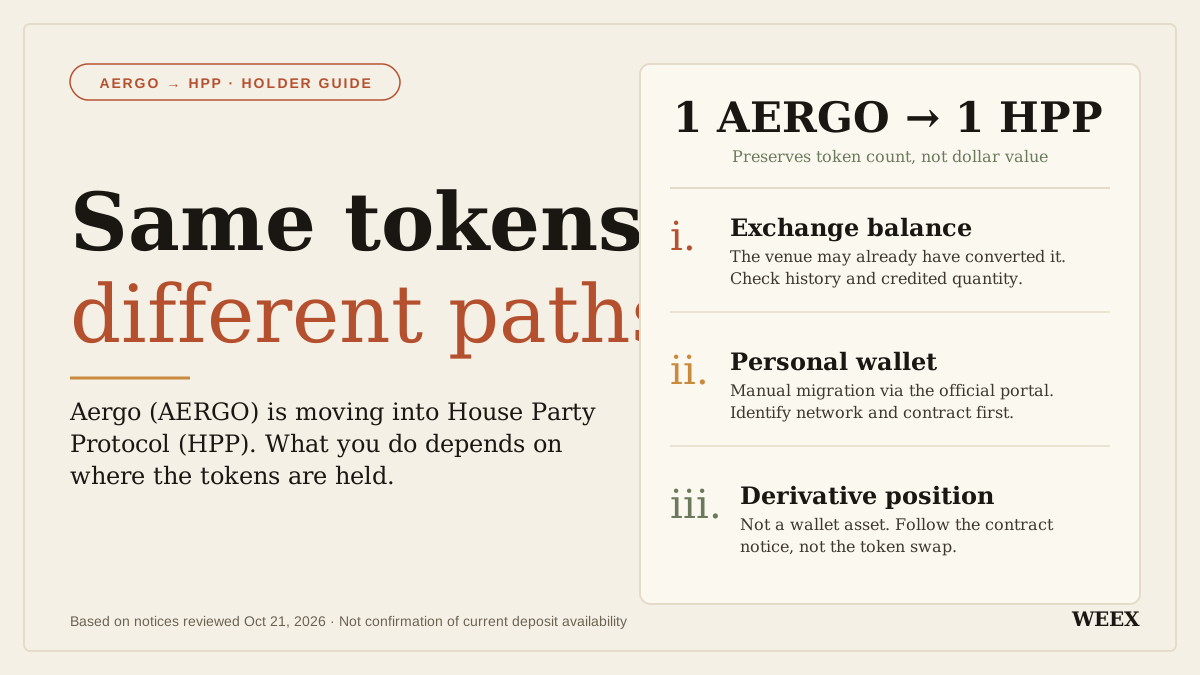
Aergo is transitioning into House Party Protocol, with eligible AERGO tokens convertible into HPP at a published 1:1 ratio. What holders need to do depends on where their assets are stored: participating exchanges may have processed the conversion automatically, while personal-wallet holders need to follow the official migration route. An old AERGO balance, an HPP balance on Ethereum, and an HPP balance on the new mainnet should not be treated as identical operational states.
The most important issue is asset continuity. Holders need to establish what they own, whether it has already been converted, and which network the destination supports before making a transfer. A new ticker does not guarantee uninterrupted exchange access, and a 1:1 token swap does not guarantee that the investment retains its previous market value. Those distinctions deserve more attention than promotional claims about a new ecosystem.
For asset research, compare the WEEX Aergo price page with the separate WEEX House Party Protocol price page. Keeping those references separate helps avoid mixing legacy and successor market data. These are information pages, not evidence that either asset is currently available for new orders; trading status and supported deposit networks require their own checks.
What Happened to Aergo (AERGO)?
Aergo’s transition involves a broader ecosystem change rather than a simple adjustment to its display name.
The April 2025 House Party Protocol white paper describes an initiative combining Aergo’s enterprise-blockchain background with additional data and AI-related infrastructure. Its proposed architecture includes legacy infrastructure, Ethereum, and a Layer 2 execution environment. These are project descriptions and strategic objectives, not independent proof of adoption or commercial success. (paper.aergo.io)
For token holders, however, the immediate question is more concrete: how does an existing balance become an asset usable in the successor ecosystem?
That process is the migration. It may involve an exchange updating customer balances internally or a wallet holder completing transactions through an official portal.
The distinction matters because a project can announce its new network before every trading venue finishes supporting it. Wallet interfaces, price aggregators, exchanges, and documentation may update on different schedules.
As a result, seeing the old AERGO name somewhere does not prove that migration has failed. Seeing the new HPP name does not prove that a particular balance is ready for deposit into every exchange.
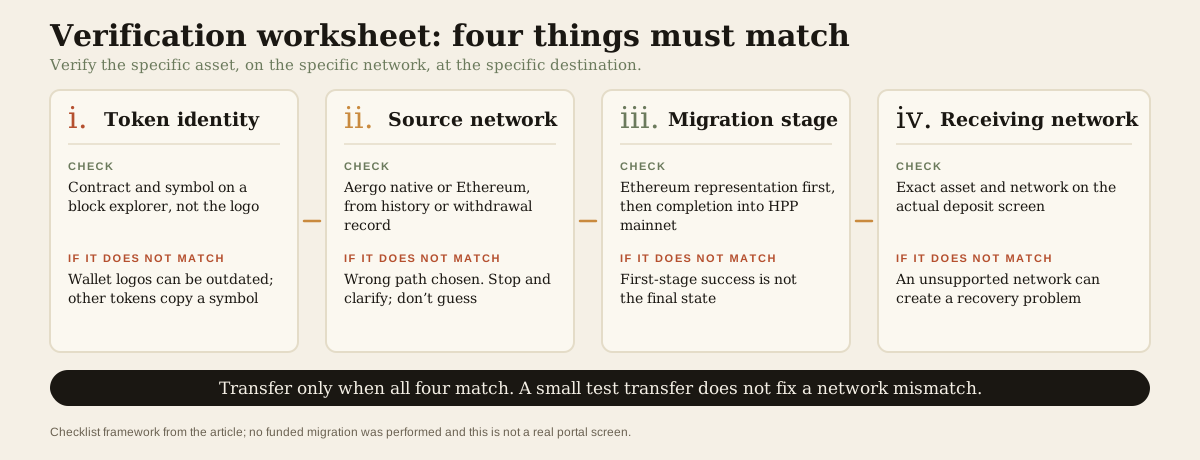
The correct unit of verification is the specific asset on the specific network at the specific destination.
Are Aergo (AERGO) and House Party Protocol (HPP) the Same Asset?
They are connected through a documented migration, but holders should not treat their tickers, contracts, and supported networks as interchangeable.
A migration establishes a conversion relationship. It does not mean that every system accepting the successor token can still accept the legacy token.
The official HPP portal distinguishes legacy native AERGO, Ethereum-based AERGO, and HPP representations across networks. It describes a route through HPP on Ethereum before completion into HPP on the new mainnet. (HPP Portal)
A practical comparison is therefore more useful than a simple yes-or-no answer.
| Holding or Position | What It Represents | What Needs Checking |
|---|---|---|
| AERGO held on an exchange | A customer balance under that venue’s rules | Whether the venue supported the swap and credited the successor balance |
| AERGO in a personal wallet | An onchain legacy holding | Network, contract identity, and supported migration path |
| HPP on Ethereum | A particular network representation of the successor token | Whether another migration or bridge step is needed for the intended destination |
| HPP on the new mainnet | A balance on that network | Destination compatibility and current deposit support |
| An AERGO futures position | A derivative referencing a market | Contract-specific settlement, suspension, or delisting rules |
This separation prevents a common mistake: assuming that matching names or matching quantities establish transfer compatibility.
An exchange deposit system may recognize only one network representation. Sending a different representation can create a recovery problem even if the wallet address looks valid.
What Does the Aergo (AERGO) 1:1 Swap Ratio Mean?
A 1:1 ratio means that an eligible quantity of AERGO converts into the same numerical quantity of HPP under the applicable migration rules.
For example, a qualifying balance of 2,500 AERGO would correspond to 2,500 HPP before considering any separately applicable transaction costs or platform adjustments. Crypto.com and MEXC both describe a 1:1 conversion in their migration notices.
The ratio does not establish a dollar value.
Suppose a holder originally paid $250 for 2,500 tokens. After migration, the holder receives the same number of successor tokens. If those tokens subsequently trade at $0.06, their market value would be $150.
The token count was preserved. The original investment value was not.
The reverse is also possible: a successor token could trade at a higher price. That outcome would come from market conditions and demand, not from the conversion ratio itself.
There are therefore three separate calculations:
Conversion quantity = eligible legacy quantity × conversion ratio.
Market value = successor-token quantity × executable market price.
Net proceeds = sale value minus applicable trading and transfer costs.
Keeping these calculations separate makes it easier to assess whether a balance was converted correctly without confusing conversion accuracy with investment performance.
-- Price
What Should Aergo (AERGO) Holders Do First?
Before connecting a wallet or transferring anything, identify where the holding exists and what type of holding it is.
The first question is whether you hold an actual token balance or only a trading position. A futures contract does not become a wallet asset merely because the underlying project migrates.
For token holders, the next question is custody. An exchange can process a supported migration within its own accounting system. A personal wallet normally requires an onchain process.
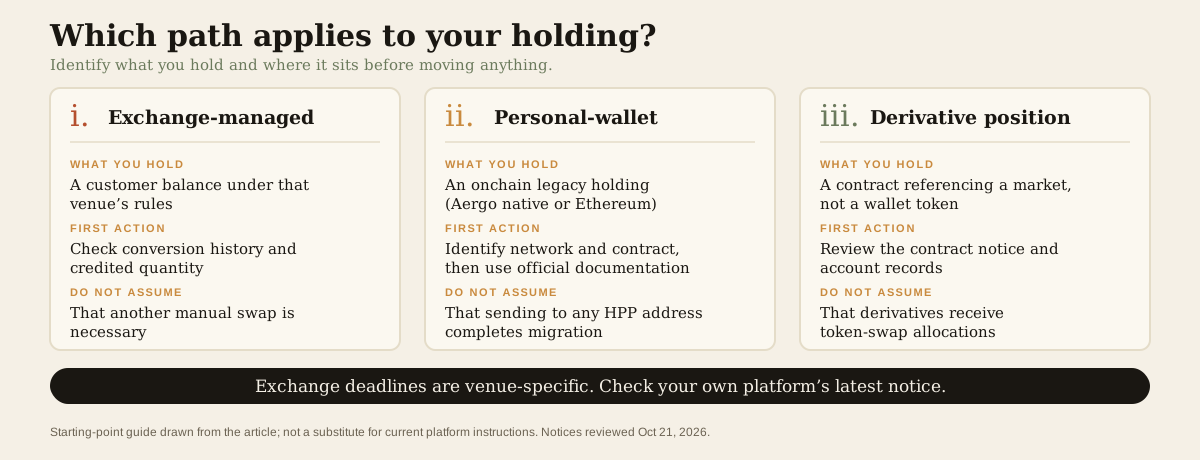
The following table provides a starting point rather than a substitute for current platform instructions.
| Your Situation | First Action | Avoid Assuming |
|---|---|---|
| Exchange balance already displays HPP | Check conversion history and credited quantity | That another manual swap is necessary |
| Exchange balance still displays AERGO | Read that exchange’s latest migration notice | That another exchange’s deadline applies |
| Personal wallet holds legacy tokens | Identify network and contract, then consult official documentation | That sending to any HPP address completes migration |
| Wallet displays HPP but destination rejects it | Compare the source and receiving networks | That identical tickers mean compatible deposits |
| You hold an open derivative | Review the contract notice and account records | That derivatives receive token-swap allocations |
| You bought legacy tokens after a venue’s snapshot | Confirm eligibility directly | That historical automatic conversion remains available |
The most useful evidence is often already in the account: transaction history, balance adjustments, withdrawal records, and dated announcements.
Save those records before attempting to resolve a missing balance. A clear timeline is more useful to support teams than a screenshot showing only the current ticker.
How Did Exchanges Handle the Aergo (AERGO) Migration?
Exchange notices show that implementation was staggered. There was no single date on which every venue changed its customer balances.
MEXC’s May 11, 2026 completion notice stated that the conversion had been processed. KuCoin’s May 20 notice described its own snapshot and reopening arrangements. Crypto.com subsequently reported completion for eligible app users in a June 25 update. (mexc.com)
These examples establish a crucial point: migration support is venue-specific.
| Platform | Published Information Reviewed | Practical Implication |
|---|---|---|
| MEXC | Completion notice dated May 11, 2026 | The notice also says old-token deposits and further old-token swaps are unsupported |
| KuCoin | Completion notice dated May 20, 2026 | Its published instructions warn against depositing old AERGO |
| Crypto.com App | Completion update dated June 25, 2026 | Conversion applied to eligible balances under its app arrangements |
These are historical notices reviewed on October 21, 2026. They should not be read as fresh confirmations that every service remains available today.
A holder should distinguish a completed conversion from current deposit availability. A platform can support the successor asset while refusing legacy deposits.
Similarly, an exchange’s conversion announcement does not guarantee that assets transferred after its cutoff receive the same treatment. Snapshot eligibility is an accounting condition, not a general promise to convert anything sent later.
If your balance appears incorrect, ask the venue to reconcile the eligible amount, snapshot time, conversion entry, and any later withdrawals.
How Can You Migrate Aergo (AERGO) From a Personal Wallet?
The official migration guide distinguishes personal-wallet holders from customers whose exchange handled the conversion. It identifies manual migration as the relevant route for personal holdings. (Aergo.docx)
Start from the official HPP migration documentation, which links to the project’s guide and portal. Do not replace that route with a link received through an unsolicited message.
A careful workflow has five stages.
1. Identify the Starting Asset
Determine whether the tokens are on Aergo’s native network or Ethereum.
Use the wallet’s transaction history and the relevant explorer rather than relying solely on the displayed logo. Wallet metadata can be outdated, and unrelated tokens can copy a symbol.
If the asset came from an exchange withdrawal, preserve the withdrawal record and selected network.
2. Read the Current Route Before Authorizing Anything
The official migration portal offers different starting paths. Select the path corresponding to the actual holding.
Review the destination network, expected output, permissions, and transaction costs before proceeding. If the instructions do not match the asset you hold, stop and clarify rather than trying a different path by guesswork.
3. Review Wallet Requests
Connecting a wallet is different from approving token spending or submitting a transfer.
Read each request. Check whether it authorizes a specific amount, creates a broader allowance, or moves assets. A migration site should not need your recovery phrase to interact with a connected wallet.
Do not approve an unfamiliar request merely because the page shows an expected balance.
4. Confirm the Result of Each Stage
After an onchain action, inspect the transaction record and resulting asset balance.
The portal describes an intermediate Ethereum representation and a completion step into HPP mainnet. A successful first-stage transaction therefore does not necessarily mean the intended final state has been reached. (HPP Portal)
This article did not perform a funded migration, so it does not certify current transaction completion times or wallet-specific screen sequences.
5. Verify the Receiving Venue Before Transferring
Before sending the result elsewhere, check the destination’s supported asset and network.
A small test transfer can reduce the amount exposed to an operational mistake when deposits are supported, minimums are understood, and the cost is reasonable. It does not solve a known network mismatch.
Keep enough of the required network-fee asset for later transactions where applicable.
Is There an Aergo (AERGO) Migration Deadline?
The official portal reviewed for this article did not specify a final calendar deadline. It said that any deadline would be announced through official channels in advance.
That is different from a guarantee that migration remains open indefinitely. (HPP Portal)
It is also different from an exchange’s deadline.
A project portal can remain accessible after a particular exchange stops accepting the legacy asset. Conversely, a venue may set an internal cutoff before it reopens successor-token services.
Holders should record the scope of every date they encounter: project migration, exchange snapshot, deposit suspension, trading reopening, or withdrawal cutoff.
Treat an undated community post cautiously. “Migration is complete” might describe one venue’s customer balances rather than every wallet on every network.
Why Can Aergo (AERGO) and House Party Protocol (HPP) Show Different Prices?
A published conversion ratio does not force two markets to display identical prices at every moment.
Market data can differ because quotes refer to different assets, networks, venues, or observation times. A legacy market may also have limited depth or restricted transfers.
Before comparing prices, establish whether both quotes are current and executable. A price-information page can continue displaying an asset after a venue changes trading support.
The apparent difference may disappear once costs and access conditions are included.
Consider a hypothetical example: a legacy token is quoted at $0.020 while its successor is quoted at $0.030. At first glance, a 1:1 conversion appears to offer a $0.010 spread.
But that calculation assumes that the legacy asset can be purchased at the displayed price, withdrawn, migrated, deposited, and sold at the successor quote.
If any stage is unavailable, the apparent spread may not be accessible. If the order book is thin, a larger purchase may execute at a much worse average price.
An actionable comparison therefore needs:
Expected successor sale proceeds minus legacy purchase cost, migration costs, transfer costs, trading fees, and slippage.
It also needs a realistic assessment of the time during which the price can change.
A migration ratio establishes quantity conversion. Arbitrage requires an executable route.
Does the Migration Make House Party Protocol (HPP) a Better Investment?
Migration can reduce fragmentation, but it does not independently establish an attractive valuation.
The HPP documentation describes a unified utility and governance framework with allocations for several stakeholder groups. Its white paper presents a broader ecosystem strategy. Those materials help explain the project’s intentions; they do not demonstrate future returns. (HPP Builders)
Investors need to evaluate the successor system on its own terms.
A useful assessment examines which applications are operating, whether developers maintain them, whether customers use them repeatedly, and what demand those activities create for the token.
Supply also needs a fresh review. Preserving an individual holder’s token count does not necessarily preserve that holder’s percentage of a reorganized ecosystem.
For illustration, owning 1,000 units out of a hypothetical 1 million-unit supply represents 0.1%. Owning the same 1,000 units out of 2 million represents 0.05%.
This example does not describe the actual migration allocation. It shows why a 1:1 conversion and unchanged ownership share are separate concepts.
Historical AERGO valuation figures should therefore not be carried into an HPP investment model without checking the successor’s supply definitions and distribution.
What If Your Aergo (AERGO) Balance Is Missing or Unchanged?
A missing display, unchanged ticker, or unexpected amount can have several explanations. The first task is to locate the asset through records rather than repeatedly moving funds.
For an exchange account, inspect balance history and migration adjustments. Check whether the token moved into a different asset category or whether an internal credit was recorded separately.
For a personal wallet, inspect the correct network and transaction explorer. A wallet may fail to display a token even when the address holds it. Adding a display entry does not create or recover assets; it only changes what the interface shows.
If a transfer has already been made to an unsupported destination, stop making further transfers. Collect the transaction hash, network, asset contract, amount, receiving address, and time.
Then contact the destination through its verified support route. Recovery may depend on technical control, policy, and operational capability. It should not be assumed.
Do not pay an unsolicited “recovery agent” who claims that another transfer is required to unlock the first one.
How Can You Avoid Aergo (AERGO) Migration Scams?
Migration creates a convincing pretext for impersonation because holders expect changes and may feel uncertain about deadlines.
A fraudulent page may copy the project’s branding and offer an urgent conversion. The dangerous part is the transaction or permission it requests.
Begin with documentation reached through established official sources. Compare the domain carefully, then verify the requested asset, network, and action.
A genuine conversion ratio does not authenticate a website. Neither does a familiar logo or a copied announcement.
Messages demanding a recovery phrase, private key, remote computer access, or a separate payment to “activate” migration should not be treated as normal wallet procedures.
For exchange questions, contact the platform from within its official application or website. A stranger approaching you after a public support request is not proof of platform affiliation.
How Can You Check Aergo (AERGO) and House Party Protocol (HPP) on WEEX?
WEEX provides separate information pages for the legacy and successor assets. Use the Aergo market-information page for the old identifier and the House Party Protocol market-information page for the successor identifier.
Do not combine their historical figures into a continuous return series without verifying how migration was handled.
Futures Availability Comes First
The AERGO/USDT futures page and HPP/USDT futures page resolved during research, but the retrieved content displayed trading-restriction notices and incomplete live fields.
These responses did not establish that new positions were available. They also do not establish the full authenticated trading state. Confirm current status through the platform interface and official notices before placing an order. (WEEX)
If a contract is available, verify its exact underlying asset. A legacy-referencing derivative should not be assumed to migrate into a successor contract.
Spot and Deposits Need Separate Verification
The retrieved spot pages did not provide sufficient live order-book information to confirm active execution. The HPP information page also displayed “Not listed.”
Accordingly, this guide does not present WEEX as a confirmed destination for migrating or depositing either token. (WEEX)
If support becomes available, confirm the network on the actual deposit screen. A trading pair’s existence does not establish support for every onchain representation.
Fees and Campaigns Should Not Decide Migration
Consult the WEEX fee page for the applicable product and account tier when trading is available.
No AERGO- or HPP-specific fee discount or currently claimable campaign with complete relevant conditions was verified in this review. No reward assumption is therefore included in the migration examples.
The correct sequence is asset verification, network compatibility, operational availability, and then costs. A promotional reward cannot compensate for sending the wrong asset.
FAQ
1. Did Aergo (AERGO) Change to House Party Protocol (HPP)?
The project documents a transition into HPP, and several exchanges have published completed conversion notices. The action required depends on where the tokens are held.
2. What Is the Aergo (AERGO) to House Party Protocol (HPP) Conversion Ratio?
The reviewed notices specify 1 AERGO to 1 HPP for eligible conversions. That preserves the numerical token amount under the rules, not a guaranteed dollar value.
3. Do Exchange Holders Need to Migrate Aergo (AERGO) Manually?
Not necessarily. A supporting exchange may already have processed eligible balances. Check that venue’s account records and latest announcement before taking further action.
4. Can You Deposit Old Aergo (AERGO) Tokens Into a House Party Protocol (HPP) Address?
Do not assume so. The destination must explicitly support the exact asset and network. Reviewed MEXC and KuCoin notices warn against old-token deposits after their conversions.
5. Does an Aergo (AERGO) Futures Position Receive House Party Protocol (HPP) Tokens?
A futures position is a derivative, not an onchain token holding. Any treatment depends on the exchange’s specific contract rules and notices.
WEEX Editorial View: Establish Asset Continuity Before Evaluating the Opportunity
The transition gives holders two separate tasks: complete any necessary operational steps and reassess the successor investment.
The first task requires precise records, supported networks, and current platform instructions. The second requires evidence about applications, adoption, token demand, and supply.
Conflating those tasks creates avoidable mistakes. A correctly completed migration does not prove a strong investment case, while uncertainty about a wallet display does not establish that the assets are lost.
Our conclusion is straightforward: reconcile the holding first. Identify the asset, confirm the conversion history, and verify the destination. Only then compare valuations or consider a new trade.
Sources
| Source | Document | Publication or Review Date |
|---|---|---|
| HPP Builders | Migration Guide and linked migration PDF | Accessed October 21, 2026; exact revision date not established |
| HPP Portal | Migration paths and FAQ | Accessed October 21, 2026 |
| House Party Protocol | Public Mainnet Is Live | Accessed October 21, 2026; describes August 18, 2025 mainnet launch |
| House Party Protocol | White Paper, Version 1.0 | April 2025 |
| HPP Builders | Tokenomics | Accessed October 21, 2026 |
| MEXC | AERGO-to-HPP conversion completion notice | May 11, 2026 |
| KuCoin | AERGO-to-HPP conversion completion notice | May 20, 2026 |
| Crypto.com | AERGO swap and rebrand announcement | June 17, 2026; updated June 25, 2026 |
| WEEX | Asset-information pages, market interfaces, and fee page | Accessed October 21, 2026; retrieved market fields did not establish executable quotes |
This content is provided for general informational purposes only and doesn't constitute financial, investment, legal, or tax advice. Any events, rewards, online promotions, or related information mentioned herein should not be considered a recommendation, solicitation, or invitation to purchase, sell, trade, or otherwise deal in any crypto assets. Crypto assets are highly volatile and may result in loss. The availability of WEEX services, products, and related events may vary by region. You are responsible for ensuring that your participation is in accordance with applicable local laws and regulations.
You may also like
ETH Funding Rate Today: 0.0087% per 8h as Ether Longs Re-Lever
What Is Blockchain and How Does It Work? One Transaction, Traced
Staking APR vs Inflation: How Much of Your Crypto Yield Is Real?
WEEX Convert Fees: What Zero-Fee Conversion Really Costs You
WEEX Convert Quote: How the 8-Second Price Lock Really Works
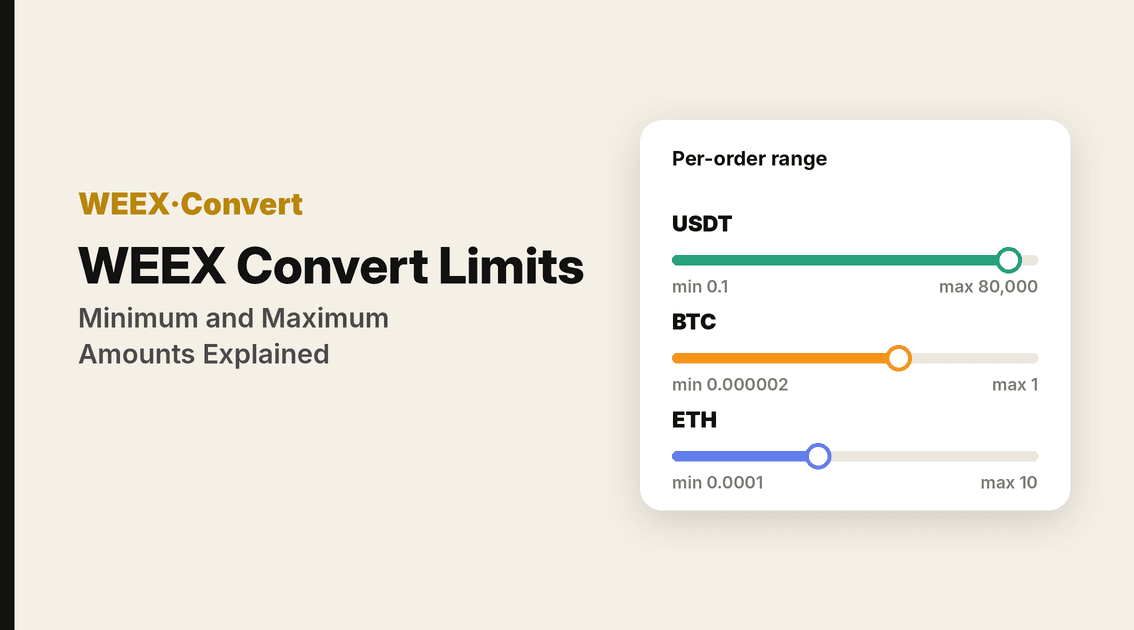
WEEX Convert Limits: Minimum and Maximum Amounts Explained
How to Check a WEEX Convert Order: History, Rate and Status
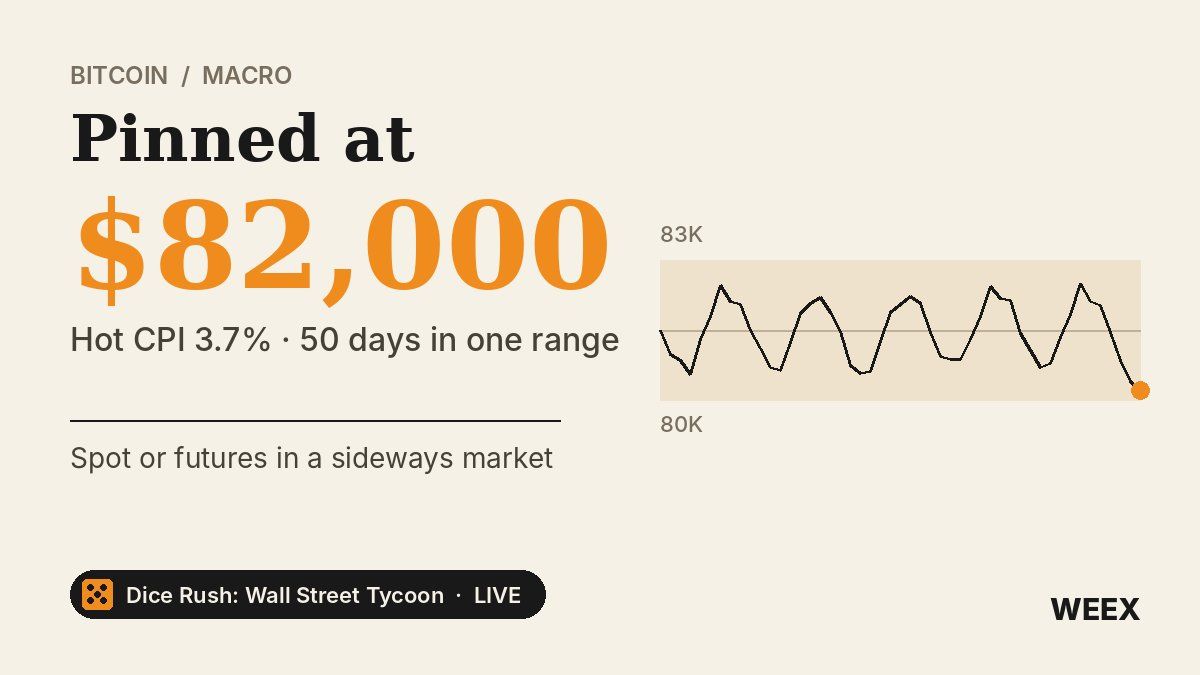
Bitcoin Price After Hot CPI: Why BTC Is Pinned Near $82,000
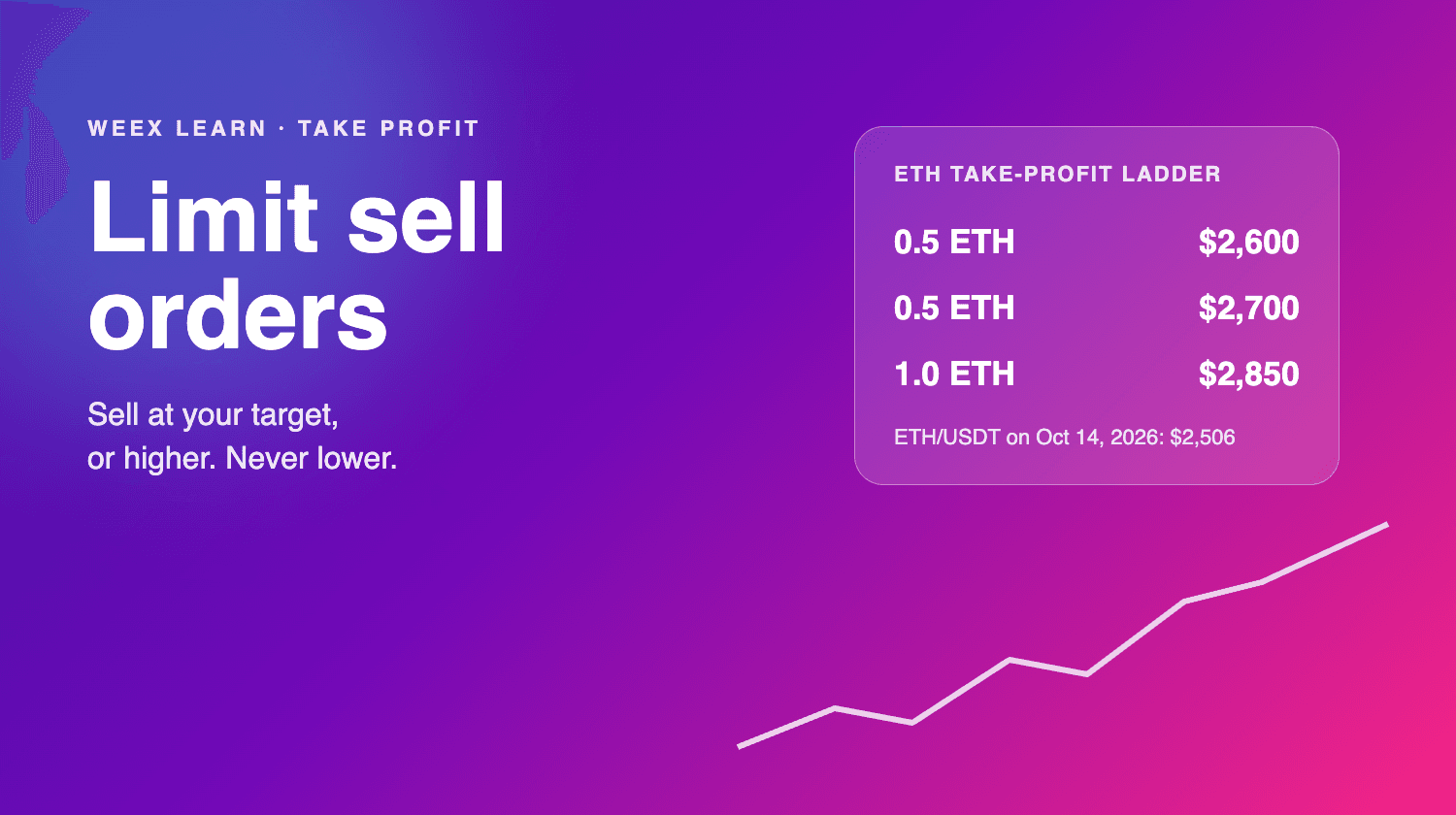
Limit Sell Order: How to Set a Take-Profit Price in Crypto

Best Crypto Podcasts for Beginners: A 4-Week Listening Plan

What Is Plume (PLUME)? Why the RWA Token Stays 93% Below Its High Even After the Layer 2 Rally
ETH Futures: Why Ether Is Falling Faster Than Bitcoin This Week
How to Buy Presale Crypto: Step by Step Guide for Beginners

Ethereum Glamsterdam Hits 200M Gas on Sepolia: What Changes After the Upgrade?

What Is Staking? 4 Myths to Clear Up Before You Stake Crypto
CAP Price Up 23%: Why Short Liquidations Don't Explain the Rally
Ethereum Glamsterdam Upgrade: Sepolia Date and ETH Price Impact
How to Earn Interest on USDT: What a 10% APR Really Pays in 2026
How to Buy Crypto With Apple Pay in 5 Steps: Why Your Bank May Decline the Payment
What Is Blockchain and How Does It Work? One Real Block Explained
Ethereum Glamsterdam Upgrade Countdown: Can ETH Price Break Out?
Anonymous Crypto Wallet: What Still Protects Your Privacy in 2026
How Tether Freezes USDT: Address Blacklists and Holder Checks
Bitcoin Futures at $83K: PnL and Position Sizing Into Jobs Week
Ethereum 2030 Roadmap: Vitalik's Cryptographic World Computer
Common P2P Crypto Scams and How to Spot Them
How to Choose a P2P Crypto Merchant on WEEX
How to File a WEEX P2P Appeal: Evidence and Video Requirements
Is WEEX P2P Crypto Trading Safe? Risks and Checks Before You Trade
WEEX P2P Order Limits: Minimums, Maximums, and Available Ads
ETH Funding Rate Today: 0.0087% per 8h as Ether Longs Re-Lever
What Is Blockchain and How Does It Work? One Transaction, Traced
Staking APR vs Inflation: How Much of Your Crypto Yield Is Real?
WEEX Convert Fees: What Zero-Fee Conversion Really Costs You
WEEX Convert Quote: How the 8-Second Price Lock Really Works
WEEX Convert Limits: Minimum and Maximum Amounts Explained


