
What Is a Crypto Broker? How Is It Different From a Crypto Exchange?

 Prefer us on Google

Most people who trade cryptocurrency have used an exchange without realizing that another model exists alongside it. A crypto broker is the part of the market that most retail traders never encounter directly but whose presence shapes the conditions they trade in every day. Understanding what a crypto broker actually does, how it differs from the exchanges that most people interact with, and why the broker model has grown into a significant segment of the professional crypto market is the foundation for understanding how institutional cryptocurrency trading actually works rather than how it appears from the retail interface.
The crypto broker model separates the client relationship from the market infrastructure in a way that creates commercial opportunities and service capabilities that direct exchange access cannot replicate. That separation is the defining characteristic of the broker model and the reason it exists alongside rather than instead of the exchange model that most people encounter first.

What a Crypto Broker Actually Is
A crypto broker is a business or individual that provides cryptocurrency trading access to clients without operating its own exchange infrastructure. The broker maintains client relationships, handles account management, and provides the interface through which clients place orders. The actual execution of those orders happens through an exchange or liquidity provider that the broker has established a relationship with.
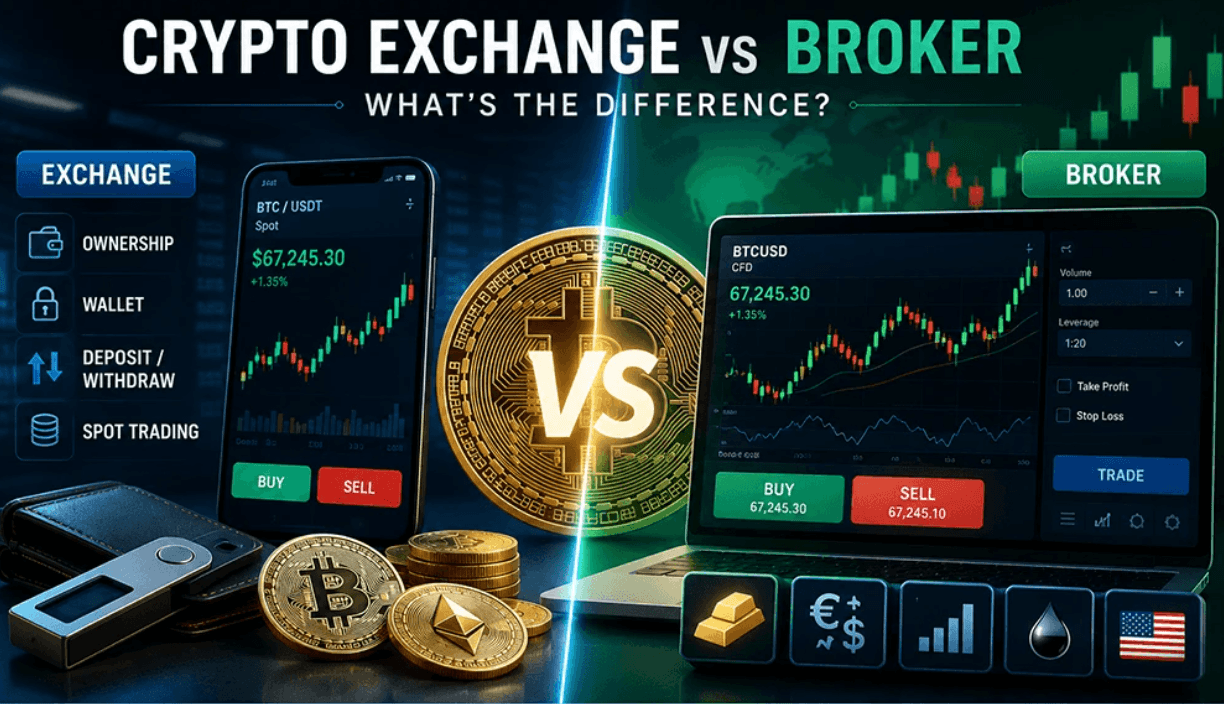
The broker model separates the client relationship from the market infrastructure. An exchange handles both: it maintains client accounts and operates the matching engine that pairs buyers with sellers. A broker handles the client relationship and delegates the market infrastructure to a third party.
This separation is not a workaround or a limitation. It is a deliberate business model that allows brokers to specialize in client service, local market knowledge, and customized trading experiences without the regulatory burden, technical complexity, and capital requirements of operating exchange infrastructure.
A crypto broker's business is built on three components that exchanges also provide but that brokers can optimize independently. Client acquisition and retention, which is where brokers often outperform exchanges through local presence, personalized service, and community specific offerings. Order execution quality, which depends on the liquidity sources the broker has access to. And account and risk management, which determines how client funds are handled and how the broker manages its exposure.
The Exchange Model vs the Broker Model
The distinction between exchanges and brokers is clearest when examined through what each party actually does and where their economic interest lies.
An exchange operates a marketplace. Its primary function is maintaining an order book where buyers and sellers interact, matching orders when prices align, and settling the resulting transactions. The exchange's revenue comes from transaction fees charged to every participant regardless of the outcome of their trade. The exchange is indifferent to which direction prices move and profits from volume rather than from directional outcomes.
A broker operates a client service business. Its primary function is maintaining relationships with clients, providing them with market access, and earning revenue from the spread between what it charges clients and what it pays for execution, or from a share of the fees generated by client trading activity. The broker's revenue depends on client trading volume, which means brokers have a structural interest in client success that exchanges do not.
The practical differences extend to account management, service levels, and market access. An exchange typically offers standardized account types with uniform fee schedules and self-service support. A broker can offer differentiated account tiers, negotiated fee arrangements, dedicated account management, and customized reporting that exchanges cannot economically provide to all users.
Why Crypto Brokers Exist When Exchanges Are Already Accessible
The existence of crypto brokers alongside direct exchange access is sometimes presented as a historical artifact from the early days of crypto when exchanges were technically complex and difficult to access. That explanation is incomplete and increasingly inaccurate.
Crypto brokers exist because they solve specific problems that exchanges are structurally ill-equipped to solve regardless of how user-friendly exchanges become.
Geographic and regulatory fragmentation is the first problem. Cryptocurrency exchanges operate under regulatory frameworks that vary by jurisdiction and that frequently exclude certain user categories from direct access. A broker established in a specific jurisdiction can serve local clients under local regulatory frameworks, accepting local payment methods and providing local language support, in ways that a global exchange cannot replicate efficiently for every market it wants to reach.
Institutional client requirements are the second problem. Sophisticated institutional traders, hedge funds, family offices, and corporate treasury operations have specific requirements around reporting, custody, credit facilities, and operational integration that standard exchange interfaces do not provide. Brokers who specialize in institutional clients build the infrastructure around those requirements rather than expecting institutional clients to adapt to retail-focused exchange interfaces.
Community and platform integration is the third problem. Trading signal communities, algorithmic trading platforms, social trading networks, and investment advisory services have user bases that want to trade but whose primary relationship is with the community or platform rather than with any specific exchange. Brokers who can integrate with these platforms allow their users to execute trades without leaving their primary environment, which increases user retention for the platform and creates trading volume for the broker.
-- Price
The Three Types of Crypto Brokers
Not all crypto brokers operate the same model, and the differences between broker types have significant implications for how they access markets, manage client funds, and generate revenue.
Agency brokers act purely as intermediaries, routing client orders to exchanges or liquidity providers and charging a commission on each transaction without taking any market risk themselves. The agency broker's revenue is entirely fee-based and its interest is aligned with client execution quality because better execution increases client satisfaction and trading volume. Agency brokers are the model most consistent with traditional financial services brokerage.
Principal brokers take the other side of client trades directly, quoting prices to clients and accepting the resulting market exposure on their own balance sheet. The principal broker profits from the spread between the price it quotes clients and the price at which it can hedge its resulting exposure in the market. Principal brokers can offer tighter spreads and faster execution than agency brokers because they are not routing orders through an exchange order book, but they introduce counterparty risk that clients must evaluate.
Hybrid brokers combine elements of both models, acting as principal for smaller orders where the spread economics are attractive and routing larger orders through exchanges or liquidity providers where direct market access produces better execution. Most professional crypto brokers operate some version of the hybrid model, using market conditions and order size to determine the optimal execution approach for each transaction.
What Brokers Need to Operate at Scale
Building a crypto brokerage that serves clients reliably at scale requires infrastructure that most broker businesses cannot build themselves and therefore source from specialized providers.
Liquidity infrastructure is the foundational requirement. A broker that cannot execute client orders at competitive prices with reliable fill rates will lose clients to alternatives regardless of how well it manages other aspects of the business. Professional brokers access liquidity through one of three routes: direct connections to major exchanges, relationships with professional liquidity providers who aggregate order flow across multiple venues, or API-based integration with exchange platforms that provide institutional-grade liquidity access.
The API Broker model has emerged as the most practical solution for brokers who want institutional-grade liquidity access without the operational complexity of managing direct exchange relationships across multiple venues. Rather than negotiating separate agreements with multiple exchanges and managing multiple technical integrations, API Broker programs allow a broker to access deep liquidity through a single integration point while maintaining their own client-facing infrastructure.
WEEX's API Broker Program, launched in 2026, is designed for AI trading platforms, trading bots, and signal communities that already have active users but lack the infrastructure to execute trades directly.
Risk management infrastructure is the second requirement. Brokers who act as principal in any portion of their business need tools to monitor and manage their market exposure in real time. Brokers who act purely as agents need tools to monitor execution quality and ensure that client orders are being filled at prices consistent with their obligations to clients.
Client account infrastructure is the third requirement. This includes the account management systems, reporting tools, and fund custody arrangements that allow a broker to maintain client relationships at scale. The complexity of this infrastructure increases with the sophistication of the broker's client base: retail clients require different tools from institutional clients, and institutional clients require different tools from professional trading firms.
The Economics of Crypto Brokerage
Understanding how crypto brokers generate revenue clarifies why the broker model is commercially viable alongside direct exchange access and why brokers can offer services that exchanges cannot economically provide.
The fee sharing model is the most straightforward revenue structure for brokers who use exchange infrastructure. The broker routes client order flow through an exchange or liquidity provider that shares a portion of the resulting transaction fees with the broker. The broker's revenue is therefore a function of client trading volume multiplied by the fee sharing rate, which creates a direct alignment between broker revenue and client activity.
WEEX's Broker Program provides the infrastructure that allows partners to integrate trading execution into their own platforms while using WEEX as the execution venue. The program includes a commission-sharing model, enabling eligible partners to receive a share of trading fees generated through client activity routed via the integration. It also supports tiered partnership structures based on trading activity, along with technical integration, account management, and operational support to help partners build and scale their brokerage services.
The spread model supplements fee sharing for brokers who act as principal in client transactions. By quoting prices that include a spread over the market mid-price, the broker earns the spread on each transaction in addition to any fee sharing from the underlying execution venue. Managing the spread to balance client competitiveness with broker profitability is one of the core skills of professional market-making brokerage.
What Distinguishes a Professional Crypto Broker
The crypto market has no shortage of entities that describe themselves as brokers while operating at very different levels of professionalism, capitalization, and client protection. Understanding what distinguishes professional brokers from superficially similar operations helps clients and potential broker partners evaluate their options accurately.
Regulatory status is the most visible distinguishing factor. Professional brokers obtain appropriate licenses in the jurisdictions where they operate rather than relying on regulatory arbitrage or informal exemptions. The regulatory requirements for crypto brokers vary significantly by jurisdiction and are evolving rapidly, but the commitment to operating within applicable frameworks rather than around them is a consistent characteristic of professional operations.
Liquidity source quality is the less visible but equally important distinguishing factor. A broker whose client orders are executed against deep, institutional grade liquidity will deliver consistently better execution than a broker sourcing liquidity from thin or unreliable venues. The quality of the underlying liquidity infrastructure determines execution quality more than any aspect of the broker's client-facing interface.
Client fund protection is the third distinguishing factor. Professional brokers maintain clear segregation between client funds and operational funds, provide transparent reporting on fund custody arrangements, and in some cases maintain protection pools that provide additional security for client assets in the event of operational failures.
WEEX maintains a 1,000 BTC protection fund with a publicly disclosed address. For brokers who access markets through WEEX's infrastructure, this underlying exchange level protection is part of the institutional foundation on which their clien facing services are built.
The Broker Opportunity in Today's Crypto Market
The growth of the crypto broker market reflects several converging trends that make the broker model more commercially attractive in 2026 than at any previous point in the market's history.
The maturation of institutional crypto participation has created demand for broker-level services that exchanges alone cannot satisfy. Institutional clients require custody arrangements, reporting formats, and operational integration that standard exchange interfaces do not provide. Brokers who build specifically for institutional requirements occupy a market segment that exchanges address only partially.
The proliferation of crypto adjacent platforms, including AI trading assistants, algorithmic strategy platforms, social trading communities, and investment advisory services, has created a large population of potential broker businesses whose users want trading access but whose primary relationship is with the platform rather than with any specific exchange. The API Broker model allows these platforms to add trading execution to their existing offerings without becoming exchanges themselves.
The geographic expansion of crypto participation beyond the markets where major exchanges have established local presence creates opportunity for regional brokers who combine local regulatory compliance, local payment method support, and local language service with institutional grade execution infrastructure sourced through API integration.
Conclusion
Crypto brokers occupy a distinct and commercially significant position in the cryptocurrency market's structure that is separate from and complementary to the exchange model most retail participants interact with directly. By separating the client relationship from the market infrastructure, brokers can specialize in client service quality, local market knowledge, and platform specific trading experiences while accessing institutional grade liquidity through exchange partnerships and API integrations.
The broker model's commercial viability rests on fee sharing economics that align broker revenue with client trading activity, on the ability to serve client segments that direct exchange access cannot efficiently reach, and on the growing demand from crypto-adjacent platforms for embedded trading execution that does not require building exchange infrastructure from scratch.
Understanding what crypto brokers are and how they operate is the foundation for evaluating whether the broker model represents a business opportunity, a service to seek out as a client, or an infrastructure investment to make as a platform looking to add trading capabilities to an existing user base.
FAQ
1. What is a crypto broker?
A crypto broker is an intermediary that provides cryptocurrency trading access to clients without operating its own exchange infrastructure. Brokers maintain client relationships and provide trading interfaces while routing order execution through exchanges or liquidity providers. They earn revenue through fee sharing arrangements with execution venues and through spreads on client transactions.
2. What is the difference between a crypto broker and a crypto exchange?
An exchange operates a marketplace where buyers and sellers interact directly through an order book, charging fees to all participants. A broker maintains client relationships and delegates market execution to exchanges or liquidity providers, earning revenue from fee sharing and spreads. Exchanges provide market infrastructure while brokers provide client services built on top of that infrastructure.
3. Why would someone use a crypto broker instead of a crypto exchange directly?
Brokers offer advantages that direct exchange access cannot efficiently provide, including local regulatory compliance and local payment methods for geographically specific markets, institutional grade reporting and custody arrangements for sophisticated clients, and integrated trading execution for platform and community users whose primary relationship is with a specific product rather than with an exchange.
4. What infrastructure do crypto brokers need to operate?
Professional crypto brokers require liquidity infrastructure to access competitive execution, risk management systems to monitor market exposure, and client account infrastructure for fund custody and reporting. API Broker programs from established exchanges allow brokers to access institutional liquidity through a single integration rather than managing multiple direct exchange relationships.
5. How do crypto brokers make money?
Crypto brokers generate revenue primarily through fee sharing arrangements with exchanges, where a portion of the trading fees generated by client activity is returned to the broker. Additional revenue comes from spreads on principal transactions where the broker acts as counterparty to client orders. The fee sharing rate and spread management determine the broker's revenue relative to the client trading volume they generate.
This content is provided for general informational purposes only and doesn't constitute financial, investment, legal, or tax advice. Any events, rewards, online promotions, or related information mentioned herein should not be considered a recommendation, solicitation, or invitation to purchase, sell, trade, or otherwise deal in any crypto assets. Crypto assets are highly volatile and may result in loss. The availability of WEEX services, products, and related events may vary by region. You are responsible for ensuring that your participation is in accordance with applicable local laws and regulations.
You may also like

MU Stock and the Apple CXMT Test: What Replacing Micron With Chinese Memory Actually Means

Tiffany Milanovich and the $5M Fake-Support Call Playbook

Microsoft Stock Forecast After Q4 Earnings: Short and Long-Term Outlook

WEEX TradFi Trading Fest: Trade Stock Futures and Share 50,000 USDT Rewards

USDC Use Cases Explained: Payments, DeFi, Cross-Border Transfers, and Key Risks
CRUDEOIL Airdrop: Share 50,000 USDT Rewards on WEEX
What Is a Crypto Trading Bot and How Does It Work?
How Does Quantitative Trading Work? A Simple Step-by-Step Guide

How Trump Used $TRUMP Meme Coin World Cup Tickets to Reverse a 97% Crash in 2026
Why Was Donald Trump at the 2026 World Cup Final and How Did Fans React
What Is DeXe (DEXE) Crypto and How Does Its DAO Governance Protocol Work in 2026
Tesla Stock Is Down 17% in 2026: What Q2 Earnings Need to Deliver to Turn the Story Around
What Is Mark Cuban's Stock Options Philosophy? How SpaceX Turned Welders Into Millionaires
How Will the CLARITY Act and Bank-Grade Stablecoin KYC Rules Change Crypto Trading in 2026
Why Is BitMine Buying Millions of Ethereum Tokens and Staking $9 Billion in ETH in 2026
How to Protect Your Bitcoin from Physical Attacks: Lessons From the NYC Crypto Torture Case in 2026
What Is the NYC Crypto Kidnapping Case? The Soho Bitcoin Attack Explained — 2026 Case Analysis

Are Prediction Markets Legal? CFTC vs SEC Regulation Explained

MU Stock and the Apple CXMT Test: What Replacing Micron With Chinese Memory Actually Means
Tiffany Milanovich and the $5M Fake-Support Call Playbook
Microsoft Stock Forecast After Q4 Earnings: Short and Long-Term Outlook
WEEX TradFi Trading Fest: Trade Stock Futures and Share 50,000 USDT Rewards
USDC Use Cases Explained: Payments, DeFi, Cross-Border Transfers, and Key Risks
CRUDEOIL Airdrop: Share 50,000 USDT Rewards on WEEX


