
63% of Americans Say Financial System Needs Overhaul; Cryptocurrency Faces Awareness Barriers, According to U.S. DEF Survey

 Prefer us on Google


Key Points of This Article
- Only 19% of respondents in the U.S. survey deemed the financial system safe
- Cryptocurrency suffers from low awareness and trust, with exchange trust at 4%
Distrust in Existing Financial Systems is Clear
On the 27th, the U.S. DeFi Education Foundation (DEF) and the survey company Ipsos released a national survey titled "The Current State and Future of Finance: Perspectives of Americans." The survey was conducted from September 8 to 16, targeting 1,545 adults aged 18 and older in the U.S., with a margin of error of ±2.8 points. While there is a strong distrust in the existing financial system, it was found that both cryptocurrency and DeFi (decentralized finance) have low levels of awareness and trust.
Only 19% of respondents considered the current U.S. financial system to be safe. Meanwhile, 63% stated that an overhaul of the system is necessary to address new threats such as cybercrime and AI (artificial intelligence).
There is also a strong desire among individuals to manage their own data and assets. 49% feel they can control their assets, and 74% prioritize financial privacy.
80% believe that the financial system needs to change to allow for more freedom in managing personal data, and 74% think reforms are necessary to increase the freedom of managing funds and assets. Additionally, 66% want to have access to their funds at any time.
Trust in existing financial institutions is also not high. The percentage of those who said they "fully trust" or "somewhat trust" was only 48% for credit unions, the highest among institutions, down 5 points from 53% the previous year. Major national banks had a trust level of 42%, while regional and community banks had 41%.
Only 21% fully or somewhat trust centralized fintech companies, and 18% trust online-only banks.
Cryptocurrency Faces Challenges in Awareness and Branding
Despite growing dissatisfaction with existing systems, cryptocurrency and DeFi are not sufficiently recognized and have not gained trust.
Only 4% of respondents said they "highly trust" centralized exchanges (CEX), while 5% trusted DeFi platforms. These figures are significantly lower compared to traditional financial institutions, indicating a deep-rooted distrust in the cryptocurrency industry.
22% of people have owned or used cryptocurrency, an increase of 4 points from 18% in 2025. However, only 13% have used it in the past 12 months, remaining flat. 17% (1 in 6) said they might own cryptocurrency in the future, nearly unchanged from 16% in 2025. The main reason for trying cryptocurrency among users was "curiosity," at 34%.
16% expressed a desire to learn more about cryptocurrency, but only 9% said they are knowledgeable about it. 35% stated they "do not know how to explain cryptocurrency."
The phrasing of questions also led to significant differences in responses. When asked whether candidates should support building next-generation financial technologies in the U.S. in light of the midterm elections, 35% said it was important. However, when the same question included specific terms like "blockchain," "cryptocurrency," and "decentralized finance (DeFi)," the percentage of those who found it important dropped to 13%.
Journalist Eleanor Terrett commented on these results, stating, "As of 2026, cryptocurrency still faces branding challenges, and the path to proving its value to the average American is long."
She also mentioned the move by U.S. venture capital firm a16z to rename its cryptocurrency fund from "a16z Crypto" to "a16z Frontier," expanding its investment focus to frontier technologies including AI. This reflects a trend where companies tend to avoid defining themselves solely within the framework of "cryptocurrency."
Uses of DeFi Include Savings and Remittances
Regarding DeFi, 40% of respondents said they would like to try it if the environment allows, which is consistent with the level in 2025. Among them, 10% expressed a "very high" or "extremely high" intention to use it.
When asked about potential uses among interested groups, 85% mentioned savings (up from 77% in 2025), 82% for remittances to friends and family within the U.S. (up from 73%), and 82% for earning deposit interest. 69% also indicated they would like to receive job payments, retirement benefits, or government assistance, an increase from 58% the previous year.
-- Price
This content is provided for general informational purposes only and doesn't constitute financial, investment, legal, or tax advice. Any events, rewards, online promotions, or related information mentioned herein should not be considered a recommendation, solicitation, or invitation to purchase, sell, trade, or otherwise deal in any crypto assets. Crypto assets are highly volatile and may result in loss. The availability of WEEX services, products, and related events may vary by region. You are responsible for ensuring that your participation is in accordance with applicable local laws and regulations.
You may also like

The IMF warns of fiscal risks due to rising rates

Ethereum Foundation Supports Development of Kohaku Privacy Tool

Zondacrypto Scandal: How Monaco Became the Showcase for the Platform

Ten Decrees: Old Masters, New Money

Revolut Under Scrutiny: London Examines Its Product Launches

The Wall Street Journal Publishes Full-Page Ad: Eight Risks of Stock Tokenization

Ethereum Foundation backs default wallet privacy as Kohaku work advances

Pump.fun 'optimized for addiction': what the internal messages cited in court really say

Is 24/7 Trading a Necessity? Analyzing the Real Trading Rhythm of RWA Perpetual Contracts
[ETH Letter] Meritz Securities Reviews Tokenization of Korean Securities Based on OP Stack

"Without Changing the Nature of Government Bonds" Toward Tokenization: Progmat's Saito Explains

LDP Proposes Establishing a Cyber Response Headquarters Ahead of Cybersecurity Crisis, Emphasizing Cryptocurrency Tracking and Post-Quantum Cryptography
Former FTX Executive Slams Netflix's New Series: Turning Financial Fraud into a 'Romantic Film' is Absurd

Delphi Digital: Why Speculation is the Theme of the Next Decade

Bitgo Launches AI Financial Application 'Gokubu' and Research Organization
"Millions of devices are vulnerable": Ledger CTO

Private Jets and Investor Pressure Force Polymarket CEO to Mature

Doctor Profit Warns of a Very Big Monero (XMR) Liquidation Event

Stuttgart Stock Exchange Gets Green Light to Trade and Settle Tokenized Securities
WEEX Exclusive:Tech Rebounds; Bitcoin Holds $81,000–$82,000 Support| WEEX TradFi Daily (October 20, 2026)
Tech Rebounds; Bitcoin Holds $81,000–$82,000 Support| WEEX TradFi Daily (October 20, 2026)
On October 19, tech rebounded. The three major indexes were mixed, with the Nasdaq relatively stronger. Intel rose after a JPMorgan upgrade, and SpaceX closed up more than 2%. Bitcoin traded near $81,000–$82,000, a zone traders viewed as strong support and a local bottom. Worldcoin (WLD) rose more than 10% in 24 hours, leading majors. October 20 focus includes earnings from SPCX and other listed names.
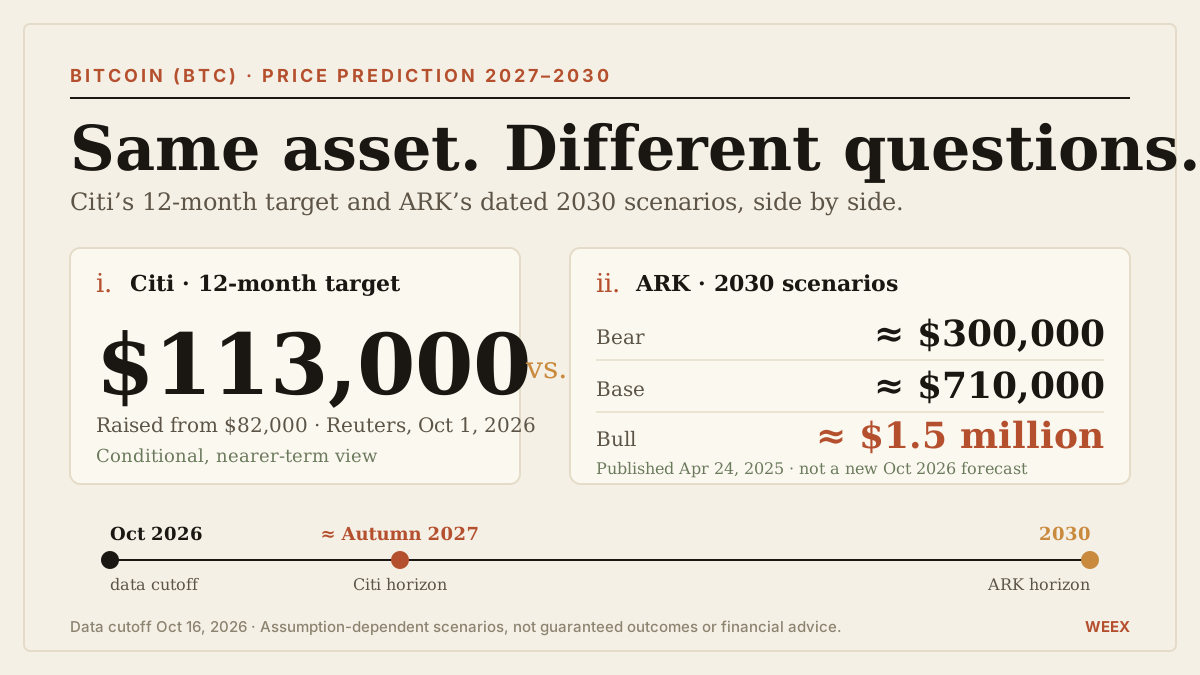
Bitcoin (BTC) Price Prediction 2027–2030: Citi’s $113,000 Target vs. Cathie Wood’s ARK Scenarios
Bitcoin price prediction for 2027–2030: compare Citi’s $113,000 target with ARK’s dated scenarios, demand assumptions, valuation math and key risks.

Crypto: 107 incidents and $1.18 billion stolen in Q3 2026

Is Pearl, Dreaming of Bitcoin in the AI Era, an Innovation or Just Simple Hype?

唐华斑竹 Analyzes Bitcoin Trends, Suggests Monitoring Support Levels

Howard Marks: If Everyone is Talking About a Bubble, Then the Bubble May Not Have Burst Yet

Quantum Alliance Established to Protect Blockchain from Quantum Computers

唐华斑竹 Analyzes the Current State of the Crypto Market, Advises Caution
U.S. Treasury Department's Survey Fails to Signal Debt Reduction, Bond Yields Rise with 10-Year Yield Back Above 5.12%
The Past and Present of Currency in the Age of Exploration
The IMF warns of fiscal risks due to rising rates
Ethereum Foundation Supports Development of Kohaku Privacy Tool
Zondacrypto Scandal: How Monaco Became the Showcase for the Platform
Ten Decrees: Old Masters, New Money
Revolut Under Scrutiny: London Examines Its Product Launches
The Wall Street Journal Publishes Full-Page Ad: Eight Risks of Stock Tokenization
Contents
Latest articles




Latest coin listings on WEEX


