
A Look at Traditional Banks Entering Web3: Who Made Money and Who Lost?

 Prefer us on Google


The answer lies not in what coins they bought, but in whether they sold pipelines or risks.
Written by: EX.IO
1. Two Directions in the Same Week
On November 11, 2026, two events occurred simultaneously: Deutsche Bank officially launched institutional crypto custody (covering Bitcoin, Ethereum, USDC, EURC, and AllUnity Euro stablecoin EURAU, operating under MiCA and German regulatory frameworks) and signed a memorandum of understanding with its asset management subsidiary DWS to explore tokenized products; on the same day, Bloomberg reported that Nomura Holdings was in talks with potential buyers like Marex to sell its crypto subsidiary Laser Digital (a final decision has not been made, and it may also retain the subsidiary).
One enters the market, while the other exits. This article does not reiterate the events but focuses on one thing: breaking down “who made money and who lost” to summarize the common actions of the profitable companies.
2. List of Profitable Companies: How They Made Money
In this section, “making money” refers to revenue models based on fees or traffic, with disclosed income or clear business models, rather than the profitability data of each disclosed business segment.
BlackRock launched digital shares for its six UCITS money market funds in Europe (totaling approximately $311 billion) in August 2026, running on Ethereum via JPMorgan's Kinexys platform. It is not that this money “turned into tokens,” but rather that the entry point was tokenized—fees did not decrease due to being on-chain, and on-chain transfers opened new distribution and settlement channels. The key action: connecting existing assets to new interfaces, rather than creating new assets.
JPMorgan's Kinexys has a daily trading volume of approximately $5 billion (DL News), and management hopes to increase it to over $10 billion; in October 2026, JPMorgan expanded its JPM Coin deposit token (JPMD) to Ethereum. This path does not require a bull market, nor does it need tokens to be classified as securities—just “settlements cheaper than now.”
Citi expanded its Citi Token Services to Japan and the UAE in September 2026; WSJ reported that several major banks are planning a shared tokenized deposit network. Such businesses often do not charge directly, with revenue reflected in deposit retention and customer stickiness—defensive income, but defending the most expensive deposits.
BNY and Goldman Sachs launched a tokenized money market fund solution for asset management clients in 2025 (BNY press release: participants include BlackRock, Fidelity, Goldman Sachs Asset Management, etc.), selling a complete service of “allowing your fund to be held on-chain.”
Morgan Stanley launched its own Bitcoin ETF in April 2026, with fees reduced to 0.14% (the lowest tier at the time), attracting approximately $100 million in the first week. The way to make money is clear: fees multiplied by channels, unrelated to the direction of coin prices.
Deutsche Bank does not engage in trading or proprietary trading; it first focuses on custody, signing an MOU with its asset management on the launch day to explore tokenized products—a typical “occupy the position first, expand the product later” strategy.
Commonality: All six companies’ revenues are based on fees and traffic, with none relying on holding token inventories for profit.
3. List of Companies with Losses: How They Lost Money
In this section, “losses” refer to specific periods of loss disclosed in public financial reports or news, and do not constitute an evaluation of the relevant companies' operational capabilities or overall performance.
Laser Digital was established in 2022, covering institutional trading, market making, asset management, and venture capital, achieving profitability by 2024 (Ledger Insights). The turning point came in October 2025: during the flash crash on October 10, altcoins fell by 20%-27% within minutes, with some dropping nearly 70% (AmberData). By the end of the December 2025 quarter, Nomura recorded a loss of approximately 10 billion yen outside its four major departments (EMEA), attributing it to its digital asset business; the CFO stated they had “tightened positions and risk exposure”; the pre-tax loss for European operations was 13.8 billion yen and 7.4 billion yen for the quarters ending March and September 2026, respectively. The two sets of figures cannot be directly linked, and Nomura has not disclosed Laser's performance in Europe—“the sale is due to Laser's losses” is an analytical judgment, not the company's stance.
Mechanism is key: market makers fear not just price drops, but the inability to hedge inventories during declines—Laser's market making is not limited to Bitcoin and Ethereum; when there are large amounts of illiquid small and mid-cap tokens in the inventory, and the market is repriced within minutes, you are not making price differences but passively taking on inventory. The quarterly market value pricing, VaR limits, and parent company capital scrutiny of listed banks do not allow market makers the freedom to “withstand during drawdowns”: this is a mismatch of mechanisms, not a team capability issue. Another equally important fact: during the same period, Nomura's investments did not cease (gaining a new crypto exchange license in Japan and preliminary approval for its trust bank application from the US OCC), and the quarter in which it reported losses saw Nomura record record overall income.
ASX announced in November 2022 that it would abandon the blockchain reconstruction of its clearing system CHESS, a project that lasted about seven years and cost approximately AUD 250 million. The failure was not due to technical infeasibility but treating an extremely complex institutional project as a mere technical upgrade; Reuters commented: not only money was burned, but also market trust.
In November 2026, OKX and ICE's tokenized US stock plan was scheduled to launch under the SEC's temporary innovation exemption framework, facing collective backlash from issuers: the opposition list grew from 22 to 67; IMF research showed that the volatility of tokenized stocks is 1.5 times that of traditional markets for the same underlying assets (the above is summarized from Cointelegraph). This route has not disclosed any losses, but it is being repriced by the market. A more telling comparison: CoinDesk reported that the crypto-native market making benchmark B2C2 (under SBI) is also in talks for sale. Even “the best in the business” are looking for exits, making the claim that “traditional institutions lost to native teams” untenable—the business model of selling inventory risk itself is being repriced as a whole. Attribution is not a variable; the business model is.
-- Price
4. The Divide: Four Revenue Models
Behind the two lists is one statement: where revenue comes from determines how much risk there is.
- Model 1: Management fees and custody fees (based on asset size) — BlackRock, BNY, Goldman Sachs, Deutsche Bank custody; does not bear directional risk, the larger the more stable.
- Model 2: Channel and settlement fees (based on traffic) — Kinexys, Citi Token Services; can even be free, with revenue reflected in deposit retention and stickiness.
- Model 3: Price differences and inventory (based on balance sheet) — market making, proprietary trading, OTC; best business during good markets, with no lower limit downward.
- Model 4: Asset appreciation (revenue comes from cycles) — crypto venture capital, token treasuries; bullish on the upside, ugly on the downside.
The first two models earn “the tolls others must pay you,” while the latter two earn “how much uncertainty you are willing to bear.”
5. The Entry Posture of Winners
Looking at the profitable list in reverse shows the same set of actions. The following is a general summary of public cases and does not constitute advice:
- First define the revenue model, then determine the technical solution — first have a clear charging standard (AUM or traffic), with technology selection postponed.
- Match assessment cycles with business types — businesses that need to withstand a 40% drawdown are usually not included in quarterly market value pricing reports; either put them into independent entities with long-term funding or simply do not do them.
- Buy time, not pride — acquisitions solve “where the capability comes from,” not “who bears the risk.”
- Compete for authorization and rosters, not for matchmaking — charging standards are handled by issuer authorization, shareholder rosters, and corporate actions; the opposition list of 67 issuers is proof of this.
- Align with regulators, making compliance a barrier — MiCA, Hong Kong licensed platform system, Singapore licensing framework, all turn compliance from a cost into a moat.
- Write a good exit script at the project initiation — setting exit clauses and valuation anchors in advance usually leads to more dignified disposals (this point is an observation derived from results rather than an industry-proven fact).
6. Three Accounts: Clarifying Revenue Structure
The following are indicative calculations, used only to demonstrate differences in revenue structures, not constituting any predictions or assessments of any institution's revenues or costs.
With a scale of $10 billion and a fee of 5-10 basis points, annual revenue is approximately $5 million to $10 million; the value lies in zero directional risk, high stickiness, and the ability to stack fees from staking, settlement, foreign exchange, etc.
Revenue = AUM × Management Fee Rate × Sharing Ratio, relying more on distribution than custody — only institutions with terminal channels can drive fees down to 0.14%, leaving little room for newcomers to fight back.
With an inventory of $1 billion and a daily volatility of 3%, a standard deviation of daily inventory profit and loss is around $30 million. Capital adequacy, hedging speed, and risk limits determine whether market making is a money printer or a shredder — these three are precisely the hardest for the banking system to adjust flexibly.
In short: the first two revenue streams grow linearly with scale, with limited tail risk; the third revenue stream's earnings and risks come from the same variable, making them inseparable.
7. Hong Kong's Position
Hong Kong's choice is clear: to thicken the system rather than enlarge the leverage. The VATP licensing system, the Stablecoin Ordinance (Cap. 656) effective August 1, 2025, and the HKMA-led pilot for tokenized bonds and settlements collectively form a combination of “official roster + regulated custody + local currency settlement.” According to this article's classification, Hong Kong has almost turned “selling pipelines” into a main road: custody, settlement, issuance, and secondary trading must go through licensed entities, while purely speculative paths are minimized.
This does not mean there is no competitive pressure: as BlackRock connects its $311 billion money market fund to the blockchain, JPMorgan spreads deposit tokens to Ethereum, and Deutsche Bank formalizes custody products, the real challenge is to make these “pipelines” willing to connect the Asian nodes to this system rather than elsewhere.
8. Conclusion
In Web3, the most profitable are not those who understand tokens best, but those who know how to collect tolls. The past five years can be condensed into two sentences: those selling pipelines are building scale into cost barriers; those selling risks are turning volatility into lessons. The next phase's dividing line is not whose trading desk is faster, but whose roster is thicker, custody more trustworthy, and settlement cheaper.
The reported sale is not a surrender but possibly a dignified retreat; Deutsche Bank's launch is not a declaration but a quiet takeover. History does not score righteous wars, only prices commercial models.
🔗 Sources
- Bloomberg --- Nomura Explores Possible Sale of Laser Digital Crypto Unit (2026-11-11) https://www.bloomberg.com/news/articles/2026-11-11/nomura-explores-possible-sale-of-laser-digital-crypto-unit
- Cointelegraph --- Nomura explores sale of crypto unit Laser Digital (2026-11-12) https://cointelegraph.com/news/nomura-sale-crypto-unit-laser-digital
- Ledger Insights --- Nomura temporarily tightens crypto exposure at Laser Digital following losses (2026-02-02) https://www.ledgerinsights.com/nomura-temporarily-tightens-crypto-exposure-at-laser-digital-following-losses/
- The Japan Times --- Nomura stock hit after research affiliate writedown and Europe loss (2026-04-27, paywall, single source unverified) https://www.japantimes.co.jp/business/2026/04/27/companies/nomura-shares-fall/
- Bloomberg --- BlackRock Launches Tokenized Money Market Funds in Europe (2026-08-03) https://www.bloomberg.com/news/articles/2026-08-03/blackrock-launches-tokenized-money-market-funds-in-europe
- Ledger Insights --- BlackRock launches first European tokenized MMFs (2026-08-04) https://www.ledgerinsights.com/blackrock-launches-first-european-tokenized-mmfs/
- DL News --- JPMorgan expands digital assets push with Mitsubishi deal as it targets $10bn in daily transactions (2026-03-31) https://www.dlnews.com/articles/markets/jpmorgan-expands-digital-assets-push-with-mitsubishi-deal-as-it-targets-dollar10bn-in-daily-transactions/
- the Block --- JPMorgan expands 'JPM Coin' deposit token to Ethereum for institutional clients (2026-10-19) https://www.theblock.co/news/business/2026-10-19-jpmorgan-jpm-coin-deposit-token-ethereum-418874
- PaymentsJournal --- Citi Expands Token Services Into Japan and UAE (2026-09-30) https://www.paymentsjournal.com/citi-expands-token-services-into-japan-and-uae/
- The Wall Street Journal --- JPMorgan, Citi and Big Banks Plan New Tokenized Deposit System to Answer Crypto (2026-06-04, paywall, full text unverified) https://www.wsj.com/finance/banking/jpmorgan-citi-and-big-banks-plan-new-tokenized-deposit-system-to-answer-crypto-6b2d696b
- BNY --- BNY and Goldman Sachs Launch Tokenized Money Market Funds Solution (2025-07-23) https://www.bny.com/corporate/global/en/about-us/newsroom/company-news/bny-and-goldman-sachs-launch-tokenized-money-market-funds-solution.html
- CoinDesk --- The cheapest bitcoin ETF yet: Morgan Stanley uses 0.14% fee to draw $100 million in first week (2026-04-16) https://www.coindesk.com/markets/2026/04/16/morgan-stanley-s-bitcoin-etf-reaches-usd100m-in-first-week-marking-the-bank-s-strongest-launch
- Cointelegraph --- Deutsche Bank debuts digital asset custody services in EU (2026-11-11) https://cointelegraph.com/news/deutsche-bank-debuts-digital-asset-custody-services-eu
- Reuters --- Insight: Australian stock exchange's blockchain failure burns market trust (2022-12-19) https://www.reuters.com/markets/asia/australian-stock-exchanges-blockchain-failure-burns-market-trust-2022-12-19/
- CoinDesk --- Crypto market maker B2C2 held sale talks with multiple potential buyers (2026-06-29) https://www.coindesk.com/business/2026/06/29/crypto-market-maker-b2c2-held-sale-talks-with-multiple-potential-buyers
- Cointelegraph --- OKX/ICE tokenized stocks: blue chips push back (2026-11-12) https://cointelegraph.com/news/okxice-tokenized-stocks-blue-chips-push-back
- CoinDesk --- Circle overtakes BlackRock in tokenized Treasuries as market hits record $11 billion (2026-03-13) https://www.coindesk.com/markets/2026/03/13/circle-overtakes-blackrock-in-tokenized-treasuries-as-market-hits-record-usd11-billion
- Hong Kong SFC --- Licensing regime for virtual asset trading platforms https://www.sfc.hk/en/Welcome-to-the-Fintech-Contact-Point/Virtual-assets/Virtual-asset-trading-platforms-operators
- Hong Kong Monetary Authority --- Regulatory framework for stablecoin issuers https://www.hkma.gov.hk/eng/key-functions/international-financial-centre/stablecoin-issuers/
- Hong Kong E-Legislation --- The Stablecoin Ordinance (Cap 656, effective August 1, 2025) https://www.elegislation.gov.hk/hk/cap656
- Hong Kong Monetary Authority --- Bond market development (including pilot projects related to tokenized bonds) https://www.hkma.gov.hk/eng/key-functions/international-financial-centre/bond-market-dev
elopment/
This content is provided for general informational purposes only and doesn't constitute financial, investment, legal, or tax advice. Any events, rewards, online promotions, or related information mentioned herein should not be considered a recommendation, solicitation, or invitation to purchase, sell, trade, or otherwise deal in any crypto assets. Crypto assets are highly volatile and may result in loss. The availability of WEEX services, products, and related events may vary by region. You are responsible for ensuring that your participation is in accordance with applicable local laws and regulations.
You may also like

'Tokenization Is Not the Finish Line': Jupiter to Let Users Borrow Against Bullish Shares

Anthropic's Wall Street Operator: CFO Krišna Rao

'Nobody Knows Who's in Charge': Boris Johnson Stands by Bitcoin Skepticism at Breakpoint

Mazama Energy Finds New Solution to the Biggest Challenge in Geothermal Drilling

Have Semiconductors Bottomed? Here's How the Current Chip Stock Plunge Compares With Past Bear Markets.

Is Apple Losing Its Memory?

Rising Transportation Costs Make Large Holiday Purchases More Difficult
Zhao Changpeng Lists Six Possible Reasons for Bitcoin's Decline: Anthropic IPO and ETF Redemptions, Security Incidents, Regulatory Uncertainty, and More

J.P. Morgan's Forecast for 2027: Inflation Around 2% and Increased Pressure on the Dollar

The Amber Controversy: Diverging Paths with Wintermute
First Financial Report After Jensen Huang's Departure: Colette Kress Faces Core Questions

Dreamteam Completes $53 Million Financing to Expand AI CRM Business
Stellar Bell Vote on November 23: What It Means for XLM Holders

Solana Breakpoint attendees warned of robberies after reported wallet theft

Federal Reserve Governor Barr Warns AI Agents May Exacerbate Bank Runs
Trezor found implants in reseller wallets. What protects the buyer?

The Vast Used Car Market: CarMax and Carvana Clash Over Americans' Car Buying Methods
Trump and Xi Jinping to Meet in Shenzhen, Focusing on Chip Regulation and AI Security

Why is the only spot Bitcoin ETF in continental Europe acquired by an Asian group, BIT?
The Application is Landing, Wealth is Evaporating: Analyzing the Painful Roots of the Crypto Industry through Three Financial Statements

IMF President Warns Global Economy is 'Standing on One Leg': AI Circular Financing Reaches $1 Trillion

Tesla Autopilot Team Veterans Found Simulation Startup Valued at $1 Billion
Ministry of Industry and Information Technology to Interview Automotive Companies with Large Accounts Payable
Twenty One Capital’s $1.09 Billion Profit Is Mostly a Bitcoin Accounting Story
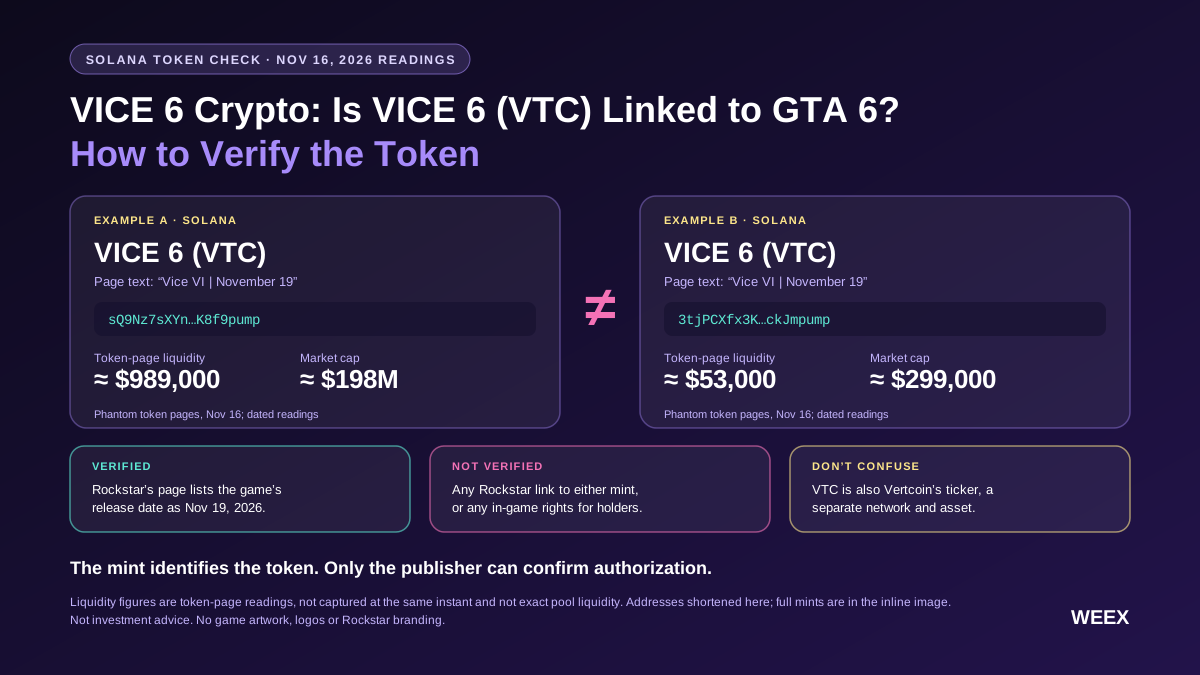
VICE 6 Crypto: Is VICE 6 (VTC) Linked to GTA 6? How to Verify the Token
Is VICE 6 crypto linked to GTA 6? Compare two Solana tokens using VTC, verify their mint and pool addresses, and see what Rockstar has confirmed.

Enterprise Blockchain: Why It's Time to Return?
DTCC Plans to Introduce Tokenized Securities and Bonds on Solana by 2027—Expanding Under Wallet Restrictions

Cardano holders reject 22M ADA treasury bid to buy physical copper

What Licenses Are Needed for Crypto Payments in Hong Kong?
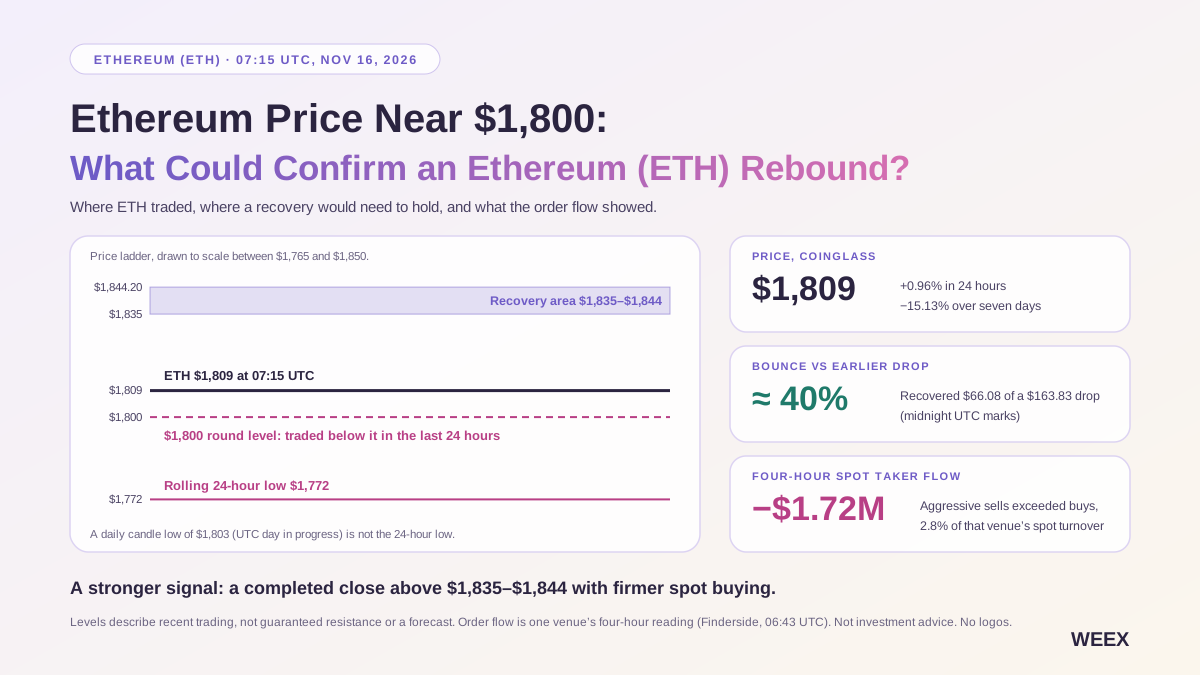
Ethereum Price Near $1,800: What Could Confirm an Ethereum (ETH) Rebound?
Ethereum traded near $1,800 on November 16. See what four-hour spot order flow, futures positioning, and Friday’s ETF flows say about an ETH rebound.
'Tokenization Is Not the Finish Line': Jupiter to Let Users Borrow Against Bullish Shares
Anthropic's Wall Street Operator: CFO Krišna Rao
'Nobody Knows Who's in Charge': Boris Johnson Stands by Bitcoin Skepticism at Breakpoint
Mazama Energy Finds New Solution to the Biggest Challenge in Geothermal Drilling
Have Semiconductors Bottomed? Here's How the Current Chip Stock Plunge Compares With Past Bear Markets.
Is Apple Losing Its Memory?
Latest articles



Latest coin listings on WEEX


