
Have Semiconductors Bottomed? Here's How the Current Chip Stock Plunge Compares With Past Bear Markets.

 Prefer us on Google


After reaching all-time highs in June, the broader semiconductor sector has gone into a severe bear market.
The first big pullback came in July, with the release of powerful Chinese open-weight models and notable short-sellers making valuation-based calls. In October and into November, fears of a Democratic sweep of both houses of Congress and state governorships fueled concerns about a data center ban or slowdown.
The semiconductor sector has been the best-performing sector over the long term, but it's also the most volatile. So if chip stocks have bottomed, now could be a great entry point for long-term investors. But has the pullback ended? Here's how the current drawdown compares with past chip bear markets.
How the mighty have fallen
The chip sector, as denoted by the iShares Semiconductor ETF (SOXX -3.67%), fell 39.5% from its June high to its recent low on Nov. 5. That is very severe, but roughly in line with the ETF's periodic declines over the past 10 years. In fact, the current 2026 sell-off puts it right in the middle of the average chip sector sell-off over the past decade.
| Max Drawdown | Peak | Bottom | Recovered | Peak-to-Peak Recovery |
|---|---|---|---|---|
| (45.8%) | Dec 2021 | Oct 2022 | Dec 2023 | Two years |
| (41.4%) | July 2024 | April 2025 | Sept 2025 | One year two months |
| (39.5%) | June 2026 | Nov 2026 | ? | ? |
| (34.3%) | Feb 2020 | March 2020 | June 2020 | Four months |
| (23.0%) | March 2018 | Dec 2018 | April 2019 | One year one month |
Data source: Investmentvisual.com
As you can see, the current drawdown is right in the middle in terms of magnitude compared with the other four major drawdowns in the SOXX over the past 10 years.
The reasons for these past drawdowns were also somewhat similar to the current chip plunge. Like 2018, this year is a midterm election year during a Trump administration. Also, as in 2018, inflation had begun to tick up -- albeit off very low levels -- and the Federal Reserve was beginning to raise interest rates, which hadn't really happened since the global financial crisis of 2008.
The same sort of thing happened in late 2021, only to a greater degree. The post-pandemic shortages and stimulus spurred a wave of inflation not seen since the 1980s, prompting the Federal Reserve to raise interest rates at the fastest pace in its history. Rising inflation and interest rates in both cases caused companies and consumers to pull back on technology spending, which had been pulled forward during the pandemic. They had also been strong during the cloud computing boom in 2017-2018.
In 2024 and into 2025, government policy, combined with overly optimistic valuations at the beginning of that year driven by the AI boom, caused the pullback. The Biden administration tightened export controls on China during that period, while companies largely deferred IT spending on PCs and traditional servers to make room to buy expensive Nvidia (NVDA -2.01%) GPUs. That sell-off continued into the early second Trump term, when tariff worries, culminating in "Liberation Day," caused a final market flush and a market bottom.
Today, we are seeing a mix of all the different factors that colored prior sell-offs, aside from the unique COVID-19 crash. In these three other scenarios, a mix of high valuations, inflation, rising interest rates, and restrictive government policy led investors to question the high growth expectations embedded in chip stock valuations.
Image source: Getty Images.
The older -- and more worrisome -- example
Of course, these four other examples only encompass recent history. Some investors compare the current AI pullback to the bust after the dot-com boom.
If the AI boom were to come undone similarly, the consequences would be more severe than even the severe pullback we've already seen. In the case of the SOXX, the semiconductor index never even recovered its prior high before a second crisis -- the housing bust of 2008 -- took it down even further than the dot-com crash.
Most know that the dot-com boom peaked in early 2000, which was actually before the SOXX ETF started trading in July 2001. However, after peaking in early August 2001, the SOXX eventually retreated 70.2% to its bottom in November 2008. The ETF didn't recover its August 2001 high until January 2014 -- 12.5 years after its prior peak!
If, in fact, the AI boom is one large "overbuild," as the dot-com build-out was, then this sell-off might not be over yet.
But it's probably a good buying opportunity
In this investor's opinion, the current situation seems more akin to more recent semiconductor bear markets than the dot-com bust. As Blackstone (BX +1.39%) CEO Jon Gray said in a recent interview with Bloomberg News:
When you think about a bubble, you think about building capacity, and then hoping the demand comes. With AI, you're building capacity, and you're hoping you can keep up with demand. That's a very different dynamic... You go back to the 90s, and telecom infrastructure, classic bubble, right? They built tons of fiber, hoping the demand would come; they used a lot of leverage, and it ended poorly. Contrast that with today. At our portfolio companies, demand for models, spend on models, is up 20-fold year-on-year... so demand is almost parabolic.
If the current pullback is indeed a growth and supply-related scare, rather than a demand bubble bursting, then the chip sector has just about fallen in line with recent bear-market bottoms in semiconductors. That's why I have been buying more chip stocks over the past two weeks, and I would recommend that others with a long-term investing horizon do the same.
-- Price
This content is provided for general informational purposes only and doesn't constitute financial, investment, legal, or tax advice. Any events, rewards, online promotions, or related information mentioned herein should not be considered a recommendation, solicitation, or invitation to purchase, sell, trade, or otherwise deal in any crypto assets. Crypto assets are highly volatile and may result in loss. The availability of WEEX services, products, and related events may vary by region. You are responsible for ensuring that your participation is in accordance with applicable local laws and regulations.
You may also like

'Tokenization Is Not the Finish Line': Jupiter to Let Users Borrow Against Bullish Shares

Anthropic's Wall Street Operator: CFO Krišna Rao

'Nobody Knows Who's in Charge': Boris Johnson Stands by Bitcoin Skepticism at Breakpoint
Mazama Energy Finds New Solution to the Biggest Challenge in Geothermal Drilling

Is Apple Losing Its Memory?

Rising Transportation Costs Make Large Holiday Purchases More Difficult
Zhao Changpeng Lists Six Possible Reasons for Bitcoin's Decline: Anthropic IPO and ETF Redemptions, Security Incidents, Regulatory Uncertainty, and More

J.P. Morgan's Forecast for 2027: Inflation Around 2% and Increased Pressure on the Dollar

The Amber Controversy: Diverging Paths with Wintermute
First Financial Report After Jensen Huang's Departure: Colette Kress Faces Core Questions

Dreamteam Completes $53 Million Financing to Expand AI CRM Business
Stellar Bell Vote on November 23: What It Means for XLM Holders

Solana Breakpoint attendees warned of robberies after reported wallet theft

Federal Reserve Governor Barr Warns AI Agents May Exacerbate Bank Runs
Trezor found implants in reseller wallets. What protects the buyer?

The Vast Used Car Market: CarMax and Carvana Clash Over Americans' Car Buying Methods
Trump and Xi Jinping to Meet in Shenzhen, Focusing on Chip Regulation and AI Security

Why is the only spot Bitcoin ETF in continental Europe acquired by an Asian group, BIT?
The Application is Landing, Wealth is Evaporating: Analyzing the Painful Roots of the Crypto Industry through Three Financial Statements
A Look at Traditional Banks Entering Web3: Who Made Money and Who Lost?

IMF President Warns Global Economy is 'Standing on One Leg': AI Circular Financing Reaches $1 Trillion

Tesla Autopilot Team Veterans Found Simulation Startup Valued at $1 Billion
Ministry of Industry and Information Technology to Interview Automotive Companies with Large Accounts Payable
Twenty One Capital’s $1.09 Billion Profit Is Mostly a Bitcoin Accounting Story
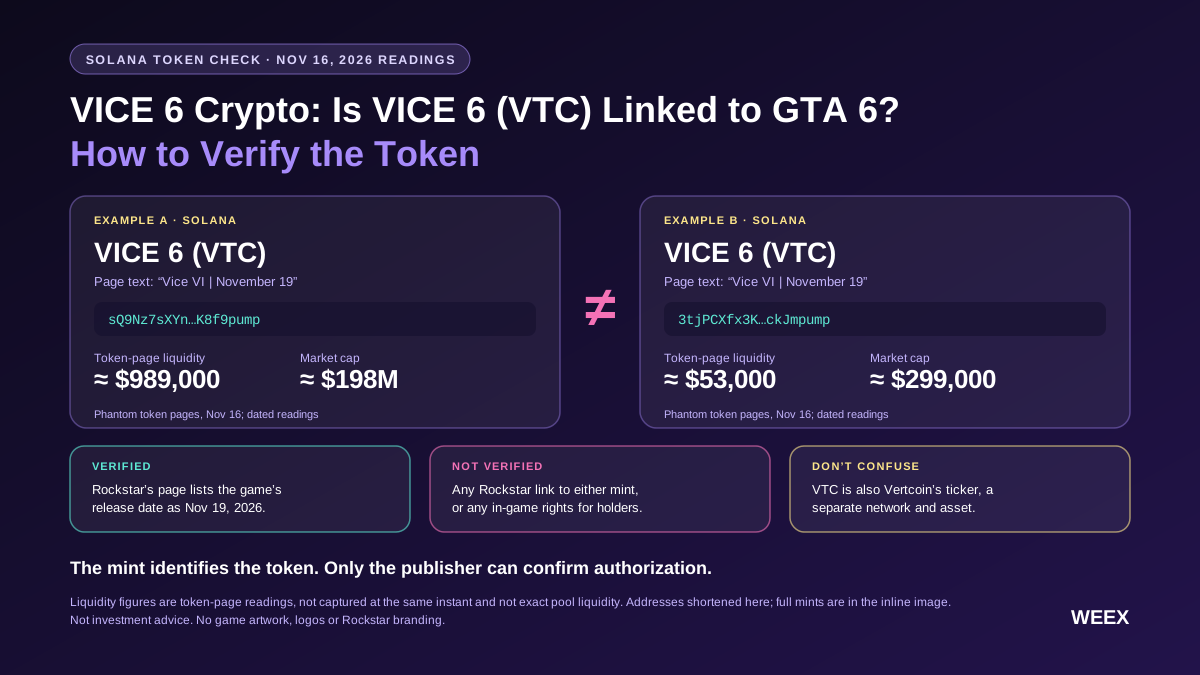
VICE 6 Crypto: Is VICE 6 (VTC) Linked to GTA 6? How to Verify the Token
Is VICE 6 crypto linked to GTA 6? Compare two Solana tokens using VTC, verify their mint and pool addresses, and see what Rockstar has confirmed.

Enterprise Blockchain: Why It's Time to Return?

DTCC Plans to Introduce Tokenized Securities and Bonds on Solana by 2027—Expanding Under Wallet Restrictions
Cardano holders reject 22M ADA treasury bid to buy physical copper

What Licenses Are Needed for Crypto Payments in Hong Kong?
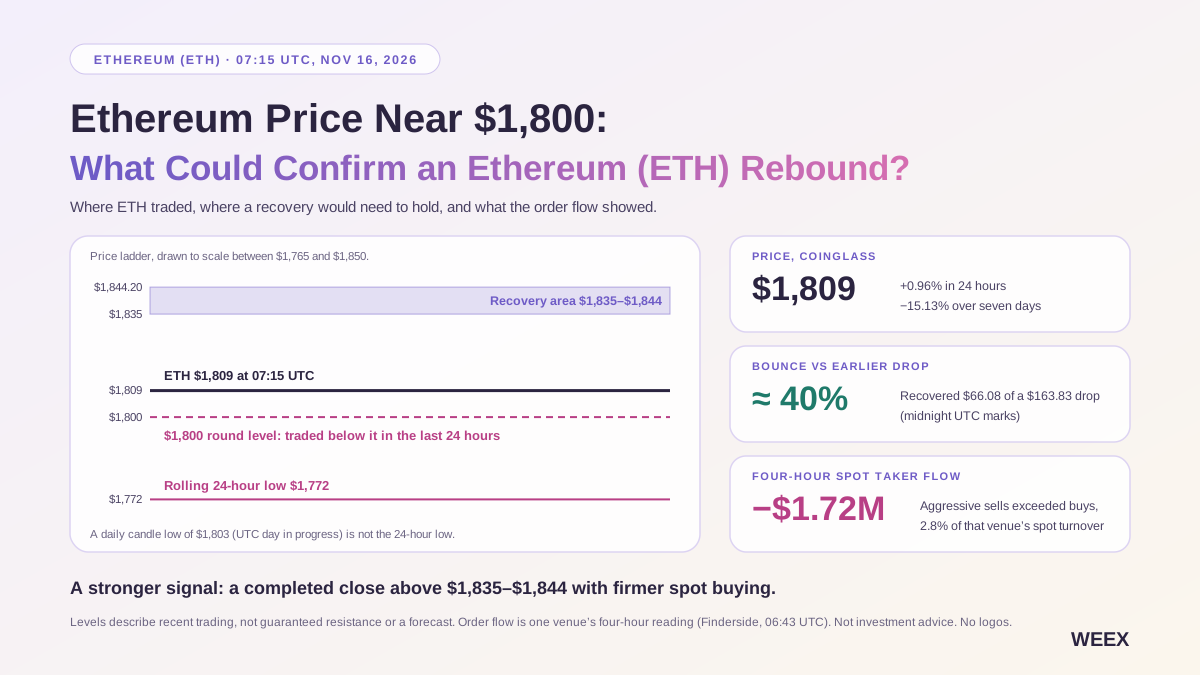
Ethereum Price Near $1,800: What Could Confirm an Ethereum (ETH) Rebound?
Ethereum traded near $1,800 on November 16. See what four-hour spot order flow, futures positioning, and Friday’s ETF flows say about an ETH rebound.
'Tokenization Is Not the Finish Line': Jupiter to Let Users Borrow Against Bullish Shares
Anthropic's Wall Street Operator: CFO Krišna Rao
'Nobody Knows Who's in Charge': Boris Johnson Stands by Bitcoin Skepticism at Breakpoint
Mazama Energy Finds New Solution to the Biggest Challenge in Geothermal Drilling
Is Apple Losing Its Memory?
Rising Transportation Costs Make Large Holiday Purchases More Difficult
Latest articles



Latest coin listings on WEEX


