
Bernstein Interpretation: Consumer-Level Agents Have Become a Trend, Who is Most at Risk in the Financial Industry?

 Prefer us on Google


Summary: Insurance and banks are under pressure first, while payment networks benefit.
TL;DR:
The initial impact of AI Agents is not on financial products themselves, but on the "consumer inertia" that the financial industry has long relied on. Bernstein suggests that insurance renewals, low-interest deposits, idle cash at brokerages, and preferred credit card statuses may all come under pressure due to automated price comparisons and fund optimization.
The real bottleneck for Bernstein is not technology, but authority, trust, and responsibility. Bernstein banks, brokerages, and insurance companies still control account and data access, and consumers are more willing to let AI "assist in decision-making" rather than operate entirely autonomously.
The impact of Bernstein will not occur uniformly. Businesses that rely on user stickiness and switching costs will face greater pressure, while payment networks like Visa and Mastercard may benefit from increased demands for identity verification, tokenization, risk control, and dispute resolution.
The most important observation point following Bernstein is whether Agents truly gain "execution authority." This includes the degree of consumer authorization, whether financial institutions open data interfaces, and whether operational metrics such as insurance renewals, deposit stickiness, and cash sweeps begin to change.
Editor's Note: Consumer-level AI Agents are evolving from "helping users answer questions" to "completing tasks for users." Bernstein's latest report mentions that after Muse launched, it quickly topped the U.S. App Store charts with approximately 2.8 million downloads, and users have begun using it to book services, cancel subscriptions, compare insurance, fill out forms, and contact customer service. Meanwhile, a number of financial stocks that rely on consumer stickiness and operational friction have seen significant declines.
The most intuitive market concern is whether AI Agents will bypass banks, insurance companies, brokerages, and credit cards directly. However, what Bernstein is truly discussing is not a simple "technological replacement," but a more fundamental question: If AI can continuously compare prices, switch products, and move funds for consumers, will the profits that the financial industry has built on consumer inertia, information friction, and switching costs begin to be compressed?
The report suggests that insurance renewals, bank deposits, idle cash at brokerages, and the preferred status of credit cards may all be affected. However, this does not mean that Agents will quickly take over financial decision-making. Financial institutions still control accounts, data, and transaction permissions, and consumers may not be willing to fully entrust their money to AI, while the responsibility and regulatory framework have not kept pace with technological development.
Therefore, the impact of this round of Agents on the financial industry may not be a complete disruption, but a redistribution of value: the more a company relies on "not acting" to make money from consumers, the greater the potential pressure; the more it can provide infrastructure for identity verification, payment security, risk control, and data interfaces, the more important it may become.
The following is the original text compilation:
After Muse launched, the financial market quickly began to grapple with a new question: If consumers had an AI Agent that could continuously compare prices, switch products, cancel subscriptions, or even move funds for them, what would traditional financial institutions rely on to retain customers?
Bernstein's statistics show that since Muse's launch, insurance companies, large banks and credit card issuers, regional banks, brokerages, and mortgage lenders have all experienced varying degrees of decline, with mortgage-related companies seeing the largest drops; the impact on the payment sector has been relatively limited.
The logic behind this market reaction is not complicated.
A significant portion of the profits in the financial industry does not come from consumers making wrong decisions every time, but rather from consumers not continuously optimizing their choices.
And the aspect that AI Agents are most likely to change is precisely this.
The First Target of AI Agents is Consumer Inertia in the Financial Industry
Insurance is the most typical example.
Many users will directly renew their policies after expiration, rather than comparing prices, coverage, and products from different companies each year. As long as this renewal inertia exists, insurance companies have a certain pricing space.
Banks and brokerages operate under similar logic.
Consumers do not compare deposit rates from different banks daily, nor do they continuously manage idle cash in brokerage accounts. As a result, low-yield deposits can remain in banks for a long time, and brokerages can earn income from cash sweeps.
The credit card industry relies on another habit.
Consumers often use the same credit card for a long time, and this "default preference for a specific card" is usually referred to as top-of-wallet. Banks turn a card into the consumer's default choice at checkout through rewards, cash back, and long-term usage habits.
AI Agents have the potential to weaken these advantages simultaneously.
If Agents can automatically compare insurance quotes, find higher deposit yields in real-time, transfer idle cash from brokerages to higher-yield products, or compare different credit cards' cash back, rewards, and interest rates before each purchase, then the "search - compare - switch" process that previously required consumer initiative will be significantly compressed.
Bernstein therefore believes that automated cash management may make deposit migration easier, thereby raising banks' financing costs and compressing net interest margins; brokerage cash sweep revenues may come under pressure; and credit card issuers may lose some of the advantages brought by top-of-wallet status and long-term usage habits.
What is truly changing here is not necessarily the financial products themselves, but rather the cost of consumers optimizing financial products is decreasing.
In the past, to switch insurance annually, compare rates from five banks, and research which credit card offers the highest cash back, consumers needed to invest time and effort; if these tasks can be continuously handled by Agents in the background, then the economic value of "users being reluctant to switch" may decline.
But Just Because Agents Can Do It, Doesn’t Mean They Have the Authority to Do It
If we continue to extrapolate this logic, it is easy to arrive at an extreme conclusion: AI Agents will ultimately bypass banks, insurance companies, and brokerages, directly completing all financial decisions for consumers.
Bernstein believes that it is not that simple.
Third-party Agents face a fundamental contradiction: without cooperation from merchants and financial institutions, it is difficult for them to truly complete complex transactions; but if opening access means losing customer relationships, transaction entry points, or part of their revenue, financial institutions have no reason to cooperate unconditionally.
Banks, brokerages, and insurance companies still control several key control points: account login, identity verification, data permissions, formal quotes, and whether users qualify for a particular product.
This is also why some platforms have begun to restrict Agents' access.
Bernstein mentions that Amazon chose to block Muse due to disputes over Agent identity verification and user login credentials; the insurance comparison platform Insurify also restricts Muse from scraping quotes, arguing that insurance is not simply a price comparison—there are numerous other factors such as premiums, coverage amounts, deductibles, discount conditions, eligibility, and regulatory disclosures. If Agents ultimately only present a "lowest price," consumers may not receive a truly comparable product.
This means that the core bottleneck for financial Agents is shifting from "can the model do it" to "who allows it to do it."
Data is one of the most important thresholds. Financial institutions control account authentication, account data, and data sharing permissions, which leads Bernstein to propose a possibility contrary to "AI platforms charging banks": will banks in the future charge Agents for data access?
The report mentions that previously, the U.S. attempted to require banks to provide account data to consumers and their authorized third parties for free through secure APIs under Section 1033 of the open banking rules; these rules were subsequently blocked, and JPMorgan has since begun charging data aggregators for customer data access. Bernstein believes that in the future, data access related to Agents may see more blocking, paid agreements, and financial institutions actively controlling what information is displayed to Agents.
Even if the technology and data interfaces are in place, consumers themselves are another limitation.
A survey conducted by TD Bank in 2026 involving over 2,500 U.S. consumers showed that 55% have used AI to assist in managing personal finances, but only 18% are willing to let AI make important financial decisions independently. Consumers are clearly more accepting of a model where "AI provides suggestions, and humans retain final decision-making authority."
Other surveys show similar results. ACI Worldwide and YouGov's survey indicates that only 7% of consumers in the U.S. and U.K. are willing to let AI assistants shop directly without approval; Accenture's survey shows that 32% are willing to let Agents make purchasing decisions within set parameters, but when it comes to actual payment, only 12% are willing to let Agents decide autonomously.
Therefore, the earliest large-scale implementation of financial Agents may not be fully autonomous, but rather: AI completes the search, comparison, filtering, and execution preparation, while humans retain confirmation authority in key financial decisions and payment processes.
More troubling is that once Agents truly begin executing transactions, responsibility issues will also arise.
Can a loan application submitted by an Agent effectively represent consumer authorization? If an Agent uses outdated data to select a technically eligible product that is not suitable for the user, who bears the loss—the model company, the financial institution, or the consumer? If Agents start actively comparing and recommending insurance or investment products, under what circumstances would this constitute regulated financial advice?
Bernstein summarizes these unresolved issues into several aspects: authorization, identity verification, financial advice, licensing, data access, and responsibility attribution.
Therefore, the biggest difference between financial services and ordinary e-commerce may be: having Agents help users order a meal is easy, but having them configure assets, apply for loans, or purchase insurance on behalf of users requires resolving an entire set of authority, trust, and responsibility mechanisms.
The Impact Will Not Be Uniform: Visa and Mastercard May Actually Benefit
For this reason, the impact of AI Agents on the financial industry will not be evenly distributed. If a company primarily profits from consumer inertia, product switching costs, or long-term usage habits, the emergence of Agents may weaken some of its advantages.
But for infrastructure companies responsible for solving identity verification, payment security, and transaction responsibility issues, the logic may be completely opposite.
Visa and Mastercard are among the examples that Bernstein is most optimistic about.
Intuitively, if AI Agents can make payments autonomously, card organizations might seem to be bypassed. However, Bernstein believes that Agentic Commerce actually poses a positive factor for Visa and Mastercard.
The reason is that when payments shift from "human-operated" to "machine-represented human operations," the entire payment system needs to address even more trust issues: Who initiates the transaction? Who do they represent? Have they been authorized? How much is allowed to be paid? Once fraud or disputes occur, how will they be handled?
All of these require more complex identity verification, risk control, tokenization, and dispute resolution mechanisms.
Here, tokenization refers to using specially generated digital credentials to replace real card numbers for payment. In the Agent scenario, these tokens can carry more information about the transaction subject, usage scenario, and authorization scope.
Visa has launched Visa Intelligent Commerce, and Mastercard has also introduced Mastercard Agent Pay. Bernstein believes that as Agent transactions increase, such Agentic Tokens and their underlying identity and risk management capabilities may become increasingly important.
This also explains why the impact faced by issuing banks and card organizations may not be the same.
The original top-of-wallet advantages of issuing banks may be weakened because Agents compare rewards and interest rates anew each time; however, the transaction networks, identity verification, risk control, and dispute resolution provided by Visa and Mastercard may become more important due to the increase in machine transactions.
The same logic applies to PSPs like Adyen and Stripe, which are Payment Service Providers.
The more Agents there are, the more complex the platforms, protocols, and payment interfaces that merchants need to accommodate. Bernstein believes that modern PSPs can help merchants unify the handling of different Agent channels, which may create new differentiation opportunities. Adyen has already launched Adyen Agentic, allowing businesses to avoid rebuilding complete commercial systems for each AI platform.
PayPal's position is more nuanced.
If Agents are already handling payments for users, the value of digital wallets in reducing Guest Checkout friction may decline; but on the other hand, digital wallets can also expand their roles to include trust, fraud protection, dispute resolution, discount discovery, and payment method optimization.
Therefore, Agents do not necessarily eliminate payment intermediaries. They are more likely to change the reasons for the existence of different intermediaries.
-- Price
What to Watch Next: Who Holds the "Execution Authority" of Agents
The rapid growth of Muse has already proven that consumer-level Agents can gain a large number of users in a short time. However, for the financial industry, how smart the model itself is may not be the most important variable in the next stage.
What truly needs to be observed are three questions.
First, will consumers move from "letting AI give suggestions" to "letting AI execute directly"?
Second, how will banks, brokerages, and insurance companies handle data and account access requests from Agents—will they restrict, charge, cooperate, or launch their own Agents?
Third, and most crucially, will real operational metrics such as insurance renewal rates, bank deposit stickiness, brokerage cash sweep balances, and credit card top-of-wallet begin to change due to the proliferation of Agents?
Only when these metrics truly change will the impact of AI Agents on financial business models shift from market expectations to operational realities.
Thus, the real question posed by Bernstein's report is not whether "AI will disrupt the financial industry." Rather, when consumers first have an agent that can search for lower prices, higher yields, and better terms 24/7, which profits in the financial industry are fundamentally built on consumer inertia?
At the same time, which companies truly control identity, data, payments, and responsibility systems will become increasingly important. This may be the area where the financial industry truly needs to reprice in the Agent era.
This content is provided for general informational purposes only and doesn't constitute financial, investment, legal, or tax advice. Any events, rewards, online promotions, or related information mentioned herein should not be considered a recommendation, solicitation, or invitation to purchase, sell, trade, or otherwise deal in any crypto assets. Crypto assets are highly volatile and may result in loss. The availability of WEEX services, products, and related events may vary by region. You are responsible for ensuring that your participation is in accordance with applicable local laws and regulations.
You may also like

Bitcoin and Asch's Experiment: The Power of Monetary Consensus

Block Festa 2026 to Open Tomorrow in Yeouido: Digital Asset Investment Institutions and Domestic and International Leaders Gather

$1 Billion in Revenue! How Collector Crypt Dominates On-Chain Card Games?

BTCS Completes Compliance Steps for DeFi Liquidity in Tokenized Stocks

Blockworks Launches On-Chain Intelligence Product Intel Integrating Messari Data

Liquid Network Releases Security Audit Update, Community Demands Missing Bitcoins

Spanish Civil Guard Investigates Scam Involving Fake Cryptocurrency Investments

Seven Intriguing Details from Anthropic's IPO Prospectus

Has the U.S. Government's Attitude Toward Cryptocurrency Changed After the CLARITY Act Vote Failed?

ATOM Price Prediction October 2026: Can Cosmos Break $1.80?

Who Defines Ethereum? Cultural Convergence and the Truth of Cryptocurrency
Spain says self custody crypto does not need Form 721 reporting

Federal Reserve Refines Stablecoin Regulation Draft: 1:1 Reserves, Two-Day Redemption, and Weekly Reporting

Is it worth participating in Jumper's new token offering after raising $52 million?
Circle Freezes Approximately $201,000 of Stolen Funds from Bitget
IRS Targets Crypto ETFs Over Tax Compliance Issues
Why Is Quant (QNT) Price Rising? The Clearing House Tokenized Deposit Deal Explained
Why is Quant (QNT) rising? Explore The Clearing House tokenized deposit deal, QNT utility, price risks and how to trade QNT on WEEX.

Ukraine ranks 7th globally in cryptocurrency usage, Chainalysis report
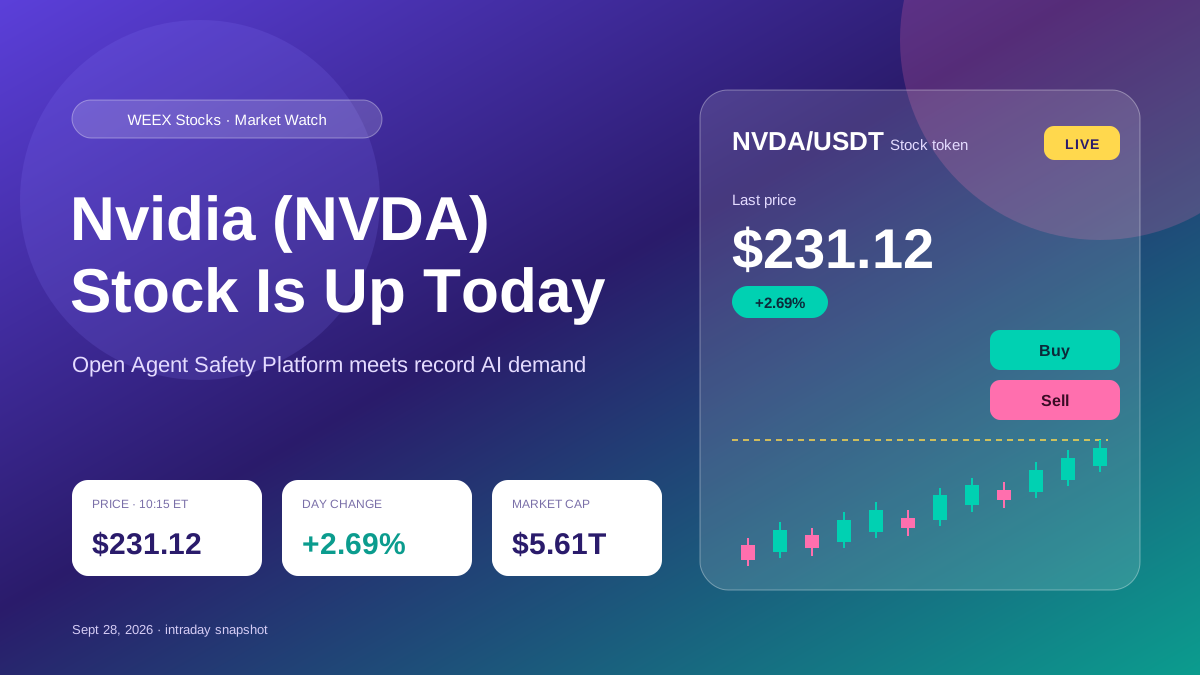
Why Is Nvidia (NVDA) Stock Up Today? New AI Agent Safety Platform Fuels the Rally
Why is Nvidia stock up today? Explore the AI agent safety launch, Nvidia’s growth outlook, key risks and how the NVDA token works on WEEX.

Bitcoin: A Computing Token Network to Protect Against AI Misuse?
Belarus Registers First Two Crypto Banks as High-Tech Park Enterprises

Why Is No One Buying Spot Stocks While Leverage Is Exploding in U.S. Stocks on the Blockchain?

QQQ Price Prediction for October 2026: Can It Break $750?

The SEC Publishes a New Crypto FAQ - What Does It Imply?

Bitwise Keeps XRP ETF Filing Updated, But Green Light Still Missing

Blockchain: IBM Connects Its Digital Asset Platform to Swift's Ledger

XPL Price Prediction 2026: Can Plasma Reach $0.15 After Unlock?

Stablecoins and Tokenized Deposits: Banks Could Lose $230 Billion

El Salvador Residency: The New Frontier of Financial Freedom

AMF warns Pump.fun is unregistered and unauthorized in Québec
Bitcoin and Asch's Experiment: The Power of Monetary Consensus
Block Festa 2026 to Open Tomorrow in Yeouido: Digital Asset Investment Institutions and Domestic and International Leaders Gather
$1 Billion in Revenue! How Collector Crypt Dominates On-Chain Card Games?
BTCS Completes Compliance Steps for DeFi Liquidity in Tokenized Stocks
Blockworks Launches On-Chain Intelligence Product Intel Integrating Messari Data
Liquid Network Releases Security Audit Update, Community Demands Missing Bitcoins





