
Debt Expansion and Currency Shuffle: The Biggest Beta Opportunity in the Crypto Market According to Hayes

 Prefer us on Google



As the "Schrödinger's Euro" arrives, Bitcoin may welcome a super cycle of passive balance sheet expansion by the Federal Reserve.
Written by: Arthur Hayes
Compiled by: Saoirse, Foresight News
On a Friday during the deep winter of Patagonia, I was doing what I love most: backcountry skiing. The annual St. Rosa storm had brought over a meter of snow to the mountainous regions, but it required a drop in temperature and a few days of waiting for the snowpack to stabilize, thus reducing the avalanche risk. As the clouds lifted and visibility improved, I managed to take a run in a south-facing snow bowl. In the Southern Hemisphere, south-facing slopes receive the least sunlight, which also means the snow quality is the best. Although it can't compare to Japan's powder snow (Japow = Japan + Powder, a popular term in the skiing community referring to Japan's top-quality natural powder), it was the best snow condition I could experience in August.
This Friday was particularly significant for the financial markets. Federal Reserve Chairman Waller (the author sarcastically nicknamed the Fed Chairman Kevin Waller as "Weasel" to mock his hawkish rhetoric while his actual policies waver) was giving a speech in another one of my favorite ski towns, Jackson Hole... Want to try the Corbet's Couloir? But I had to stay focused; the snowpack was still unstable, and I was mentally rehearsing which escape route to take if an avalanche were triggered. Just moments ago, my guide and I were discussing which slope to ski to minimize the angle and risk of an avalanche.
I would rather spend my time skiing and surfing than "keeping a close eye on market conditions." But as the Chief Investment Officer of a family office, I always have to find ways to make money—skiing is an expensive hobby. Due to my lifestyle constraints, I can only focus on one or two key price indicators to gauge whether the pace of fiat currency liquidity injection is accelerating or slowing down. Based on these signals, I can instantly switch my portfolio to long or cash; I never short. These observation indicators change over time, and in this article, I will explain why my current macro core anchor point is the EURJPY exchange rate.
Before diving into the discussion, let me state my judgment: by June next year, the EURJPY will drop from the current level of 185 to 140 or even lower, which will trigger a massive expansion of dollar liquidity. Before that, I need to clarify why I chose this indicator. In short, U.S. Treasury Secretary Basant (the author mockingly nicknamed U.S. Treasury Secretary Scott Basant as "Buffalo Bill," describing his hardline tactics and proactive approach to stirring up the global currency market and forcibly reshaping the global exchange rate landscape) is the one who wants to force U.S. allies' currencies to appreciate against the dollar, the "serial killer" of currencies. In speech after speech, he bluntly tells the market the ultimate goal and clarifies the means to achieve it in July-August this year. Even though he holds immense monetary and regulatory power to intervene in the market, the size of the U.S. Treasury and foreign exchange markets is too large for him to achieve his goals single-handedly. He needs profit-seeking private investors to follow suit. That is why he has been very clear in guiding the market: sell euros, buy yen.
The core argument of this article: behind Basant's series of actions is a logically coherent strategy. I admit that I am somewhat beautifying him here; sometimes you have to give credit to the person responsible for turning on the money printing machine. The vast majority of global politicians only respond passively, concerned only with the next election, lacking long-term strategy. But even if Basant's decisions are completely random, the chain reactions he triggers, regardless of intent, will serve the goal of "peace under American rule."
Make America Great Again
The most brilliant political slogan in history, it is both hollow and all-encompassing. For whom should America be made great again? When was America ever great? Before the mid-20th century, so-called greatness belonged only to domestic white male property owners, while everyone else was in a dire situation. So which era should we look back to? It exploits misplaced nostalgia and caters to the public's cognitive inertia. A perfect slogan, everyone can imagine themselves as winners.
I have said before, and I will say it again: the Trump administration, and whichever party comes to power after 2028, all hope to restore the American industrial economy to its glorious status of 1945-1980. After 1980, first Japan, and then emerging Asian economies led by China, including South Korea and Taiwan, became the global manufacturing centers for major commodities. Conceptually, all countries wanting to achieve this mercantilist model must adopt the same policy mix: set tariff barriers to block foreign goods while allowing their currencies to depreciate relative to major trading partners.
America's real opponent is China, which skillfully executes this strategy. American companies find it difficult to enter the Chinese market; once the powers that be in America believe the economic strength can bear the cost of decoupling, the American market will also close its doors to Chinese companies. Thus, the most important economic battleground becomes: from whom will Europe import goods? Europe is the second-largest economy after the U.S., capable of absorbing exports from either the U.S. or China. To win the European market, the U.S. needs to meet several conditions: the dollar must be weaker than the euro; EU countries must act independently and not unify, making it easier for the U.S. to divide and conquer; and the dollar must also weaken against other Asian currencies, including the yen, won, and New Taiwan dollar.
As I mentioned earlier, due to the operations of Basant and others, the EURJPY will decline, so how does this align with the weakening of the dollar against the euro?
To dismantle Europe, one must first weaken Germany. The euro mechanism allows Germany to effectively depress the exchange rate of the Deutsche Mark relative to other member states, achieving prosperity through exports, which was also the economic cost of Germany's reunification. The result is that Germany has accumulated a massive net investment position, placing it in the same league as China and Japan, the two most successful mercantilist economies post-World War II. To effectively compete with Germany in the European market, the dollar must depreciate relative to the "nominal or real Deutsche Mark." Either Germany must exit the euro, or France must effectively exit the euro. The euro has been flawed since its inception. But what will truly push this false currency system to its end is the internal politics of Europe, combined with the market pressure that Japan brings to the European bond market.
A few weeks ago, Basant used the Exchange Stabilization Fund (ESF) to directly sell euros and buy yen, officially sounding the horn for action. As a profit-seeking private investor, I naturally have to follow in his footsteps. Next, I will elaborate on why the euro will soon collapse, accompanied by some chart interpretations.
What is the Euro?
The euro is essentially a transaction of interests. Germany promises to maintain a low military posture; in exchange, German goods can be dumped into other European markets without tariffs. This system generally achieves balance, but under a unified currency, the exchange rate of German export goods does not appreciate, while the German banking system accumulates massive euro surpluses. The savings earned by Germany through exports must find investment destinations, so they lend money to trading partners, allowing them to continue buying German goods. This is why Greece was able to obtain borrowing rates close to Germany's back in the day. The imbalance is reflected in the Target2 clearing system: the German banking sector is a net creditor, while the banks of other European countries are debtors. Through this euro-based interest exchange, Germany has become affluent, even becoming one of France's largest creditors. France's high welfare system also relies on the euro and the common market. These two points are crucial in the following text.
It is not that Germans are inherently frugal, while other Europeans are inherently lazy. Germany's credit corresponds to France's debt; this is merely an accounting identity, unrelated to national culture. It is the flow of currency and trade that shapes social culture, not the other way around.
The structural problem of the euro is that when the imbalance accumulates to a critical point, the populace will want to reclaim national sovereignty. The German populace wants the government to increase spending and strengthen labor rights; the populace of other European countries wants to reclaim local jobs and end the boom-bust cycle dominated by German banking credit.
The EU leadership and the European Central Bank will never allow the citizens of Germany and France to pursue national interests first; otherwise, they would lose the power in their hands. This is why nationalist parties, both left and right, are thorns in the side of Brussels' rulers, and the centrists will go to great lengths to suppress the rights of the populace to make their own choices.
First Down, Then Up
France is the second-largest economy in Europe, yet its credit status is the worst in Europe. The behavior of French savers has already confirmed this point.
The first chart shows the changes in Target2 balances from 2021 to the present. France (white line) was initially a net creditor, meaning that euros from other European countries continuously flowed into the French banking system more than French capital flowed out. However, the trend reversed in 2021, and France became the largest debtor in the Target2 system. French savers and other European investors are withdrawing euros from French banks and transferring them to other parts of the eurozone. Why is this happening?
The second chart shows the yields on 10-year government bonds in France, Spain, and Italy. Spain and Italy have always been the economically weaker countries in the eurozone, while France's 10-year government bond yields have deteriorated from a previously strong position to the worst-performing tier in eurozone sovereign debt.
French government spending accounts for about 60% of the economy, with only Finland having a higher government share. France needs to borrow massive amounts of money each year to fill the ever-expanding fiscal deficit, continuously pushing up government bond yields.
To make matters worse: French fiscal deficit financing increasingly relies on foreign hot money, mainly from Germany and Japan.
The core political issue: do the French want a larger or smaller government? Across various political factions, the French generally believe that the problem lies in the government not doing enough. Let’s not forget that when Macron merely intended to slightly delay the retirement age, it triggered a nationwide strike that paralyzed society. In the 2027 presidential election, the far-left candidate Jean-Luc Mélenchon ranks second in polls, just behind Marine Le Pen. On August 25, 2025, after a speech by French Finance Minister Bayrou, he made a statement regarding foreign debt:
"Do not create panic by sensationalizing the French crisis. 30 trillion in debt, 60% belongs to foreign investors. Let them have respect for France. If they try to short and bring down France, the cost will ultimately fall on them."
At this point, can you still blame the French and European savers for rushing to withdraw their capital? To maintain the level of government spending that the populace expects, France will ultimately have to implement capital controls and financial repression.
Bessent has lit the fuse on this powder keg, and all contradictions will explode next year. The Schrodinger Euro will emerge from this sea of fire.
Japan: The Fuse ------
I wrote in "Yen-Quake" that the Bank of Japan is reluctant to raise interest rates. The bureaucracy does not want to bear the paper losses and public criticism that come with a stronger yen. Therefore, the Japanese government will encourage domestic private and semi-official institutions (Japanese corporate groups) to sell overseas assets and bring capital back home to boost the yen. The problem is that the largest overseas assets held by Japan are American assets. The United States will not allow one of its largest creditors to sell U.S. Treasuries just to solve Japan's domestic problems. South Korea is currently experiencing this reality: Trump has reduced U.S.-South Korea military exercises and redirected THAAD interceptors that were supposed to be delivered to South Korea to the Middle East. The underlying message is: if you do not follow U.S. directives, you will face China alone. Due to historical and geopolitical concerns, Japan, South Korea, Taiwan, and most economies in Northeast Asia choose to comply with the U.S. rather than make alternative choices. I believe that without U.S. troops stationed, Northeast Asia will not erupt into hot war, but historical animosities and real fears exist and profoundly affect current economic and political decisions.
Bessent has proposed a solution: Japan, South Korea, Taiwan, and other Asian export countries that comply with the U.S. do not need to sell U.S. Treasuries directly; they can use the Fed's FIMA repo tool to exchange their Treasuries for dollars. To maintain U.S. geopolitical strategy, Bessent and the Fed are willing to turn on the money printing machine to prevent the monetary system established after the 1998 Asian financial crisis from collapsing chaotically. I suspect that if China is willing to accept U.S. competition rules in certain trade areas, Trump might even be willing to offer China the same tools. However, for China to abandon its mercantilist policies would touch deeply entrenched interest groups at home, making it practically impossible.
European assets thus become the second-largest pool of assets that Japan and other Asian export countries can sell. Bessent directly utilized the foreign exchange stabilization fund to sell euros and buy yen, completing yen intervention without even notifying the European Central Bank in advance, breaking diplomatic norms between central banks. At the same time, Trump wielded a big stick, making Asian countries under the security umbrella understand the consequences of defying orders. South Korea was hit because it refused to deeply participate in the U.S. confrontation with Iran. Later this month, Xi will visit the U.S., and Trump's words and actions will be worth observing.
Although there are no official details published about "which country sold which assets on what day," we can observe the market performance of French government bonds after Japan's Ministry of Finance, Katayama, publicly requested Japanese corporate groups to repatriate capital on July 10.
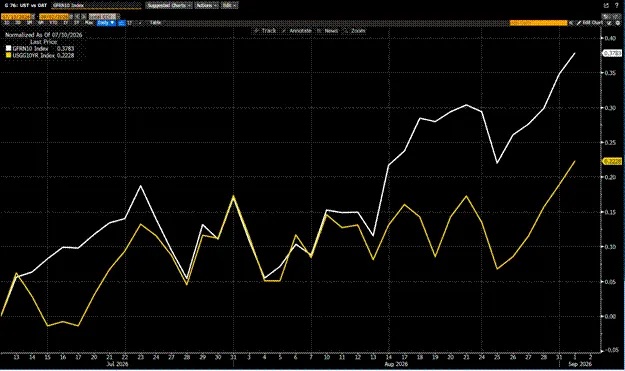
The yield on French 10-year OAT bonds rose by 38 basis points, while the yield on U.S. 10-year Treasuries only rose by 22 basis points during the same period. Japanese companies received orders to shift from marginal buyers of French bonds to sellers, and the current French market is precisely the least able to bear sell orders.
Not only French government bonds, but about 71% of the debts in the French banking sector are held by foreign investors, and this portion will also be sold off.
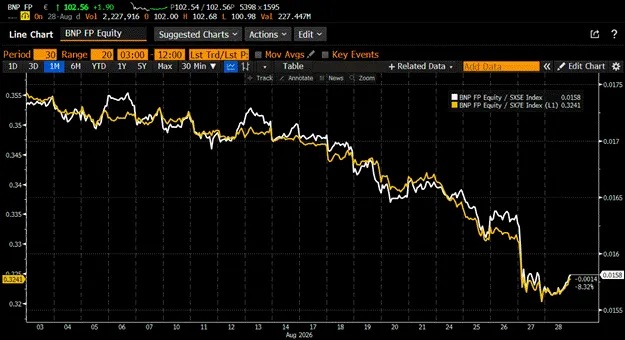
Look at the comparative performance of France's largest bank, BNP Paribas, relative to the European Stoxx Index and the European Stoxx Bank Index. BNP Paribas is classified as a Global Systemically Important Bank (GSIB) and is also a crucial financing partner for U.S. hedge funds, a point I will mention again later. In August, its stock price already performed poorly; as foreign capital sells off debt, depositors are trying to transfer their savings to Germany and Switzerland, and its situation will only worsen.
The situation did not have to reach this point. The European Central Bank has designed various money printing tools, and once market prices threaten the survival of the euro, it can smooth out the market pricing of bonds. However, the European Central Bank will set political thresholds for member states before stepping in to provide assistance. In the case of France: do you agree that Brussels' power is above Paris? If so, the European Central Bank will print euros to absorb foreign sell orders; if not, the European Central Bank will watch coldly and allow the market to clear freely.
The European Central Bank hopes that Macron's successor will also obey Brussels, and the current president, Christine Lagarde, is even a potential candidate. Imagine her taking over the Élysée Palace. French voters are extremely resistant to such a future. Therefore, voters tend to lean towards the left or the right, both advocating for prioritizing French national interests.
The European Central Bank believes it can create panic to force French voters to choose the "correct" candidate. By allowing French government bonds and the banking system to collapse under the pressure of foreign sell-offs, it aims to intimidate the public into choosing to cede sovereignty to the EU to escape the pain. In 2011, the European Central Bank successfully played out this script in Greece: the Syriza campaign platform could have pushed Greece to exit the euro, but the European Central Bank created enough fear, and the Greek public ultimately voted to accept austerity measures, allowing Draghi to implement a brutal rescue plan. However, French youth once went on strike for pensions, and I do not believe the European Central Bank can intimidate the French into accepting austerity.
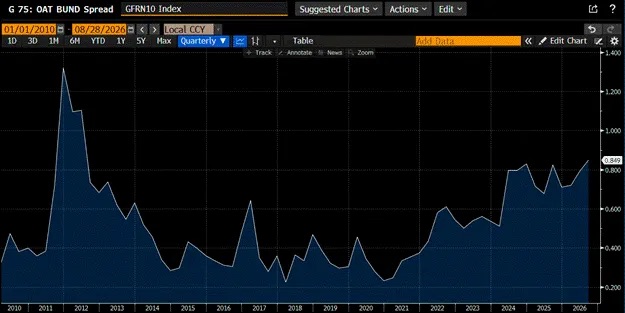
The longer the European Central Bank delays assistance to France, the wider the spread between French OAT bonds and German bonds will become, already reaching the widest level since the 2011 euro debt crisis. If the TPI (Transmission Protection Instrument) money printing tool is not activated, French government bonds will continue to underperform.
By the time the French presidential election is settled in May next year, all contradictions will converge, and the situation will explode completely.
The Schrodinger Euro ------
How to be in the eurozone while effectively detaching from the euro?
Even if the public shouts for France first, Germany first, Italy first, they are not psychologically prepared to completely exit the euro. The European Central Bank's narrative of intimidation and erroneous economics has deeply penetrated people's minds. Therefore, the Banque de France will take a path of soft exit from the euro: printing bank reserves to provide a backstop for domestic government and bank debts.
The entire logical chain: Problem: Foreign capital continues to sell bonds, and yields keep rising. Solution: If the European Central Bank refuses to act, the Banque de France will break the rules, print bank reserves, and openly buy domestic government and bank debts, placing them on its balance sheet. This constitutes quantitative easing (QE), which is explicitly prohibited by the European Central Bank.
Capital controls? Capital controls are essential. If capital can flow freely out of France, QE will only turn domestic savings into overseas assets, rendering it meaningless. After restricting capital outflows, the government will force funds to be directed towards "compliant financial assets," theoretically boosting the domestic economy.
Impact on the euro: France effectively achieves currency depreciation, giving birth to a "French version of the euro, livre-euro." This currency circulates only within France, and whether it can be exchanged for foreign currency entirely depends on the approval of the Banque de France. Like other controlled economies, exporters can only apply for cross-border capital flows with real invoices.
Currency depreciation gives French goods a price advantage relative to other eurozone member states. As the second-largest core economy in the eurozone, once France does this, other member states, except for Germany and a few Nordic countries, will follow suit. Under this "Schrodinger Euro" system, countries can effectively devalue their currencies. Germany continues to adhere to the old rules but holds the strongest currency in Europe, equivalent to the return of the Deutsche Mark.
Thus, the euro will perish, replaced by the Schrodinger Euro. But this does not yet explain the Fed's money printing. This system explains why EURJPY is falling, but to achieve U.S. export goals, the dollar also needs to weaken against both the euro and the yen. I discussed the logic of the dollar weakening against the yen in "Yen-quake"; now let’s talk about how the Schrodinger Euro forces the Fed to expand its balance sheet and maintain the U.S. Treasury repurchase market.
How do you say "repo" in French? ------------
Fed Chair Waller appears to be a monetary hawk. In his Jackson Hole speech, he reiterated the need to bring inflation down to the 2% target (government rhetoric, not the inflation felt by the public), and previously stated that the Fed's balance sheet is too large. However, for a true bull market in cryptocurrencies to arrive, the Fed needs to accelerate its money printing pace. The Fed needs a decent excuse, using a set of unrealistic economic theories to publicly claim that expanding the balance sheet to purchase bonds will not cause inflation. The most visible place for money printing expansion is in the tools that are already in operation.
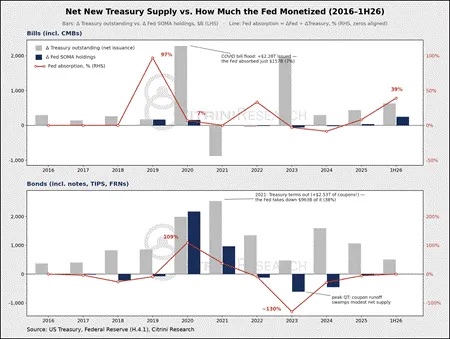
Currently, the Fed has absorbed 39% of short-term Treasury issuance, while this proportion will still be zero by the end of 2024. Simply put, the Fed has turned on the money printing machine, taking on nearly half of Bessent's short-term debt financing. This RMP (Reserve Management Purchase) tool was launched last December. So how does the market force the Fed to further increase the pace of money printing?
Trigger condition: Large banks reduce their lending scale in the repo market.
Are there banks in trouble that occupy a large share of the repo market? Yes, the French global systemically important banks led by BNP Paribas. As mentioned earlier, their debts are highly dependent on foreign investors, and their operational capabilities will be severely impacted. The weakening stock price of BNP Paribas is a leading signal of credit pressure and accelerated deposit outflows. The ongoing deterioration of France's Target2 deficit also confirms this point.
What share do French systemically important banks occupy in the repo market? According to data from the U.S. Treasury's OFR monitoring of money market funds, BNP Paribas, Credit Agricole, and Societe Generale together account for about 20% of the lending scale in the repo market, which is significant. Once they reduce lending, the marginal repo rate will soar, and the cost of bond financing will fluctuate violently.
Uncertainty is the enemy of relative value strategies for hedge funds. These funds heavily use leverage to capture small price differences between cash Treasuries and derivatives. If they cannot ensure financing at SOFR or lower rates, risk control departments will require funds to reduce leverage and cut positions. Hedge funds are the most important marginal buyers of U.S. Treasuries; once they reduce purchases, the cost of rolling short-term debt for Bessent's Treasury will soar. This is an absolutely unacceptable situation. Thus, the New York Fed will significantly expand the RMP purchase scale to fill the gap left by French banks exiting the repo market.
So while Waller talks about tapering, it is simply not feasible in reality. Don’t listen to what he says; the financing demand in the U.S. Treasury market means that RMP bond purchases must continue.
How large will the money printing scale be?
It depends on the Besant Treasury repurchase plan and the extent to which the Treasury General Account (TGA) is used to purchase long-term bonds. If long-term yields remain high, Besant may increase long-term bond purchases, and the Fed's balance sheet expansion rate could approach $100 billion per month. Since December 2026, the average monthly expansion has been about $22 billion.
A statement from Besant starkly reveals his gaming intentions:
"The information everyone has is poor, while I possess asymmetric information. So the market should consider: why are we intervening in the exchange rate alongside Japan? Do we have information that the market is unaware of? In the bond market, we are willing to implement what is called Treasury distortion operations. What do I know that the market does not?"
It sounds like a crypto speculator boasting about their ability to manipulate the market to hype up junk coins. Although his efforts to push for crypto regulation may not succeed, Trump can be seen as the first U.S. president with the temperament of a crypto speculator, as evidenced by the statements from his aides.
If he were not confident that the Fed could ramp up RMP money printing at any moment to support the repo market, Besant would not be so arrogant. Therefore, I completely disregard Waller's public statements. If you take his words at face value and lose money, you can only blame yourself.
The advantage of this RMP mechanism is that it injects liquidity directly into the market in the short term. Shares of French banks have already begun to be sold off last month. As investors clarify the logic, with the French elections approaching, these banks' credit will suffer severe blows. The European Central Bank welcomes this pain, hoping voters will reject far-right and left-wing nationalist candidates due to their suffering. The signal of a crisis is a significant drop in EURJPY. Thus, EURJPY serves as a warning indicator for the imminent short-term expansion of U.S. dollar liquidity.
-- Price
Victory Day
Besant's goal is to create this Schrödinger's Euro situation. No country needs to formally exit the euro; as long as countries initiate their own QE to support the bond market for their own interests, Germany will ultimately be isolated, holding the strongest currency in Europe.
In the midst of chaos in the Eurozone, Besant and Lutnick* (Howard Lutnick, the current U.S. Secretary of Commerce, former Wall Street mogul of Cantor Fitzgerald, significant supporter of Bitcoin and Tether, and leader of U.S. tariff trade policy)* can negotiate bilateral trade agreements with European countries one by one. The dollar weakens due to the Fed's RMP bond purchases and the issuance of dollars through the FIMA repo tool, greatly boosting U.S. exports. The trading opportunity for EUR against JPY is thus formed. Let the yacht parties begin.
Trading Strategy
If conditions allow, consider buying EURJPY put options. We are looking for exchange-traded options, but liquidity is poor. Even if I cannot obtain direct positions, I gain indirect exposure to EURJPY volatility by investing in David Dredge's Convex Asia volatility fund. If you have an ISDA agreement with a bank, you can operate freely. However, my experience is that entering into OTC derivatives with investment banks has a wide entrance but a narrow exit.
For crypto speculators, we have the best assets to seize the dividends brought by Besant's plan. Money printing will come from two sources. First, as I wrote in "Yen-quake": once the Fed lifts the counterparty limit on the FIMA repo tool, it can release trillions of dollars, allowing U.S. allies to access dollar liquidity without selling U.S. Treasuries. Japan will be the largest user, which is also the reason for the yen's strength. Second, and this is the core of this article: French banks are in trouble, exiting the repo market, forcing the Fed to expand RMP, printing money for U.S. fiscal financing. Treat EURJPY as an alarm signal; once it plummets, it indicates that French banks are about to face issues, and the Fed will step in to maintain the operation of the U.S. Treasury market.
Maelstrom's outlook on crypto assets remains unchanged. Bitcoin is the cornerstone of the long-term bullish portfolio. The short-term speculative targets for 2026 remain Ether (target price $10,000), Ethena (target price $0.5), and Ether.fi (target price $2). Where did my Zcash go? I don’t know; perhaps AI stole it from the mining pool.
Listen closely; Besant is serious. After a day of skiing in the wet snow of Patagonia, it’s time to make money and enjoy life.
This content is provided for general informational purposes only and doesn't constitute financial, investment, legal, or tax advice. Any events, rewards, online promotions, or related information mentioned herein should not be considered a recommendation, solicitation, or invitation to purchase, sell, trade, or otherwise deal in any crypto assets. Crypto assets are highly volatile and may result in loss. The availability of WEEX services, products, and related events may vary by region. You are responsible for ensuring that your participation is in accordance with applicable local laws and regulations.
You may also like

How Uniswap's Fee Switch Redefined Revenue

Arbitrum Nova Migration Window Ends, Transitioning to Minimal Maintenance Mode

Sui Chain DeFi Protocol Full Sail Announces Liquidation: $91,000 Lost Due to Attack on Oracle Switchboard

G20 Supports Regulatory Path for Digital Assets, Strengthens Anti-Money Laundering Enforcement Requirements

Jupiter Launches Universal Deposit, Supporting Multi-Chain Asset Cross-Chain Exchange for USDC

Leverage, Ferraris, and the Law of Attraction: Carl Moon’s "First Life" | WE TALK by WEEX
From a supermarket clerk in Northern Europe to a trader, racer, and musician who dictates his own destiny, Carl Moon’s story isn’t a simple get-rich-quick fantasy. It’s a long-term, self-driven game of goals, discipline, and risk control.
Coldcard Wave 3 Attackers Transfer Stolen Funds for the First Time, Some Assets Converted to ETH

Three Public Chains Halt Operations in Four Days: Who Has the Power to Press the Pause Button?

Kraken IPO delayed until Q2 2027: report

Goldman Sachs, BofA and 19 Other Banks Plan U.S. Dollar Stablecoin Launch
Saudi Arabia Confirms Death of Two Filipino Sailors in Iranian Attack on Oil Tanker

Tracking Cryptocurrency May Be Included in Exporters' Currency Revenue Control

Backpack Adds Micron, SanDisk Shares as Margin Collateral
What is Hedera Hashgraph and how does HBAR work?
Agentic Payment Research Report: From Payment Pathways to Ecological Landscape

What is Chainlink and how does the LINK oracle network work?
Wyoming Adopts Chainlink for FRNT On-Chain Reserve Verification

Crypto Will Eventually Merge with AI Finance

From Glamsterdam to Hegotá: What Will Ethereum Address in Its Next Phase After Scaling?
The Similarities and Differences of Meme from a Long-Cycle Perspective
August Cryptocurrency Security Incident Report: Total Loss of $215 Million, Price Manipulation and Governance Vulnerabilities as Major Attack Methods

TAC Report Reveals Cosmos EVM Vulnerability Attackers Cashed Out Approximately $1 Million
Cronos' Single-Player Philosophy: Theft Is No Big Deal, Just Roll Back
China's Blockchain BaaS Market Expected to Reach 2.07 Billion Yuan by 2025, Ant Group Leads with 32.4% Market Share

AI Networking (Broadcom/AVGO) and Space Tech (RKLB): The Impact of TradFi Megatrends on the Cryptocurrency Market

SNDK Stock Trading Rewards: Share $100K on WEEX
When AI Agents Gain On-Chain Execution Authority: Who Verifies the Information They See and the Commands They Issue?
How Much of the $1.5 Billion Can Be Recovered? The Realistic Boundaries and Industry Insights of Bybit's Lawsuit Against North Korea
Breaking the 'Blame-Shifting Narrative' and Secret Governance: A Structural Bloodletting in Tokenomics and the Governance Challenge Behind Sun Yuchen's Lawsuit Against WLFI

MultiversX to pause transactions for 24 minutes during Supernova upgrade
How Uniswap's Fee Switch Redefined Revenue
Arbitrum Nova Migration Window Ends, Transitioning to Minimal Maintenance Mode
Sui Chain DeFi Protocol Full Sail Announces Liquidation: $91,000 Lost Due to Attack on Oracle Switchboard
G20 Supports Regulatory Path for Digital Assets, Strengthens Anti-Money Laundering Enforcement Requirements
Jupiter Launches Universal Deposit, Supporting Multi-Chain Asset Cross-Chain Exchange for USDC
Leverage, Ferraris, and the Law of Attraction: Carl Moon’s "First Life" | WE TALK by WEEX
From a supermarket clerk in Northern Europe to a trader, racer, and musician who dictates his own destiny, Carl Moon’s story isn’t a simple get-rich-quick fantasy. It’s a long-term, self-driven game of goals, discipline, and risk control.

Contents
Latest articles


Latest coin listings on WEEX


