
Ethereum Researchers Explore Transaction Assertions to Reduce Signing Risks

 Prefer us on Google


TL;DR: Ethereum Foundation researchers are examining native transaction assertions that could make transaction safety depend on the final state as well as the signed instructions. The official source also identifies specific limits or future steps, so implementation and market impact should not be assumed.
Ethereum Foundation researchers are examining native transaction assertions that could make transaction safety depend on the final state as well as the signed instructions. For digital-asset markets, the important issue is less the announcement in isolation than the channel through which it could affect users, capital or network activity. The latest development deserves attention, but its relevance depends on the facts published by the organisation behind it and the work still required to make it matter.
What the primary announcement establishes
The foundation describes blind signing and uncertain execution outcomes as distinct ways users can approve actions with unwanted results. The research explores checks that inspect net balance, storage or code changes after execution and revert the transaction if a required rule fails.
EIP-7906 is a possible route, using a read-only post-transaction frame to evaluate changes and events before accepting the outcome. The foundation states that EIP-7906 is under consideration, not yet confirmed for a future upgrade, and would still require wallets or protocols to enforce a rule.
Why this could matter for crypto markets
A transaction signature proves authorisation of certain bytes; it does not by itself guarantee that a complex smart-contract interaction achieves the signer's economic objective. Independent checks over final balances or approvals could narrow that gap. Yet they introduce design choices about who defines the rule, how much gas it costs and whether third-party software can silently omit it.
Blockchain infrastructure does not improve in a vacuum. Engineers must consider existing applications, node operators, client compatibility and how errors behave under stressed conditions. A change that appears straightforward at the protocol level can create a demanding coordination problem. That distinction matters to investors trying to separate a plausible structural change from a headline that may not immediately move price or onchain activity.
The limits of the headline
This is research and proposal-level work, not a new safety guarantee available for ordinary Ethereum transactions today. Assertions sourced from a compromised interface could still encode a harmful outcome.
Performance claims also require careful definitions. Throughput, finality, responsiveness, cost and fault tolerance are different measurements. Improving one does not automatically improve all of them, especially when a wallet, exchange or application adds its own confirmations.
-- Price
The wider context
Ethereum native transaction assertions sits within a wider shift toward wallet security. This area has a recurring challenge: the benefits are easiest to describe before the operational details are complete. Different stakeholders measure success differently. A user wants clarity and predictable access; an operator wants reliable controls and manageable costs; an institution wants accountability if something fails. Those perspectives can be in tension, and the source announcement should be read with that in mind.
The distinction also shapes how to read future updates. A new partnership, proposal or software version is a verifiable milestone. Adoption, consistent performance and financial effects require additional evidence. That is why follow-up reporting should distinguish released features, planned features and measured use rather than combining them into one claim.
What to watch next
Watch for EIP governance, wallet implementations, protocol support and testing of the proposed state-difference opcodes.
The operational test comes after the proposal or release note: can different client teams implement it, can developers upgrade safely and can users rely on it when activity spikes? That is the difference between an attractive design and durable infrastructure. The next evidence should come from official implementation updates and measurable outcomes, not from assuming that a news release guarantees adoption or a token-price response.
Primary source: Ethereum native transaction assertions (published 2026-10-05).
This article was written by the News Desk and edited by Samuel Rae.
This content is provided for general informational purposes only and doesn't constitute financial, investment, legal, or tax advice. Any events, rewards, online promotions, or related information mentioned herein should not be considered a recommendation, solicitation, or invitation to purchase, sell, trade, or otherwise deal in any crypto assets. Crypto assets are highly volatile and may result in loss. The availability of WEEX services, products, and related events may vary by region. You are responsible for ensuring that your participation is in accordance with applicable local laws and regulations.
You may also like

Hyperliquid trader’s $170M oil orders raise spoofing concerns

ENSv2 launches on Ethereum as NFT claims require name upgrades

Omani Phaze Ventures Launches Two Investment Funds Targeting Over $75 Million

BNB Chain contract deployments nearly triple to 12.3M in Q3
Morgan Stanley Research on China's Robot Market: Companies Still Want Humanoid Robots, but Large-Scale Deployment Will Have to Wait

Coinbase and Thunes Tie Stablecoins to Local Bank and Wallet Payouts

Morgan Stanley Raises Global Electricity Growth Forecast: Who Will Share the $500 Billion Increment in the Power Market Beyond AI?
Ritual Raises $30 Million to Launch Token: AI Game Changer or Retail Investor Trap?

Can Derive V3 Maintain Its Leadership in the Growing On-Chain Options Market?

After a 95% Drop in TVL, Sony's L2 Soneium is Finally Launching Its Token
Onchain Fees: Crypto Protocols Earn $4 Billion in the Third Quarter
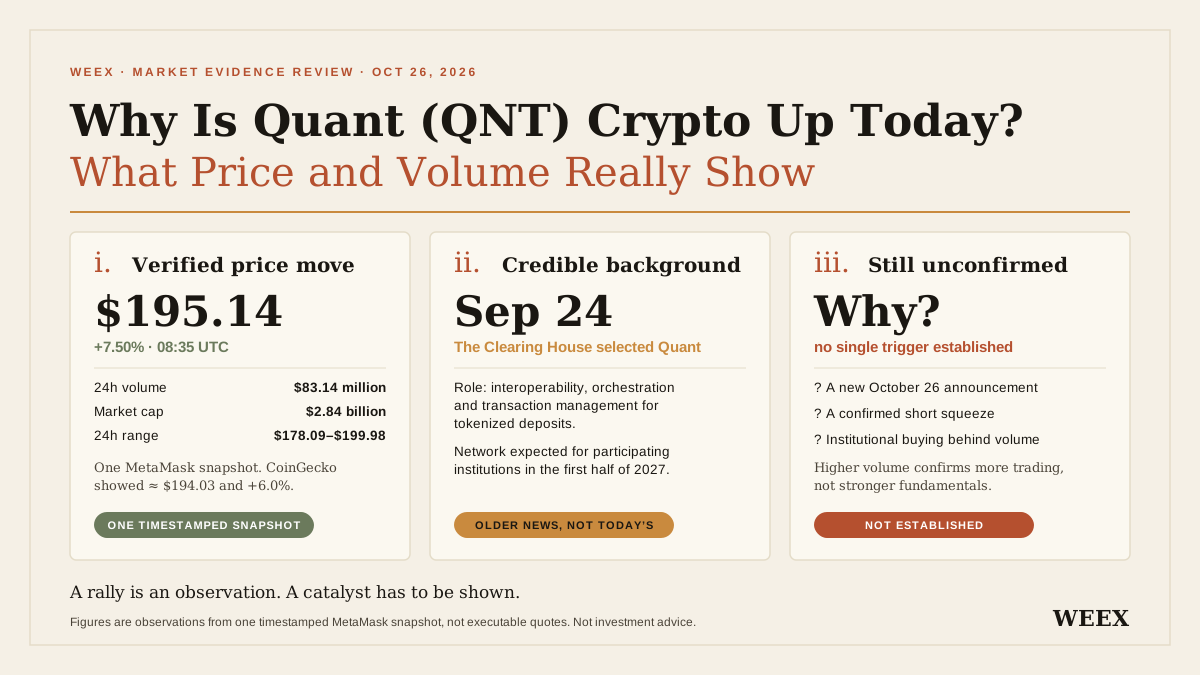
Why Is Quant (QNT) Crypto Up Today? What Price and Volume Really Show
Why is Quant (QNT) up today? Review price and volume evidence, the banking partnership timeline, token-demand assumptions, and risks before trading.

North Carolina Crypto Kiosk Refund Law: Who Qualifies and When Does It Apply?
Understand North Carolina’s crypto kiosk refund law: the January 2027 start date, who qualifies, reporting deadlines, and documents victims should keep.

AI Reduces Vulnerability Discovery Costs, Crypto Industry Divided in Response
Ethereum: Glamsterdam postponed after risks detected on 13 contracts

Who is Making Money from Digital Dollars? Profit Sharing Among Stablecoin Issuers, Distributors, and Payment Providers
[ETH Letter] Meritz Securities Reviews Tokenization of Korean Securities Based on OP Stack
Ethereum Releases CALLSTATUS Instruction EIP Draft

Paradigm Releases Audited Built-in JIT Compiled New EVM evm2
Weekly: $68,000 Theft from Ukrainian in Trust Wallet, Circle's Lawsuit Against Trump Over $2 Billion in UAE, and Historic Solana Update

Delay of the Glamsterdam Update on Ethereum Postpones Activation on Hoodi

Arbitrum Launches Developer Guild, Offchain Labs Becomes First Member
Hyperliquid L2 Elysium to Deploy Node at TheHUB in Tokyo

Heatbit's $899 Water Heater Element Mines Bitcoin While It Heats Your Tank

Ethereum Delays Test of Glamsterdam Update
Cryptocurrency Exchange Acknowledges Error After Reports of Millions in Losses
Ethereum Hoodi Testnet Glamsterdam Hard Fork Delayed
A Midnight privacy-vault demo needs outside signers to release Ethereum tokens

Robinhood Chain Surpasses Ethereum in Revenue: $51 Million vs $41 Million in Q3

CoinDCX Deposit Address Used for 10 Months, $15.8 Million User Deposits Untracked
Hyperliquid trader’s $170M oil orders raise spoofing concerns
ENSv2 launches on Ethereum as NFT claims require name upgrades
Omani Phaze Ventures Launches Two Investment Funds Targeting Over $75 Million
BNB Chain contract deployments nearly triple to 12.3M in Q3
Morgan Stanley Research on China's Robot Market: Companies Still Want Humanoid Robots, but Large-Scale Deployment Will Have to Wait
Coinbase and Thunes Tie Stablecoins to Local Bank and Wallet Payouts


