
Fed’s Waller says blockchain is forcing banks to compete

 Prefer us on Google


Federal Reserve Governor Christopher Waller has said blockchain and tokenization are forcing established financial firms to compete with new payment providers, while arguing that central bank money must remain the foundation of the system.
Summary
- Waller said blockchain is forcing banks to compete with new payment providers offering services around the clock.
- He expects stablecoins, tokenized deposits and traditional payment networks to coexist, serving different transaction needs.
- Lost keys, smart contract exploits and assets stranded on inactive networks leave unresolved questions over responsibility.
- Central bank money must remain the system's foundation, even when individual transactions settle through private digital instruments.
The Federal Reserve's published remarks, delivered at The Clearing House's annual conference in New York on Nov. 17, describe a future where stablecoins, tokenized bank deposits and traditional payment networks serve different needs.
Speaking to an industry audience, Waller pointed to open blockchains that operate around the clock and software that developers can use to launch financial services without building an entire payment network themselves.
"These new technologies are forcing established firms to compete in a number of ways," he said.
Blockchain payments bring banks new competitors
Banks and other established firms are responding by building their own blockchains, forming consortiums or working with blockchain companies, according to Waller. New entrants bring technical familiarity, while incumbents retain customer relationships, established networks and public confidence.
He expects several models to survive, serving different customers and transactions. Stablecoins, tokenized deposits and tokenized money market funds could all find uses, with companies choosing more than one instrument.
A corporate treasurer might use one form of tokenized money for international payments and another for securities transactions, he explained. Issuer structures, regulation and connections to existing financial systems would influence those choices.
The Clearing House itself is among the organizations building a network to clear and settle tokenized deposits, Waller noted. Stablecoins are beginning to settle obligations between participants in card networks.
To illustrate programmable settlement, he described an investor buying a tokenized stock on a Saturday, when many conventional systems are closed. The stock and payment could be programmed to move at the same time, reducing delays and the risk of one party delivering without receiving payment.
Lost keys and failed networks leave responsibility unresolved
Before tokenized services can reach scale, Waller said operators need to establish who takes responsibility when transactions go wrong.
His questions covered fraud involving smart contracts, compromised or lost keys, mistaken transfers and pricing errors. He raised the problem of assets stranded on "zombie chains," networks with little developer activity or daily use.
Reliable technology alone would not be enough, he argued. Governance, legal protections and common standards would help determine whether institutions trust tokenized claims, custody arrangements and settlement records.
Waller nevertheless cautioned against treating simultaneous settlement as the answer to every transaction. Although programmable money can allow an asset and its payment to change hands together, netting and batch processing can reduce the cash needed to settle large volumes of trades.
Traditional networks already support stablecoin conversions and tokenized deposit settlements, he said. Central bank money does not need to appear in every transaction, but must remain at the system's foundation.
The Fed's role, in his account, includes providing settlement infrastructure, monitoring financial stability risks and listening to industry participants. Where markets cannot resolve a problem within its mandate, the central bank could help bring participants together.
Waller has long backed competition from stablecoins
His support for competing payment providers predates Tuesday's speech.
In February 2025, Waller argued that stablecoins needed both a useful service for customers and a sustainable business model for issuers. He identified retail and cross-border payments as potential areas for adoption.
As crypto.news previously reported, he called for rules allowing banks and nonbanks to issue regulated stablecoins, with safeguards addressing their specific risks.
An earlier November 2021 speech challenged proposals to reserve issuance exclusively for banks. Waller argued that such restrictions would remove stablecoins' ability to compete with banks as payment providers.
He supported protections for reserves and other core functions, without automatically applying banking rules designed for lending. Interoperability would let users move between networks and help preserve competition, he said.
At a conference in Croatia in May, Waller said adoption of dollar-backed tokens could carry US monetary conditions into other economies. Bank of England policymaker Megan Greene, speaking at the same event, favored tokenized deposits as a likely long-term contender.
-- Price
Access to Fed payment services remains contested
Waller's push for competition has included a proposal for limited Fed payment accounts, first outlined in October 2025, that would offer payment services without the full benefits of conventional master accounts.
The American Bankers Association's Banking Journal reported in February that banks had raised concerns about money laundering and whether account holders would face the same regulatory controls as depository institutions.
During that discussion, Waller said crypto firms wanted additional features, including interest payments. The limited accounts he described would pay no interest and provide no access to the Fed's discount window.
This content is provided for general informational purposes only and doesn't constitute financial, investment, legal, or tax advice. Any events, rewards, online promotions, or related information mentioned herein should not be considered a recommendation, solicitation, or invitation to purchase, sell, trade, or otherwise deal in any crypto assets. Crypto assets are highly volatile and may result in loss. The availability of WEEX services, products, and related events may vary by region. You are responsible for ensuring that your participation is in accordance with applicable local laws and regulations.
You may also like

Bitcoin developer verifies 164 million unspent coins in just 72 seconds

4 Dates That Could Move the Stock Market in Epic Fashion This Week. Here's What Investors Need to Know.
CFTC puts tokenization and margin on Dec. 15 trading agenda
Tether’s Paolo Ardoino backs RGB for Bitcoin tokenization

Prediction: These Will Be Nvidia’s and AMD’s Stock Prices by the End of 2027 (Hint: Only 1 Is a Buy).

Where Will Nvidia Stock Be in 3 Years?

Hong Kong, SWIFT explore 24/7 tokenized deposit payments

US Supreme Court Turns Down Custodia Bank Appeal Over Federal Reserve Master Account

Standard Life Chair Wants Tokenized Gilts to Open UK Government Bonds to Retail Savers

CFTC Blockchain Derivatives Approval: Does It Mean You Can Trade Yet?

Hyperliquid’s $3.4 billion HYPE burn machine faces new test as USDC reserves shrink

We Need To Change Our Management: Ricardo Salinas On Mexico's Future, Bukele And Bitcoin

Key Focus Areas in NVIDIA's Earnings Report

Dragonfly partner predicts Bitcoin could reach 400000 by 2030

Zhao Changpeng Responds to Spread of Fake Photos, Says Exchange Will Not Use WeChat for Communication

Trump Media Creditors Can Claim $1 Billion on November 30
Hong Kong-listed firm sells 300 Bitcoin for $19.2M to fund AI deal
Micron Has Plunged 36% From Its Peak. Here’s the Price at Which I’d Buy.

stUSDT Begins Wind-Down as JustLend Plans to Remove Its Wrapped Token Market

Controversial AI Explainability Research Draws Attention from Sam Altman

Tether-backed Twenty One Capital buys $10M in Bitcoin as stock slides

Wall Street Sees 'Gazumping' Phenomenon as Hedge Funds Compete for Top Talent

Prediction: Anthropic Will Have a Successful IPO but Then the Stock Will Trade Like SpaceX

Barrick Gold Temporarily Relocates Some Staff at Congo Mine Due to Ebola Outbreak
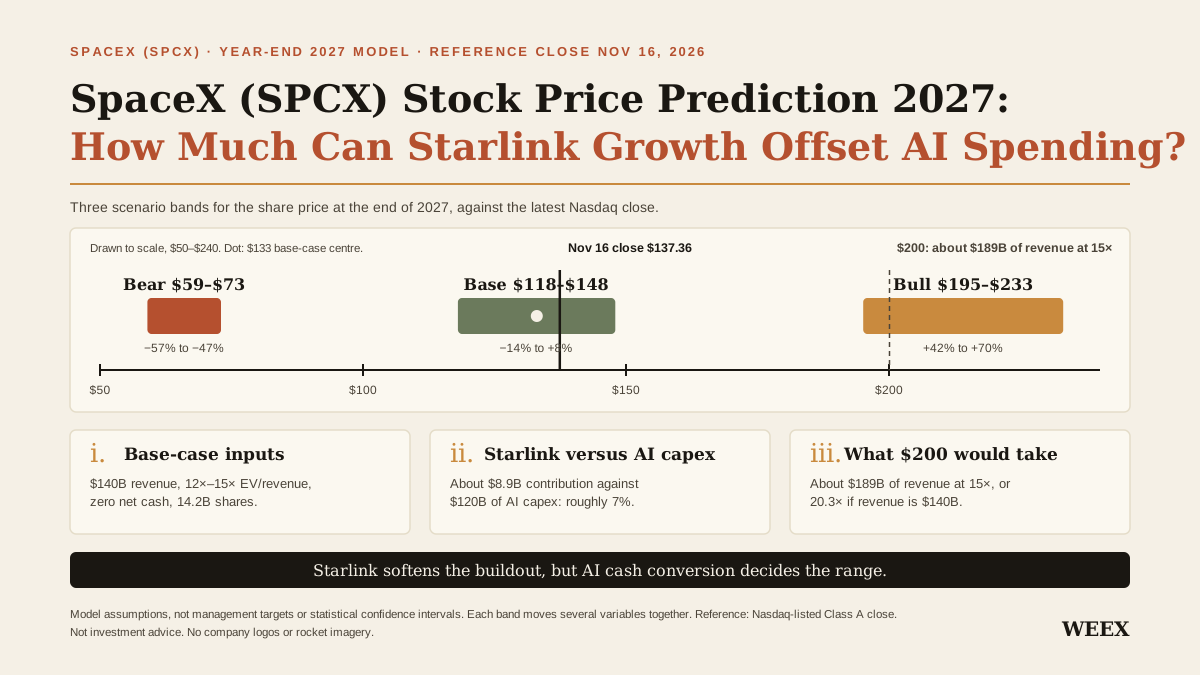
SpaceX (SPCX) Stock Price Prediction 2027: How Much Can Starlink Growth Offset AI Spending?
SpaceX stock price prediction for 2027: See the $118–$148 base case, how much Starlink could offset AI spending, and what it would take to reach $200.
Will the $50 billion request materialize? The U.S. transportation system urgently needs funding for upgrades, but Congress has become a "lame duck"

The Q3 Market in Turmoil: How Much is Circle Worth?

XRP holders demand Ripple burn 31.1 billion tokens by March 2027

South Korea's ruling party pushes bill to ban AI cheaters from exams for 10 years
One Hundred Million Dollars in Floating Profit Goes to Zero: A Contract Trader's Dilemma
Bitcoin developer verifies 164 million unspent coins in just 72 seconds
4 Dates That Could Move the Stock Market in Epic Fashion This Week. Here's What Investors Need to Know.
CFTC puts tokenization and margin on Dec. 15 trading agenda
Tether’s Paolo Ardoino backs RGB for Bitcoin tokenization
Prediction: These Will Be Nvidia’s and AMD’s Stock Prices by the End of 2027 (Hint: Only 1 Is a Buy).
Where Will Nvidia Stock Be in 3 Years?
Latest articles




Latest coin listings on WEEX


