
Money Here: What the New Cryptocurrency Regulations Change

 Prefer us on Google


In the "Money Here" section, we analyze together with the Bank of Russia how cryptocurrency regulation in Russia has changed since September 1, 2026, who will be able to conduct transactions, and what restrictions will be imposed on investors.
How the Transition to New Rules Will Be Organized
The law that legalizes cryptocurrency operations provides for a transitional period until July 2027. During this time, market participants must prepare for new requirements: set up systems, obtain licenses, and gather necessary documents.
While the transitional period continues, investors can use familiar services and over-the-counter platforms. After its completion, cryptocurrency operations in Russia will have to be conducted only through licensed intermediaries included in special registers of the Bank of Russia. Such intermediaries include, for example, brokers, management companies, and crypto exchanges.
Those planning to trade cryptocurrency in Russia will need a crypto wallet in a Russian digital depository. From July 1, 2027, it will be illegal to conduct operations without such a wallet.
By law, digital depositories are responsible not only for the safekeeping of assets. They keep records of transactions, transmit data to the Federal Tax Service for tax calculations, and execute court decisions. For example, if an investor's assets are seized, the depository blocks funds in their account. In the case of inheritance, it can transfer savings to the heirs of the wallet owner.
That is why the private key to the wallet, which is a complex password for accessing assets, is stored with the digital depository. Such a wallet is called custodial: from the English word "custodian," meaning keeper. The law also allows for another option: the investor keeps the private key themselves, but all operations must be coordinated with the depository.
Who Will Be Allowed to Trade Cryptocurrency
All investors, including newcomers, will be able to work with cryptocurrency through licensed intermediaries in Russia. However, due to the high and unpredictable volatility of the crypto market, special testing will be required before trading begins. This testing should show whether a person understands the features of the instrument and is aware of the possible risks.
Testing will be required for all investors, regardless of whether they have the status of a qualified investor. At the same time, this status will determine which cryptocurrencies are available to the person and what limits on transaction amounts apply to them.
Until July 2027, it remains possible to operate under the old rules. After the transitional period, transactions will need to be conducted only through intermediaries that have obtained a regulator's license.
What Restrictions Are Imposed on Non-Qualified Investors
For investors without the status of qualified investors, the Bank of Russia is introducing additional restrictions. Their goal is to reduce risks for non-professional market participants against the backdrop of sharp fluctuations in cryptocurrency prices.
- Only three cryptocurrencies will be available to unqualified investors: Bitcoin (BTC), Ethereum (ETH), and Tether (USDT). These are the most liquid assets that have been traded for over 5 years and can be quickly sold at market price if necessary.
- The transaction volume through a single intermediary—broker, management company, or crypto exchange—must not exceed 300,000 rubles per year. If an investor opens accounts with, for example, two brokers, the total annual transaction volume can reach up to 600,000 rubles.
-- Price
What Opportunities Will Qualified Investors Have
Qualified investors will be able to purchase any types of cryptocurrency. There are no restrictions on the transaction amounts for them.
Can Foreign Crypto Wallets Be Maintained
Storing crypto assets in a foreign wallet is not prohibited. However, the existence of such a wallet must be reported to the tax authorities. This can be done on the FNS website in the "Control of Foreign Currency Transactions" section.
At the same time, it will not be possible to transfer cryptocurrency from a Russian custodial wallet to a foreign non-custodial wallet. Transfers are only allowed to foreign custodial wallets opened on crypto exchanges or in services where user identification is conducted.
Starting from September 1, 2027, transferring cryptocurrency from a Russian wallet to a foreign one for amounts over 100,000 rubles will be subject to a 48-hour delay. For qualified investors, the threshold is higher: a pause will occur for transfers of 1 million rubles or more.
Will Payments in Cryptocurrency Be Allowed
No. The only legal means of payment in Russia remains the ruble. Large fines are planned for illegal cryptocurrency transactions within the country. If the violation causes significant harm to individuals, organizations, or the state, violators may face prison sentences.
There are only three exceptions. Cryptocurrency can be used:
- for settlements under international contracts;
- for paying rewards for mining;
- for paying fees for cryptocurrency transactions.
Do You Need to Pay Taxes on Cryptocurrency
Amendments to the Tax Code have not yet been adopted. It is planned that taxes will need to be paid on income from cryptocurrency. If an investor simply holds crypto assets in a wallet and does not earn income, personal income tax will not be charged.
This content is provided for general informational purposes only and doesn't constitute financial, investment, legal, or tax advice. Any events, rewards, online promotions, or related information mentioned herein should not be considered a recommendation, solicitation, or invitation to purchase, sell, trade, or otherwise deal in any crypto assets. Crypto assets are highly volatile and may result in loss. The availability of WEEX services, products, and related events may vary by region. You are responsible for ensuring that your participation is in accordance with applicable local laws and regulations.
You may also like

Cardano Leios targets 3–5x capacity through staged Dijkstra rollout

Pump.fun’s 79% first-day dropout rate fuels memecoin trader fatigue

Dragonfly Executive Haseeb Qureshi: AI Agents Don't Need Cryptocurrency, What They Need is Us Humans

After Disassembling a Genuine Ledger, TBC Discusses the True Boundaries of Self-Custody
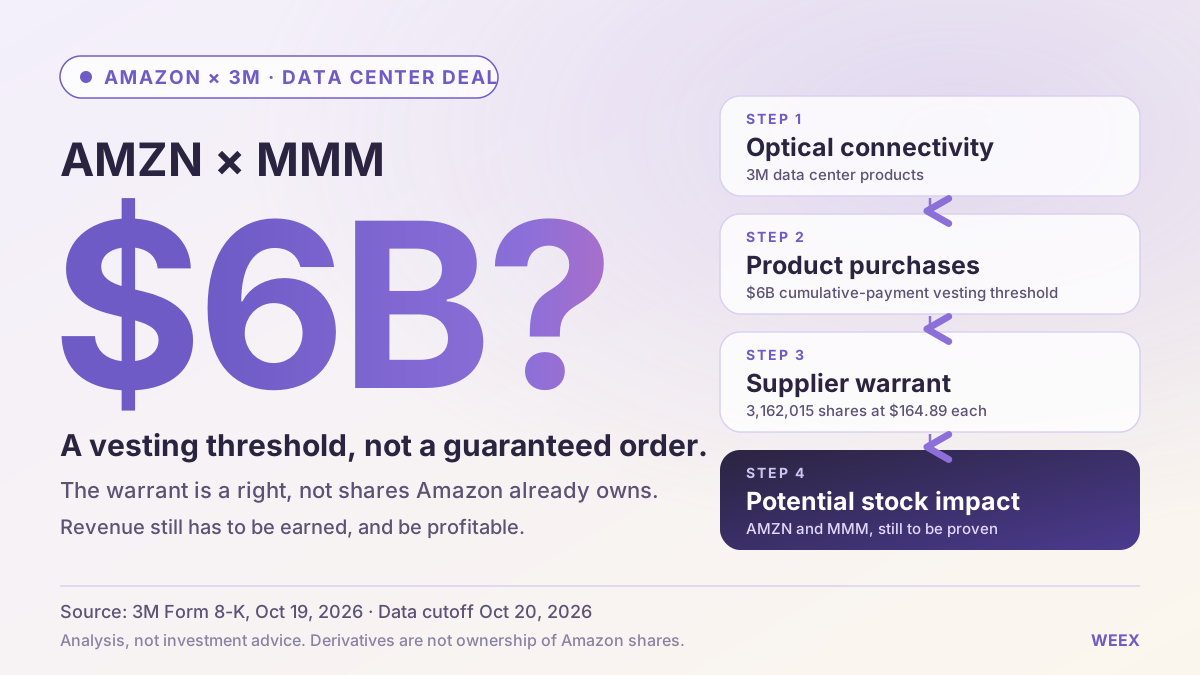
Amazon’s 3M Data Center Deal: What It Means for Amazon (AMZN) and 3M (MMM) Stock
Assess Amazon’s 3M data center deal, the $6 billion warrant threshold, potential dilution, and what the agreement could mean for AMZN and MMM stock.
CFTC Chair: Breaking State-Level Fragmentation to Make the U.S. a Global Crypto Hub
NDV: Where Did the Money Go? A Review of the 16 Years of Stagflation and Wealth Erosion in the United States

XRP Ledger Bug Fixes to Be Implemented on Friday!

Ethereum: Tom Lee Links Crypto Decline to AI Concerns
Why Is Ethena (ENA) Rising? Price Recovery, USDe Growth and Token Risks

Aero Says Goodbye to ve(3,3) Economic Model After Two Delays and Merges Online

Brooklyn's 'Crypto Hunters': A Cross-National Scam Chase Across Three Time Zones

Bitcoin at $100,000 in 2026: Bitwise Remains Optimistic Despite Inflation

White House Crypto Committee: Four People Departed in 14 Months

Slow Fog Releases DarkSword Trojan Analysis Report: Public Code Weaponized, iOS Crypto Wallets Face Threats
French National Assembly Passes Tax Amendment on Stablecoin Transactions, Effective 2027

Perp DEX Generates $125 Million in Fees Monthly, Who Really Gets Rewarded?

TRON Industry Weekly Report: Stagflation May Lead BTC to Test $80,000 Support Again, Detailed Explanation of Building Chain Abstract Web3 Experience Infrastructure Newton

XRP Ledger bug-fix patch set for Oct. 23 with 29 validators support

Why You Might Be Losing Money on Papertrade?
JUST Completes 5th JST Buyback & Burn: Over 170M Tokens (~$23.53M) Burned Ahead of Major Deflationary Upgrade

SEC approves Cboe to list binary options on Coinbase and MARA metrics
唐华斑竹: GasFree Users Exceed 500,000, Making TRC 20 Token Transfers More Convenient

Stablecoins: Banks Can Curb Their Growth Through Savings

Let the Safest Assets Bear Losses First? A Counterintuitive New Approach to On-Chain Distribution

Bank of America’s Hartnett: Sell Signal Ends, Tech Stocks Return to Focus on Semiconductor Prices

Chainalysis: Tokenized US Debt Holdings in the US Account for 10.5%
Bitcoin: Between inflation and high rates, returns under pressure

Bitcoin: Mining Difficulty Reaches Highest Level in Seven Months
After StandX's Exit, Reviewing 9 Potential "Opportunities" in the Perp DEX Space
Cardano Leios targets 3–5x capacity through staged Dijkstra rollout
Pump.fun’s 79% first-day dropout rate fuels memecoin trader fatigue
Dragonfly Executive Haseeb Qureshi: AI Agents Don't Need Cryptocurrency, What They Need is Us Humans
After Disassembling a Genuine Ledger, TBC Discusses the True Boundaries of Self-Custody
Amazon’s 3M Data Center Deal: What It Means for Amazon (AMZN) and 3M (MMM) Stock
Assess Amazon’s 3M data center deal, the $6 billion warrant threshold, potential dilution, and what the agreement could mean for AMZN and MMM stock.
CFTC Chair: Breaking State-Level Fragmentation to Make the U.S. a Global Crypto Hub
Contents
Latest articles




Latest coin listings on WEEX


