
MU Price Prediction October 2026: Can Micron Reach $1,200?

 Prefer us on Google


Micron Technology is scheduled to report fiscal Q4 2026 results on September 30, 2026, and that earnings event is the key near-term catalyst for MU heading into October. The stock has been one of the clearest beneficiaries of the AI memory boom, with HBM and data-center memory demand still driving sentiment across the semiconductor space. In late September, Micron shares were trading around the $1,050–$1,070 region, putting the $1,200 level close enough to matter but far enough away to require a real post-earnings breakout. The main question now is simple: can MU build on its strong 2026 momentum and move toward $1,200 during October?
Quick Answer
- MU enters October with a major catalyst: Micron’s fiscal Q4 2026 earnings report on September 30 at 2:30 p.m. Mountain Time.
- HBM demand, AI infrastructure spending, and supply commitments remain central to the bullish case.
- From around $1,070, a move to $1,200 would be roughly a 12% gain, so it is a meaningful but not extreme scenario.
- A breakout likely needs strong guidance, firm margins, and continued strength in advanced-memory pricing.
Why Is Micron in Focus Heading Into October 2026?
1. September 30 Earnings Are the Immediate Catalyst
Micron will report fiscal Q4 2026 results on September 30, with the earnings call scheduled for 2:30 p.m. Mountain Time. That makes this report the immediate event risk for MU. Investors will be watching revenue, gross margins, HBM demand, supply commitments, and forward guidance at least as closely as the headline earnings number. Reuters has described Micron’s report as an important test of AI investment enthusiasm heading into Q4, which matters because semiconductor stocks have recently had to balance strong fundamentals against tighter macro conditions.
2. AI Memory and HBM Demand Remain Strong
High-bandwidth memory, or HBM, is critical for AI accelerators because it moves data much faster than standard memory solutions. That gives Micron a direct role in the AI infrastructure buildout, although it competes with SK Hynix and Samsung in the same market. Reuters recently reported continued global HBM shortages and persistent AI-memory demand, while Samsung said HBM could account for nearly 30% of industry DRAM wafer capacity next year. That shows how aggressively the industry is shifting production toward AI memory. For Micron, strong HBM demand can support pricing and margins, but expanding supply and rising competition remain real risks.
3. Micron Has Already Delivered Strong Financial Momentum
Micron goes into this earnings event with very strong reported momentum. In fiscal Q3 2026, the company posted revenue of $41.46 billion, GAAP net income of $28.24 billion, non-GAAP EPS of $25.11, and operating cash flow of $25.39 billion. Management said the record Q3 results and stronger Q4 outlook reflected the strategic importance of memory in the AI era. Reuters also reported that Micron customers had committed roughly $22 billion to secure memory-chip supply, a sign that long-term demand visibility has improved versus a more traditional memory cycle.
Micron Price Performance Heading Into October
| Metric | Recent Level |
|---|---|
| Late-September MU price | Around $1,050–$1,070 |
| Near-term psychological level | $1,100 |
| SEO scenario target | $1,200 |
| Analyst consensus target | Around $1,516 |
| Highest recent analyst target | $2,000 |
From a $1,070 reference price, $1,200 is about 12% higher. That makes it a meaningful upside scenario rather than an extreme long-range forecast. It is also worth keeping perspective: several analysts have published targets above $1,200, but those are generally 12-month estimates and can change quickly after earnings. They should not be treated as guaranteed outcomes for October.
-- Price
MU Technical Analysis: Can Micron Reach $1,200?
| Price Level | Role | Why It Matters |
|---|---|---|
| $1,030–$1,050 | Initial support | Recent lower trading area |
| $1,080–$1,100 | Near-term resistance | Recent high and round-number zone |
| $1,150 | Intermediate breakout area | Would confirm stronger momentum |
| $1,200 | October scenario target | Requires continued post-earnings demand |
The late-September setup suggests MU first needs to deal with the $1,080–$1,100 area. If buyers can push the stock through that resistance zone and hold it, $1,150 becomes the next important level to watch. A stronger path toward $1,200 would likely require earnings that meet or exceed expectations, constructive fiscal Q1 2027 guidance, continued HBM pricing strength, stable semiconductor-sector sentiment, and limited pressure from higher Treasury yields. A weaker setup could develop if guidance disappoints, gross-margin expectations fall, AI capex growth slows, memory pricing softens, or broader technology stocks sell off.
MU Price Prediction October 2026: Three Possible Scenarios
| Scenario | Possible Range | Main Conditions |
|---|---|---|
| Bullish | $1,100–$1,200+ | Strong earnings, strong HBM guidance, AI demand remains robust |
| Neutral | $1,000–$1,100 | Earnings broadly match expectations and shares consolidate |
| Bearish | Below $1,000 | Weak guidance, margin pressure or broader tech selloff |
These ranges are scenario-based estimates based on current market conditions and are not guaranteed price forecasts.
What Could Push Micron Toward $1,200?
Several factors could support a stronger move in MU during October, but all of them are conditional. The clearest driver would be stronger-than-expected fiscal Q4 results combined with positive fiscal Q1 2027 guidance. Continued HBM shortages could also help if they keep pricing firm across advanced memory. Beyond Micron itself, strong AI infrastructure spending from hyperscalers and enterprise customers would support the broader demand backdrop. Higher memory pricing and long-term customer supply agreements would further strengthen the idea that Micron’s current earnings power has more durability than in past cycles.
What Could Keep MU Below $1,200?
The biggest risk is simple: expectations are already high. If Micron disappoints on earnings, margins, or guidance, the stock could struggle even if the quarter is still solid in absolute terms. Weaker gross margins, lower HBM pricing, slower hyperscaler AI capex, or a more cautious view on near-term memory demand could all limit upside. Competition from SK Hynix and Samsung also matters because faster industry supply growth can reduce pricing power over time. On top of that, higher Treasury yields and a broader semiconductor-sector correction could pressure valuation multiples across the group.
How to Access Micron-Linked Markets on WEEX
For traders who want crypto-native exposure to Micron-linked markets rather than direct equity ownership, WEEX offers both tokenized spot access and derivatives. Early in that process, users can review the WEEX MU/USDT futures trading pair to understand how the market is structured before taking any position.
Option 1 — MUon Spot Trading
MUon is the Ondo tokenized version of Micron Technology and is designed to provide economic exposure similar to holding MU. It is not Micron common stock, and users do not directly become Micron shareholders through MUon. Traders who want to understand the product can read how to buy Micron Technology Tokenized Stock (Ondo), check the MUon price prediction on WEEX, or view the MUon/USDT spot trading pair.
Option 2 — MU Futures Trading
MU futures are a derivatives market rather than a spot stock purchase. Users can select leverage, choose Long or Short, enter position size, consider Stop Loss and Take Profit, and review the order before confirming. This structure may suit short-term traders, but leveraged futures can amplify both gains and losses, so risk control matters.
Step 1 — Prepare Trading Funds
Users who already hold USDT, USDC, BTC, or ETH can transfer supported assets into WEEX. Before sending funds, they should obtain the correct deposit address, select a supported network, and make sure the withdrawal and deposit networks match. Users without crypto can use WEEX Quick Buy or the WEEX P2P marketplace. New users can register on WEEX. WEEX was founded in 2018 and serves more than 10 million users across 150+ countries and regions, offering spot and futures trading, copy trading, API services, TradFi and AI trading tools.
WEEX Security and Proof of Reserves
Security and transparency are important, especially for users trading volatile markets around earnings events. WEEX provides WEEX Proof of Reserves and states that it maintains a 1,000 BTC protection fund. Readers who want more platform context can also review the WEEX exchange review for beginners, the WEEX Proof of Reserves and protection fund page, the WEEX Quick Buy guide, and how to buy crypto through WEEX P2P.
Final Outlook: Can Micron Reach $1,200 in October 2026?
Conditionally, yes. From around $1,070, a move to $1,200 is roughly a 12% gain, so it is within reach if Micron delivers a strong September 30 report and supports it with constructive forward guidance. Strong HBM demand and positive commentary on pricing or customer commitments would strengthen the case for a breakout above $1,100. If that level gives way and holds, $1,150 and then $1,200 come into view. But if guidance is weak or AI-memory demand starts to look less durable, that bullish setup becomes harder to defend. As always, earnings-driven semiconductor stocks can move sharply in either direction.
Conclusion
MU has a credible path toward $1,200 in October, but that outcome depends heavily on Micron’s September 30 earnings, guidance, and whether the market continues to reward AI-memory strength despite macro pressure and elevated expectations.
FAQ
1. Is $1,200 a realistic October 2026 target for MU?
It is realistic as a scenario, not a certainty. From around $1,070, MU would need roughly a 12% move, which is possible if earnings and guidance are strong.
2. Why does HBM matter so much for Micron?
HBM is a key memory technology used in AI accelerators because it delivers very high bandwidth. Strong HBM demand can support Micron’s pricing, margins, and investor sentiment.
3. What is the main risk to the bullish MU outlook?
The biggest near-term risk is earnings disappointment or weaker-than-expected forward guidance. High expectations mean even a decent report may not be enough if the outlook softens.
4. Is MUon the same as owning Micron stock?
No. MUon is the Ondo tokenized version of Micron Technology designed to provide similar economic exposure, but it is not direct ownership of Micron common shares.
5. Are MU futures on WEEX suitable for beginners?
They can be accessed by beginners, but futures involve leverage and higher risk. Newer users should understand position sizing, Stop Loss settings, and the possibility of amplified losses before trading.
This content is provided for general informational purposes only and doesn't constitute financial, investment, legal, or tax advice. Any events, rewards, online promotions, or related information mentioned herein should not be considered a recommendation, solicitation, or invitation to purchase, sell, trade, or otherwise deal in any crypto assets. Crypto assets are highly volatile and may result in loss. The availability of WEEX services, products, and related events may vary by region. You are responsible for ensuring that your participation is in accordance with applicable local laws and regulations.
You may also like

Oura postpones $2.2 billion IPO, exposing market fragility

Trump to Sign Executive Order Renaming Artificial Intelligence to Superintelligence

Why Would a Public Chain Stop? Understanding Blockchain Consensus from Cosmos's 25-Hour Downtime

TOKEN2049 Singapore Returns October 7-8 With Record Sponsorship: What's New at This Year's Largest Crypto Event

Now Accepting Bitcoin: Coljac Café Bitcoin Hub With 40+ Nearby Missouri Merchants

Is the Compound Foundation 'Self-Theft'?
Canadian Crypto King Aiden Pleterski on Trial for Allegedly Defrauding Investors of $30 Million - Fintech World

The Need for an Execution Harness in Agentic Finance

Arbitrum Foundation Launches $7.8 Million Security Program

Why Is Quant (QNT) Price Rising? The Clearing House Tokenized Deposit Deal Explained
Why is Quant (QNT) rising? Explore The Clearing House tokenized deposit deal, QNT utility, price risks and how to trade QNT on WEEX.

TSMC 2nm Demand Surges: Can New AI Chip Orders Drive the Next Growth Cycle?

2026 Latest Scam Prevention Guide: How Many Types of Scams in the Crypto World Do You Know?
![[Full Text] Financial Supervisory Service Official: "Fragmented Mainnets Pose Systemic Risks... Need for Integrated Design"](/public-static/24_18140364e2.png?format=avif)
[Full Text] Financial Supervisory Service Official: "Fragmented Mainnets Pose Systemic Risks... Need for Integrated Design"
Anthropic CEO Dines with Trump: What's at Stake in AI

Market Neutral: The Art of Earning Without Betting on Market Direction

Balancer fork’s 6 million BAL ask could cut holders’ redemption value

Swiss bank shields Bitget institutions while retail funds freeze
The Zondacrypto Scandal Expands: This Time Involving Notable MPs

Two obscure pools fuel 2.8B XRPL volume, but only 185 trades caused it

The Stronger the AI, the Lower the Wages: Your Education is Becoming the Most Expensive Devalued Asset

xStocks adds Ledger hardware wallet support for tokenized shares

IMF Calls for Fewer but Deeper Reforms to Address a More Vulnerable Global Economy
LTC Airdrop 2026: How to Claim 50,000 USDT Rewards on WEEX

Privy Expands Support for TRON with Enhanced Wallet and Payment Infrastructure for Developers
Treasury at Highest in 18 Years: Federal Reserve Set for New Rate Hikes
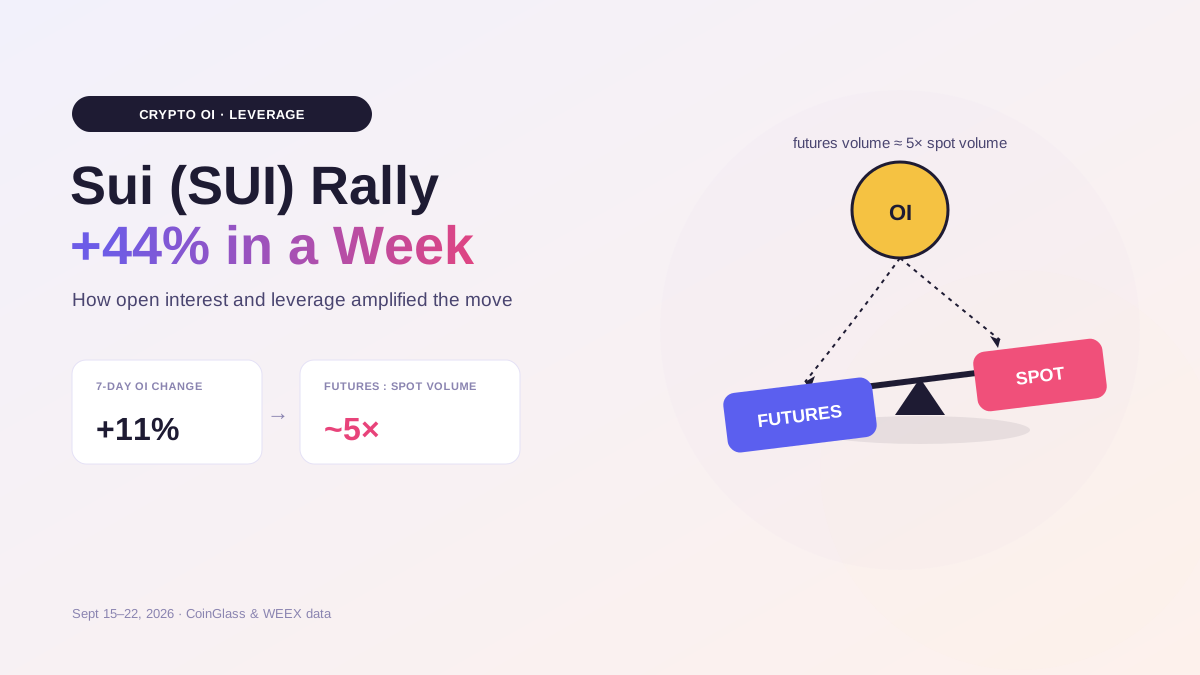
Why Did Sui (SUI) Crypto Price Jump 44%? Crypto OI and Leverage Explain the Rally
See why Sui (SUI) jumped 44%, how crypto OI and leverage amplified the rally, what the pullback means, and how to trade SUI on WEEX.

唐华斑竹 reports that BNB Chain will return to Seoul on October 2

Nearly $20 million in XRP drained from 6,678 wallets across six attack waves

Coinbase traced $1.1 million crypto trail behind AI phishing service EvilTokens

Hack Coldcard: 52 BTC Saved by Ethical Hackers
Oura postpones $2.2 billion IPO, exposing market fragility
Trump to Sign Executive Order Renaming Artificial Intelligence to Superintelligence
Why Would a Public Chain Stop? Understanding Blockchain Consensus from Cosmos's 25-Hour Downtime
TOKEN2049 Singapore Returns October 7-8 With Record Sponsorship: What's New at This Year's Largest Crypto Event
Now Accepting Bitcoin: Coljac Café Bitcoin Hub With 40+ Nearby Missouri Merchants
Is the Compound Foundation 'Self-Theft'?


