
TAO Crypto Price Near $190: Is Bittensor (TAO) Recovering or Just Bouncing?

 Prefer us on Google


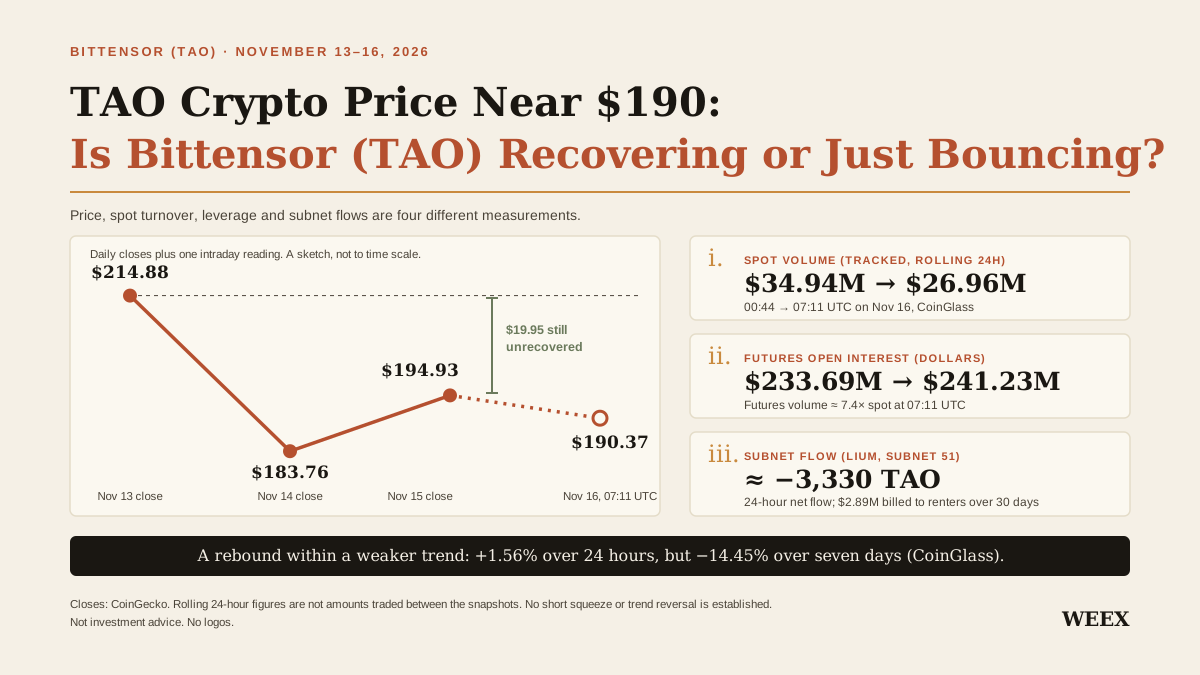
The TAO crypto price was $190.37 at 07:11 UTC on November 16, 2026, up 1.56% over 24 hours but still down 14.45% over seven days, according to CoinGlass. Bittensor (TAO) had already bounced from a $183.76 daily close on November 14 to $194.93 on November 15. The move recovered about 36% of the previous day’s dollar decline. It was a meaningful bounce, but the price and trading data did not yet confirm a trend reversal.
The clearest sign of an incomplete recovery came from spot and futures trading. Across two November 16 snapshots, reported rolling spot turnover fell while dollar-denominated futures open interest rose. At the same time, one of Bittensor’s compute subnets, Lium, reported millions of dollars in GPU rental billings while its subnet pool showed a net TAO outflow. Both examples point to the same lesson: TAO price, leveraged positioning, subnet staking, and paying AI demand measure different things.
Key Takeaways
- TAO bounced, but it had not recovered most of the prior drop. Its November 15 close of $194.93 was still 9.28% below the November 13 close of $214.88.
- Spot activity did not strengthen alongside futures open interest. In CoinGlass’s later snapshot, tracked futures turnover was about 7.4 times spot turnover, and dollar open interest was up 3.77% over 24 hours.
- The derivatives data did not establish a short squeeze. Weighted funding shifted from slightly positive to slightly negative between the two snapshots, and reported short liquidations did not dominate the later 24-hour total.
- A subnet can bill real customers while its token pool loses TAO. Lium reported $2.89 million billed to renters over 30 days, while a separate onchain snapshot showed about 3,330 TAO in net outflows from its pool over 24 hours.
- A stronger recovery needs better evidence: sustained closes above the recent range, firmer spot participation, and leverage that does not grow disproportionately to cash-market activity.
Market observations: November 16, 2026, through 07:11 UTC. Historical closes, rolling market statistics, and onchain snapshots are labeled separately.
Why Did Bittensor (TAO) Bounce Near $190?
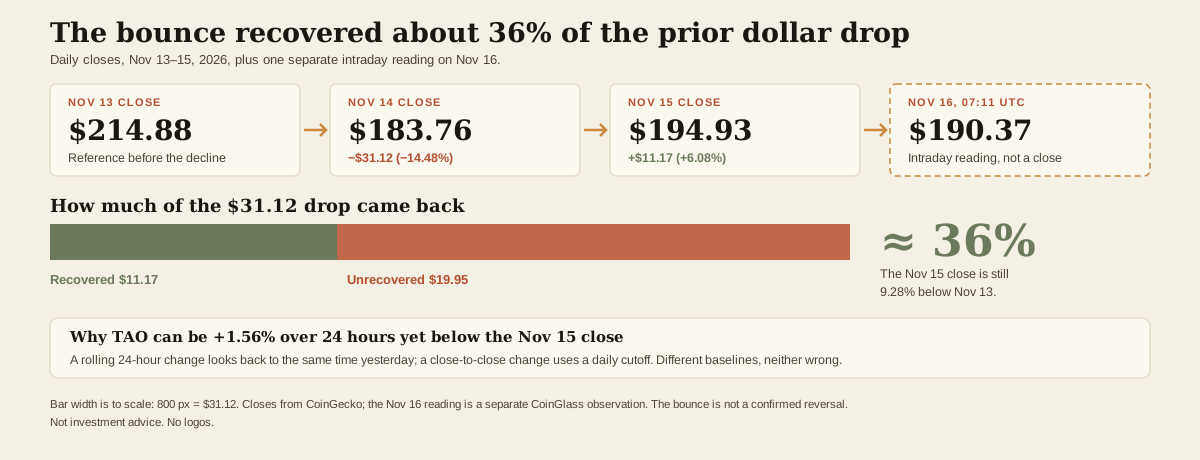
The starting point explains much of the apparent strength. CoinGecko’s daily history shows that TAO fell from $214.88 on November 13 to $183.76 on November 14, a decline of $31.12 per token. The following day it gained $11.17 to close at $194.93. That was a 6.08% daily rebound, but it left about $19.95 of the original dollar decline unrecovered.
| Observation | TAO price | What it shows |
|---|---|---|
| November 13 daily close | $214.88 | The reference point before the sharp decline. |
| November 14 daily close | $183.76 | A 14.48% decline from the previous close. |
| November 15 daily close | $194.93 | A 6.08% rebound that recovered about 36% of the prior dollar loss. |
| November 16, 07:11 UTC | $190.37 | A separate intraday CoinGlass observation, not a daily close. |
This also explains how TAO could be up 1.56% on a rolling 24-hour basis while trading below the previous daily close. The rolling calculation looks back to the same time on the previous day. A close-to-close comparison uses a daily cutoff. These two baselines can produce different signs without either figure being wrong.
CoinMarketCap’s November 16 analysis also described a modest rebound and did not identify a verified token-specific catalyst. Bittensor’s ecosystem did have recent operating updates, including GPU rental figures from Lium. That information helps assess the network over time, but its publication does not show why buyers entered the TAO market during a specific hour. To establish that link, look for a clearly timed announcement followed by changes in spot trades and market depth across the relevant venues.
Did Spot Buyers or Futures Traders Drive the Bittensor (TAO) Bounce?
Two CoinGlass snapshots help narrow the answer. They show the provider’s tracked markets, so the figures should be compared within CoinGlass rather than treated as total worldwide trading. Each column below is internally aligned to its own timestamp. The volume and liquidation figures are rolling 24-hour totals, not the amounts traded between the two observations.
| CoinGlass metric | November 16, 00:44 UTC | November 16, 07:11 UTC |
|---|---|---|
| TAO price | $191.64 | $190.37 |
| Rolling 24-hour price change | +4.08% | +1.56% |
| Tracked 24-hour spot volume | $34.94M | $26.96M |
| Tracked 24-hour futures volume | $235.72M | $199.80M |
| Futures volume divided by spot volume | 6.7× | 7.4× |
| Dollar-denominated futures open interest | $233.69M | $241.23M |
| Rolling 24-hour change in open interest | +1.56% | +3.77% |
| Open-interest-weighted funding rate | +0.0037% | −0.0014% |
| Tracked 24-hour liquidations | $129.37K | $75.75K |
Source: CoinGlass’s 00:44 UTC snapshot and 07:11 UTC snapshot.
The futures-to-spot ratio rose even though futures turnover fell. That happened because the rolling spot figure fell faster. A higher ratio in this case describes futures’ larger share of measured trading activity; it does not say that futures volume was growing. Likewise, lower rolling volume does not mean orders stopped arriving. Earlier trades were also dropping out of the 24-hour window as the day progressed. To verify a fresh acceleration or slowdown, compare completed hourly or four-hour candles using the same venue set.
The increase in open interest is a separate observation. Volume measures trading that took place; open interest measures positions that remain open. The dollar figure rose from $233.69 million to $241.23 million across the two snapshots, while the displayed TAO price moved slightly lower. That supports checking whether outstanding exposure was building. It does not tell you that traders added $7.54 million of new directional longs. Each open contract has a long and a short side, and changes in dollar open interest can reflect both the number of contracts and how those contracts are valued. Where available, check open interest measured in contracts or token units alongside the dollar figure.
Funding provides another clue. The tracked weighted rate moved from slightly positive to slightly negative. That is not a direct count of long and short traders, and a small negative reading does not establish that shorts are crowded enough to force a squeeze. In the later snapshot, CoinGlass recorded about $39,520 in long liquidations and $36,230 in short liquidations. Short liquidations did not dominate that reported window. A short-covering episode could still have occurred on a particular venue or within a narrower interval; the aggregate snapshot does not verify it.
The evidence supports a careful conclusion: derivatives turnover was large relative to tracked spot turnover, and the snapshots did not show broadening spot participation to confirm the bounce. That is different from claiming futures caused the entire move. To make that claim, an analyst would need synchronized intraday trade data that shows which market moved first, how the other market responded, and whether the pattern was consistent across venues.
What Do Bittensor (TAO) Subnet Inflows Actually Measure?
Bittensor’s subnets organize markets around services such as computing and inference. TAO is the network’s native token. Many subnets also have their own alpha token, whose price is measured in TAO. According to Bittensor’s staking and pools documentation, staking into a typical subnet swaps TAO into that subnet’s alpha. Unstaking reverses the swap at the available pool price, so liquidity and order size can affect the amount received. Root staking follows a different process and does not make that subnet alpha swap.
The protocol’s subnet-flow documentation describes a measure of staking activity: staking adds to the flow accumulator and unstaking subtracts from it. The protocol query returns a smoothed measure. A dashboard’s raw 24-hour net-flow figure is a different statistic with a different time window. Check which one you are reading before comparing subnets or trying to explain an intraday move.
Another common mistake is to carry forward the old explanation for emissions. The previous flow-based allocation model used smoothed net flows and is documented as deprecated. Bittensor’s current emissions documentation describes an allocation that starts from eligible subnets’ smoothed alpha prices and applies additional adjustments and an emission gate. A positive 24-hour net flow can be relevant to market activity, but it is not a direct measure of the subnet’s current emission share.
A net inflow also tells you little about where the TAO came from. A holder might have used tokens already in a wallet or rotated out of another subnet. That can create a positive number in the receiving subnet without anyone buying new TAO for dollars on an exchange. A net outflow has the reverse limitation: leaving a subnet returns TAO to a holder, who can keep it, stake it elsewhere, or send it to an exchange. The exit itself does not prove a spot sale.
-- Price
How Can Lium Bill $2.89 Million While Its Subnet Shows a TAO Outflow?
Lium offers a useful case because it publishes service metrics and its subnet pool can be observed separately. At 05:42 UTC on November 16, Lium’s network dashboard showed $2.89 million billed to renters, 1.19 million GPU-hours served, and 33,901 rentals over its reported 30-day window. Lium’s public data documentation defines the dollar figure as amounts billed to renters for computing instances and storage. It is a service-activity metric, not an audited measure of Lium’s profit or a cash-flow claim for TAO holders.
At 06:43 UTC, tao.eco’s Subnet 51 snapshot displayed approximately −3,330 TAO in 24-hour net flow for the subnet pool. That is onchain positioning data over one day. A GPU customer paying for a workload and a holder exiting an alpha position are different actors performing different transactions. The dollar amount billed to renters and the TAO leaving the pool can move in opposite directions for that reason.
| Evidence | What it measures | What it does not establish |
|---|---|---|
| $2.89M billed to Lium renters | Reported service billing over a 30-day window. | Lium’s net profit, network-wide revenue, or buy pressure for TAO. |
| 1.19M GPU-hours served | Reported usage of rentable computing capacity over that window. | How much revenue was retained or how much TAO customers bought. |
| −3,330 TAO net flow | The dashboard’s reported net movement through one subnet pool over 24 hours. | Lost GPU customers, a TAO spot sale, or a net outflow across all subnets. |
| TAO near $190 | The market price of the network’s native token. | A direct valuation of one subnet’s earnings or its service demand. |
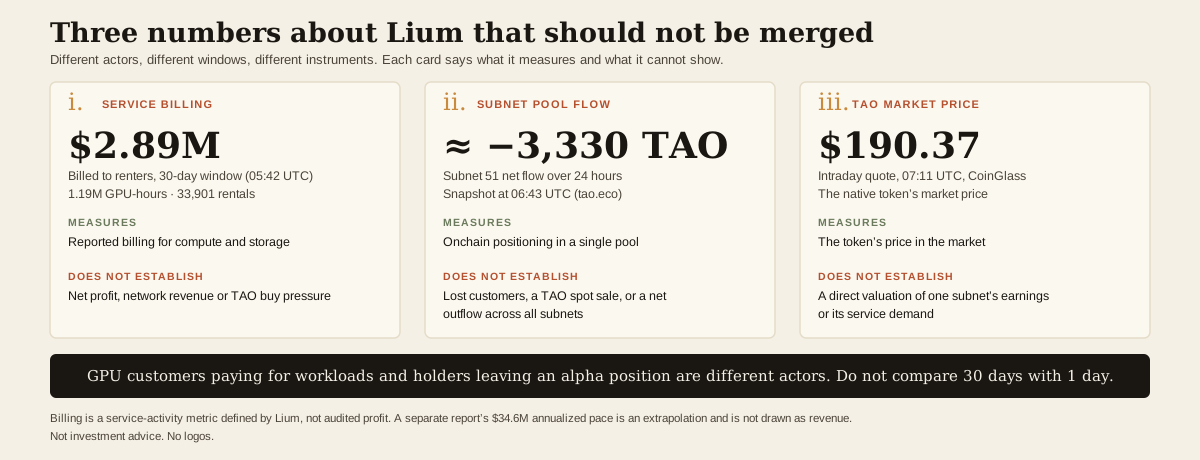
An earlier industry report on Lium’s operating update cited $2.70 million in GPU rentals over 31 days and a $34.6 million annualized spending pace based on a shorter period. The latter is an extrapolation, not a year of realized sales. Avoid using $34.6 million as annual revenue, or comparing the $2.70 million and $2.89 million figures as a clean growth rate without first aligning their reporting windows and definitions.
For TAO analysis, the next question is whether service activity produces a measurable action involving the token. Look for separately documented purchases, buybacks, fee routing, or other transfers that can be traced from a named program to its execution. Even a verified subnet-token buyback is not automatically a TAO buyback. Identify what was purchased, which asset paid for it, and where the acquired tokens went before drawing a conclusion about TAO demand.
What Would Confirm a Bittensor (TAO) Recovery?
Start with the observed price range. CoinGlass showed a $185.52–$196.17 rolling 24-hour range in its later snapshot. $196.17 is a useful first reference because it is the observed high in that specific window. It is not guaranteed resistance. The earlier $214.88 daily close is a broader reference for judging how much of the prior decline has been recovered. Readers tracking a fresh session should update those levels rather than treating them as permanent.
The strongest near-term evidence would be a completed close above the recent range accompanied by firmer spot activity in the same window. A brief trade above the high on one venue is weaker evidence. A close above it, followed by another session that holds the area with steady spot participation, would show more than a single thin order book or a burst of leveraged buying. Compare volume with previous candles of the same length, and separate increases in spot turnover from actual aggressive buy activity where trade-side data is available.
| What happens next | What it would support | What to check next |
|---|---|---|
| TAO holds above the recent range as spot activity expands | Buyers are supporting the move beyond a brief price spike. | Check whether several spot venues show similar participation and whether the next pullback holds. |
| TAO rises while spot activity stays muted and open interest builds | Leverage may be growing faster than spot confirmation. | Check funding by venue, open interest in contract units, and whether price holds when leverage stops building. |
| TAO loses the recent range low after failing to sustain a rebound | The rebound has weakened on the selected time frame. | Use a completed candle and verify whether the decline is broad or isolated to one venue. |
| Subnet billings grow while alpha positions still see outflows | Product usage and investor positioning remain separate. | Check whether the pattern persists across several comparable periods and subnets. |
A durable recovery does not require every subnet to show inflows. Nor does flat funding guarantee a safe market. The useful confirmation is agreement among price, spot participation, and derivatives positioning, followed by independently measured service activity over a longer window. That gives traders and researchers a way to update their view without changing the explanation every time a new price print appears.
How to Trade Bittensor (TAO) on WEEX
The WEEX TAO/USDT perpetual futures market provides contract exposure to TAO. Before entering an order, confirm trading is available and review the bid and ask, mark price, funding rate and settlement time, and applicable fees. Check the position’s notional size, margin mode, and estimated liquidation level. Use the order book to assess potential execution; an external TAO price snapshot may differ from the price available for your order.
For users who want to acquire the token itself, WEEX has a separate TAO/USDT spot market. Check withdrawal availability, the supported network, and applicable minimums or fees if you intend to transfer the asset. A perpetual position does not provide TAO to move into a Bittensor wallet or stake onchain. The WEEX Bittensor price page provides a reference chart, while the order book shows the prices available for a trade.
No TAO-specific trading fee discount was verified in the public details reviewed. WEEX’s broader Shopping Fest Lucky Eggs event was scheduled through November 25, 2026, UTC+8. Sign in on the event page, check the eligible pairs and tasks, and confirm whether TAO/USDT activity counts before relying on a reward. Event rewards are separate from trading fees and funding.
WEEX Editorial View
The better description as of November 16 is a rebound within a weaker trend. TAO recovered only about a third of the preceding dollar decline by the November 15 close. By the following morning, tracked spot turnover had softened across the observations reviewed while dollar open interest was higher. A more convincing recovery would be visible in completed closes and spot participation, not just a higher futures-to-spot ratio.
The Bittensor business question deserves a longer window. Lium’s billings and GPU-hours offer a clearer view of actual compute activity than TAO’s market price or a single subnet-flow reading. The next step is to track service usage across comparable periods and verify how much of it translates into documented token activity. Until those links are visible, keep the trading case and the adoption case separate.
FAQ
1. What Was the TAO Crypto Price on November 16, 2026?
CoinGlass recorded $190.37 at 07:11 UTC, up 1.56% over 24 hours and down 14.45% over seven days. That was an intraday quote, not a daily closing price.
2. Is Bittensor (TAO) Recovering or Just Bouncing?
The observations reviewed support a bounce. The November 15 close recovered about 36% of the preceding dollar decline, while the next day’s market snapshots did not show strengthening spot turnover. A sustained move above the recent range with stronger spot participation would improve the recovery case.
3. Does Rising TAO Open Interest Mean Traders Are Going Long?
No. Open interest measures outstanding contracts, and every matched contract has a long and a short. Check contract-denominated open interest, funding, trade direction, and liquidations before interpreting which side is under more pressure.
4. Do Bittensor Subnet Inflows Mean Customers Are Paying for AI?
No. Subnet net flow measures positioning activity. Customer billings, GPU-hours consumed, and completed service transactions are more direct measures of usage. The two can move in opposite directions.
5. Can a Bittensor (TAO) Futures Position Be Staked on a Subnet?
No. Futures provide price exposure. Native subnet staking requires eligible TAO held onchain and typically involves a swap into the subnet’s alpha token, with its own liquidity and price risk.
This content is provided for general informational purposes only and doesn't constitute financial, investment, legal, or tax advice. Any events, rewards, online promotions, or related information mentioned herein should not be considered a recommendation, solicitation, or invitation to purchase, sell, trade, or otherwise deal in any crypto assets. Crypto assets are highly volatile and may result in loss. The availability of WEEX services, products, and related events may vary by region. You are responsible for ensuring that your participation is in accordance with applicable local laws and regulations.
You may also like

Matt Hougan has a positive outlook on Bitcoin and altcoins

Win an iPhone 18 Pro Max on WEEX? 201 Lucky Eggs Explained

Tesla Autopilot Team Veterans Found Simulation Startup Valued at $1 Billion

CoW Swap Launches on Solana, Supporting USDC and Wrapped SOL Exchange

CoW Swap Launches Alpha Version, Supporting USDC and wSOL Exchange
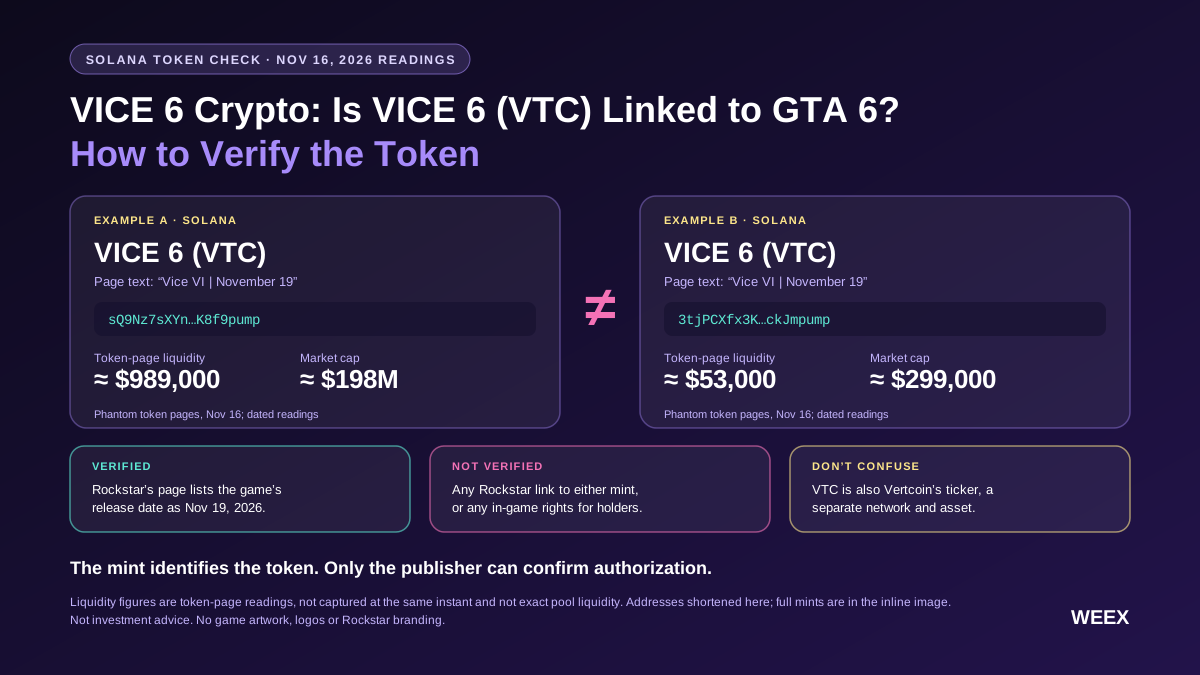
VICE 6 Crypto: Is VICE 6 (VTC) Linked to GTA 6? How to Verify the Token
Is VICE 6 crypto linked to GTA 6? Compare two Solana tokens using VTC, verify their mint and pool addresses, and see what Rockstar has confirmed.
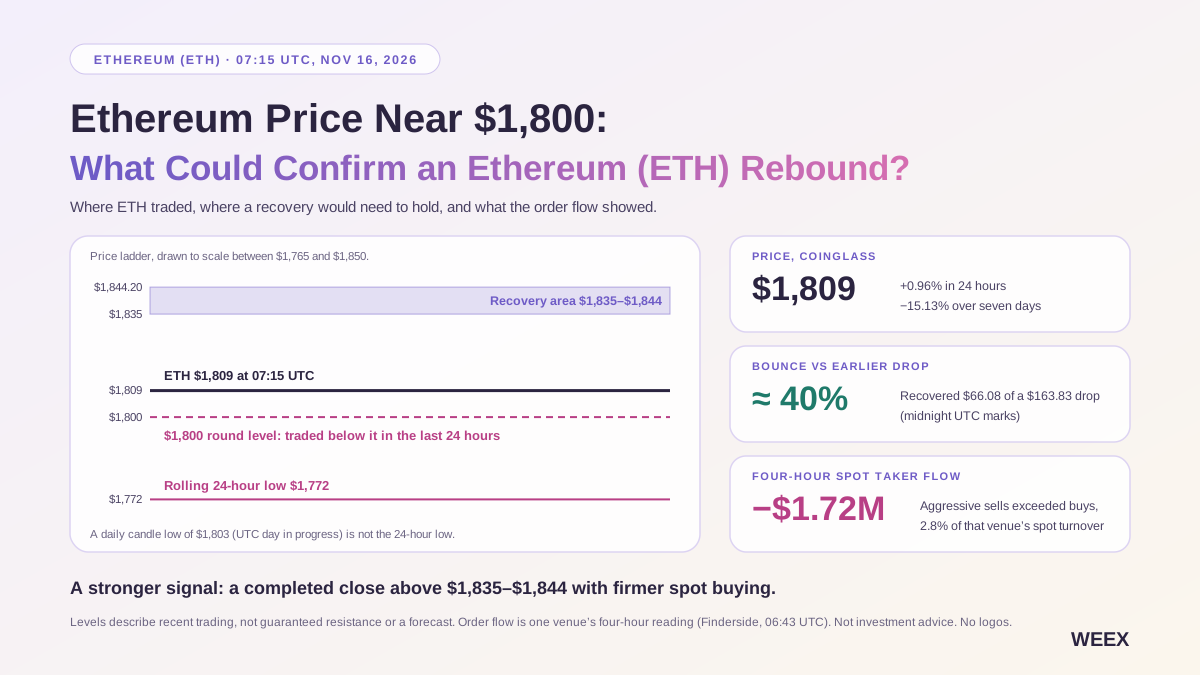
Ethereum Price Near $1,800: What Could Confirm an Ethereum (ETH) Rebound?
Ethereum traded near $1,800 on November 16. See what four-hour spot order flow, futures positioning, and Friday’s ETF flows say about an ETH rebound.
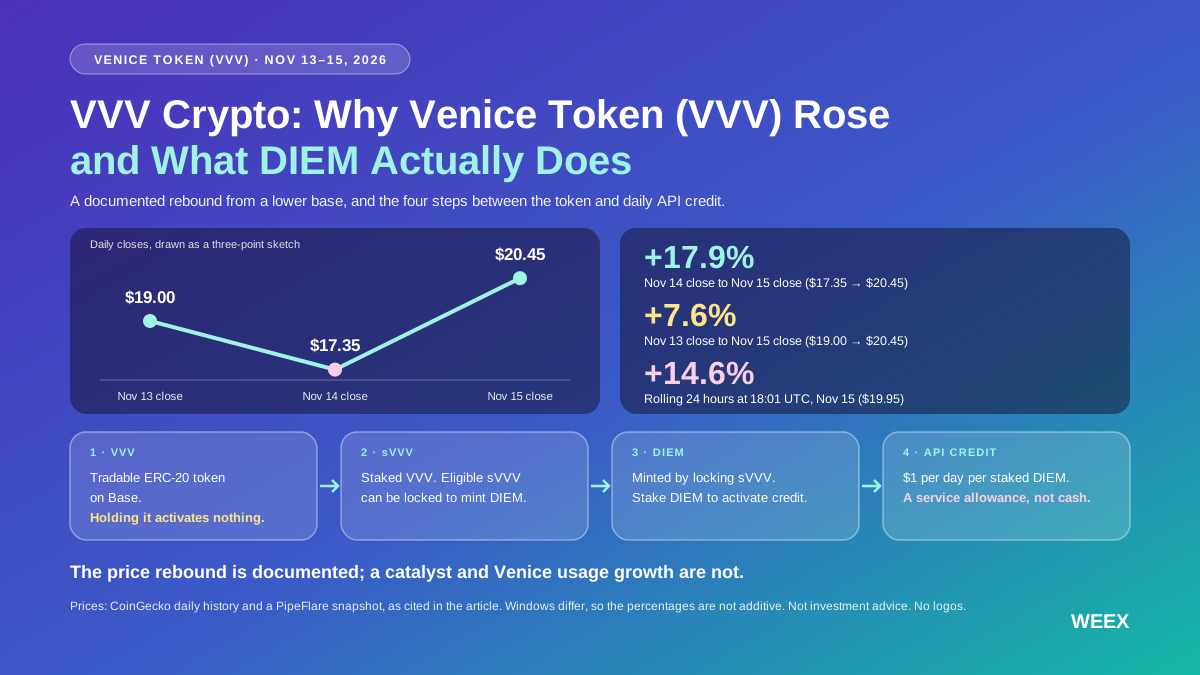
VVV Crypto: What Is Venice Token, Why Venice Token (VVV) Rose and What DIEM Actually Does
Venice Token rose about 14.6% in one November 15 snapshot. Learn what the data shows, how VVV staking works, and what DIEM’s daily API credit buys.
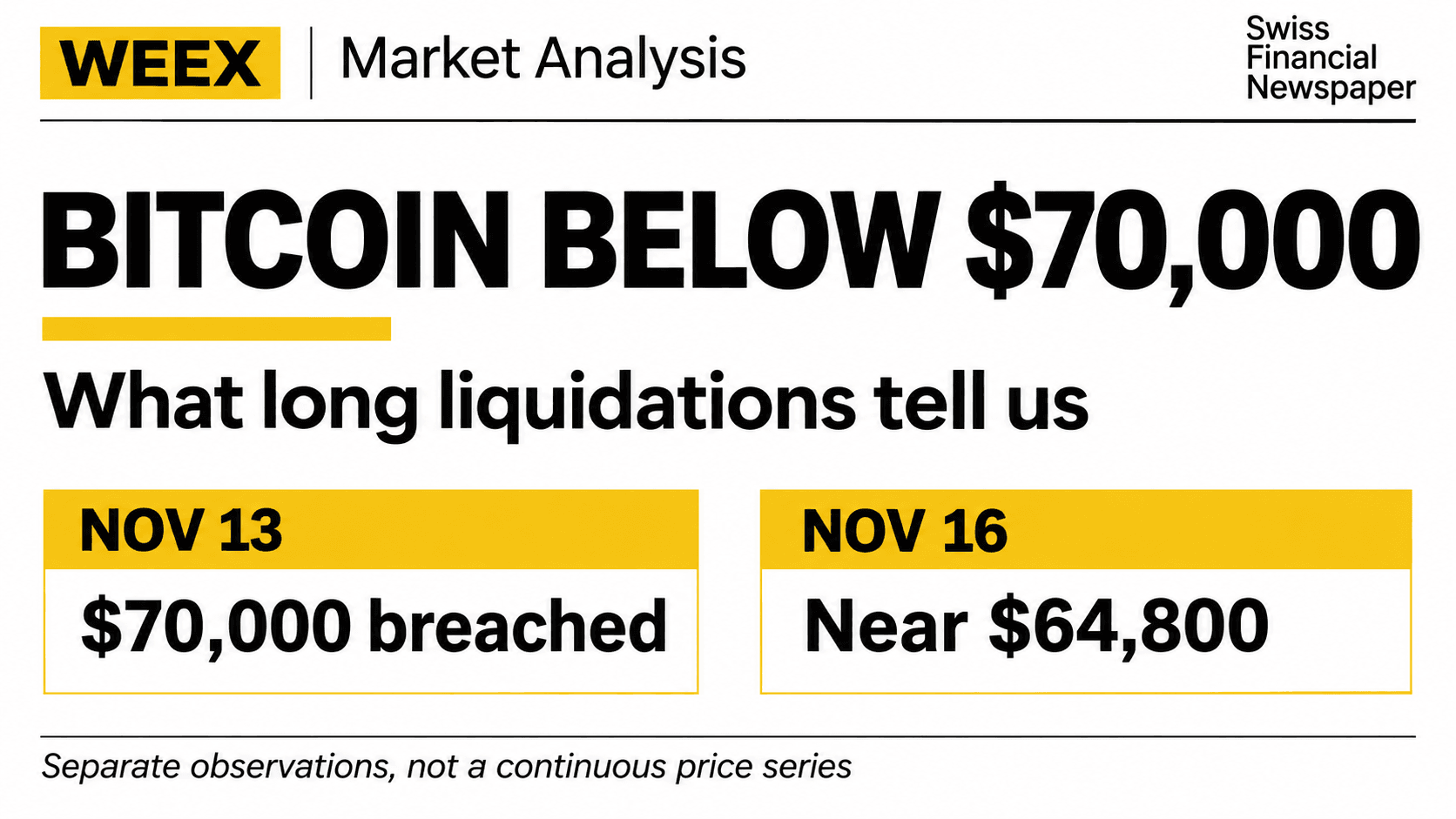
Why Did Bitcoin (BTC) Drop Below $70,000? What Long Liquidations Tell Us
See why Bitcoin fell below $70,000 on November 13, how long liquidations amplified the decline, and what to watch before calling a rebound. If you already plan to trade, you can check whether your activity qualifies for the WEEX Lucky Eggs event, scheduled to run through November 25, 2026 (UTC+8).

WEEX Lucky Eggs: How to Earn Daily Egg Cracks and Win Every Time
Learn how to earn daily WEEX Lucky Eggs from qualifying futures trading volume, check your progress, and understand what “Win Every Time” means.

Meta’s Internal Prediction App Uses Points, Not Cash — and That Distinction Matters

US Signs Silicon Peace Agreement with Eight Nations

Three Questions Every Investor Should Ask About Any Management Team

NuScale Stock Has Lost More Than Half Its Value in 2026, Its Worst Year Since 2023. Here's What Happened the Year After That One.

From 'Patching' to 'Eliminating Entire Classes of Bugs': How to Build Internet Resilience?

5 Dividend Stocks With High Yields That Are Safer Than You Might Think

MiCA gave crypto a passport, but customers still face borders
Regeneron Has $16 Billion in Net Cash and Trades Near 20 Times Earnings. Is It the Cheapest Big Biotech?
Unocoin halts all services after hackers bypass BitGo freeze

Can the Anthropic IPO Save the AI Rally?

Hyperliquid Q3 Revenue Reaches $190.9 Million, Kraken Parent Company Sees 12% Decline in Earnings

Guoyin Financial Leasing Plans to Purchase Computer Equipment for 981 Million Yuan
‘Roadmap is Complete,' Cardano Founder Charles Hoskinson Says

In Anthropic's Doomsday Narrative, There Is No Room for Jensen Huang

What Investment Signals Are Released as the 'Big Three' of AI New Cloud Submit Their Reports?

RWA Weekly: NYSE to Use Avalanche for Settling Tokenized Stocks; Goldman Sachs, Citigroup Commit Approximately $270 Million to Joint Stablecoin Project

BNY Mellon Adds to Invesco Galaxy Bitcoin ETF: What Changes with the Custody Filing?

Ethereum Foundation Launches Universal Ethereum Signer App

CoreWeave Says Its AI Demand Is 10 Times Its Capacity Through 2027. I Think Micron Stock Is Still Worth Buying.

MultiBank Group and Universal Sign Agreement to Develop USDU Settlement Capabilities for Institutional Clients
Matt Hougan has a positive outlook on Bitcoin and altcoins
Win an iPhone 18 Pro Max on WEEX? 201 Lucky Eggs Explained
Tesla Autopilot Team Veterans Found Simulation Startup Valued at $1 Billion
CoW Swap Launches on Solana, Supporting USDC and Wrapped SOL Exchange
CoW Swap Launches Alpha Version, Supporting USDC and wSOL Exchange
VICE 6 Crypto: Is VICE 6 (VTC) Linked to GTA 6? How to Verify the Token
Is VICE 6 crypto linked to GTA 6? Compare two Solana tokens using VTC, verify their mint and pool addresses, and see what Rockstar has confirmed.
Latest articles



Latest coin listings on WEEX


