Why Crypto Platforms Want to Become Your Everyday Money App

 Prefer us on Google


Martin Masser opens his banking app even when he has nothing to pay. Sometimes, he just wants to check his balance.
"I check my banking app all the time," ChangeNOW's director of strategic partnerships said during an interview at TOKEN2049 in Singapore.
Crypto platforms want a similar place in their customers' lives. The "super app" model puts trading alongside services such as payments and borrowing, giving people reasons to return between transactions. Whether those services become a habit is a harder question.
What Brings You Back When You Have Nothing to Trade?
Asked whether crypto has enough demand for super apps, Masser started with the limits of swapping tokens. Some traders transact constantly. Others might make a swap every few days, or once a week.
He described checking earnings and reviewing previous transactions as reasons to open an app without making another trade. His comparison was with banking, where customers routinely look at their money without moving it.
"The more use cases that you get, the more you start using," he said.
Kaiko's 2026 research describes exchanges expanding into broader financial platforms, connecting trading balances to yield products and spending services. Keeping those activities together gives platforms more opportunities to retain customers and their funds.
Masser offered examples of that behavior, though the interview included no retention figures showing how widely it has taken hold at ChangeNOW.
Does Everyone Need the Same Reason to Return?
A super app can provide all sorts of financial resources and activities. But does it need one dominant, recurring use-case? Masser argued that different customers could build different routines around the same product.
"People use the apps in very different ways," he said. Drawing on his earlier work in banking product development, he added: "We aren't the user."
A customer checking a balance may have little interest in borrowing. An active trader may care more about swap fees. Masser also pointed to AML wallet checks for money-laundering exposure among ChangeNOW Pro's features.
His argument leaves room for occasional users. An app can become useful across someone's financial life without demanding the attention of a messaging service.
Why Does Moving Money Still Take Several Apps?
For some users, the appeal is more immediate. They receive USDT on one blockchain and need it on another.
Masser described that as a recurring problem in conversations with customers. A transaction that looks simple to the recipient can require unfamiliar steps between networks.
He recalled his own experience of buying crypto on one platform, then moving elsewhere to swap it. Bringing those steps together could also help customers discover services as their needs develop.
"It's much easier to have it in one place," he said.
This is the practical case for a broader app: fewer separate processes to complete one financial task. Adding more services helps only if moving between them becomes easier.
-- Price
When Does a Super App Become a Cluttered App?
That creates a design problem. The host asked how platforms could keep adding functions without overwhelming the interface.
"There's no point adding something that doesn't make sense for the product," Masser said.
He used ordering McDonald's through a crypto app as an example of a feature that could feel out of place. His test was whether services fit together and allow people to move naturally from one task to the next.
The argument puts a limit on expansion. Every additional function asks users to understand another choice. A platform promising convenience can make itself harder to navigate.
Telegram's Audience Did Not Automatically Become Customers
Masser had seen another assumption fail during his time at TON Foundation: access to a large audience would make a product successful.
He recalled teams launching applications inside Telegram and expecting its enormous reach to deliver users. In his telling, they later returned with a complaint: "Martin, we've got no users."
His response was straightforward: "Have you done any marketing?"
Masser said successful teams had considered what people wanted and worked to reach them. That experience informs the questions he now asks developers about why they are building a product and how they define success.
"Just because you think you have a big audience does not mean you're going to have a naturally successful product."
What Happens After the Partnership Announcement?
The same test applies to partnerships, Masser's remit at ChangeNOW.
"You don't want to have a partnership just to have your name on a press release," he said.
He described ongoing work to understand a partner's customers and help a product find its market. A business might initially integrate swaps, then add payment services later.
ChangeNOW's API lets developers connect its services to their own applications. Masser said this could save teams from building those functions themselves and maintaining support for new blockchains.
"Maybe what you're starting out with isn't the finished product," he said. His view of a partnership leaves room for that product to change after launch. https://t.co/VZlYYN41bl --- BeInCrypto (@beincrypto) July 16, 2026
Will People Eventually Stop Calling It Crypto?
Stablecoins give this ambition a practical test. Recent reports estimate at least $401 billion in stablecoin payments during the first eight months of 2026, up 42% year over year.
Businesses received an estimated 58% to 64% of payment volume, so those figures do not establish widespread consumer spending.
Masser pointed to markets where stablecoins are already used more routinely in everyday financial activity as a reason to build services beyond holding or exchanging tokens.
Asked what would show that crypto super apps had succeeded in five years, he answered: "That you are using it in day-to-day life without realizing it's a crypto super app."
For the platforms building them, that means earning a place in ordinary financial routines. The user needs a reason to open the app even when there is no trade to make.
This content is provided for general informational purposes only and doesn't constitute financial, investment, legal, or tax advice. Any events, rewards, online promotions, or related information mentioned herein should not be considered a recommendation, solicitation, or invitation to purchase, sell, trade, or otherwise deal in any crypto assets. Crypto assets are highly volatile and may result in loss. The availability of WEEX services, products, and related events may vary by region. You are responsible for ensuring that your participation is in accordance with applicable local laws and regulations.
You may also like
Solana’s Yakovenko questions Alpenglow build as vote transactions exit
Bitcoin: JPMorgan Sees It Outperforming Stocks and Gold in the Long Term

Tether joins Tenstorrent’s $1.5B round as AI investments grow

110 wallets account for 99.6% of RLUSD payments on XRP Ledger

Raised US$28 million and now seeking to expand in Argentina and other Latin American countries

Claude Pushes Bitcoin and Banks to Accelerate in 53 Hours

Capital as Production Capacity: Where Did the Money of the Top 100 VC and CVC in the U.S. Go in the First Three Quarters of 2026?
Strive Surpasses Saylor in Bitcoin Purchases: What Is This Company?

Charles Hoskinson's Meme Coin Plummets Over 90% in Just Hours
After Disassembling a Genuine Ledger, TBC Discusses the True Boundaries of Self-Custody
Unitree Stock Surges: Why Shares Jumped 16% on October 19 and What Investors Should Check Before Q3 Results
SpaceX Stock Price Explained: Why SPCX Is Down From Its $225 High and What Could Move It Next
21shares launches Lighter, Venice crypto ETPs in Europe
Stablecoins Have Solved On-Chain Settlement, But How Do They Enter Merchant Checkout?
CFTC Chair: Breaking State-Level Fragmentation to Make the U.S. a Global Crypto Hub
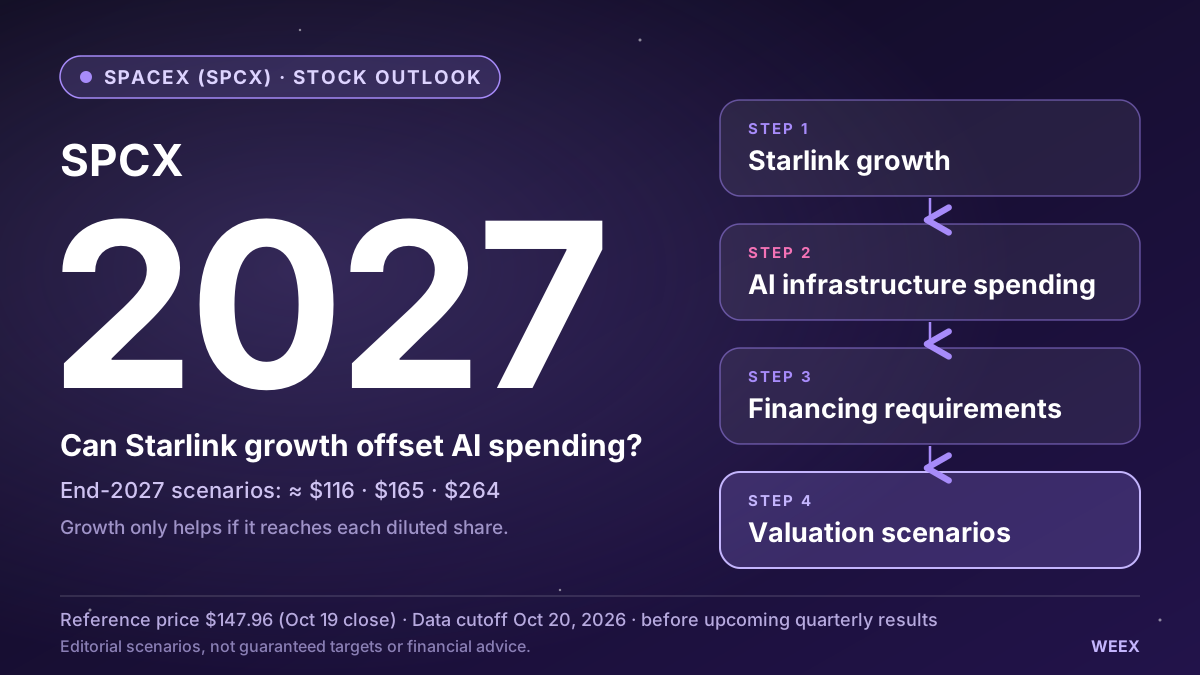
SpaceX Stock(SPCX) Price Prediction 2027: Can Starlink Growth Offset AI Spending?
SpaceX stock price prediction for 2027: assess Starlink growth, AI spending, valuation compression and dilution through transparent price scenarios.
a16z Talks to Circle Founder: Arc is More Than Just a Public Chain, It is the Foundation of the Machine Economy
NDV: Where Did the Money Go? A Review of the 16 Years of Stagflation and Wealth Erosion in the United States
Danantara Boosts Economy 30-Fold Through Technology - Fintech World
What Is Messari? Crypto Research, Blockworks Integration and Investor Tools
How Did Myer Kripke Invest With Warren Buffett? Long-Term Investing Lessons
Bitcoin (BTC) Mining Profitability: Will Higher Difficulty Trigger Miner Selling?
In the Winter of Blockchain Games, "$8 Million Sold in 30 Seconds" - A New Speculative Game on Robinhood

Kerman Kohli: The Bottleneck in Computing Financing Lies in Credit
Banking Coalition Gathers: Stablecoin Market Faces Structural Shock
AI 'Challenges' Cryptography? Web3 Must Prepare in Advance, But Should Never Rush Migration

Brooklyn's 'Crypto Hunters': A Cross-National Scam Chase Across Three Time Zones
Without diesel subsidies and with a shortage of dollars, Bolivia protests and adopts USDT
XRP Opens X Account After 10 Years, Gains 47,000 Followers on First Post
Circle cites 175+ institutions as CPN wins Money20/20 payments bronze
Solana’s Yakovenko questions Alpenglow build as vote transactions exit
Bitcoin: JPMorgan Sees It Outperforming Stocks and Gold in the Long Term
Tether joins Tenstorrent’s $1.5B round as AI investments grow
110 wallets account for 99.6% of RLUSD payments on XRP Ledger
Raised US$28 million and now seeking to expand in Argentina and other Latin American countries
Claude Pushes Bitcoin and Banks to Accelerate in 53 Hours