
NVDA Stock Rises After Nvidia Denies Kyber AI Rack Delay: What Investors Should Know


NVDA stock moved on a single sentence today.
Nvidia told Bloomberg that its product roadmap is intact, directly refuting a SemiAnalysis report published earlier that suggested the company's next-generation Kyber NVL144 AI rack system would be pushed back to 2028. NVDA stock had dropped approximately 1.5% in premarket trading on the delay report before recovering more than 1% after the denial. The round trip happened within hours, and investors who were not paying close attention saw NVDA stock finish higher without understanding what caused the volatility in between.
Understanding what Kyber is, why a delay would matter, and what the denial actually confirms about Nvidia's product roadmap is more useful than simply noting that NVDA stock recovered. The Kyber story touches on the most important question surrounding NVDA stock in the second half of 2026: whether Nvidia's product cadence can sustain the hyperscaler demand trajectory that has been driving AI infrastructure spending.
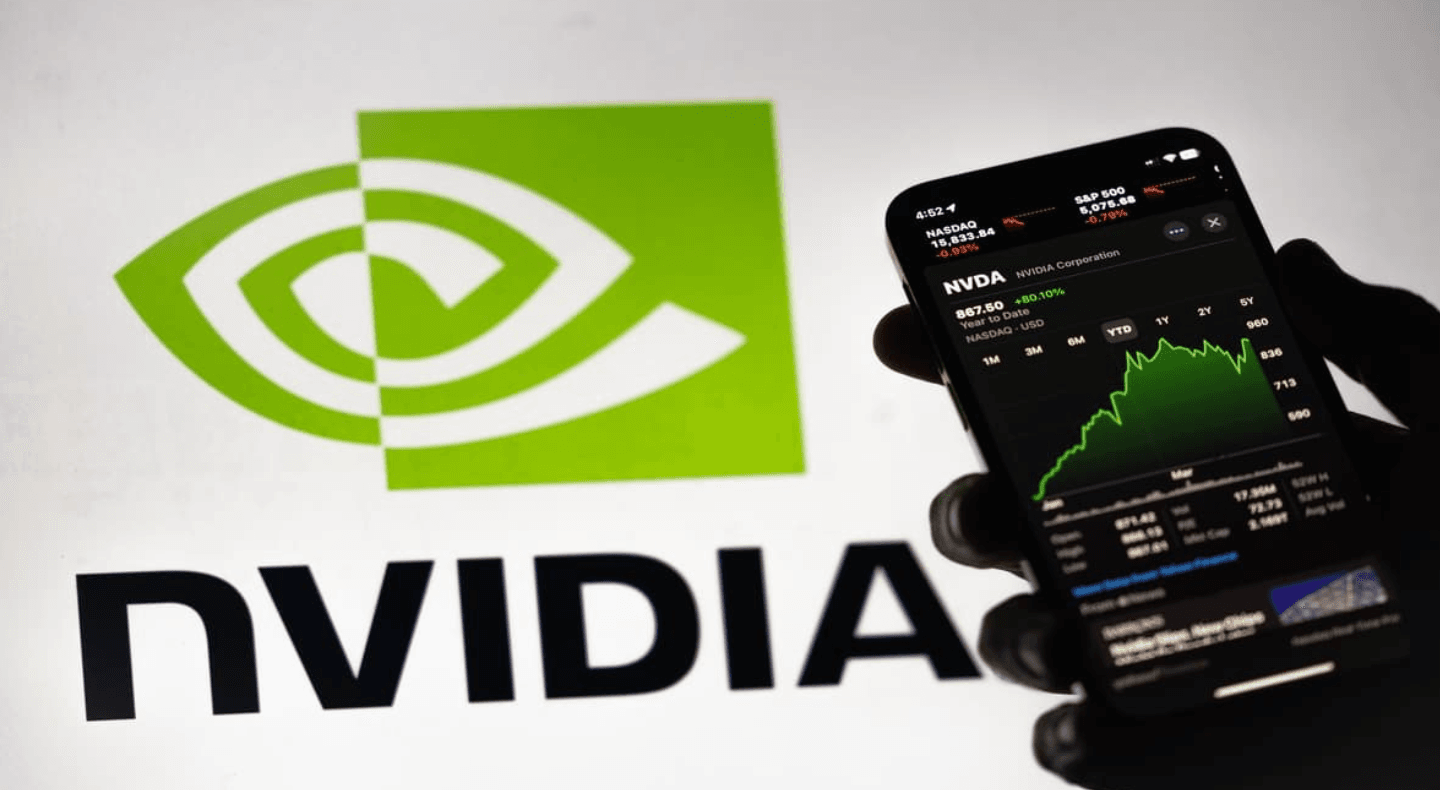
What Kyber NVL144 Actually Is
Kyber NVL144 is Nvidia's next rack-scale AI platform following the current Vera Rubin generation. Understanding what that means requires a brief map of Nvidia's product architecture.
Nvidia does not just sell individual GPUs anymore. It sells complete rack-scale systems that combine GPUs, networking, cooling, and software into integrated infrastructure units that hyperscalers deploy directly into their data centers. The current generation is Vera Rubin, which represents a significant step up from the Blackwell architecture that was sold out through mid-2026.
Kyber NVL144 is the generation after Vera Rubin. The NVL144 designation refers to a system that links 144 GPUs into a single coherent unit, roughly double the scale of the Vera Rubin NVL72 system that AMD's Helios platform has been competing against with its 432 gigabyte HBM advantage. At 144 GPUs per rack unit, Kyber would represent a significant increase in the compute density and HBM capacity that Nvidia can offer hyperscalers in a single deployable system.
For NVDA stock investors, Kyber matters because it is the product that sustains Nvidia's revenue trajectory after the Vera Rubin cycle completes. If Kyber arrives on schedule, Nvidia maintains its product cadence and the hyperscaler capex that is projected to grow from $650 billion in 2026 to $1 trillion in 2027 flows into the next Nvidia generation. If Kyber is delayed, there is a gap in Nvidia's product roadmap that competitors could exploit and that could cause hyperscalers to delay purchases while they wait.
Why the SemiAnalysis Report Moved NVDA Stock
SemiAnalysis is a semiconductor research firm whose technical reports have a track record of being accurate on product roadmap details that companies do not publicly disclose. When SemiAnalysis publishes that a platform is delayed, the market takes it seriously because the firm has historically had access to supply chain and engineering sources that predate official company announcements.
The report suggesting Kyber NVL144 would slip to 2028 moved NVDA stock immediately because it implied a specific gap in Nvidia's product roadmap. Vera Rubin is currently in deployment. Kyber was expected to follow in 2027. A slip to 2028 would mean approximately 12 months without a next-generation platform transition, during which AMD's Helios and MI455X would have more time to accumulate hyperscaler design wins without facing a new Nvidia platform to compete against.
The 1.5% premarket decline on the report was not an overreaction given those implications. A 12-month product roadmap gap at a company with a $4.7 trillion market capitalization is a material concern that deserves a price response.
What Nvidia's Denial Actually Confirms
The denial itself deserves careful reading because the language Nvidia chose is more specific than a generic refutation.
Nvidia told Bloomberg that the roadmap is intact. That specific phrasing confirms two things. First, the Kyber development program exists and is proceeding. Second, the timeline that Nvidia has been communicating internally to customers and partners has not changed. That second confirmation is the more important one for NVDA stock investors, because hyperscaler customers make purchasing and deployment decisions based on their understanding of Nvidia's product roadmap. If the roadmap they have been shown is intact, their purchasing intentions based on that roadmap remain intact.
Goldman Sachs reinforced the denial's significance by reiterating its bullish view on NVDA stock on the same day. A Goldman Sachs analyst described NVDA stock's forward price-to-earnings ratio of 21.7 times as compelling, noting it is near the average S&P 500 multiple and dramatically below Nvidia's own five-year average of 72 times. Goldman's framing is that the market is not pricing in Nvidia's 2027 growth at all, and the roadmap confirmation removes one of the key catalysts for concern.
The Broader Context: Why NVDA Stock Is Only Up 5% in 2026
The Kyber story lands in the context of one of the more surprising performance gaps in the semiconductor sector this year.
NVDA stock is up approximately 5% year to date. AMD stock is up approximately 150%. The SOXX semiconductor ETF is up approximately 59%. Nvidia is the primary AI chip supplier with approximately 70% to 80% of the AI accelerator market, and it has dramatically underperformed the sector it dominates.
The underperformance reflects a specific valuation dynamic rather than any business deterioration. Nvidia entered 2026 priced for perfection after dominating the AI trade in 2023, 2024, and 2025. The stock hit an all-time high of $236.54 in May 2026 and has since fallen approximately 17% to the current $195 range. The decline reflects profit-taking, sector rotation into AMD and memory stocks, and concerns about competition from custom chips being developed by hyperscalers internally.
The Kyber delay report and denial is a microcosm of this larger dynamic. Any negative roadmap news amplifies the existing concerns. Any positive confirmation, like today's denial, provides a brief recovery but does not by itself resolve the multiple compression that has kept NVDA stock flat in a year when the broader semiconductor sector has rallied dramatically.
The DeepSeek Custom Chip Story That Is Running Simultaneously
One complicating factor that hit NVDA stock in the same premarket session as the Kyber report is a Reuters report that DeepSeek is developing its own AI chip.
DeepSeek, the Chinese AI lab whose efficiency-focused models created significant market disruption when they were first disclosed, is reportedly working on custom silicon that could reduce its dependence on Nvidia GPUs. The report landed alongside news that US companies are increasingly seeking to use cheaper Chinese AI models, which directly threatens the premise that AI compute demand requires Nvidia's most expensive chips.
These two pressures, custom chip development by hyperscalers and Chinese AI models that require less compute, are the structural risks to NVDA stock that the Kyber denial cannot address. The product roadmap being intact is good news for the Vera Rubin to Kyber transition. It does not make custom silicon less threatening or Chinese efficiency models less relevant.
Goldman Sachs addressed this directly, noting that while hyperscalers are developing internal chips, they continue spending aggressively on Nvidia infrastructure simultaneously. The $650 billion in projected 2026 hyperscaler capex and $1 trillion projected for 2027 is not being diverted from Nvidia toward internal chips. It is additive spending that flows through Nvidia even as internal chip programs develop alongside it.
What the August 26 Earnings Report Will Tell Investors
NVDA stock's next major fundamental test is the Q2 FY2027 earnings report on approximately August 25 to 26. That report will provide the first financial data showing whether the Vera Rubin ramp is proceeding at the pace that justifies the $4.7 trillion market capitalization.
The specific metrics to watch are data center revenue trajectory, gross margin guidance, and any commentary on Kyber qualification timelines with hyperscaler customers. Nvidia guided gross margins in the range of 70% to 73% for Q2. If margins hold at the high end of that range while revenue accelerates, the Goldman thesis of an undervalued stock at 21.7 times forward earnings gets its first financial confirmation.
Management commentary on the Kyber timeline would be the most valuable additional disclosure. While today's denial confirmed the roadmap is intact, the earnings call is the venue where management can provide specific language about Kyber development milestones, customer qualification processes, and expected deployment timelines. Any incremental specificity beyond "roadmap is intact" would give analysts better inputs for modeling the 2027 and 2028 revenue trajectory.
For investors tracking stock, WEEX provides access to stock trading products, including the First Stock Trade Protected campaign offering eligible users additional protection on their first stock trade.
Conclusion
NVDA stock's recovery today after Nvidia denied the Kyber NVL144 delay report is a relief rally rather than a re-rating. The denial confirms that Nvidia's product roadmap has not changed and that the transition from Vera Rubin to Kyber remains on the timeline that hyperscaler customers have been planning around.
What the denial does not do is resolve the broader questions that have kept NVDA stock flat in a year when AMD has gained 150% and the semiconductor sector has rallied 59%. Custom chip development by hyperscalers, Chinese AI model efficiency reducing compute requirements, and competition from AMD's Helios platform are structural concerns that a product roadmap confirmation addresses only indirectly.
Goldman Sachs's observation that NVDA stock at 21.7 times forward earnings is near the S&P 500 average and dramatically below Nvidia's own five-year multiple of 72 times is the most relevant framing for investors deciding whether today's recovery is the beginning of a sustained re-rating or a single-day technical bounce. The August 26 earnings report is where that question gets its next meaningful data point.
FAQ
1. Why did NVDA stock rise today?
NVDA stock rose over 1% on July 7 after Nvidia denied a SemiAnalysis report suggesting its next-generation Kyber NVL144 AI rack system would be delayed until 2028. Nvidia told Bloomberg that its product roadmap is intact, removing a specific concern that had caused a 1.5% premarket decline earlier in the same session.
2. What is Nvidia Kyber NVL144?
Kyber NVL144 is Nvidia's next rack-scale AI platform following the current Vera Rubin generation. The NVL144 designation refers to a system linking 144 GPUs into a single coherent unit, roughly double the scale of the Vera Rubin NVL72. It represents the generation that sustains Nvidia's revenue trajectory after the current Vera Rubin cycle completes.
3. Why does a Kyber delay matter for NVDA stock?
A delay would create approximately a 12-month gap in Nvidia's product roadmap between Vera Rubin and Kyber, during which AMD's competing platforms would have more time to accumulate hyperscaler design wins without facing a new Nvidia generation. For a company with a $4.7 trillion market capitalization built on product leadership, roadmap continuity is a core valuation assumption.
4. What did Goldman Sachs say about NVDA stock today?
Goldman Sachs described NVDA stock's forward price-to-earnings ratio of 21.7 times as compelling, noting it is near the S&P 500 average and dramatically below Nvidia's own five-year average of 72 times. Goldman argued that none of 2027's projected growth is currently priced into NVDA stock.
5. When does Nvidia report Q2 FY2027 earnings?
Nvidia's Q2 FY2027 earnings report is expected on approximately August 25 to 26, 2026. Data center revenue trajectory, gross margin delivery relative to the 70% to 73% guidance range, and any Kyber timeline specifics are the primary metrics investors will focus on.
Disclaimer
This content is provided for general informational and educational purposes only and should not be considered financial, investment, legal, or tax advice. Nothing in this article constitutes an offer, recommendation, solicitation, or invitation to buy, sell, or trade any crypto asset or use any specific service. Crypto assets are highly volatile and involve a high degree of risk. You may lose some or all of the value of your investment and should not invest funds you cannot afford to lose. WEEX services may not be available in all regions and are subject to applicable laws, regulations, and user eligibility requirements. Please carefully assess risks and confirm local requirements before making any financial decisions.
You may also like
Why Is NVIDIA Stock Moving Today? NVDA Price, AI Demand, and Rebound Levels
NVDAUSDT is trading near $197 on WEEX. This article reviews why NVIDIA stock is moving, key support near $190, and rebound levels for traders.
NVIDIA Stock Forecast 2026: Can NVDA Recover From $197 and Retest $240?
NVDAUSDT trades near $197 on WEEX. This NVIDIA stock forecast reviews support, resistance, AI chip demand, and whether NVDA can retest $240 in 2026.
Rivian Stock (RIVN): Price, 2026 Forecast, and How to Trade It
Rivian stock (RIVN) trades near $16.50 after a $1.5B raise. See the 2026 forecast, analyst targets, and how to buy or trade RIVN — including on WEEX.
PENG Stock Surges on AI Earnings: Price, Forecast, and Risks
PENG stock jumped after Penguin Solutions' Q3 FY2026 AI-driven earnings beat. See the latest price, analyst forecast, valuation, and key risks.
MSTR Stock in 2026: The Bitcoin Bet That Started Selling
MSTR stock is Strategy's leveraged Bitcoin play. See why it fell in 2026, its 843,775 BTC holdings, mNAV premium, and whether it's a good buy.
SK Hynix Stock: Inside the AI Memory Giant's Nasdaq Debut
SK Hynix stock hits Nasdaq July 10 as SKHY. See why the AI memory giant soared in 2026, the ADR debut details, analyst targets, and the risks.
Is SpaceX Stock Available? How to Trade SPCX-USDT Futures on WEEX
Is SpaceX stock available? Learn how SPCX-USDT futures on WEEX offer SpaceX-linked trading exposure and why they are not direct share ownership.
Samsung Stock: Price, Q2 Earnings Shock, and How to Buy in 2026
Samsung stock fell after a record Q2 2026 profit. See the price, ticker, earnings shock, how to buy from abroad, and the risks.
Why Is SpaceX Stock Down Today? SPCX Pullback, Support Levels, and Rebound Odds
SPCXUSDT is down near $150 on WEEX. This article explains why SpaceX-linked futures are falling, key support near $148, and rebound odds.
If You Can’t Buy AVGO Stocks, What Are the Trading Alternatives?
Can’t open a U.S. brokerage to buy AVGO? This guide explains how exposure to Broadcom’s price can be…
SpaceX Stock Forecast 2026: Can SPCX Recover From $150 and Reach $200?
SPCXUSDT trades near $150 on WEEX after a sharp pullback. This SpaceX stock forecast reviews support, resistance, and whether SPCX can reach $200.
SNDK Stock vs MU Stock: Which Is the Better Buy in the AI Memory Boom?
Compare SNDK stock vs MU stock in 2026. Analysis of Sandisk vs Micron performance, valuation, and AI memory demand. Learn how to trade SNDK stock and MU stock on WEEX.
France vs Morocco Prediction 2026: Crypto Odds, Prediction Market Analysis and Who Will Win World Cup quarterfinal?
France vs Morocco prediction 2026: Expert analysis of crypto odds, prediction market data, and who will win this World Cup quarterfinal. France Morocco betting tips inside.
Tronscan vs Tronscan Pro: Feature Comparison
Tronscan is the standard TRON blockchain explorer many users know, while Tronscan Pro adds a deeper, workspace-style view…
How to Look Up a Wallet Address and Verify Balance on Tronscan
This guide shows you exactly how to use tronscan to search a TRON wallet address, verify your TRX…
How to View Smart Contract Code on Tronscan
This guide shows you how to use Tronscan to find a smart contract address, view verified source code,…
How to Check TRX/USDT Transfer History on Tronscan
This guide explains how to use Tronscan to check TRX and USDT (TRC-20) transfer history, verify wallet activity,…
What Is Tronscan? A Complete Guide to the TRON Blockchain Explorer
Tronscan is the TRON blockchain explorer: a public window into everything happening on TRON—transactions, tokens, addresses, smart contracts,…
Why Is NVIDIA Stock Moving Today? NVDA Price, AI Demand, and Rebound Levels
NVDAUSDT is trading near $197 on WEEX. This article reviews why NVIDIA stock is moving, key support near $190, and rebound levels for traders.
NVIDIA Stock Forecast 2026: Can NVDA Recover From $197 and Retest $240?
NVDAUSDT trades near $197 on WEEX. This NVIDIA stock forecast reviews support, resistance, AI chip demand, and whether NVDA can retest $240 in 2026.
Rivian Stock (RIVN): Price, 2026 Forecast, and How to Trade It
Rivian stock (RIVN) trades near $16.50 after a $1.5B raise. See the 2026 forecast, analyst targets, and how to buy or trade RIVN — including on WEEX.
PENG Stock Surges on AI Earnings: Price, Forecast, and Risks
PENG stock jumped after Penguin Solutions' Q3 FY2026 AI-driven earnings beat. See the latest price, analyst forecast, valuation, and key risks.
MSTR Stock in 2026: The Bitcoin Bet That Started Selling
MSTR stock is Strategy's leveraged Bitcoin play. See why it fell in 2026, its 843,775 BTC holdings, mNAV premium, and whether it's a good buy.
SK Hynix Stock: Inside the AI Memory Giant's Nasdaq Debut
SK Hynix stock hits Nasdaq July 10 as SKHY. See why the AI memory giant soared in 2026, the ADR debut details, analyst targets, and the risks.