
What Is HeyElsa (ELSA) Crypto and How Does It Work?

 Prefer us on Google


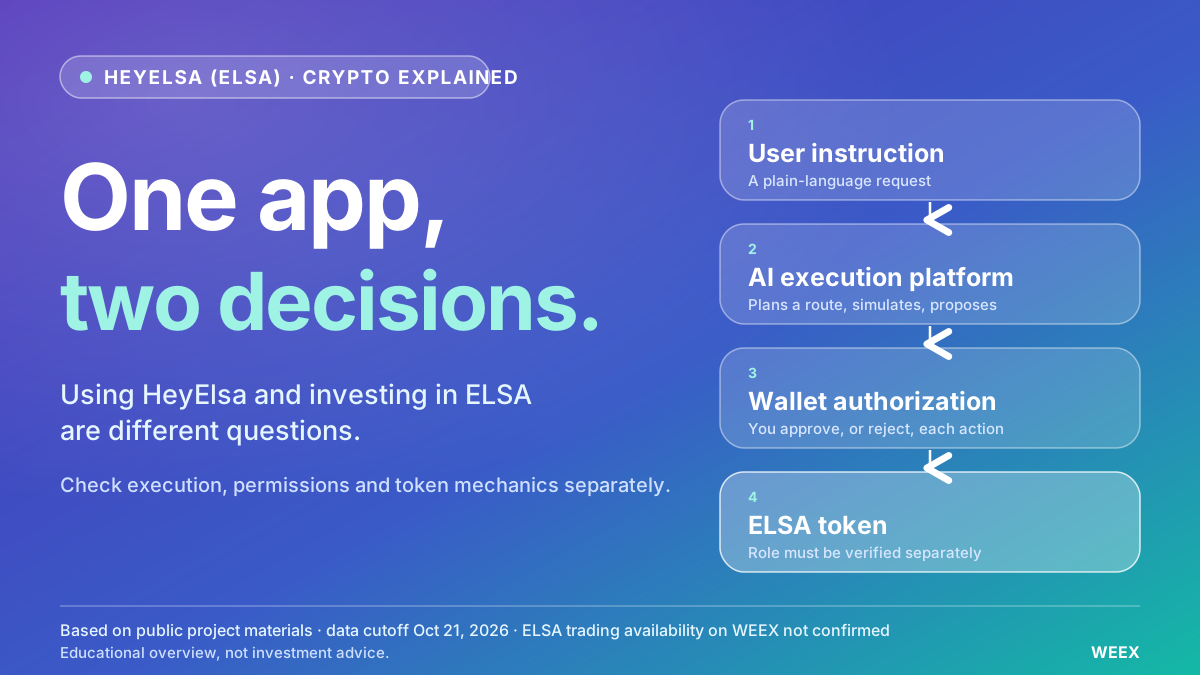
HeyElsa is an AI-powered crypto platform that helps users turn written or spoken instructions into blockchain actions, such as swapping assets, moving funds between networks, and reviewing portfolios. ELSA is its ecosystem token. Understanding HeyElsa crypto requires separating three things: the application people use, the infrastructure that executes transactions, and the token’s economic role. These are connected, but using the application and investing in ELSA are different decisions. (Circle Alliance Directory)
Our view is that HeyElsa’s strongest proposition is reducing the difficulty of completing onchain tasks. Its harder challenge is proving that a useful application creates durable demand for its token. A smooth interface can attract users without automatically making the associated asset valuable. Readers should therefore examine execution quality, wallet permissions, actual token requirements, and supply changes before treating the AI narrative as an investment case.
For market research, the WEEX HeyElsa price page provides an asset-specific starting point, while the HeyElsa futures calculator lets readers model hypothetical position outcomes. Trading availability needs a separate check: during this review, the WEEX ELSA futures page displayed a trading restriction notice, and the token page showed “Not listed.” Those observations do not establish that new positions can currently be opened. (WEEX)
What Problem Does HeyElsa (ELSA) Crypto Try to Solve?
A simple crypto goal can involve a complicated sequence of decisions.
Someone who wants to move funds into a different asset may need to identify the correct network, locate a trading venue, approve a contract, obtain gas tokens, compare execution routes, and confirm the destination address. Each step creates an opportunity for misunderstanding.
HeyElsa’s proposition is to make the user’s intended outcome the starting point. Rather than beginning with a collection of applications, the user describes a goal and receives a proposed route toward it.
Circle’s partner directory describes Elsa as a conversational interface for activities including swaps, lending, and cross-chain transfers. This supports its classification as an execution-oriented application rather than simply a chatbot that discusses prices. However, a directory listing is not a security audit or a guarantee that every advertised operation is available to every user. (Circle Alliance Directory)
The practical benefit would be fewer interface changes and less manual coordination. The trade-off is that users must understand what they are delegating. An easier interface can hide complexity from view without removing the underlying financial exposure.
For example, a bridge transaction still depends on the bridge’s design, supported assets, liquidity, and settlement process. Describing the transfer in ordinary language does not make those dependencies disappear.
How Does HeyElsa (ELSA) Work?
The clearest way to understand an AI crypto agent is to follow a transaction from intention to settlement.
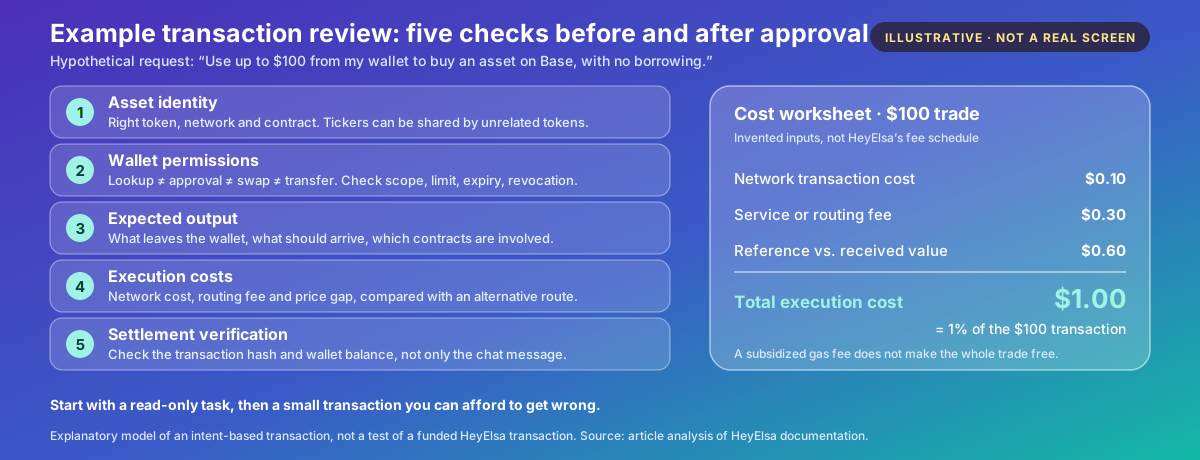
The sequence below is an explanatory model of how to assess an intent-based transaction. It is not a claim that every HeyElsa feature follows an identical interface or that this article tested a funded transaction.
From a Sentence to a Specific Instruction
Consider this hypothetical request:
“Use up to $100 from my wallet to buy an asset on Base, with no borrowing.”
Before executing anything, the system needs to establish which wallet, which asset, which available balance, and which price constraints the user means. An asset’s ticker alone may be insufficient because unrelated tokens can share a name.
A reliable transaction proposal should resolve those ambiguities before asking for authorization. “Buy the trending token” is less precise than naming the asset, network, amount, and maximum acceptable cost.
This is an important distinction between conversational convenience and execution quality. A confident response is not evidence that the intended contract was selected.
From an Instruction to an Execution Route
Once the request is specific, an execution system must determine how to complete it.
A same-network swap may require one route. A transfer involving another blockchain may require additional transactions and dependencies. The cheapest quoted route may not be the fastest, and the highest displayed output may rely on conditions that change before settlement.
HeyElsa’s public materials describe a planning and execution architecture involving specialized agents, transaction simulation, and policy constraints. These are descriptions of the project’s design; they should not be interpreted as an independent assurance that every transaction is optimal or protected from failure. (blog.heyelsa.ai)
For the user, the important output is a readable proposal: what will leave the wallet, what should arrive, which contracts are involved, and what permissions are required.
From Authorization to Settlement
Authorization is where an AI suggestion becomes a financial action.
Before approving a proposal, the user should be able to distinguish a balance lookup from a token approval, a swap, or a transfer. These actions have different consequences.
After execution, the transaction hash and resulting wallet balances matter more than a chat confirmation. A message saying “completed” should be checked against the relevant blockchain record when funds are involved.
A useful agent therefore needs to make outcomes inspectable. It should help users understand failures and partial completion, especially where a workflow involves multiple networks or protocols.
What Is the Difference Between HeyElsa and the HeyElsa (ELSA) Token?
HeyElsa is a product and infrastructure ecosystem. ELSA is a transferable cryptoasset associated with that ecosystem.
This distinction matters because people can be interested in the product for reasons unrelated to speculation. A user may want a simpler interface for managing existing assets. A developer may want execution tools inside another application. A token buyer may be evaluating future demand and supply.
Those interests overlap, but they are not interchangeable.
| Component | What It Represents | What to Evaluate |
|---|---|---|
| Consumer application | The interface used to request and review actions | Usability, supported tasks, costs, authorization |
| Developer infrastructure | Tools other applications can integrate | Documentation, reliability, integration demand |
| ELSA token | An asset with ecosystem-related uses | Enforced utility, supply, distribution, liquidity |
| Trading market | A venue for exchanging or taking exposure to the asset | Product type, execution conditions, fees |
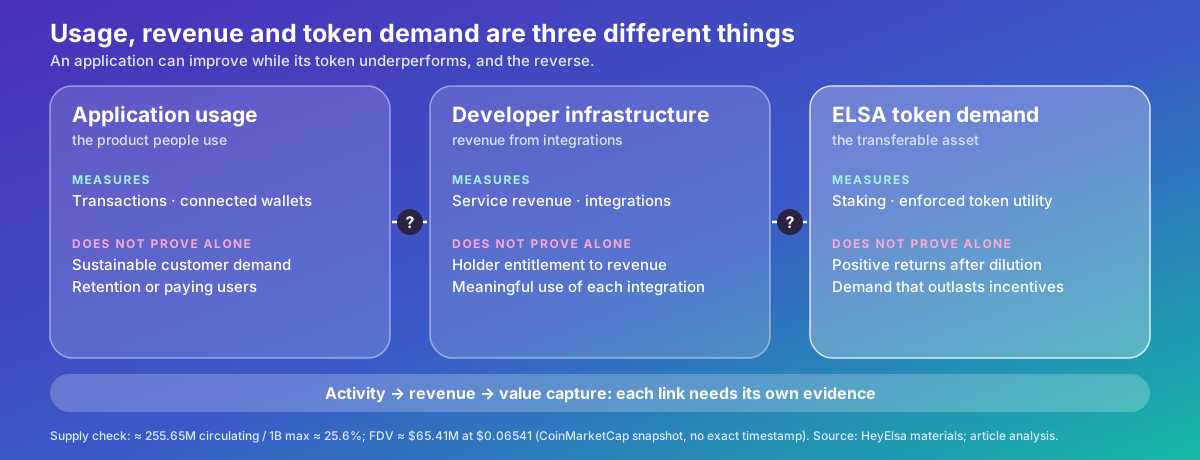
An application can improve while its token underperforms. Conversely, a token can rise while product adoption remains uncertain.
The question for an investor is therefore not simply whether HeyElsa is useful. It is whether the token has an economically meaningful role that survives beyond incentives and speculative attention.
-- Price
What Is HeyElsa (ELSA) Used For?
Official materials describe ELSA-related roles including feature access, fee benefits, ecosystem participation, and incentives. The Elsa Foundation also presents governance and staking as parts of its token framework. These descriptions establish intended uses, but they do not independently prove the current activation, availability, or terms of every feature. (blog.heyelsa.ai)
For readers, each claimed use should be tested against an observable mechanism.
A fee discount is meaningful when the discount is available, its conditions are clear, and users save enough to justify maintaining the required balance. A premium feature matters when customers want it and access genuinely depends on the token.
Governance should be assessed through actual proposals and voting arrangements. A statement that holders influence an ecosystem is less informative than evidence showing what decisions they can make.
Staking also requires closer examination. Rewards funded by new token distribution differ economically from rewards funded by external customer payments. Both can create incentives to hold, but only the latter directly introduces revenue from outside the token-distribution system.
The important question is whether participation creates lasting demand or mainly circulates incentives among existing holders.
Do You Need HeyElsa (ELSA) to Use the Application?
The reviewed documentation does not establish a universal rule that every basic interaction requires an ELSA balance.
HeyElsa’s field guide describes wallet onboarding and transaction features, while its token materials describe particular ecosystem benefits. Readers should not turn those descriptions into a blanket claim that buying ELSA is necessary to try the product. (docs.heyelsa.ai)
This is an important starting point for beginners. There are three separate questions:
Does the application require a token balance to access a specific feature? Does the transaction require the asset being traded or transferred? Does the underlying network require a fee, whether paid directly or abstracted through another arrangement?
The answer can differ by operation.
Before purchasing a token for product access, inspect the exact feature’s current requirements. If a service offers payment alternatives, token demand may depend on how attractive its token-based option is.
That does not make optional utility worthless. It means its strength must be measured through actual user choices.
Who Founded HeyElsa (ELSA), and Who Backed the Project?
A June 5, 2025 company announcement identifies Dhawal Shah as HeyElsa’s founder and reports a $3 million combined pre-seed and seed financing round. It names M31 Capital as the lead investor and includes the Coinbase Ventures Base Ecosystem Fund among participants. These are company-reported financing details, not an independent assessment of the token’s investment merits. (blog.heyelsa.ai)
Funding can help a team hire, develop infrastructure, and build integrations. It does not establish the value of a publicly traded token.
A private investment may have different rights, terms, and exposure from an exchange purchase. Readers should not assume that buying ELSA reproduces an investor’s position in the underlying business.
The more useful follow-up is what funding produced: maintained software, dependable integrations, clearer documentation, and repeat customer activity.
Named investors provide context. Operating results provide stronger evidence of execution.
How Should You Assess HeyElsa (ELSA) Token Supply?
Supply analysis starts by separating circulating supply from the amount that could eventually enter circulation.
During this review, CoinMarketCap displayed approximately 255.65 million circulating ELSA against a maximum supply of 1 billion. The page also showed a price near $0.06541 and a market capitalization around $16.72 million. These are retrieved observations, not executable quotes; the source did not provide an exact data timestamp for the snapshot used here. (CoinMarketCap)
Using those rounded inputs, the circulating ratio is approximately:
255.65 million ÷ 1 billion = 25.6%.
The corresponding fully diluted valuation is approximately:
$0.06541 × 1 billion = $65.41 million.
These calculations explain why a low token price does not establish that an asset is inexpensive. Valuation depends on the quantity of tokens as well as the price of each unit.
A hypothetical example illustrates the supply effect. If circulating supply rose from approximately 255.65 million to 400 million while circulating market capitalization remained $16.72 million, the implied price would be roughly $0.0418. That is about 36% below $0.06541.
This is not a forecast or a claim about an upcoming unlock. It holds market capitalization constant to isolate the arithmetic of supply growth.
New supply does not automatically become immediate selling pressure. Recipients may hold, stake, or deploy it. Nevertheless, maintaining the same price with more circulating tokens requires a larger circulating market capitalization.
Before investing, examine the current vesting schedule, recipient categories, actual circulating-supply updates, and whether demand is growing alongside distribution.
Can HeyElsa (ELSA) Product Growth Create Token Value?
It can, but the connection needs evidence.
A useful framework separates activity, revenue, and value capture. Activity measures what users do. Revenue measures what customers pay. Token value capture concerns the mechanism connecting those payments or actions to demand for the asset.
High transaction volume may generate little revenue if fees are small or subsidized. Revenue can accrue to a business without automatically flowing to token holders. Token purchases may also be temporary if intermediaries acquire tokens only when needed.
| Observation | What It Can Show | What It Does Not Establish Alone |
|---|---|---|
| More transactions | Increased activity | Sustainable customer demand |
| More connected wallets | Broader reach | Retention or paying users |
| More service revenue | Greater monetization | Holder entitlement to revenue |
| More staking | Tokens committed to a mechanism | Positive returns after dilution |
| More integrations | Wider distribution potential | Meaningful usage of each integration |
The strongest evidence would connect these stages. For example, recurring customers paying for a service that demonstrably requires token purchases would support a clearer economic relationship than sign-up counts alone.
Even then, valuation matters. A functioning demand mechanism can already be reflected in an expensive market price.
The right investment question is: how much durable demand does the mechanism create relative to supply and valuation?
Is HeyElsa (ELSA) Safe to Use?
Safety depends on the specific operation, wallet arrangement, authorization, and underlying protocols.
One important finding is that the project’s documents describe different aspects of wallet access. Product materials discuss generated smart wallets and external wallet connections. The reviewed Terms of Service describe an interface-only, non-custodial service and state that transactions are initiated and authorized through third-party wallets. (docs.heyelsa.ai)
These statements should not be simplified into “the AI controls everything” or “the user has no wallet responsibilities.” They require flow-specific verification.
Understand Who Can Authorize Transactions
A user should know whether an action requires a fresh signature, operates under an existing permission, or relies on another authorization arrangement.
The label “non-custodial” does not answer every question about spending permissions. A wallet can remain under the user’s ownership while a contract retains an allowance.
Before enabling automation, inspect its scope, spending limits, expiration, and revocation method.
Treat AI Interpretation as a Separate Risk
An agent can misunderstand an instruction even if the contracts function correctly.
Errors may involve the wrong token, network, amount, or destination. Clear instructions and a readable transaction preview help reduce ambiguity, but neither guarantees success.
The appropriate standard is whether a user can verify the proposed financial action before approving it.
Examine Dependencies Beyond the Interface
A transaction may rely on an exchange protocol, bridge, oracle, or lending market. Each dependency introduces conditions the AI interface cannot simply remove.
Simulation is useful, but conditions can change after a simulation. A successful test does not guarantee future settlement or profitable execution.
The reviewed service terms also state that the platform cannot reverse transactions or recover lost credentials. That makes understanding authorization and recovery arrangements part of product evaluation. (app.heyelsa.ai)
How Can You Evaluate HeyElsa (ELSA) Before Committing Funds?
A sensible evaluation begins with a limited objective and evidence you can inspect.
First, identify the official application through established project sources. Avoid using an unsolicited support message or sponsored lookalike as the starting point.
Second, begin with a read-only task if the interface supports it. Check whether the response correctly identifies networks, assets, and balances.
Third, review a proposed action before authorizing it. The purpose is to understand the spending permission and expected outcome, not merely to see whether the chatbot produces an answer.
Fourth, if proceeding, keep the initial transaction small enough that an unexpected outcome is manageable. Inspect the blockchain record and resulting balance.
Finally, compare the actual result with an alternative route. Convenience has value, but it should be evaluated alongside costs and execution quality.
A hypothetical transaction-cost worksheet can make that comparison clearer:
| Illustrative Cost | Assumed Amount |
|---|---|
| Network transaction cost | $0.10 |
| Service or routing fee | $0.30 |
| Difference between reference value and received value | $0.60 |
| Total estimated execution cost | $1.00 |
On a $100 transaction, those assumptions imply a 1% cost. These are invented example inputs for calculation, not HeyElsa’s fee schedule.
The lesson is to compare the value received after all costs. A subsidized gas fee does not necessarily make the entire transaction free.
How Can You Research or Trade HeyElsa (ELSA) on WEEX?
Start by choosing the page that matches your task. Researching a token, estimating a trade, and placing an order require different information.
The WEEX HeyElsa price page is relevant for asset research. The HeyElsa futures calculator is relevant for scenario analysis. Neither establishes current order availability.
Check Futures Availability First
The official ELSA/USDT futures page resolved during this review, but its retrieved content displayed a circuit-breaker notice stating that opening and closing positions were disabled.
That observation is insufficient to establish whether the notice reflects a temporary operational restriction or the current authenticated trading experience. It means this article cannot confirm that new ELSA futures positions can presently be opened. (WEEX)
If normal trading is available when you visit, review the contract specifications, margin settings, funding information, and current order conditions before submitting an order. Futures provide price exposure; they do not give you an onchain token balance for using the application.
Check Spot Separately
The official ELSA/USDT spot page also resolved. However, a historical listing announcement described a pre-market phase, while the retrieved token page displayed “Not listed.”
These signals do not support an unconditional claim of current spot availability. Confirm the live order book and account-level trading status. Deposits and withdrawals also require separate checks, including the supported network. (WEEX Help Center)
Model Costs Before Looking at Promotions
Use the calculator to compare hypothetical entry and exit prices. Its own notice says calculations exclude actual costs such as transaction fees.
For example, a hypothetical 1,000-token long entered at $0.06 and exited at $0.066 produces $6 gross profit. A decline to $0.054 produces a $6 gross loss. Leverage changes the margin required and the risk of liquidation; it does not improve the underlying price movement.
Check the WEEX trading fee page for applicable charges. This review did not verify an ELSA-specific fee discount or a currently claimable campaign with complete eligibility and timing information, so no reward is included in these calculations.
Is HeyElsa (ELSA) Crypto a Good Investment?
The available evidence supports evaluating HeyElsa as a concrete product proposition. It does not support a blanket conclusion that ELSA is suitable for every investor.
A stronger case would require evidence that users return, useful integrations generate activity, token benefits are active, and demand can absorb additional supply.
A weaker case would rely primarily on AI-sector enthusiasm, headline partnerships, or an expectation that every successful application must have an appreciating token.
For AI agent tokens, execution quality and economic design deserve equal attention. A compelling interface can still have weak value capture. Strong token incentives can temporarily attract activity without creating lasting customer demand.
An investor should be able to explain the connection between a customer using the service and demand for ELSA. If that explanation depends on features whose activation cannot be verified, the investment case remains conditional.
WEEX View: Prove the Link Between Usefulness and Token Demand
HeyElsa addresses a recognizable problem: blockchain applications often demand more technical coordination than ordinary users want to manage.
The opportunity is credible. The investment conclusion needs more work.
Our assessment is that the decisive evidence will be repeat usage, transparent permissions, dependable execution, and an observable connection between customer activity and token demand. Product documentation, funding announcements, and market prices each answer part of that question. None answers all of it.
For now, evaluate the product by what it can reliably execute and evaluate the token by its economic mechanism. Keeping those tests separate produces a more useful judgment than treating “AI-powered” as a substitute for either.
FAQ
1. What Is HeyElsa (ELSA) Crypto?
HeyElsa is an AI-oriented crypto application and execution ecosystem. ELSA is its associated token. The product helps users request blockchain actions through conversational instructions, while the token’s role must be assessed separately.
2. Is HeyElsa (ELSA) Its Own Blockchain?
The reviewed Litepaper identifies ELSA as a token on Base. Supporting operations across several networks does not mean HeyElsa operates each underlying blockchain. (blog.heyelsa.ai)
3. Do You Need HeyElsa (ELSA) Tokens to Use Every Feature?
The reviewed sources do not establish that every basic interaction requires ELSA. Check the current requirements for the specific feature, including payment, access, and wallet authorization.
4. Does Buying HeyElsa (ELSA) Give You Company Shares?
A token purchase should not be treated as a purchase of company equity. Any ownership, voting, or economic entitlement must be established through the relevant legal and token documentation.
5. Can You Buy or Trade HeyElsa (ELSA) on WEEX?
WEEX has ELSA-related market and research pages, but the status observations described above did not establish unrestricted current trading. Check the live futures or spot interface before attempting an order.
Sources
| Source | Document or Page | Date |
|---|---|---|
| HeyElsa | HeyElsa — The Crypto Agent Layer (Litepaper) | Published January 18, 2026; accessed October 21, 2026 |
| HeyElsa | A Field Guide to HeyElsa | Accessed October 21, 2026; exact revision date not established |
| HeyElsa | HeyElsa Raises $3M to Build AI Stack for Crypto | Published June 5, 2025 |
| Elsa Foundation | Foundation and token framework | Accessed October 21, 2026 |
| Elsa AI | Terms of Service | Accessed October 21, 2026; exact revision date not established |
| Circle Alliance Directory | Elsa partner profile | Accessed October 21, 2026 |
| CoinMarketCap | HeyElsa asset page | Accessed October 21, 2026; exact snapshot measurement time not supplied |
| WEEX | ELSA market pages, HeyElsa price page, futures calculator, and fee page | Accessed October 21, 2026 |
This content is provided for general informational purposes only and doesn't constitute financial, investment, legal, or tax advice. Any events, rewards, online promotions, or related information mentioned herein should not be considered a recommendation, solicitation, or invitation to purchase, sell, trade, or otherwise deal in any crypto assets. Crypto assets are highly volatile and may result in loss. The availability of WEEX services, products, and related events may vary by region. You are responsible for ensuring that your participation is in accordance with applicable local laws and regulations.
You may also like
Best Crypto Leverage Trading Platform: Things to Compare Before You Choose an Exchange
Is RSI a Good Indicator? How the Relative Strength Index Works, Its Limits and How Traders Use It
Bitcoin Price After Hot CPI: Why BTC Is Pinned Near $82,000
CoreWeave Stock Plunges 15%: Why a Bond Yield Spooked CRWV
WEEX 2026 New User Guide: Register, Complete KYC, and Claim the Welcome Bonus (Step-by-Step)

WEEX Convert Guide: How to Swap Crypto on Web and App and What the Quote Really Means
Best Crypto Platform for Beginners: Pick by Goal, Not Brand
Best Cold Wallet Crypto for Beginners: 5 Picks Under $150

Best Crypto Broker for Beginners: What to Check in Fees, Regulation, Security and Support Before You Deposit
Best Crypto Wallet for Beginners 2025: Pick by What You Will Do
Crypto Funding Rate: Who Pays, What It Costs, What It Signals

How to Use an APR Boost on WEEX Auto Earn Without Wasting It
Anonymous Crypto Wallet: What Each One Hides and Where It Fails
What Is a Blockchain Node? Types, 2026 Counts, and Real Costs
Taiwan Stock Market Nears 50,000: Can the TAIEX Break the Milestone After the Holiday?
How to Buy USDT in Thailand: Payment Methods, Fees and Transfer Checks
WEEX API Key Setup: How to Connect a Third-Party Platform Safely
How to Become a WEEX Broker: Application, API Setup and Go-Live
What Is WEEX Broker? API Program, Commissions and How It Works
WEEX Broker Models: Strategy Bots, Copy Trading and Sub-Exchanges
What Is Orca (ORCA) Crypto? The Solana DEX, USDY Liquidity, and the ORCA Name Confusion
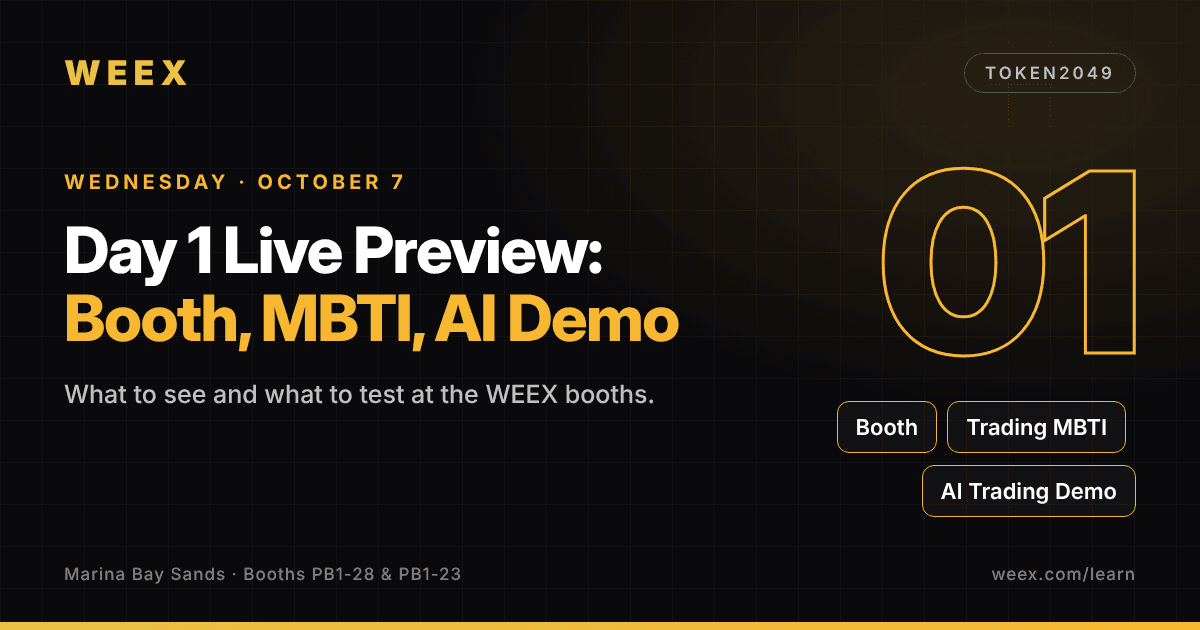
WEEX TOKEN2049 Day 1 Live Preview: Booth, MBTI and AI Demo
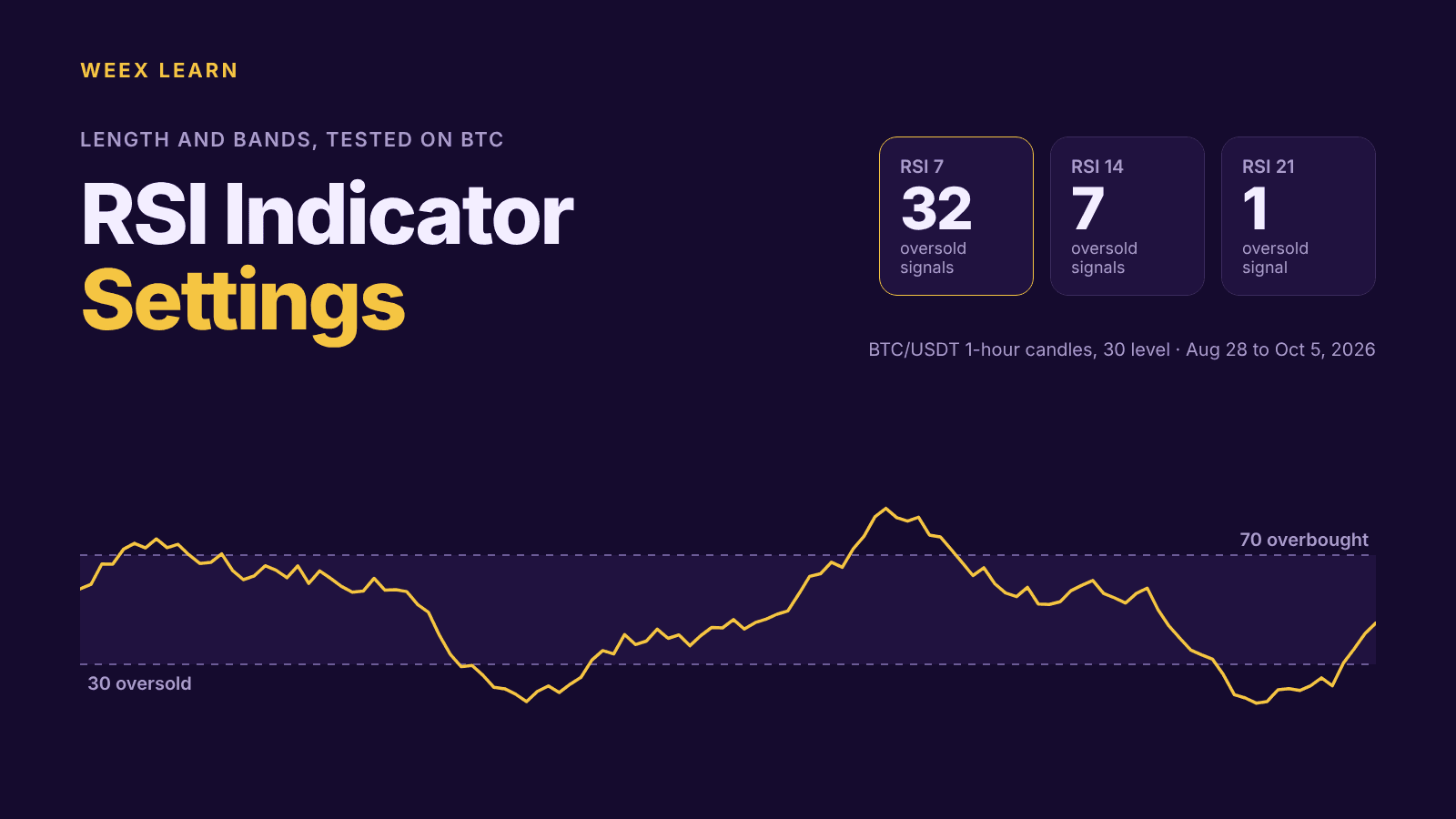
RSI Indicator Settings: What 7, 9, 14 and 21 Did on BTC Charts
Best Crypto Apps for Beginners: The Five Features That Actually Matter on Your Phone
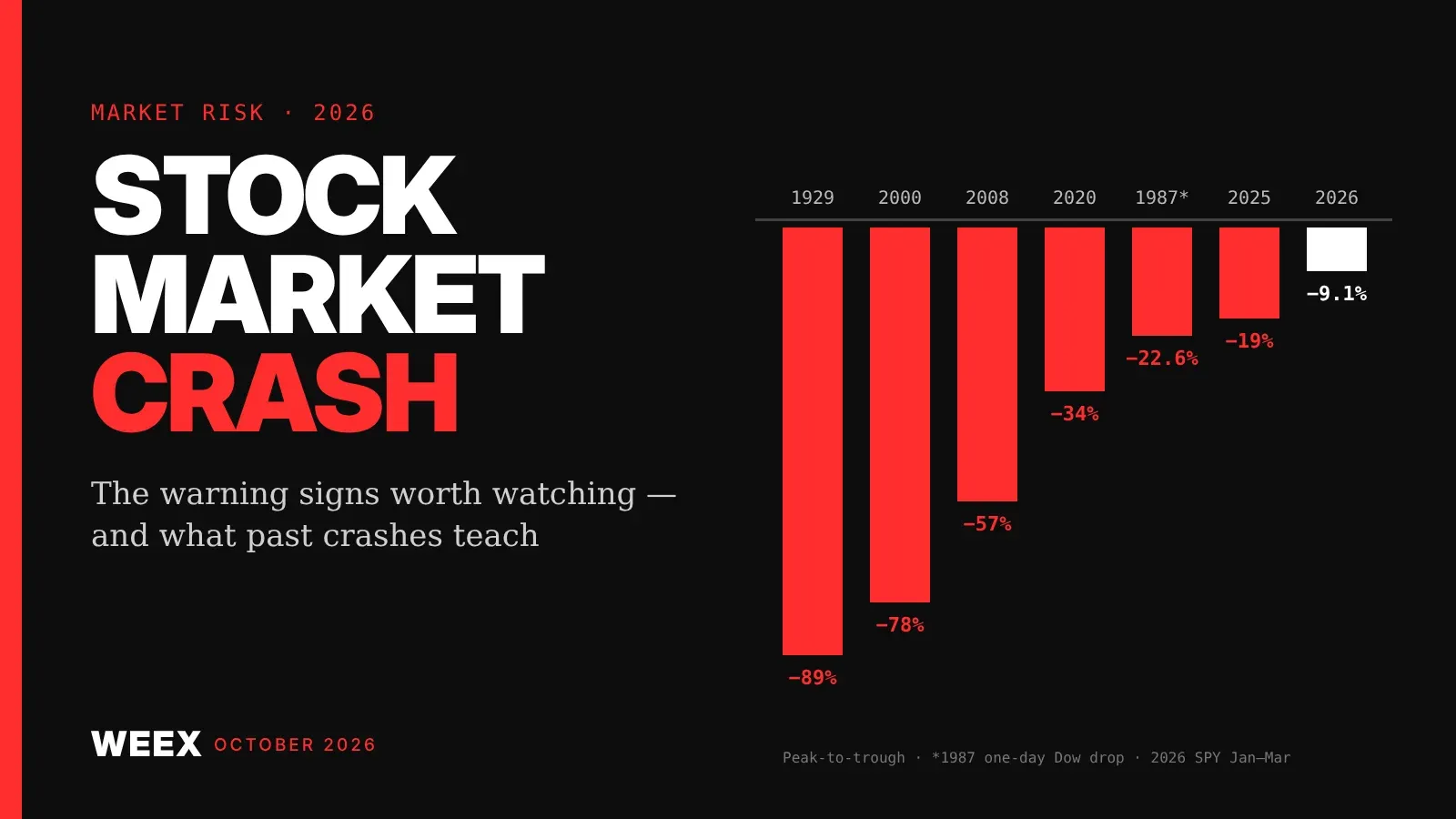
Stock Market Crash Risk in 2026: The Warning Signs Worth Watching
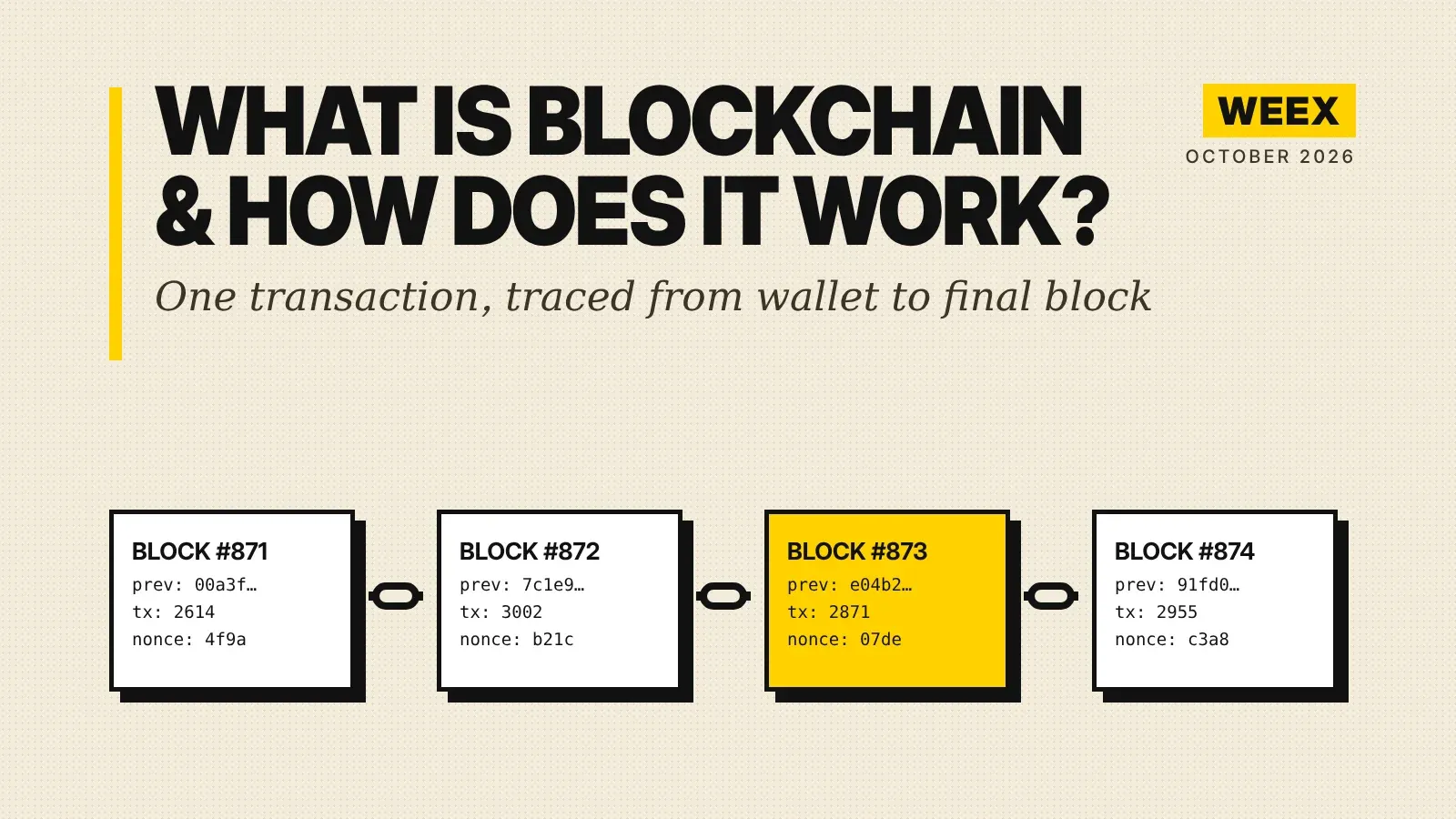
What Is Blockchain and How Does It Work? A Transaction Traced
How to Buy Crypto with PayPal: The Custody Catch Most Beginners Miss
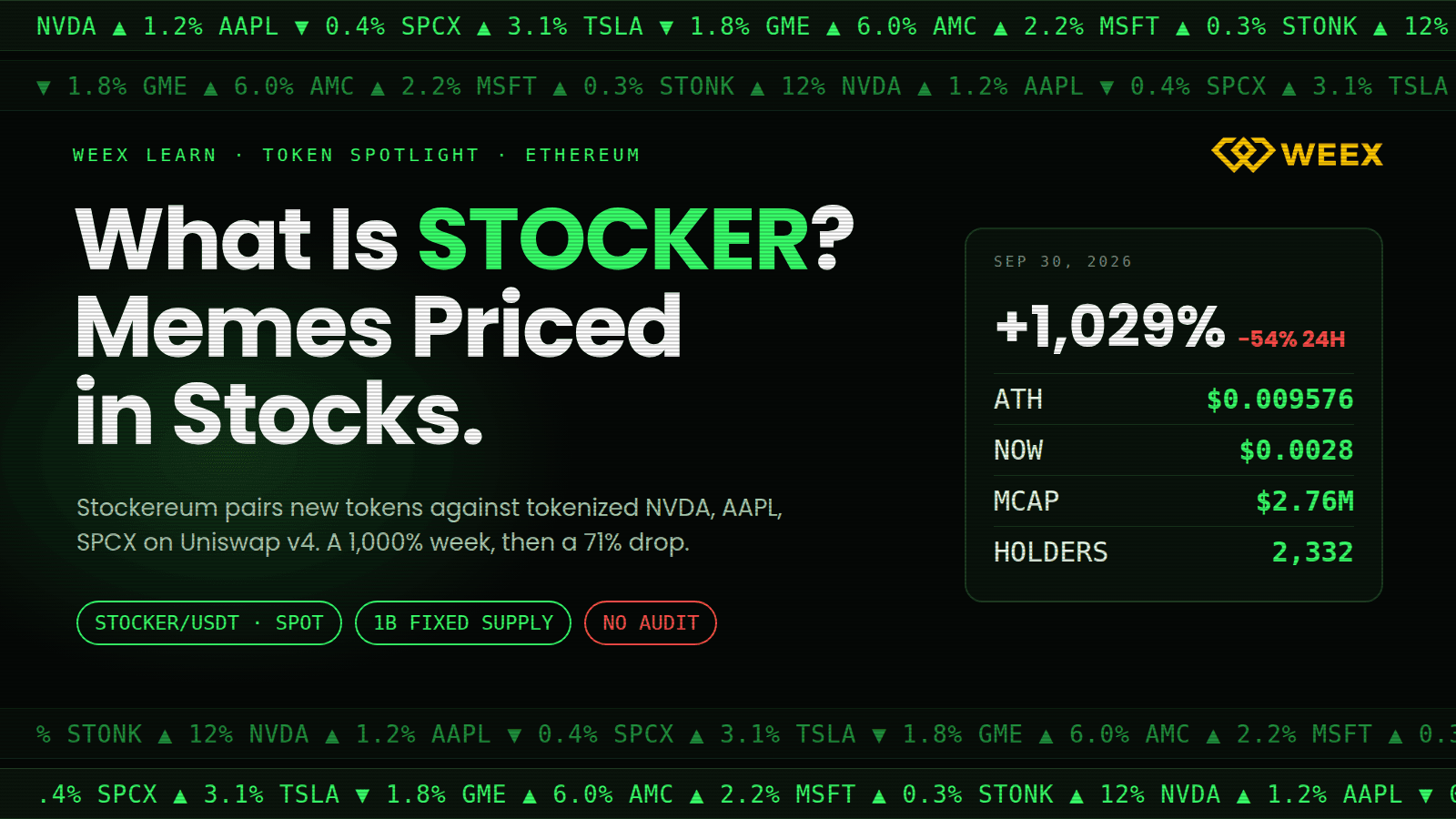
What Is STOCKER? Stockereum, Stock-Paired Meme Tokens, and Risks
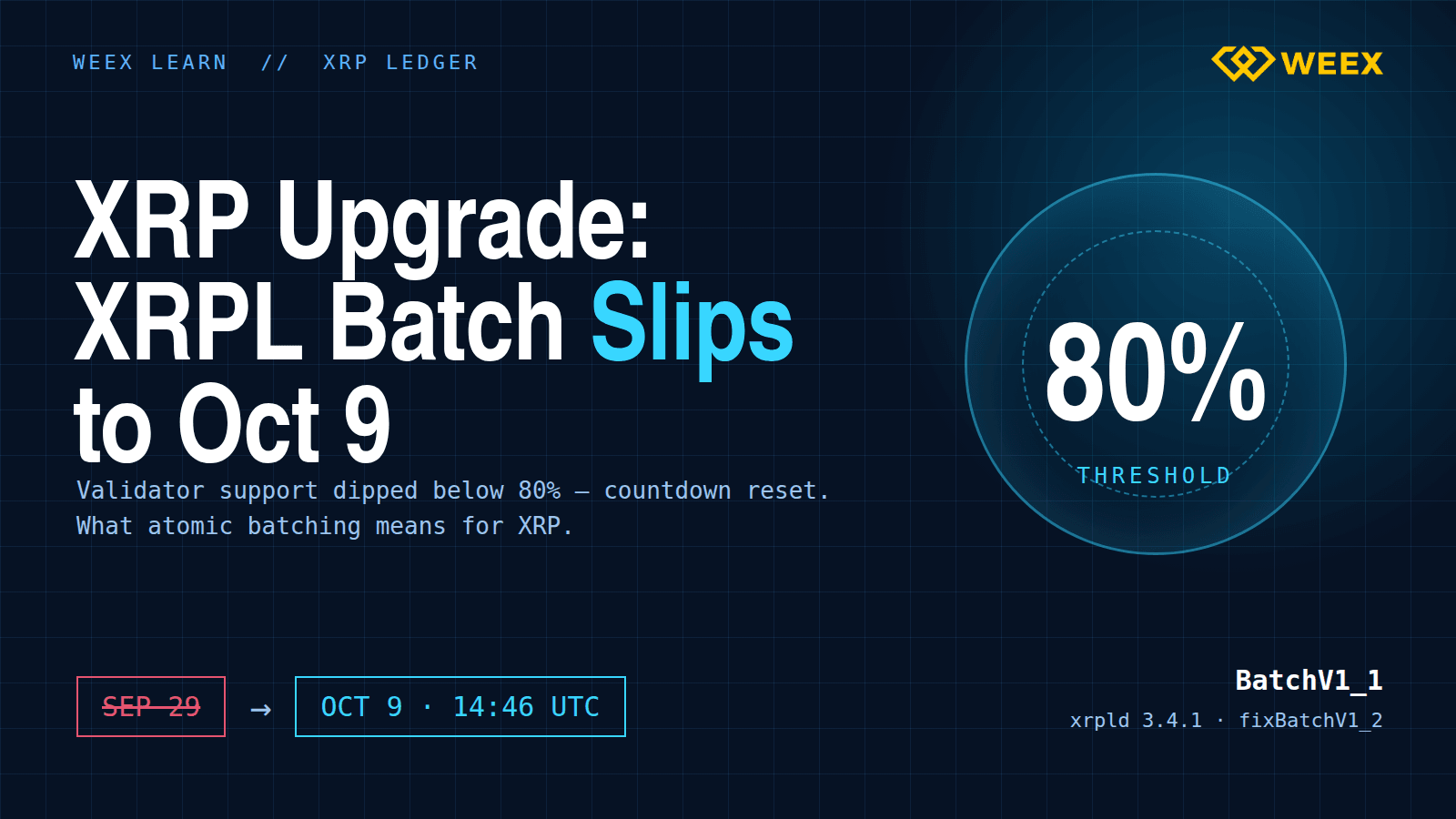
XRP Upgrade Update: XRPL Batch Slips to Oct 9 and What Changes
What Is Coinbase Wrapped HYPE (cbHYPE)? How It Works on Base, 1:1 Backing, Risks, and HYPE Conversion
Best Crypto Leverage Trading Platform: Things to Compare Before You Choose an Exchange
Is RSI a Good Indicator? How the Relative Strength Index Works, Its Limits and How Traders Use It
Bitcoin Price After Hot CPI: Why BTC Is Pinned Near $82,000
CoreWeave Stock Plunges 15%: Why a Bond Yield Spooked CRWV
WEEX 2026 New User Guide: Register, Complete KYC, and Claim the Welcome Bonus (Step-by-Step)
WEEX Convert Guide: How to Swap Crypto on Web and App and What the Quote Really Means


