
Aave Expands Stock-Backed USDC Loans on Base for Eligible Investors

 Prefer us on Google


TL;DR: The case study listed seven stocks accepted as collateral at the time and said the market supports continuous borrowing and repayment. Geographic eligibility, securities rights, market liquidity and oracle design matter.
A Base case study dated October 22 described Aave V4's Equities Hub, launched in September, allowing eligible non-U.S. investors to borrow USDC against selected Coinbase tokenized U.S. equities without first selling the shares.
The announcement and the numbers
The most concrete starting point is the dated disclosure from Aave. It offers a specific basis for assessing Aave's tokenized-equity lending on Base without turning the story into unsupported price speculation.
The case study listed seven stocks accepted as collateral at the time and said the market supports continuous borrowing and repayment. Collateral valuations rely on price feeds whose equity-market coverage differs across weekday and off-hours trading.
There is a practical market question underneath the announcement: how quickly can USDC borrowing against tokenized equities change real activity, rather than merely expand a list of proposed services? For investors, the distinction matters because product news and actual changes to liquidity or demand are not interchangeable.
Why the development matters
The question for market participants is what Aave's tokenized-equity lending on Base establishes today and what remains uncertain. An immediate reaction is not the same as evidence of a durable economic outcome.
The application demonstrates how programmable securities could gain uses beyond simple transfers. Combining equity exposure with on-chain lending, however, also connects traditional market schedules and corporate events to DeFi risk engines.
DeFi applications make financial rules executable through code, but code still depends on market inputs, transaction ordering and the availability of liquidity. A smart contract can follow its programmed conditions precisely even when those conditions produce an outcome a user did not expect.
From a market perspective, the first task is to separate the scale of the announcement from the scale of economic activity that has actually occurred. A company may report a large addressable market, an institutional name or a future capability, but those are not equivalent to settled transactions or recurring fee income. This is why the primary disclosure is a better starting point than a trading narrative attached to it.
Risks the headline does not resolve
None of this removes the need for independent assessment. The published evidence identifies a development, while its risk and long-term economics are still open to examination.
Borrowing against a tokenized stock lets an investor obtain liquidity while retaining market exposure to the share. That introduces leverage: if the value of collateral falls relative to the debt, a protocol may require repayment or liquidate some of the collateral.
Geographic eligibility, securities rights, market liquidity and oracle design matter. A continuously open loan market does not mean the underlying stock's cash market is open or that token redemptions are instantaneous under every condition.
For developers, execution quality involves more than a quoted price or an advertised feature. Gas costs, settlement success, oracle quality, permissions and incident handling all shape whether an integration is safe and convenient in real markets.
-- Price
The milestones to watch
The immediate checklist is relatively straightforward: look for verifiable implementation details and avoid interpreting a stated target as an outcome that has already occurred.
Watch whether additional equity collateral is approved and how the lending market handles holidays, sudden gaps in stock prices and unexpected liquidations. A useful product must keep those risks understandable to borrowers.
Investors also need to separate changes in infrastructure from changes in token demand. Revenue may accrue to a company, a protocol treasury or a service provider without necessarily creating a one-for-one benefit for holders of a related token. Market impact depends on adoption, competition and the design of whatever fees or incentives are involved.
A durable signal would be consistent follow-through: actual usage, transparent reporting and a credible explanation of risk. Short-term token-price moves can be driven by macroeconomic conditions or leverage and may say little about whether the product or initiative succeeds over months and years.
Primary source: Aave's primary announcement. This reporting reflects information available on October 31, 2026; targets, estimates and statements about future plans are attributed to their issuers.
This article was written by the News Desk and edited by Samuel Rae.
This content is provided for general informational purposes only and doesn't constitute financial, investment, legal, or tax advice. Any events, rewards, online promotions, or related information mentioned herein should not be considered a recommendation, solicitation, or invitation to purchase, sell, trade, or otherwise deal in any crypto assets. Crypto assets are highly volatile and may result in loss. The availability of WEEX services, products, and related events may vary by region. You are responsible for ensuring that your participation is in accordance with applicable local laws and regulations.
You may also like

Why Are More Projects Moving Back to the Ethereum Mainnet from L2?

[Interview] JPYC CEO: "The 1 Million Yen Remittance Regulation is Excessive... Easing Expected Next Spring"
Chainlink Launches CustodySync With Anchorage to Link Custody and DeFi Loans

Shopify’s Base USDC Checkout Puts Stablecoins Into Mainstream E-Commerce
Diversification of Revenue Sources for Hyperliquid, Increase in USDC Reserve Yield Reported

What to Do When You Receive a Tax Reminder for Foreign Income Involving Cryptocurrency?

Binance hacker may have left clues in MetaMask logs

Delphi Digital Reports Power Constraints on AI Computing Deployment

Only 10% of FOMO app’s Solana wallets were profitable after fees

Stellar Launches Project Thruput for Fee-less Parallel Transactions

Ethereum clients patch flaw that could redirect ETH rewards

Stellar launches cross-chain messaging with ethereum through VIA Labs

Ethereum Researchers Explore Transaction Assertions to Reduce Signing Risks

Hyperliquid trader’s $170M oil orders raise spoofing concerns

ENSv2 launches on Ethereum as NFT claims require name upgrades

Omani Phaze Ventures Launches Two Investment Funds Targeting Over $75 Million

BNB Chain contract deployments nearly triple to 12.3M in Q3
Morgan Stanley Research on China's Robot Market: Companies Still Want Humanoid Robots, but Large-Scale Deployment Will Have to Wait

Coinbase and Thunes Tie Stablecoins to Local Bank and Wallet Payouts

Morgan Stanley Raises Global Electricity Growth Forecast: Who Will Share the $500 Billion Increment in the Power Market Beyond AI?
Ritual Raises $30 Million to Launch Token: AI Game Changer or Retail Investor Trap?

Can Derive V3 Maintain Its Leadership in the Growing On-Chain Options Market?

After a 95% Drop in TVL, Sony's L2 Soneium is Finally Launching Its Token
Onchain Fees: Crypto Protocols Earn $4 Billion in the Third Quarter
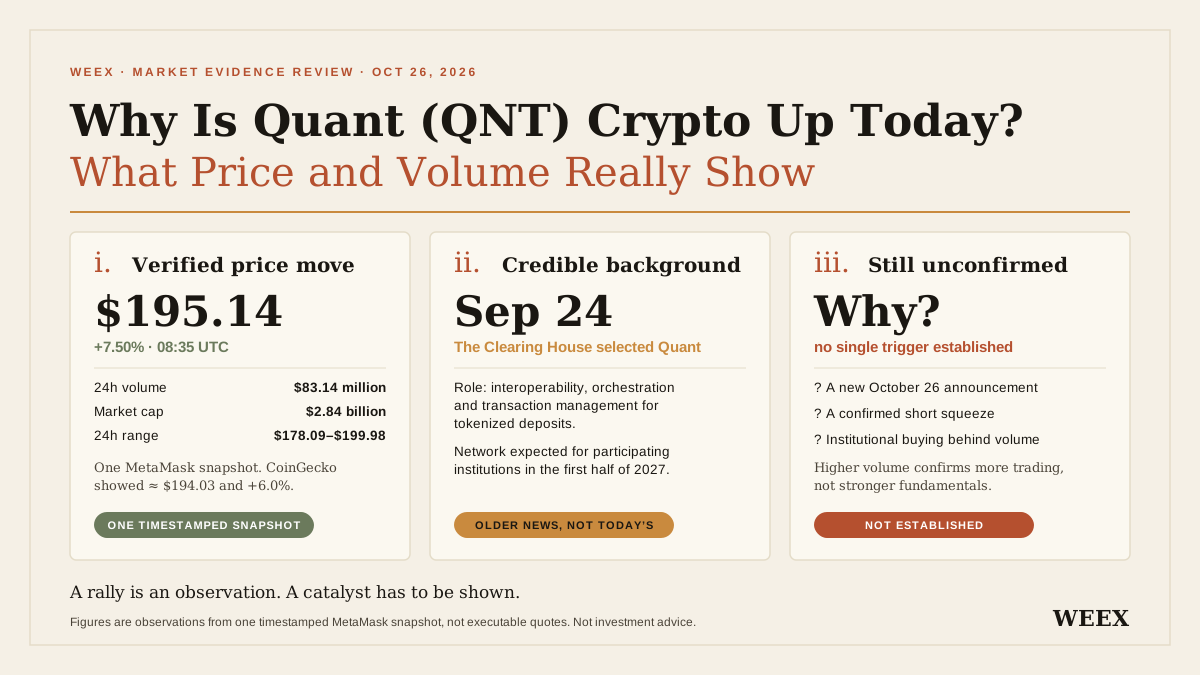
Why Is Quant (QNT) Crypto Up Today? What Price and Volume Really Show
Why is Quant (QNT) up today? Review price and volume evidence, the banking partnership timeline, token-demand assumptions, and risks before trading.

North Carolina Crypto Kiosk Refund Law: Who Qualifies and When Does It Apply?
Understand North Carolina’s crypto kiosk refund law: the January 2027 start date, who qualifies, reporting deadlines, and documents victims should keep.

AI Reduces Vulnerability Discovery Costs, Crypto Industry Divided in Response

Ethereum: Glamsterdam postponed after risks detected on 13 contracts

Who is Making Money from Digital Dollars? Profit Sharing Among Stablecoin Issuers, Distributors, and Payment Providers
[ETH Letter] Meritz Securities Reviews Tokenization of Korean Securities Based on OP Stack
Why Are More Projects Moving Back to the Ethereum Mainnet from L2?
[Interview] JPYC CEO: "The 1 Million Yen Remittance Regulation is Excessive... Easing Expected Next Spring"
Chainlink Launches CustodySync With Anchorage to Link Custody and DeFi Loans
Shopify’s Base USDC Checkout Puts Stablecoins Into Mainstream E-Commerce
Diversification of Revenue Sources for Hyperliquid, Increase in USDC Reserve Yield Reported
What to Do When You Receive a Tax Reminder for Foreign Income Involving Cryptocurrency?
Contents
Latest articles


Latest coin listings on WEEX


