
Crypto: The ECB Enters the Tokenized Bond Market

 Prefer us on Google


The European Central Bank is preparing its first direct investments in tokenized securities. A small portion of its own funds will be allocated to bonds and other securities denominated in euros, primarily issued by eurozone states, public agencies, and European institutions. The amounts and the date of the first purchases have not yet been determined. Settlements will go through Pontes, the new infrastructure launched by the Eurosystem on September 21. For institutional crypto finance, the ECB is no longer just observing tokenization: it now wants to use it itself.
In Brief
- The ECB wants to allocate a small portion of its own funds to tokenized securities.
- The first targeted assets will primarily be public and supranational bonds in euros.
- Transactions will be settled in central bank money via Pontes.
Crypto: The ECB Becomes an Investor in Tokenization
The decision concerns the ECB's own funds portfolio. This does not fall under monetary policy: it is used to generate income to cover part of the institution's operating expenses.
This time, a small portion will be directed towards assets recorded on DLT infrastructures. The ECB had already laid the groundwork. The first investments will not be in Bitcoin, ether, or other cryptocurrencies.
The ECB aims for euro-denominated securities issued by eurozone governments, regional authorities, public agencies, and European supranational institutions. The change thus concerns the technology used to issue and trade these assets, not their economic nature.
The institution also wants to gain practical experience: order execution, settlement, system management, and portfolio monitoring.
The amount remains unknown. The board will decide after preparatory work, particularly based on the number of tokenized securities actually available on the European market.
Pontes Settles Tokenized Assets in Central Bank Money
Pontes went live on September 21. Its role is quite precise: to allow eligible banks and financial infrastructures to settle transactions on tokenized assets with central bank money. The platform connects DLT environments to the Eurosystem's TARGET services.
A security can thus circulate on a blockchain infrastructure while its monetary settlement goes through the central bank's rails.
This is a question the ECB has been following for a long time. It had already explained that tokenization could make finance more efficient while creating new risks, especially if markets become fragmented across incompatible networks.
Pontes is precisely designed to prevent a tokenized European market from relying solely on stablecoins or tokenized bank deposits for the payment part.
The difference with the digital euro intended for the general public is clear. Pontes concerns wholesale financial transactions between eligible actors. The retail digital euro follows a different timeline, with a pilot expected from the second half of 2027.
For the crypto sector, the ECB's choice is particularly interesting in its form. The institution is taking back some building blocks used for years in blockchain markets while keeping central money at the heart of settlement.
-- Price
European Tokenization Gradually Leaves the Laboratory
The ECB had already tested DLT. Now, it wants to hold the assets itself. This evolution comes as Europe seeks to develop a sufficiently large market for tokenized securities to attract banks, funds, and traditional issuers. Pontes constitutes the first step. The Appia project aims to go further by designing a more comprehensive European architecture for tokenized finance.
The movement has been visible for several months. At the end of August, Isabel Schnabel was already calling on central banks to take a stronger position on blockchain and tokenized markets. However, the market remains small compared to traditional finance. This also explains Frankfurt's caution: small allocation, public or supranational securities, settlements in central bank money, and no amount announced for now. The ECB is therefore not making a shift towards cryptocurrencies. It is rather testing the use of technologies from the crypto ecosystem for a very traditional part of finance: buying a bond, settling it, and then holding it in a portfolio. This time, it will do so with its own money.
This content is provided for general informational purposes only and doesn't constitute financial, investment, legal, or tax advice. Any events, rewards, online promotions, or related information mentioned herein should not be considered a recommendation, solicitation, or invitation to purchase, sell, trade, or otherwise deal in any crypto assets. Crypto assets are highly volatile and may result in loss. The availability of WEEX services, products, and related events may vary by region. You are responsible for ensuring that your participation is in accordance with applicable local laws and regulations.
You may also like

Bitcoin 2x Leveraged ETF Launches on Cboe, But Doesn't Buy Bitcoin: Here's Why
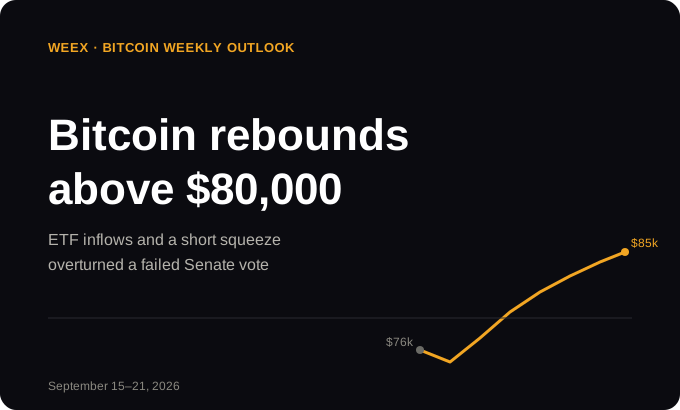
WEEX Bitcoin Weekly Outlook: Why Did Bitcoin Rebound Above $80,000 After the CLARITY Act Vote?
Bitcoin rebounded above $80,000 as SEC and CFTC action, renewed ETF inflows, and a short squeeze outweighed the failed CLARITY Act vote.
Coldcard whitehats move 52.37 BTC to recovery trust

Bitcoin's Rise Does Not Mean the Bull Market Has Returned; Don't Create Stories for Yourself

Deutsche Bank: Markets May Underestimate Rate Peaks After Central Banks' Coordinated Rate Hikes
Hyperliquid Opens Market for Bitcoin Volatility

Tom Lee Discusses Entry into Digital Asset Bull Market and AI Fund Movements

Micron Stock Price Target: Do the $1,500 to $2,000 Estimates Still Make Sense
Micron price targets range from $1,295 consensus to $1,500- lus individual calls, while options pricing implies an 11% swing on September 30 earnings, the actual results will settle which
![[ETH Letter] Ethereum Aims to Activate Sepolia Testnet on October 6](/public-static/26_2e1840f602.png?format=avif)
[ETH Letter] Ethereum Aims to Activate Sepolia Testnet on October 6

Fypher Partners with Korea Medical Tourism Promotion Association for Digital Dollar Payment
TapeOut Ecosystem Overview: From NAND, LATCH to On-Chain Application Ecosystem
[Coin Crime] "If you give us Tether, we will give you oil" - Polish state-owned company falls victim to international fraudsters

Why real-time election odds are misleading prediction market crypto traders

What is PCE and Why September 30 is Important for Cryptocurrencies

Bitcoin: JPMorgan Sees BTC Outperforming Gold

U.S. Treasury Sanctions BitBank Over Iranian Sanctions-Evasion Network

Brazil blocks stablecoins from key cross-border payment rail as $1.1 trillion market faces new limits
RISEx Proposes 20% Retention Condition for Stolen Funds

USDT in Wallets May Be Blocked. What to Do and How to Store Them in Russia

Tokenized stocks face 24/7 pricing gap: RedStone COO

Has the Macroeconomic Pricing of BTC Changed? A Nine-Year Review of the Federal Reserve, the Dollar, the Nasdaq, ETFs, and Stablecoins

What Does the Fed's Hawkish Rate Hike Mean for the Dollar?
Galaxy launches 2 stablecoin vaults on Kamino
Nadex Under Crypto.com to Start Offering Individual Stock Futures Following SEC Approval

Crypto in the United States: Brad Garlinghouse (Ripple) remains optimistic

BitGo adds ex-Exodus executive as compliance chief

What Are the Conditions for Success of Data Centers? A Map of AI Data Centers in Korea – Bitplanet
Edel Expands Institutional Push as Wall Street Tokenization Matures

Franklin Templeton, Janus Henderson: Wall Street Integrates into Crypto as Validator

CMS Holdings: Don't Let 'Narrative Congestion' Eat Into Your Profits, Tokenized Stocks Will Surpass Stablecoins
Bitcoin 2x Leveraged ETF Launches on Cboe, But Doesn't Buy Bitcoin: Here's Why
WEEX Bitcoin Weekly Outlook: Why Did Bitcoin Rebound Above $80,000 After the CLARITY Act Vote?
Bitcoin rebounded above $80,000 as SEC and CFTC action, renewed ETF inflows, and a short squeeze outweighed the failed CLARITY Act vote.
Coldcard whitehats move 52.37 BTC to recovery trust
Bitcoin's Rise Does Not Mean the Bull Market Has Returned; Don't Create Stories for Yourself
Deutsche Bank: Markets May Underestimate Rate Peaks After Central Banks' Coordinated Rate Hikes
Hyperliquid Opens Market for Bitcoin Volatility




