
WEEX Bitcoin Weekly Outlook: Why Did Bitcoin Rebound Above $80,000 After the CLARITY Act Vote?

 Prefer us on Google



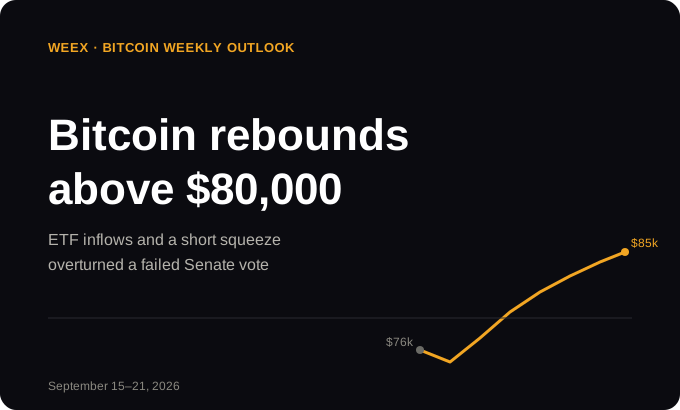
Bitcoin rebounded above $80,000 because traders stopped treating the failed CLARITY Act vote as the end of U.S. crypto regulation. The SEC announced a five-year exemption for certain tokenized-stock trading, the CFTC continued moving crypto rules through the regulatory process, spot Bitcoin ETF flows turned positive, and rising prices forced bearish derivatives positions to close. Together, those factors outweighed the immediate political disappointment and pushed Bitcoin from below $76,000 after the vote to more than $80,000 on September 18, 2026.
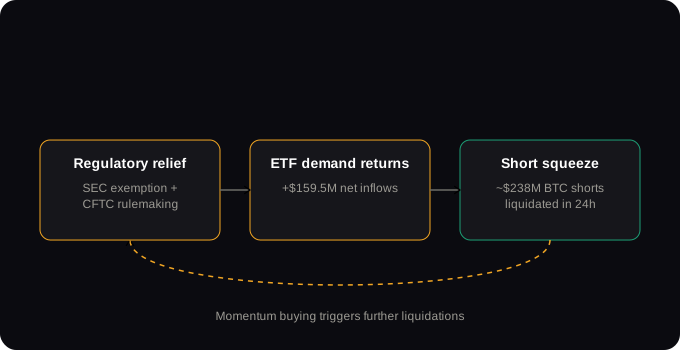
Our view is that calling this simply a “regulatory rally” misses the real mechanism. Washington supplied the narrative, but positioning supplied the acceleration. The SEC and CFTC gave traders a reason to reconsider the worst-case scenario; ETF demand and short liquidations then converted that change in expectations into actual buying pressure. The rebound was credible, but the speed of it was partly mechanical—and mechanical rallies can reverse quickly when leverage rebuilds.
The Big Picture
- The Senate rejected cloture on the CLARITY Act on September 15, 2026, by 49 votes to 50.
- Bitcoin initially fell below $76,000 as traders priced in another delay to comprehensive U.S. crypto legislation.
- The SEC announced a five-year tokenized-stock trading exemption on September 17.
- Reported CFTC rulemaking activity suggested regulators would continue acting without waiting for Congress.
- U.S. spot Bitcoin ETFs recorded approximately $159.5 million in net inflows on September 17 after two days of outflows.
- Bitcoin traded above $80,500 on September 18, while approximately $238 million in bearish BTC derivatives positions were liquidated over 24 hours.
- By September 21, Bitcoin had extended the recovery above $85,000, showing that the initial move was not limited to a brief intraday spike.
What Happened in the CLARITY Act Vote?
The Senate vote on September 15 was not a final vote on whether the CLARITY Act should become law. It was a procedural cloture vote on whether the Senate should move forward with considering H.R. 3633.
Cloture required support from three-fifths of the Senate. The official roll call recorded 49 votes in favor and 50 against, so the motion failed.
That distinction matters. The vote blocked the bill’s immediate progress, but it did not repeal existing crypto rules, prohibit agencies from issuing regulations, or make the bill permanently impossible to reconsider.
The market nevertheless reacted negatively because the CLARITY Act was expected to provide a more durable division of authority between the SEC and CFTC. Without legislation, crypto businesses remain more dependent on agency interpretations, exemptions and rules that a future administration could revise.
Bitcoin subsequently fell below $76,000, while publicly traded crypto companies also declined. The initial response was rational: Congress had removed one potential source of long-term regulatory certainty.
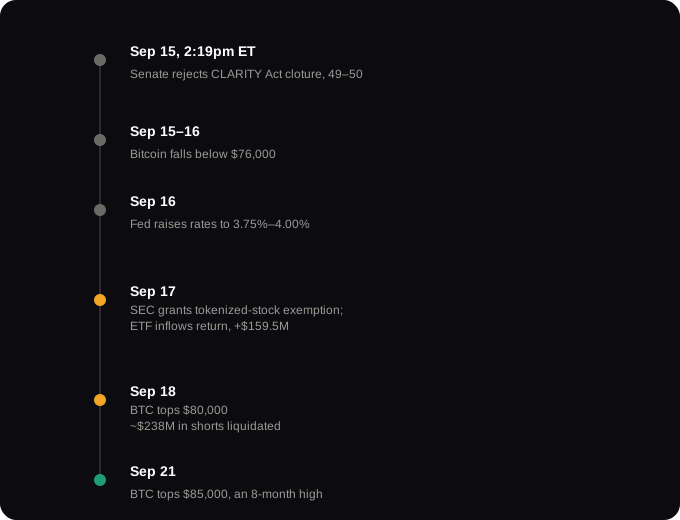
Event Timeline: From the Senate Loss to the $80,000 Rebound
| Date | Event | Immediate Market Significance |
|---|---|---|
| September 15, 2:19 p.m. ET | The Senate rejected cloture on the motion to proceed to H.R. 3633 by 49–50 | Reduced the probability of comprehensive crypto legislation advancing before the midterm elections |
| September 15–16 | Bitcoin traded below $76,000 following the vote | Reflected political disappointment and reduced risk appetite |
| September 16 | The Federal Reserve raised its target range by 25 basis points to 3.75%–4.00% | Added another potential headwind for Bitcoin and other risk assets |
| September 17 | The SEC introduced a temporary exemption for certain tokenized-stock trading venues | Demonstrated that agency-level crypto policy could continue without the CLARITY Act |
| September 17 | U.S. spot Bitcoin ETFs recorded about $159.5 million in net inflows | Reversed two consecutive days of outflows and restored measurable spot demand |
| September 18 | Bitcoin moved above $80,000 and traded around $80,587 during U.S. morning trading | Confirmed that the market had recovered its immediate post-vote losses |
| September 18 | Roughly $238 million of BTC short positions were liquidated over 24 hours | Forced bearish traders to buy back exposure, accelerating the move |
| September 21 | Bitcoin traded above $85,000 and reached its highest level in approximately eight months | Showed that regulatory relief had developed into a broader risk and momentum rally |
-- Price
Why Did Bitcoin Recover So Quickly?
The rebound was produced by several connected catalysts rather than a single announcement.
1. The Market Realized the CLARITY Act Was Not the Only Regulatory Path
The failed vote weakened the legislative route to crypto regulation, but it did not stop the executive agencies from acting under their existing authority.
That became clearer on September 17, when the SEC announced an “Innovation Exemption” for certain trading systems handling tokenized National Market System stocks. The exemption took effect on September 17, 2026, and is scheduled to run until September 17, 2031, although the SEC may modify it.
The measure was not a Bitcoin regulation and did not replace the CLARITY Act. Its importance was symbolic and strategic: it showed that the SEC was prepared to create a functioning pathway for blockchain-based financial markets even after Congress failed to advance comprehensive legislation.
At the same time, reports indicated that the CFTC had submitted a crypto-market rulemaking proposal for White House review. The full proposal had not been released publicly when Bitcoin first crossed $80,000, so traders did not yet know its detailed provisions.
The market was therefore responding to direction rather than complete policy certainty. The direction suggested that federal agencies would continue building crypto rules instead of waiting indefinitely for Congress.
2. The SEC Announcement Changed the Meaning of the Senate Defeat
Before the SEC action, the failed vote could be interpreted as a broad rejection of U.S. crypto policy. After the exemption was announced, the same event looked more like a delay to legislation than a complete policy reversal.
This is an important difference:
| After the Senate vote | After subsequent agency action |
|---|---|
| Comprehensive legislation was stalled | Agency-level rulemaking remained active |
| Long-term regulatory durability weakened | Near-term operational pathways were still possible |
| Traders feared policy paralysis | Regulators demonstrated that they could use existing authority |
| Political risk dominated sentiment | Attention shifted toward implementation and market access |
The SEC exemption did not solve the crypto industry’s largest legal questions. It did, however, challenge the bearish assumption that nothing useful could happen without the CLARITY Act.
3. Spot Bitcoin ETF Demand Returned
Regulatory headlines can change sentiment, but a sustainable market move usually requires buyers.
According to data cited by The Wall Street Journal, U.S. spot Bitcoin ETFs registered approximately $160 million in inflows on Thursday, September 17. Separate market data placed the total at about $159.5 million. Those inflows ended a two-day run of net redemptions.
ETF inflows matter because spot Bitcoin funds generally need to obtain Bitcoin exposure corresponding to new investor demand. The effect is not always an immediate one-for-one market purchase, since funds and authorized participants may use inventory, cash creation and other execution arrangements. Even so, positive flows represent a more concrete source of demand than social-media enthusiasm alone.
The timing was particularly important. ETF demand returned just as traders were reassessing the regulatory outlook, helping turn improved sentiment into spot-market support.
4. Short Liquidations Accelerated the Breakout
Once Bitcoin began rising, bearish derivatives positions became vulnerable.
CoinGlass data cited by CoinDesk showed that approximately $470 million in crypto short positions were liquidated over the 24 hours ending during the September 18 rally. Bitcoin accounted for approximately $238 million of those liquidations as its price approached $81,000.
When a leveraged short position is liquidated, the exchange closes the position. That process creates buy orders, which can push the price higher and trigger additional liquidations at higher levels.
The sequence can be summarized as follows:
- Regulatory news improves expectations.
- Spot buyers and ETF-related demand support the price.
- Bitcoin breaks above levels where short sellers positioned for further declines.
- Forced closures create additional buying.
- Faster price gains attract momentum traders.
- More shorts reach their liquidation thresholds.
This does not mean the rebound was “fake.” It means that the initial catalyst and the later acceleration came from different sources.
5. The Bad News Had Already Been Partly Priced In
Markets do not react only to whether an event is good or bad. They react to whether the result is better or worse than existing expectations.
Bitcoin had already declined as the CLARITY Act vote approached and fell further after the motion failed. By the time the SEC announced its exemption, many traders who expected a negative regulatory outcome had already reduced exposure or opened short positions.
That created an asymmetric setup. More bad news might have pushed Bitcoin lower, but evidence of continued regulatory progress forced bearish traders to reconsider positions that had become crowded.
The Federal Reserve’s September 16 rate increase created a similar effect. The central bank raised its target range by 25 basis points to 3.75%–4.00%, normally an unfavorable development for speculative assets. Yet Bitcoin recovered shortly afterward.
The rebound did not mean higher rates were suddenly bullish for Bitcoin. It meant the market absorbed two known setbacks—the Senate vote and the Fed hike—without producing a sustained breakdown.
Was the CLARITY Act Failure Actually Bullish for Bitcoin?
No. The failed vote was not bullish in itself.
The legislation could have provided a statutory framework that would be more difficult to reverse than temporary exemptions or agency interpretations. Its failure preserved political and legal uncertainty, particularly for token issuers, exchanges and other market intermediaries.
Bitcoin’s rebound showed that traders believed the consequences were manageable, not that the vote was beneficial.
That distinction prevents a common mistake in market commentary: reversing the meaning of an event simply because the price later moved in the opposite direction. A negative catalyst can be followed by a rally when:
- the outcome was already priced in;
- the damage was smaller than feared;
- another catalyst changes expectations;
- bearish positioning becomes excessive;
- or fresh demand enters the market.
Several of those conditions were present after the CLARITY Act vote.
What the Rebound Revealed About Bitcoin’s Market Structure
The move above $80,000 exposed three characteristics of the current Bitcoin market.
Regulation Still Influences Short-Term Valuation
Bitcoin is decentralized, but its market price depends heavily on regulated financial access. ETF demand, custody rules, tokenization policy and derivatives regulation all affect who can obtain exposure and how much capital can enter the market.
The price response to the SEC exemption was therefore not irrational, even though the exemption concerned tokenized stocks rather than Bitcoin directly. Investors interpreted it as evidence of broader institutional acceptance of blockchain-based markets.
Institutional and Leveraged Flows Can Reinforce Each Other
ETF inflows provided spot-market demand, while derivatives liquidations amplified the resulting price movement. Neither component fully explains the rebound alone.
This interaction is increasingly important. Bitcoin no longer trades only as a crypto-native asset. It sits at the intersection of ETFs, institutional portfolios, offshore derivatives markets and macroeconomic positioning.
Congress Is Not the Only Source of Crypto Policy—but It Is the Most Durable
The SEC and CFTC can make meaningful policy changes. What they cannot provide is the same durability as a federal statute.
Agency action may be challenged in court, changed through later rulemaking or reversed after a change in political leadership. Congress remains necessary if the United States wants a regulatory framework that survives electoral cycles.
The market welcomed the agencies’ response because it reduced near-term paralysis. It did not eliminate long-term legislative risk.
What Should Traders Watch After the $80,000 Breakout?
ETF Flows
One positive day can support a rebound, but a sustained trend requires repeated demand. Continued inflows would provide stronger evidence that institutional buyers are accumulating rather than making a one-day allocation.
Open Interest
If open interest rises rapidly after a short squeeze, leverage may be rebuilding. Traders should determine whether new positions are predominantly long and whether the market is becoming vulnerable to the opposite type of liquidation cascade.
Funding Rates
Strongly positive funding indicates that perpetual-futures traders are paying to maintain long exposure. Moderate funding can accompany a healthy trend; extreme funding can signal crowded positioning.
Treasury Yields and Federal Reserve Expectations
Bitcoin overcame the immediate impact of the September rate increase, but that does not make it immune to tighter financial conditions. Rising Treasury yields, a stronger dollar or expectations of further Fed hikes could reduce demand for risk assets.
SEC and CFTC Documents
Headlines about regulatory proposals are less useful than their actual scope. Traders should watch for published rules, eligibility requirements, implementation dates and legal challenges rather than assuming every pro-innovation statement creates immediate commercial access.
Trade Bitcoin on WEEX and Join the 1 BTC Reward Event
Traders who want to act on Bitcoin’s post-vote volatility can currently join WEEX’s Trade to Share 1 BTC event, which runs from September 15 at 18:00 to September 25, 2026 at 18:00 (UTC+8). The campaign distributes a total pool of 1 BTC on a first-come, first-served basis and includes separate rewards for new and existing users.
New users who register during the campaign can receive 5 USDT worth of BTC after making a net on-chain or P2P deposit of at least 100 USDT. They can receive another 4 USDT worth of BTC by completing their first spot trade of at least 30 USDT in BTC, ETH, or SUI. To claim the complete new-user reward package, both the deposit and first-trade tasks must be completed.
The daily trading task is available to all eligible users. Traders who reach at least 100 USDT in daily spot trading volume can receive 3 USDT worth of BTC for each qualifying day. Trading volume is calculated from the combined value of buy and sell orders, while API-generated volume, self-trading, wash trading, and institutional or market-maker accounts are excluded.
Because the campaign counts spot volume rather than futures volume, users seeking to complete the activity can trade through the WEEX BTC/USDT spot market. Those who want to trade Bitcoin’s subsequent price movements with perpetual contracts can instead access the WEEX BTC/USDT futures market, but futures volume does not count toward the event tasks.
Rewards are scheduled for distribution within 10 working days after the campaign ends. The amount of BTC credited will be calculated using Bitcoin’s price at the time of distribution rather than its price when the task was completed. Since the 1 BTC pool may be exhausted before the official closing time, eligible users should review the current availability and full rules on the event page before participating.
WEEX Editorial View: The Rally Rejected Paralysis, Not Political Risk
The most convincing interpretation of Bitcoin’s rebound is not that traders suddenly stopped caring about the CLARITY Act. It is that they rejected the idea that one failed procedural vote could freeze the entire U.S. crypto market.
The SEC exemption and continued CFTC activity proved that regulators still had tools available. ETF inflows supplied measurable demand, while short liquidations punished traders who treated the Senate defeat as an automatic signal for another leg lower.
Still, the industry should not confuse temporary agency flexibility with durable law. A five-year exemption can open a market, but it can also be modified. An unpublished rulemaking proposal can improve sentiment, but it cannot resolve uncertainty until traders know what it contains.
Bitcoin’s move above $80,000 was therefore justified as a repricing of excessive pessimism. Treating it as proof that regulatory risk no longer matters would be a much less intelligent conclusion.
Frequently Asked Questions
1. When Did Bitcoin Rebound Above $80,000?
Bitcoin moved above $80,000 on September 18, 2026. The Wall Street Journal reported a price near $80,587 during U.S. morning trading, more than 5% above its previous-afternoon level.
2. Did the CLARITY Act Pass the Senate?
No. On September 15, the Senate rejected cloture on the motion to proceed to H.R. 3633. The official vote was 49 in favor and 50 against, below the required three-fifths threshold.
3. Did the SEC Exemption Directly Regulate Bitcoin?
No. The September 17 exemption concerned certain trading venues handling tokenized National Market System stocks. Its effect on Bitcoin was indirect: it demonstrated that the SEC was continuing blockchain-related policy development despite the stalled legislation.
4. Did Short Liquidations Cause the Entire Bitcoin Rally?
No. Liquidations accelerated the move but did not create the initial change in sentiment. Agency action, renewed ETF inflows and a market that had already priced in substantial bad news helped Bitcoin begin recovering before forced short closures added momentum.
Sources
- U.S. Senate, “Roll Call Vote 234,” September 15, 2026, 2:19 p.m. ET. Official cloture vote and result.
- U.S. Securities and Exchange Commission, “SEC Issues ‘Innovation Exemption’ to Facilitate the Trading of Tokenized NMS Stock,” September 17, 2026.
- Federal Reserve, “Federal Reserve Issues FOMC Statement,” September 16, 2026.
- The Wall Street Journal, “Bitcoin Climbs Above $80,000,” September 18, 2026. Bitcoin price and September 17 ETF-flow data.
- CoinDesk, “Bitcoin Climbs Over $80,000 as Crypto Shakes Off CLARITY Failure and Higher Interest Rates,” September 18, 2026. Liquidation and market-movement data.
- Reuters, “US Senate Fails to Advance Sweeping Cryptocurrency Bill,” September 15, 2026. Legislative and initial market context.
Data cutoff: September 22, 2026, UTC. Some market-data providers did not provide an exact observation timestamp for every underlying figure.
This content is provided for general informational purposes only and doesn't constitute financial, investment, legal, or tax advice. Any events, rewards, online promotions, or related information mentioned herein should not be considered a recommendation, solicitation, or invitation to purchase, sell, trade, or otherwise deal in any crypto assets. Crypto assets are highly volatile and may result in loss. The availability of WEEX services, products, and related events may vary by region. You are responsible for ensuring that your participation is in accordance with applicable local laws and regulations.
You may also like

Bitcoin 2x Leveraged ETF Launches on Cboe, But Doesn't Buy Bitcoin: Here's Why

Crypto: The ECB Enters the Tokenized Bond Market
Coldcard whitehats move 52.37 BTC to recovery trust

Bitcoin's Rise Does Not Mean the Bull Market Has Returned; Don't Create Stories for Yourself

Deutsche Bank: Markets May Underestimate Rate Peaks After Central Banks' Coordinated Rate Hikes
Hyperliquid Opens Market for Bitcoin Volatility

Tom Lee Discusses Entry into Digital Asset Bull Market and AI Fund Movements

Micron Stock Price Target: Do the $1,500 to $2,000 Estimates Still Make Sense
Micron price targets range from $1,295 consensus to $1,500- lus individual calls, while options pricing implies an 11% swing on September 30 earnings, the actual results will settle which
![[ETH Letter] Ethereum Aims to Activate Sepolia Testnet on October 6](/public-static/26_2e1840f602.png?format=avif)
[ETH Letter] Ethereum Aims to Activate Sepolia Testnet on October 6

Fypher Partners with Korea Medical Tourism Promotion Association for Digital Dollar Payment
TapeOut Ecosystem Overview: From NAND, LATCH to On-Chain Application Ecosystem
[Coin Crime] "If you give us Tether, we will give you oil" - Polish state-owned company falls victim to international fraudsters

Why real-time election odds are misleading prediction market crypto traders

What is PCE and Why September 30 is Important for Cryptocurrencies

Bitcoin: JPMorgan Sees BTC Outperforming Gold

U.S. Treasury Sanctions BitBank Over Iranian Sanctions-Evasion Network

Brazil blocks stablecoins from key cross-border payment rail as $1.1 trillion market faces new limits
RISEx Proposes 20% Retention Condition for Stolen Funds

USDT in Wallets May Be Blocked. What to Do and How to Store Them in Russia

Tokenized stocks face 24/7 pricing gap: RedStone COO
Has the Macroeconomic Pricing of BTC Changed? A Nine-Year Review of the Federal Reserve, the Dollar, the Nasdaq, ETFs, and Stablecoins

What Does the Fed's Hawkish Rate Hike Mean for the Dollar?

Galaxy launches 2 stablecoin vaults on Kamino
Nadex Under Crypto.com to Start Offering Individual Stock Futures Following SEC Approval

Crypto in the United States: Brad Garlinghouse (Ripple) remains optimistic

BitGo adds ex-Exodus executive as compliance chief

What Are the Conditions for Success of Data Centers? A Map of AI Data Centers in Korea – Bitplanet
Edel Expands Institutional Push as Wall Street Tokenization Matures

Franklin Templeton, Janus Henderson: Wall Street Integrates into Crypto as Validator

CMS Holdings: Don't Let 'Narrative Congestion' Eat Into Your Profits, Tokenized Stocks Will Surpass Stablecoins
Bitcoin 2x Leveraged ETF Launches on Cboe, But Doesn't Buy Bitcoin: Here's Why
Crypto: The ECB Enters the Tokenized Bond Market
Coldcard whitehats move 52.37 BTC to recovery trust
Bitcoin's Rise Does Not Mean the Bull Market Has Returned; Don't Create Stories for Yourself
Deutsche Bank: Markets May Underestimate Rate Peaks After Central Banks' Coordinated Rate Hikes
Hyperliquid Opens Market for Bitcoin Volatility


