
IBEX 35 Outlook 2026: Can Spain's Stock Market Reach 20,000 Again?

 Prefer us on Google


The IBEX 35 outlook 2026 has become more interesting because Spain’s benchmark is once again trading very close to 20,000. The IBEX 35 closed at 19,573.40 on September 24, after touching 19,942.80 intraday on September 22, according to BME, and was back near 19,750 intraday on September 25. That leaves only a small gap to one of the market’s most watched round-number levels. For investors following the IBEX 35 outlook 2026, the bigger question is no longer whether Spain’s stock market can approach 20,000, but whether it can break above it and hold there.
Quick Answer
- The IBEX 35 is already within roughly 1% to 2% of 20,000, based on recent BME closes and September 25 intraday trading.
- Its move matters because the index is highly concentrated in banks, utilities, and energy, with Santander and Iberdrola carrying especially large weights.
- A durable move above 20,000 would likely need support from bank earnings, the European rate backdrop, utility and energy stability, and steady risk appetite.
- The main risk is not only failing to clear 20,000, but failing to stay above it if macro or earnings expectations weaken.
Where Is the IBEX 35 Trading Now?
The latest IBEX 35 setup is straightforward: Spain’s main stock index is close enough to 20,000 that every daily move now gets extra attention. BME data shows the index closed at 19,724.40 on September 21, 19,754.10 on September 22, 19,632.20 on September 23, and 19,573.40 on September 24. On September 22, the session high reached 19,942.80, which was just shy of the 20,000 mark. On September 25, intraday trading returned to around 19,750.
That means the distance to 20,000 is narrow. Depending on the exact reference point, the gap is only about 1% to 2%. For market participants, that is close enough for positioning, headlines, and short-term sentiment to matter. It is also important to separate the intraday high from the closing level. The IBEX 35 has already shown it can trade near 20,000 during the day, but a sustained breakout requires stronger follow-through than a single spike.
Why Is the IBEX 35 Back Near 20,000?
The answer starts with how the index is built. Under BME’s methodology, the IBEX 35 is designed to track the real-time performance of the most liquid Spanish stocks and to serve as an underlying benchmark for derivatives and investment products. That makes it highly tradable, but it also means index performance can be heavily shaped by a relatively small group of large, liquid names.
The recent return profile helps explain why the market is paying attention. BME data shows the IBEX 35 gained about 22.76% in 2023 and 14.78% in 2024, after declining 5.56% in 2022. That pattern fits an index that is sensitive to shifts in rates, the economic cycle, and dividend expectations. Spain’s benchmark is not dominated by high-growth technology in the way some US indices are. Instead, it leans toward sectors that respond more directly to interest rates, credit conditions, energy markets, and income-focused investing.
Third-party sector breakdowns cited in the research materials suggest financial services account for roughly 25% of the index, oil and energy about 24%, and technology and telecommunications around 17.5%. Even allowing for classification differences, the broad message is clear: the IBEX 35 tends to do well when investors are comfortable owning banks, utilities, and mature cash-generating businesses.
-- Price
Which Stocks Are Driving Spain's Stock Market?
The IBEX 35 is not an evenly balanced basket. According to BME’s factsheet, Santander has a weight of about 16.99% and Iberdrola about 13.93%. That level of concentration matters. When those names move, the whole index often feels it.
Banks are especially important. Santander, BBVA, CaixaBank, Banco Sabadell, and Bankinter all help define the tone of the index because financials are such a large part of the benchmark. When investors believe the European rate environment can still support bank profitability, the IBEX 35 often benefits. The reverse is also true. If rate expectations fall sharply or credit quality becomes a concern, the index can lose momentum quickly.
Utilities and energy names also carry major influence. Iberdrola is one of the largest weights, while Repsol and other energy-linked companies add cyclical exposure. These stocks matter not only because of price performance but also because the IBEX 35 is widely used in income-oriented strategies. MEFF’s IBEX 35 Div Impact futures, which track the index-point effect of constituent dividends over a defined period, show how central dividends are to the ecosystem around the benchmark.
This structure makes the IBEX 35 different from a broad global equity proxy. It is more concentrated, more traditional, and more sensitive to a handful of large companies than many newer investors expect.
Why Does 20,000 Matter for the IBEX 35?
Round numbers attract attention because they are simple, visible, and easy to remember. That does not make 20,000 a magical technical barrier, but it does make it important for sentiment. Investors, traders, and financial media naturally focus on levels like this because they can shape expectations and trading behavior.
For the IBEX 35, 20,000 also matters because it sits just above the recent trading range. The index has already shown it can get close, but a clean move above that threshold would signal that buyers are still willing to support Spanish equities after a strong multiyear run. Just as important, holding above 20,000 would suggest that demand is broad enough to absorb profit-taking.
This is why the discussion should focus less on the first break and more on what happens after it. A brief move above 20,000 could be headline-worthy, but a stable position above that level would carry more information about the strength of the trend.
What Could Stop the IBEX 35 From Breaking Higher?
The first risk is sector concentration. Because the index is heavily influenced by banks and utilities, weakness in just a few large constituents can drag on the whole benchmark. That is especially relevant when the top two names alone account for a very large share of the index.
The second risk is the European interest-rate backdrop. Spanish bank stocks have been important drivers, so any sharp change in expectations around rates, margins, or loan quality could hit sentiment. The IBEX 35 is also sensitive to dividend assumptions, which means earnings quality matters as much as headline growth.
Third, global risk appetite still matters. Even though the index is domestic in composition, international investors use the IBEX 35 as a liquid way to express views on Spain and parts of Southern Europe. If broader equity markets turn defensive, Spain is unlikely to be fully insulated.
Finally, energy and utility volatility can cut both ways. Energy strength can help some constituents, but it is not the only driver of the IBEX 35 and should not be treated as one. Regulatory shifts, commodity swings, and changing power-market assumptions can all affect key names differently.
IBEX 35 Outlook 2026: Can It Reach 20,000 Again?
The practical answer is yes, because the index is already trading close enough that reaching 20,000 again is clearly possible. In fact, the September 22 intraday high of 19,942.80 shows that the market has already tested that area closely. But the more useful question for the IBEX 35 outlook 2026 is whether the index can reclaim 20,000 on a closing basis and stay there.
In a stronger scenario, Spanish banks remain firm, dividend expectations stay supportive, and utilities avoid a major drawdown. That combination could give the index enough support to push above 20,000 and hold it more convincingly. In a middle-ground scenario, the IBEX 35 may continue hovering around this zone, occasionally crossing it intraday but struggling to build lasting momentum. In a weaker scenario, softer earnings, changing rate expectations, or a broader global equity pullback could push the index back from the threshold.
So the title question is slightly different from what it would have been a year ago. The IBEX 35 no longer needs a dramatic rally just to approach 20,000. It is already there in practical terms. The real test is sustainability.
Conclusion
The IBEX 35 is close enough to 20,000 that the market is now debating durability rather than distance, and that debate will likely be decided by Spain’s heavyweight banks, utilities, energy names, and the wider European macro backdrop more than by any single trading session.
FAQ
1. What is the IBEX 35?
The IBEX 35 is Spain’s main blue-chip stock index. According to BME, it is designed to track the real-time performance of the most liquid stocks on the Spanish market and to serve as an underlying benchmark for financial products.
2. How close is the IBEX 35 to 20,000 right now?
Based on the supplied data, the index closed at 19,573.40 on September 24, reached 19,942.80 intraday on September 22, and traded around 19,750 intraday on September 25. That places it only about 1% to 2% below 20,000.
3. Which companies have the biggest impact on the IBEX 35?
BME’s factsheet shows Santander and Iberdrola among the largest weights, at about 16.99% and 13.93% respectively. That means moves in major banks and utilities can strongly influence the entire index.
4. Why is the IBEX 35 more sensitive to rates than some other indices?
Its sector mix is more concentrated in financials, energy, and utilities than many growth-heavy benchmarks. That makes it more exposed to interest rates, dividend expectations, and the broader economic cycle.
5. Is 20,000 a guaranteed breakout level?
No. It is an important round number and a clear psychological marker, but not a guarantee of further gains. A lasting move depends more on earnings, sector leadership, and macro conditions than on the number itself.
This content is provided for general informational purposes only and doesn't constitute financial, investment, legal, or tax advice. Any events, rewards, online promotions, or related information mentioned herein should not be considered a recommendation, solicitation, or invitation to purchase, sell, trade, or otherwise deal in any crypto assets. Crypto assets are highly volatile and may result in loss. The availability of WEEX services, products, and related events may vary by region. You are responsible for ensuring that your participation is in accordance with applicable local laws and regulations.
You may also like

DeltaForesight Announces Completion of 324 Million Yen Financing to Develop Over-Collateralized Yen Stablecoin JPYdf
Goldman Sachs: AI Capital Expenditure to Reach $1.73 Trillion in 2026-2027

Federal Reserve Plans to Raise Regulatory Thresholds for Large Banks

Crypto in France: Binance, taxes, digital euro, what changes by 2027
LTC Airdrop 2026: How to Claim 50,000 USDT Rewards on WEEX

Dom Kwok Expects a Sudden Surge in Crypto Prices

Exclusive Interview with Frontier Technology Investor Zheng Di: SEC's 'Innovation Exemption' Opens the Door to a Compliant Bull Market, Which Assets Are Potential Stocks?

XRPL to Implement Major Upgrade on October 5: Adding Permission Delegation Feature

67% of the wealthy own digital assets, but the crypto adoption gap remains huge
How to Rewrite Internet Rules When Everyone Has an Indefatigable Agent

The End of the Blank Prompt: Why Trading AI Needs a Playbook

Cardano proposal slashes fees by 55%, but it comes with a cost for small pools

The Evolution of AI: The Boundaries and Truth of Recursive Self-Improvement (RSI)
The Quantum Issue: You Never Really Know The Future

Security and fees hold back deeper crypto use among wealthy investors: Nexo report

Bitcoin Developers Concerned About Mining Subsidy

VVV Hits All-Time High: Founder’s Perspective on Models, Privacy, and Crypto

XRPL fixes critical pre-mainnet flaw, but client apps remain at risk

Glassnode Indicates Shift Towards Altcoin Season
Crypto: Kalshi accused of inflating its volumes with thousands of identical orders

HODLing ETH: Should You Choose Staking for Yield or Collateralized Lending?

SEC Clarity Meets Fed Rate Hike: How WEEX TradFi Lucky Eggs S2 Taps Into Cross-Market Opportunities

How Significant Are Changes in Overseas AI Investment?
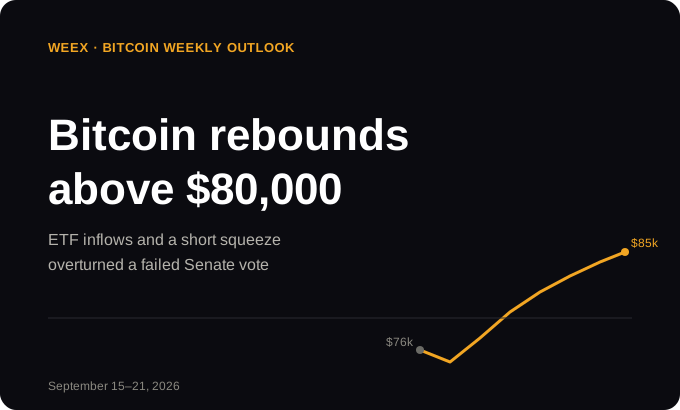
WEEX Bitcoin Weekly Outlook: Why Did Bitcoin Rebound Above $80,000 After the CLARITY Act Vote?
Bitcoin rebounded above $80,000 as SEC and CFTC action, renewed ETF inflows, and a short squeeze outweighed the failed CLARITY Act vote.
$8 Makes a Comeback, This Time X Money Rewrites the Logic of NFT Issuance
AMD Jumps Nearly 10%, Market Cap Tops $1 Trillion| WEEX TradFi Daily Brief (September 22, 2026)
Global markets on September 22 focus on a repair in AI-compute pricing. On September 21 the three major equity indexes closed higher. AMD rose nearly 10% and its market cap crossed $1 trillion for the first time, while Intel and Arm also surged. Brent crude fell about 3.4% to $100.34 and the 10-year Treasury yield eased to about 4.96%, lowering discount-rate pressure on long-duration tech. Bitcoin briefly broke above $87,000 and total crypto market cap returned above $3 trillion. Investors next watch consumer and housing earnings plus PMI flash prints.
Balancer Community Proposes Fork and Rebirth

The Answer to Dreamforce 2026: AI Agent, Has It Finally Turned from Demo to Revenue?
Ethereum: BitMine Approaches 5% of Total ETH Supply
Bitcoin's $84K rally isn't saving miners as difficulty signals already flash caution
DeltaForesight Announces Completion of 324 Million Yen Financing to Develop Over-Collateralized Yen Stablecoin JPYdf
Goldman Sachs: AI Capital Expenditure to Reach $1.73 Trillion in 2026-2027
Federal Reserve Plans to Raise Regulatory Thresholds for Large Banks
Crypto in France: Binance, taxes, digital euro, what changes by 2027
LTC Airdrop 2026: How to Claim 50,000 USDT Rewards on WEEX
Dom Kwok Expects a Sudden Surge in Crypto Prices





