
These Bitcoin miners have halved their hashrate, while their AI revenues have doubled

 Prefer us on Google


IREN, Core Scientific, and TeraWulf have nearly doubled their AI-related revenues in the third quarter of 2026. Together, the three companies generated approximately $478 million from AI cloud services and colocation, compared to $239 million in the previous quarter. At the same time, their cumulative Bitcoin hashrate dropped from 32.8 to 16.8 exahashes per second (EH/s). The figures indicate that the shift towards AI has now surpassed the announcement stage.
In brief
- IREN, Core Scientific, and TeraWulf have doubled their AI-related revenues, while their Bitcoin mining power has decreased by nearly 49%.
- The cumulative hashrate of eleven listed miners has only decreased by 2%. However, without Bitdeer, the contraction reaches nearly 15%.
- Bitdeer produced 3,855 bitcoins in the third quarter, accounting for about 9.2% of the rewards distributed by the network.
AI brings in more, mining loses ground
The phenomenon was already visible, but the financial results of the third quarter give it another dimension. IREN, Core Scientific, and TeraWulf increased their combined AI cloud and colocation revenues to $478 million, up from $239 million three months earlier. At the same time, their realized hashrate lost nearly half its value.
IREN particularly illustrates this transformation. According to its financial results, its computing power dedicated to mining dropped from 21.6 to 8.9 EH/s. In contrast, its AI cloud revenues surged from $70.5 million to $200 million. Its installed mining capacity also fell from 23.2 to 7.9 EH/s. In other words, the company is not just talking about conversion: it is actively removing machines from the Bitcoin circuit.
Core Scientific follows a similar trajectory. Its hashrate decreased from 7 to 3.8 EH/s, while its colocation revenues increased by nearly 58%, reaching $215.4 million. This activity now represents about 92% of its quarterly revenue.
The company is also accelerating the development of its infrastructures. By the end of September, it was billing 485 megawatts of capacity, up from 395 megawatts three months earlier. It even plans to completely abandon mining before the end of the year. For some players, Bitcoin machines are already a thing of the past.
Bitdeer benefits from the departure of miners
As some miners reduce their power, others capture a larger share of the rewards. Bitdeer is among the main beneficiaries of this movement.
Its quarterly production increased from 2,694 BTC in the second quarter to 3,855 BTC in the third. The company thus captured about 9.2% of the network's rewards. At the same time, its hashrate increased from 63 to 85 EH/s.
The figures for September also deserve attention. Bitdeer mined 1,355 BTC during the month, accounting for more than 9.7% of the rewards distributed to miners. The company is therefore approaching the symbolic threshold of one bitcoin out of ten. The next data will show whether it manages to surpass this threshold.
On a sector-wide scale, this progress masks a less comfortable situation. Eleven listed mining companies total approximately 246 EH/s, representing a 2% decline over the quarter. But this figure changes significantly when Bitdeer is removed from the calculation.
The other ten companies dropped from 189 to 161 EH/s, a decline of nearly 15%. In short, Bitdeer compensates for a good portion of the decline of its competitors. It is also developing its own AI-related activities, with $20.4 million in cloud revenues, compared to $14 million in the previous quarter.
-- Price
Mining machines already destined for resale or scrap
This conversion raises another question: what to do with equipment that is no longer used for Bitcoin mining?
IREN and Keel together held approximately $80.5 million worth of mining equipment intended for sale at the end of September, after depreciation. Core Scientific reported $29.7 million in stocks to be sold, including mining equipment, electrical equipment, and HPC infrastructures.
Some companies are already opting to recover part of their investment. Cipher has thus sold 6,840 Avalon A15Pro machines to Canaan. However, it had purchased this equipment in July 2025. Even relatively recent machines can therefore find their way onto the market when priorities change.
Other equipment faces a less favorable end. In its prospectus, Ionic planned to sell or scrap 73,400 machines, while 19,100 others would serve as spare parts.
The shift towards AI is therefore not simply about installing new servers in old mining centers. It also involves parting with some equipment and completely reassessing investments.
One essential question remains: will this conversion be profitable enough to compensate for the abandoned revenues from mining? For now, the figures show that AI is attracting more and more capital and computing power. Meanwhile, miners who remain in Bitcoin could benefit from less intense competition.
This content is provided for general informational purposes only and doesn't constitute financial, investment, legal, or tax advice. Any events, rewards, online promotions, or related information mentioned herein should not be considered a recommendation, solicitation, or invitation to purchase, sell, trade, or otherwise deal in any crypto assets. Crypto assets are highly volatile and may result in loss. The availability of WEEX services, products, and related events may vary by region. You are responsible for ensuring that your participation is in accordance with applicable local laws and regulations.
You may also like

Gnosis Safe wallet reportedly drained of $6.45M in suspected exploit

Thailand Stablecoin Transfer Limit: What the SEC Draft Proposes

Tesla Autopilot Team Veterans Found Simulation Startup Valued at $1 Billion
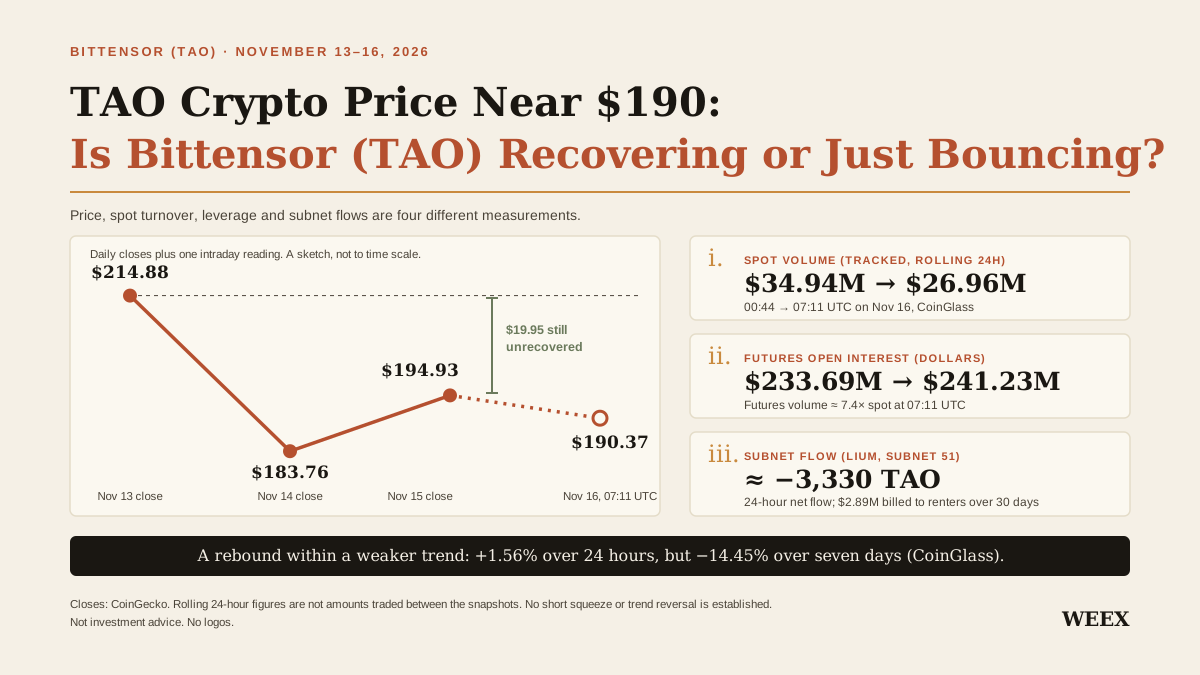
TAO Crypto Price Near $190: Is Bittensor (TAO) Recovering or Just Bouncing?
TAO bounced near $190. Compare spot volume, futures positioning, and Bittensor subnet flows to see what would confirm a more durable recovery.
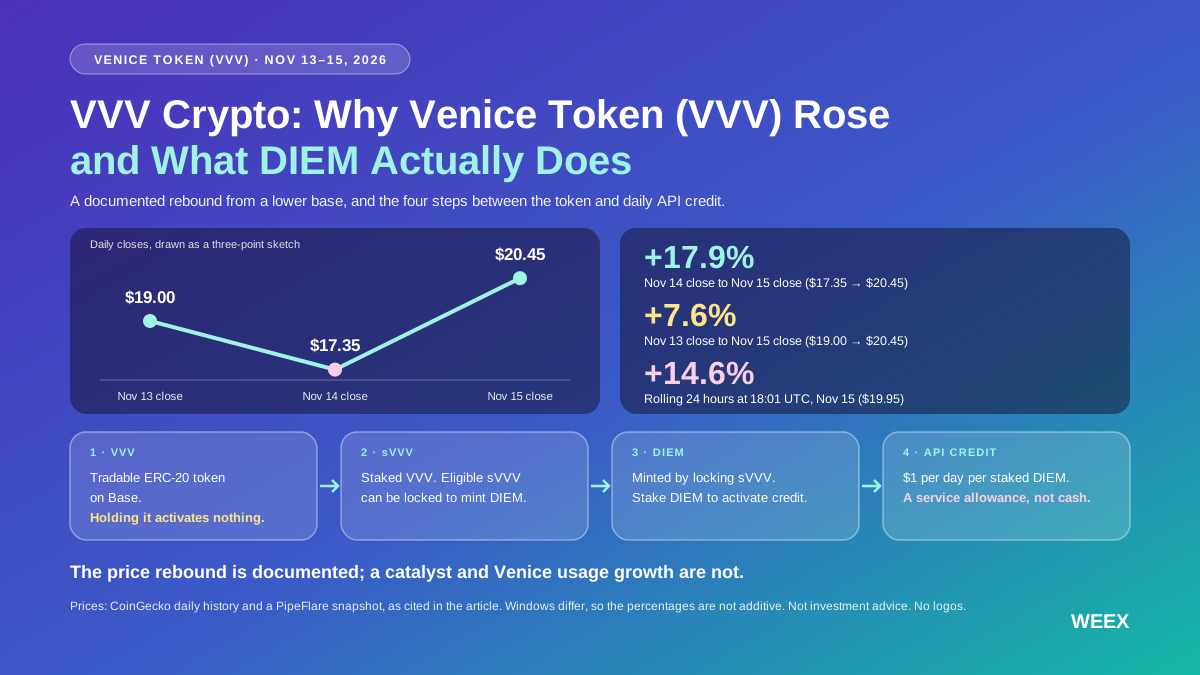
VVV Crypto: What Is Venice Token, Why Venice Token (VVV) Rose and What DIEM Actually Does
Venice Token rose about 14.6% in one November 15 snapshot. Learn what the data shows, how VVV staking works, and what DIEM’s daily API credit buys.
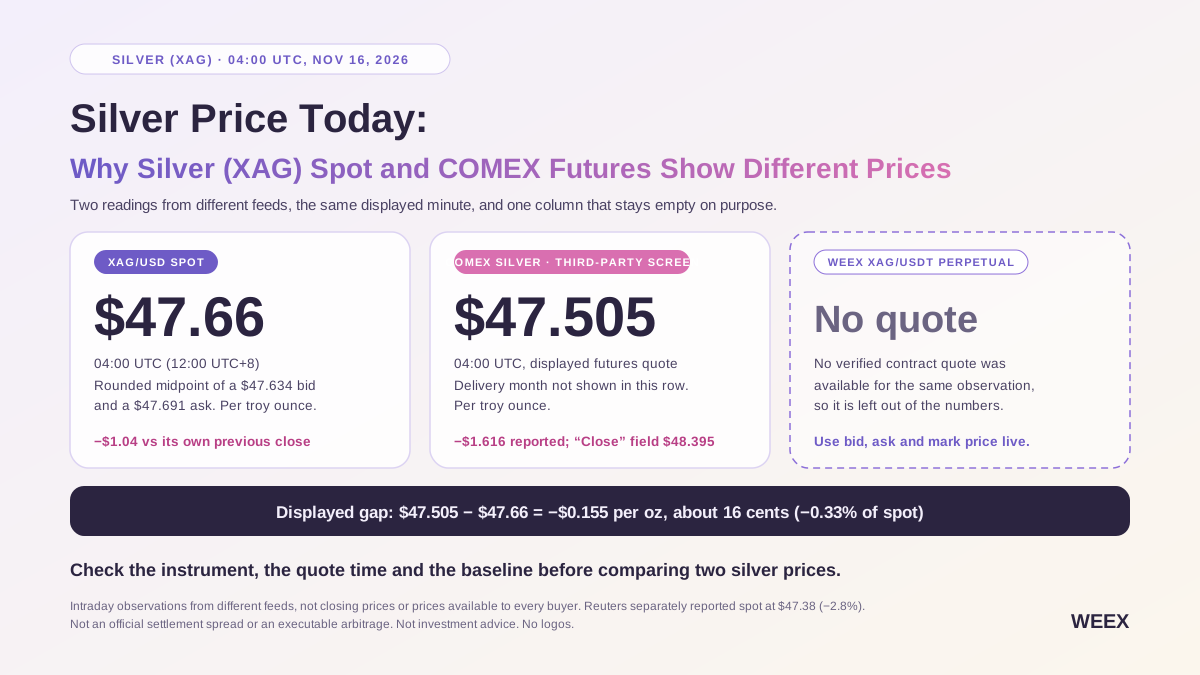
Silver Price Today: Why Silver (XAG) Spot and COMEX Futures Show Different Prices
Silver traded near $47–$48 on November 16. Compare XAG/USD spot, COMEX silver futures, and XAG/USDT perpetuals, and learn why their prices differ.

Options Big Bets | Nvidia's $118 Million Cross-Period CALL Spread Bets on Mid to Long-Term Upside; AMD's Bearish Spread Combined with Long-Term Bullish Spread, Underlying Tensions Between Bulls and Bears

Galaxy Securities: A-shares Market's Downward Risk Converges, Focus on Sector Rotation Opportunities

How $10,000 in stablecoins would have gained €420 without earning interest

Bitcoin now looks cheap by one measure after $1 billion in ETF outflows

Bitcoin: Should We Fear the Worst or Bet on Hopes for a Rebound?

This Under-the-Radar Stock Is Behind Steak 'n Shake's MAHA-Driven Growth. Should You Buy?

XDC vs XRP: Which Payment-Focused Blockchain is Superior?

The Privacy Paradox of Bitcoin: Satoshi Acknowledged It Long Ago, Have the Successors Solved It?

[Analysis] Two Barriers Preventing Bitcoin from Rising

No New Money Inflows in Dogecoin ETFs for a Month
XRP loans trigger 883 liquidations, and $53M remains at risk

CoreWeave and Nebius Group: 1 Soars, the Other 1 Plunges. A Tale of 2 Neoclouds

Research Reveals 3D Spatial Navigation Map of Hand in the Brain to Aid Brain-Machine Interface Development

Yen Fluctuations Highlight Current Trading Difficulties, Investors Have Huge Divergence on Long-term Outlook

BNY Mellon Adds to Invesco Galaxy Bitcoin ETF: What Changes with the Custody Filing?
South Korea Proposes Withdrawal Suspension for Cryptocurrency: What Happens When Exchanges Suspect a Hack
Exclusive: Canton Strategic CEO warns MEV could raise costs for tokenized stock traders

CARF Customer Transaction Information Report: What Data Processing is Required from On-Chain Transactions to Tax Reporting?

Bottomline Completes First USDC Transfers Inside Its Enterprise Payments Platform

Bitcoin: Glassnode warns of liquidity shortage and capital flight

9-Minute Attack Window, 7.1 Million BTC Exposed: How Bitcoin Can Save Itself from Quantum Threats
Can You Withdraw Crypto From Schwab? External Wallet Transfers, Fees, and Rollout Explained
Find out when Schwab Crypto allows external wallet withdrawals, how the 24-hour address wait works, and why the 0.75% trading fee is separate.

Adam Back Predicts Bitcoin Will Reach $1 Million by 2028

Bull Market Gains, Bear Market Losses: How to Calculate Taxes on Cryptocurrency Investments?
Gnosis Safe wallet reportedly drained of $6.45M in suspected exploit
Thailand Stablecoin Transfer Limit: What the SEC Draft Proposes
Tesla Autopilot Team Veterans Found Simulation Startup Valued at $1 Billion
TAO Crypto Price Near $190: Is Bittensor (TAO) Recovering or Just Bouncing?
TAO bounced near $190. Compare spot volume, futures positioning, and Bittensor subnet flows to see what would confirm a more durable recovery.
VVV Crypto: What Is Venice Token, Why Venice Token (VVV) Rose and What DIEM Actually Does
Venice Token rose about 14.6% in one November 15 snapshot. Learn what the data shows, how VVV staking works, and what DIEM’s daily API credit buys.
Silver Price Today: Why Silver (XAG) Spot and COMEX Futures Show Different Prices
Silver traded near $47–$48 on November 16. Compare XAG/USD spot, COMEX silver futures, and XAG/USDT perpetuals, and learn why their prices differ.
Latest articles


Latest coin listings on WEEX


