
How $10,000 in stablecoins would have gained €420 without earning interest

 Prefer us on Google


A dollar stablecoin can keep its peg while the euro spending value of a European saver's balance moves sharply. At a perfect $1 peg, an unchanged holding would have gained about 4.9% in euros between September 1 and November 13, 2026, using European Central Bank reference rates and excluding costs.
The ECB's household stablecoin analysis puts that currency exposure in context. Its experimental 2025 survey evidence identifies ownership of dollar tokens among euro area consumers. The subsequent exchange-rate comparison illustrates a separate point: stability against the dollar does not promise stability against the currency used to pay the rent.
The bulletin draws on Consumer Expectations Survey modules from August and November 2025 across the 11 largest euro area countries. In August, 5% of consumers reported stablecoin ownership by themselves or household members, while 13% reported crypto ownership.
Among respondents with crypto holdings, 17% reported USDT, 12% USDC and 10% the euro-denominated EURC. Those percentages measure how common ownership was among crypto-holding respondents. They reveal no token's share of invested capital. Respondents could select several assets, and the crypto-holder subsample comprised 1,286 people.
The ownership observations date to 2025. The ECB flags small samples, questionnaire sensitivity and possible misreporting. It also says the survey does not directly report how assets were used, so the figures cannot establish payment adoption or tell us what households earned.
The two-date illustration takes September 1 as its chosen baseline. Different holding periods can produce different currency returns. The ECB's dollar reference-rate history shows $1.1590 per euro on September 1 and $1.1052 on November 13, the latest working-day observation available for this comparison.
With fewer dollars needed to buy one euro, the same dollar balance translated into more euros. For 10,000 unchanged tokens worth exactly $1 each, the illustrative value rose from €8,628 to €9,048, a gain of about €420 before costs. Dividing 1.1590 by 1.1052 and subtracting one gives a 4.9% increase.
That entire illustrated gain comes from currency movement. Token quantity and dollar price are held constant, with no interest earned. Actual households' returns would depend on their holdings, timing and costs. The ECB also publishes its rates for information and discourages transactional use, so retail conversion quotes can differ from these translation values.
Same dollar balance. Different euro value.
Illustrative unchanged 10,000-token balance at a perfect $1 peg, using September 1 and November 13, 2026 ECB reference rates.
TOKEN BALANCE10,000×ASSUMED PEG$1=DOLLAR VALUE$10,000Fixed on both dates. No interest added.
TOKEN BALANCE10,000×ASSUMED PEG$1DOLLAR VALUE ON BOTH DATES$10,000Unchanged tokens. No interest added.
View the same balance in dollars or euros
View the same balance in dollars or eurosDollarsEuros
The assumed peg and unchanged token count hold the dollar value at $10,000 on both dates.
The dollar peg holds at both datesSept. 1, 2026Perfect $1 peg$10,000Nov. 13, 2026Perfect $1 peg$10,000$0$10,000$00%Change in dollar value at the assumed peg
The dollar value holdsSept. 1, 2026Perfect $1 peg$10,000Nov. 13, 2026Perfect $1 peg$10,000$0$10,000$00%Change in dollar value at the assumed peg
The November 13 rate translates the same dollars into about €420 more than the September 1 rate, before costs.
The same dollars translate into more eurosSept. 1, 2026€1 = $1.1590€8,628.13Nov. 13, 2026€1 = $1.1052€9,048.14€0€10,000+€420.01+4.87%Currency translation gain, before costs
The euro value changesSept. 1, 2026€1 = $1.1590€8,628.13Nov. 13, 2026€1 = $1.1052€9,048.14€0€10,000+€420.01+4.87%Currency translation gain, before costs
The euro value rises 4.87% in this chosen interval through currency translation alone, before costs.
Hypothetical unchanged balance and exact $1 peg, with no yield, fees, spreads or taxes. ECB rates are informational, not executable quotes. The chosen two-date window is not a household holding period or an estimate of survey respondents' profits. No APY comparison or forecast.
Sources and evidence
Sources
- ECB dollar reference-rate history
- ECB reference-rate convention and limits
Supporting facts
- The ECB USD reference-rate tables show $1.1590 per euro on September 1, 2026, and $1.1052 per euro on November 13, 2026, the latest displayed working-day observation at capture. [1] [2]
- At an unchanged balance and a perfect $1 token price, the ECB reference-rate movement from September 1 to November 13, 2026 implies a 4.8679% increase in the balance's euro value before costs, not a measured household investment return. [1]
- In that perfect-peg illustration, 10,000 unchanged dollar tokens translate to about €8,628.13 on September 1 and €9,048.14 on November 13, 2026, a difference of about €420.01 before costs. [1]
- The ECB publishes its reference rates for information and strongly discourages their use for transactions. [2]
Method
Euro value = 10,000 / USD per EUR: 10,000/1.1590 = 8,628.127696; 10,000/1.1052 = 9,048.136084. Difference €420.008388; return 1.1590/1.1052-1 = 4.867897%. Values rounded to cents and return to 2 decimals. Bars start at zero on a common 0-10,000 scale within each currency; currency units differ between panels.
Scope
Hypothetical unchanged balance and exact $1 peg, with no yield, fees, spreads or taxes. ECB rates are informational, not executable quotes. The chosen two-date window is not a household holding period or an estimate of survey respondents' profits. No APY comparison or forecast.
Infographic by CryptoSlate
More generally, gross euro value equals token quantity multiplied by the token's dollar price, divided by dollars per euro. Income can change the quantity or value of a position; a depeg changes the dollar price; exchange rates change its euro translation. Conversion costs reduce what is available to spend. A stronger euro can reverse the currency effect even if the dollar peg remains intact.
Yield is another exposure
A separate stablecoin-yield study by DefiLlama Research, published November 12, examined a November 9 snapshot of 98 stablecoin pools with at least $50 million supplied, no token incentives over the preceding 30 days and a recorded 30-day base annual percentage yield (APY).
It reported a median base APY of 4.1%. Forty-eight pools exceeded the study's 4.2% three-month Treasury benchmark, dated November 5; that selected group's median was 5.4%.
These are annualized yield measures based on a trailing 30-day window. They cannot be compared as realized returns with the September-to-November currency gain. They do show why a quoted income rate gives only part of the euro holder's picture. DefiLlama links higher premiums to additional credit, trading, liquidity or underlying-asset risks, alongside the risks of using smart contracts.
Bare token ownership is different again. Circle's European Economic Area (EEA) USDC white paper says USDC itself generates no interest for holders and gives them no entitlement to reserve income. Earning a DeFi yield requires a separate position with its own terms and risks.
Redemption also needs a currency and an access route. Circle describes USDC as redeemable one-for-one for dollars. Although Circle Mint is institutional, eligible EEA retail holders have a separate route through Circle France under its MiCA redemption policy, subject to identity and transaction checks and an EEA bank account able to receive USD. Third-party bank conversion or incoming-payment fees may apply.
A holder saving for euro expenses therefore carries a currency exposure alongside peg and investment risks. Someone setting aside tokens for a dollar expense or offsetting a dollar liability may have a different net exposure. The relevant question is what the balance will buy in the currency the holder actually needs.
-- Price
This content is provided for general informational purposes only and doesn't constitute financial, investment, legal, or tax advice. Any events, rewards, online promotions, or related information mentioned herein should not be considered a recommendation, solicitation, or invitation to purchase, sell, trade, or otherwise deal in any crypto assets. Crypto assets are highly volatile and may result in loss. The availability of WEEX services, products, and related events may vary by region. You are responsible for ensuring that your participation is in accordance with applicable local laws and regulations.
You may also like

Gnosis Safe wallet reportedly drained of $6.45M in suspected exploit

Thailand Stablecoin Transfer Limit: What the SEC Draft Proposes
Tesla Autopilot Team Veterans Found Simulation Startup Valued at $1 Billion
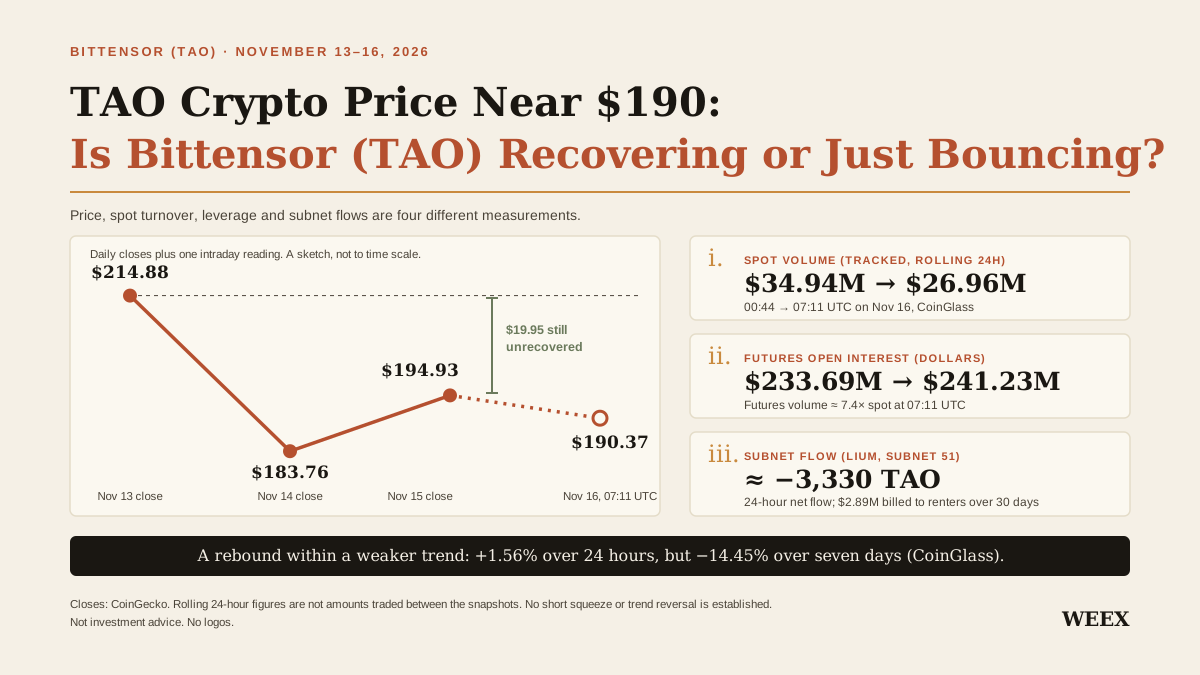
TAO Crypto Price Near $190: Is Bittensor (TAO) Recovering or Just Bouncing?
TAO bounced near $190. Compare spot volume, futures positioning, and Bittensor subnet flows to see what would confirm a more durable recovery.
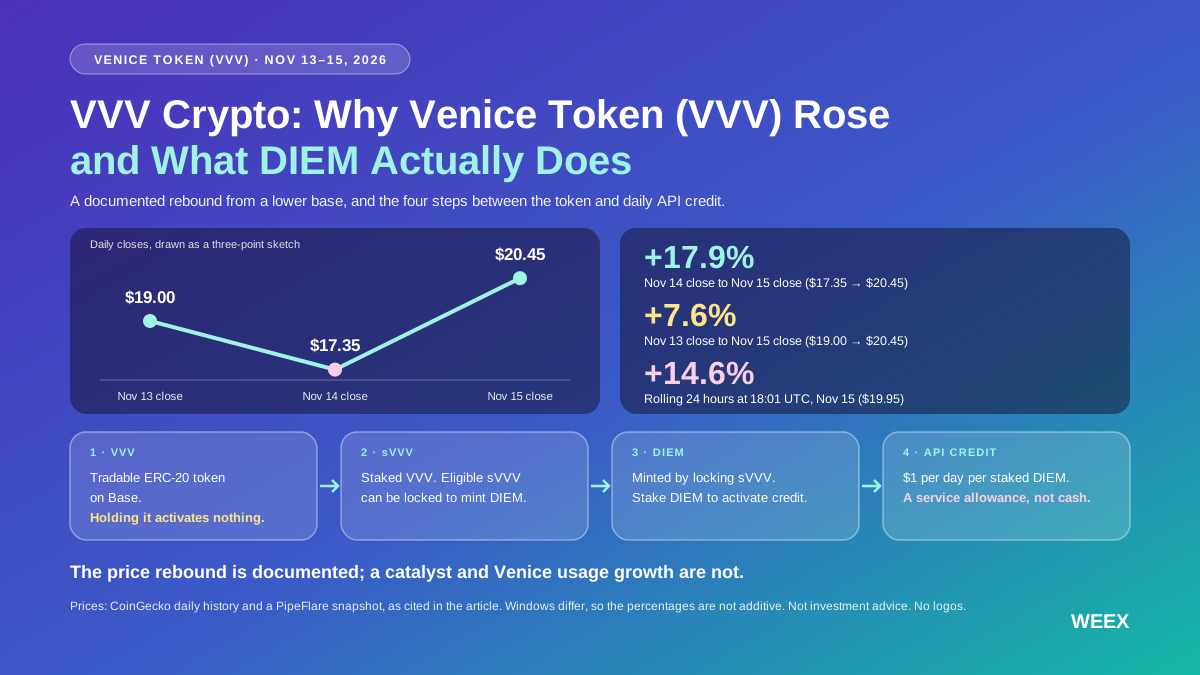
VVV Crypto: What Is Venice Token, Why Venice Token (VVV) Rose and What DIEM Actually Does
Venice Token rose about 14.6% in one November 15 snapshot. Learn what the data shows, how VVV staking works, and what DIEM’s daily API credit buys.
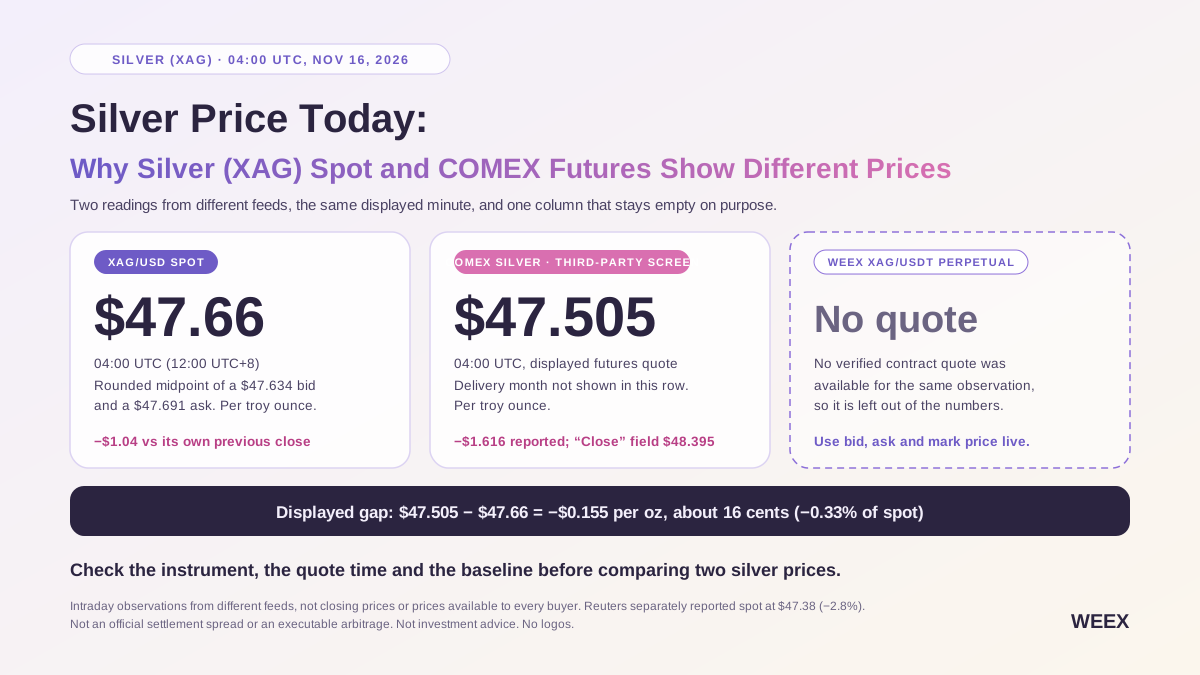
Silver Price Today: Why Silver (XAG) Spot and COMEX Futures Show Different Prices
Silver traded near $47–$48 on November 16. Compare XAG/USD spot, COMEX silver futures, and XAG/USDT perpetuals, and learn why their prices differ.

Options Big Bets | Nvidia's $118 Million Cross-Period CALL Spread Bets on Mid to Long-Term Upside; AMD's Bearish Spread Combined with Long-Term Bullish Spread, Underlying Tensions Between Bulls and Bears

Galaxy Securities: A-shares Market's Downward Risk Converges, Focus on Sector Rotation Opportunities

Bitcoin now looks cheap by one measure after $1 billion in ETF outflows
These Bitcoin miners have halved their hashrate, while their AI revenues have doubled

Bitcoin: Should We Fear the Worst or Bet on Hopes for a Rebound?

This Under-the-Radar Stock Is Behind Steak 'n Shake's MAHA-Driven Growth. Should You Buy?

XDC vs XRP: Which Payment-Focused Blockchain is Superior?

The Privacy Paradox of Bitcoin: Satoshi Acknowledged It Long Ago, Have the Successors Solved It?

[Analysis] Two Barriers Preventing Bitcoin from Rising

No New Money Inflows in Dogecoin ETFs for a Month

XRP loans trigger 883 liquidations, and $53M remains at risk

CoreWeave and Nebius Group: 1 Soars, the Other 1 Plunges. A Tale of 2 Neoclouds

Research Reveals 3D Spatial Navigation Map of Hand in the Brain to Aid Brain-Machine Interface Development

Yen Fluctuations Highlight Current Trading Difficulties, Investors Have Huge Divergence on Long-term Outlook

BNY Mellon Adds to Invesco Galaxy Bitcoin ETF: What Changes with the Custody Filing?
South Korea Proposes Withdrawal Suspension for Cryptocurrency: What Happens When Exchanges Suspect a Hack

Exclusive: Canton Strategic CEO warns MEV could raise costs for tokenized stock traders

CARF Customer Transaction Information Report: What Data Processing is Required from On-Chain Transactions to Tax Reporting?

Bottomline Completes First USDC Transfers Inside Its Enterprise Payments Platform

Bitcoin: Glassnode warns of liquidity shortage and capital flight

9-Minute Attack Window, 7.1 Million BTC Exposed: How Bitcoin Can Save Itself from Quantum Threats
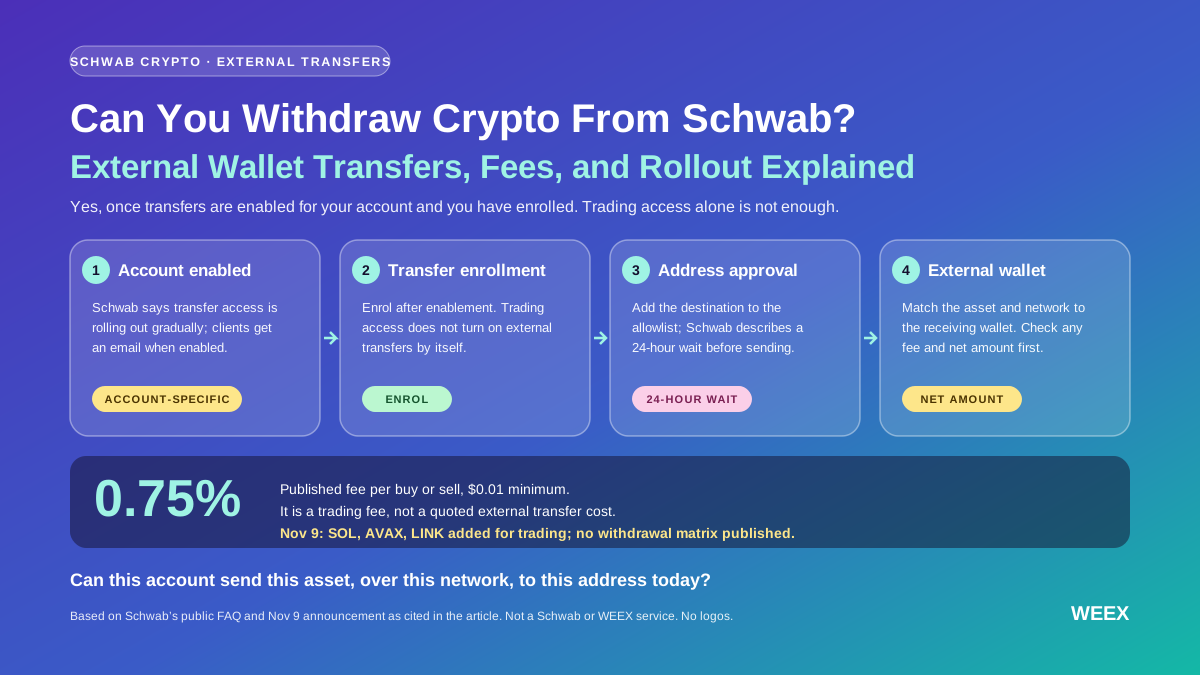
Can You Withdraw Crypto From Schwab? External Wallet Transfers, Fees, and Rollout Explained
Find out when Schwab Crypto allows external wallet withdrawals, how the 24-hour address wait works, and why the 0.75% trading fee is separate.

Adam Back Predicts Bitcoin Will Reach $1 Million by 2028

Bull Market Gains, Bear Market Losses: How to Calculate Taxes on Cryptocurrency Investments?
Gnosis Safe wallet reportedly drained of $6.45M in suspected exploit
Thailand Stablecoin Transfer Limit: What the SEC Draft Proposes
Tesla Autopilot Team Veterans Found Simulation Startup Valued at $1 Billion
TAO Crypto Price Near $190: Is Bittensor (TAO) Recovering or Just Bouncing?
TAO bounced near $190. Compare spot volume, futures positioning, and Bittensor subnet flows to see what would confirm a more durable recovery.
VVV Crypto: What Is Venice Token, Why Venice Token (VVV) Rose and What DIEM Actually Does
Venice Token rose about 14.6% in one November 15 snapshot. Learn what the data shows, how VVV staking works, and what DIEM’s daily API credit buys.
Silver Price Today: Why Silver (XAG) Spot and COMEX Futures Show Different Prices
Silver traded near $47–$48 on November 16. Compare XAG/USD spot, COMEX silver futures, and XAG/USDT perpetuals, and learn why their prices differ.
Latest articles


Latest coin listings on WEEX


