
The Rise of On-Chain Stocks: What Can Startups Do?

 Prefer us on Google


This article outlines the underlying structure of on-chain stocks, the significance of going on-chain, and entrepreneurial opportunities.
Written by: @0xRickyW
Compiled by: AididiaoJP, Foresight News
Recently, on-chain stocks have been receiving continuous attention, and one question keeps arising.
If we believe in a certain direction the world is heading, why can’t we turn that judgment into a portfolio, buy it with cryptocurrency, and let others follow suit?
For example, if one believes that artificial intelligence will significantly increase electricity demand, they might want to be exposed to companies involved in power generation, the grid, and equipment manufacturing. The focus is not just on getting a chatbot to provide five codes, but on understanding this exposure, purchasing a basket of assets, and continuing to use it as opinions change.
This is a more worthwhile product form.
The subsequent question is: can this be done directly through a regular brokerage account? What does going on-chain actually add?
Before the product becomes exciting, we need to clarify the underlying mechanisms: who holds the stocks? What do the tokens represent? How can funds be retrieved? In which aspects can startups create real business?
First: What exactly is being bought?
Buying stocks has already been highly digitized. Clicking in an app changes the numbers in the account. It is not blockchain that digitizes stocks.
Behind the button, brokers process orders, trading venues match buy and sell orders, clearing and settlement arrangements determine what each party owes and completes delivery, and custodians and registration agencies safeguard securities and ownership records. Some institutions perform multiple functions simultaneously.
In a typical brokerage structure, investors are the beneficial owners, while intermediaries or nominal holders are the registered owners. There is a layer of records and legal relationships between investors and companies. Investor.gov provides a brief explanation of this distinction.
"On-chain stocks" can refer to several different things:
- Tokens linked to actual holdings or recognized indirect securities rights;
- Third-party products backed by stocks held elsewhere;
- Derivatives that track stock prices without conferring ownership of the stock.
The second category is the most confusing. A product can be fully collateralized by stocks, but it is still a certificate issued by another company, not equity in the company indicated by the token name.
For example, xStocks defines its product as a fully collateralized tracking certificate, not direct equity, and does not grant shareholders voting rights. An overview by SEC staff also points out that different tokenization structures confer different rights to investors.
Thus, it can be broken down into two questions: what supports this token? As a holder, what rights can one actually claim?
Even if the token name includes Apple, the above two questions may not have answers. What happens if the issuer goes bankrupt, and how can holders assert their claims?
How do stocks become tokens?
Taking a simplified stock-backed product as an example. Suppose Apple’s stock price is $100, just for illustration, not the current price.
The issuer arranges to place real stocks into a designated brokerage or custodial account. The issuer creates the product, the broker assists in buying and selling stocks, and the custodian holds the positions. Apple itself does not need to be the token issuer.
Subsequently, the issuer creates or "mints" tokens according to the product terms. Suppose initially one token corresponds to one share. This does not create an additional share of Apple; it merely creates a representation of rights linked to existing assets. Dividends, stock splits, and product design will change the exchange ratio over time.
Some systems allow authorized entities to convert between stocks and tokens, while others allow qualified customers to issue and redeem directly after onboarding. Alpaca’s authorized participant guide is a specific example.
Next comes distribution. Exchanges or investment applications open the product to qualified users. Market makers quote buy and sell prices, taking on risks with their own inventory and funds. The exchange is the venue, and market makers are one of the participants.
Tokens may be held on the platform or, under certain conditions, placed in personal wallets. However, holding tokens does not mean that the underlying custodian disappears. On-chain visibility of token balances does not independently prove that stocks are indeed held in a brokerage account.
Ultimately, there are two exit paths, and they are not the same:
- Selling: Another buyer takes over the existing tokens.
- Redeeming: Following the issuer’s process, the tokens exit circulation, and the holder receives cash, stablecoins, or securities according to the terms.
Being able to buy tokens does not automatically mean one is qualified for direct redemption. Thresholds, fees, time, and qualifications all matter.
Moreover, if tokens change hands ten times, it does not mean ten new shares of stock are created. Trading volume and the number of assets supporting the product are two different metrics.
How is the price anchored to the underlying stock?
Suppose the underlying stock is $100, and the token is $105. Qualified institutions might buy the underlying stock, mint tokens, and then sell them. If the price difference is sufficient to cover costs and risks, this trade is established. An increase in token supply helps push the price back down. When tokens are too cheap, buying and redeeming can reverse the operation.
This is arbitrage. The key is whether these trades can actually be executed, rather than just existing on the screen.
Now imagine a Sunday: tokens are still trading, while the underlying stock market is closed. How difficult is it for market makers to hedge? Is there anyone who can redeem? At what price?
Therefore, "24/7 trading" does not equal "being able to transact at good prices all the time." Price differences may widen, and prices may deviate. xStocks’ explanations of the primary and secondary markets are worth referencing.
-- Price
What are the roles of various industry participants?
A simple chain can summarize:
Stocks → Brokerage and Custody → Legal Structure and Token Issuance → Trading and Distribution → Combinations, Lending, and Other Applications.
The upstream concerns assets and rights. The middle layer transforms these rights into things that people can access and trade. The downstream is about creating products that users want to use.
Supporting the entire chain are also:
- Blockchain and smart contracts record balances and execute predefined rules.
- Stablecoins and payment channels move funds, which also carry issuance and redemption risks.
- Wallets and security systems manage keys, authorizations, and permissions.
- Market data and oracles bring prices and external information into applications. Price oracles are not proof of reserves.
- Compliance systems determine who can buy, hold, transfer, and redeem according to relevant rules.
- Services handle dividends, stock splits, mergers, and other corporate actions. Reconciliation checks whether token balances, custody records, and customer accounts match.
On-chain transfers ultimately confirmed do not mean that every single securities or banking step is completed simultaneously at the underlying level. Institutions, operational processes, and legal obligations still exist.
Each participant needs a business model. Brokers and custodians charge fees, issuers may charge product fees or issuance/redemption fees, exchanges charge trading fees, market makers earn spreads and manage risks, infrastructure companies sell software, and applications rely on users or distribution for monetization.
From an investor's perspective, the key is who earns income by solving problems. High trading volumes through a certain network do not equate to high revenues; good business performance does not mean token holders can share in the profits.
Why go on-chain?
Traditional brokers already offer fractional shares, portfolios, and securities-backed loans. These are not inventions of cryptocurrency.
What is noteworthy is that when stock exposure can emerge through the same infrastructure that users have already used to hold stablecoins, trade, lend, and build financial products, what changes will occur?
From a market perspective, its importance is reflected in five aspects.
1. Assets are more accessible, with stablecoins becoming the funding track.
A user-friendly brokerage account is not equally easy to open everywhere. For those who already hold stablecoins, converting back to bank funds and then funding another account adds an extra layer of friction.
Tokenized stocks can provide qualified investors with a more direct path: from stablecoins to stock exposure. Investment products thus become easier to distribute across markets, especially for those already using cryptocurrency. It does not eliminate local rules and onboarding requirements—individual products still have geographic limitations—but it can significantly simplify the experience of funding and distribution.
2. Developers can reduce redundant construction and focus on product development.
Imagine building a portfolio around the argument that "artificial intelligence will increase electricity consumption." What is needed is not just a list of companies, but the ability to buy assets, hold, rebalance, and possibly access financing.
Under compatible tokens and protocols, developers can reuse existing wallets, trading venues, lending facilities, and smart contracts. Indices, derivatives, automated portfolios, and yet-to-emerge products all have space.
The advantage lies in lower trial-and-error startup costs. Small teams can focus their energy on the experience aspects they do differently.
3. Investors can transfer positions, not just funds.
If a better application is found, investors may want to move existing positions over rather than selling, withdrawing cash, and then buying again elsewhere.
Traditional brokers already support physical position transfers. The opportunity on-chain is to make positions easier to move and use across compatible wallets, applications, and protocols.
Transferable stock tokens could potentially achieve this between compatible wallets and platforms. For example, xStocks is designed to be usable across wallets, exchanges, and DeFi protocols.
Compatibility remains important. But "assets can move with you" will change the relationship between investors and applications. Applications must continuously sustain their business.
4. Positions do not have to just sit in accounts.
Qualified stock tokens can be used for collateral lending or margin. This is already happening: Kamino supports borrowing USDC using selected xStocks.
Where supported, holders can also lend tokens to earn interest paid by borrowers or provide liquidity to automated market makers and earn trading fees. These fees come from real transactions, and Uniswap’s fee mechanism is an example.
This is an additional option, not free yield. Lending carries liquidation risks, and lending or providing liquidity also brings risks beyond simple holding.
5. Trading and settlement can operate on the internet's timetable.
News does not wait for the stock market to close. Supported token markets can continue trading at night and on weekends, allowing investors to respond without waiting for the next market opening bell.
There is also an independent settlement benefit: stock tokens and stablecoins can be swapped in a single atomic chain transaction—either both happen or neither happens. This reduces the risk of handing over one side without receiving the other.
The distinction is important: tokens trading 24/7 do not guarantee that the underlying stock market or primary token issuance redemption is also open around the clock. Just because the market is open does not guarantee that the price difference is narrow enough.
In summary, these factors constitute the reasons for a bullish outlook in this direction. More people can access assets, developers can create products around them, and investors can do more with their existing positions.
Returning to the initial portfolio: from "believing the world will move in a certain direction" to a portfolio that is buyable, transferable, and usable, the path will be shorter.
This is more meaningful than simply putting stock codes into a cryptocurrency wallet.
Where are the opportunities for startups?
Three areas are relatively clear: turning ideas into investable products, scaling operations, and making financing available.
1. Turning investment ideas into portfolios that others can actually buy.
The viewpoint that "artificial intelligence will increase electricity consumption" still means a lot of work for users: selecting assets, understanding risks, placing orders, and maintaining portfolio updates. Startups can consolidate these steps and allow others to follow strategies within permissible limits.
The opportunity lies in occupying this experience for specific groups. AI-generated code lists are easy to replicate. Distribution, credible performance records, and products that users are willing to continuously invest in are much harder to replicate. Going on-chain must improve how portfolios are held, transferred, or used elsewhere.
2. Enabling the operation of tokenized stocks to scale across service providers.
Issuers, brokers, custodians, and applications need to keep records aligned, even if transactions fail, redemptions are delayed, or stocks are split. Startups can sell software to handle reconciliation, coordinate updates, and help operators manage exceptions.
A practical entry point is a high-cost, clearly defined workflow for buyers. Supporting multiple service providers allows independent products to exceed the internal systems of any one issuer. Reliable interfaces and a history of handling tricky cases can create switching costs; doing endless customization for each client cannot become a scalable software business.
3. Enabling qualified stock tokens to be used as collateral.
For stock tokens to become useful collateral, lenders must be able to price them, understand their legal rights, and reclaim value if borrowers default. Market closures, redemption restrictions, and differences between issuers make this more complex than just accessing a stock price source.
Startups can provide collateral assessment, risk management, and settlement tools for lending platforms without having to become lenders themselves. The value lies in helping platforms decide what to accept, how much to lend, and how to exit under pressure. This relies on reliable data and real liquidity, not just a smart contract.
These are three different businesses: user-facing investment products, operational software for financial institutions, and infrastructure for lending. Each requires specific clients and a reason for existence that goes beyond "putting tokens on-chain."
This content is provided for general informational purposes only and doesn't constitute financial, investment, legal, or tax advice. Any events, rewards, online promotions, or related information mentioned herein should not be considered a recommendation, solicitation, or invitation to purchase, sell, trade, or otherwise deal in any crypto assets. Crypto assets are highly volatile and may result in loss. The availability of WEEX services, products, and related events may vary by region. You are responsible for ensuring that your participation is in accordance with applicable local laws and regulations.
You may also like

3.568 Bitcoin Outflow from Strategy Wallet Raises Sale Concerns

Prediction Markets Hit Record Volume Ahead of TOKEN2049: Why Kalshi and Polymarket's $45 Billion August Matters

ARGUS Token Surged 900% on Arc's Launch Day: What's Actually Driving the Rally Two Weeks Later

Seven Intriguing Details from Anthropic's IPO Prospectus

EIP-8429 Seeks to Increase Fees to Curb 'Manipulative' Bots on Ethereum

EliseAI Completes $350 Million Financing, Led by a16z and Bessemer

What Do Prediction Markets and Meme Coins Have in Common?
Charles Hoskinson: Midnight Will Be Bigger Than Zcash

Smarter Web Company shareholders clear path for UK Bitcoin backed preferred shares

ATOM Price Prediction October 2026: Can Cosmos Break $1.80?

Vitalik's New Novel: A Extreme Stress Test for Web3

Polygon: 5 Points to Understand the Burn of 100 Million POL

J.P. Morgan Analyzes the 2026 Midterm Elections: Politics Will Amplify Volatility, but U.S. Stocks Are Really Trading on Interest Rates and Fundamentals

Who Defines Ethereum? Cultural Convergence and the Truth of Cryptocurrency

Prediction Market, Bot Trading Expansion... Vulnerable to Short-Term BTC Market Manipulation
U.S. Securities Commission Updates Securities Regulations for Certain Cryptocurrency Assets

The 'Roller Effect' of AI and the 'Workshopization' of Software as a Prelude to the Internet of Intelligent Agents

How will ZetaChain advance its new AI layout in the "Great Migration" to the Solana ecosystem?

Bitcoin Faces American Employment and the Fed: Today's Key Events
The Need for an Execution Harness in Agentic Finance

Tether's Excess Reserves Halved in Q1, Are Gold and Bitcoin to Blame?

Big Short Michael Burry Accelerates Bet on AI Crash: Bubble May Burst Sooner Than Expected

Korean FSC Strengthens Response to Abnormal Values of Yen and Yuan in Cryptocurrency Market

BCRA reserves fell below $48 billion for the first time in two months, dragged down by the collapse of gold

PrimeXBT Insights: Bitcoin rallied through a rate hike; Can it rally through a bond selloff?

After AI Agent Hacked Its Government, Australia Calls Altman and Amodei to Testify

D'CENT Wallet Hack Steals Over 12.4 Million XRP from 7,000 Users

Telegram Wallet Turns into Crypto Platform Walt After 5 Years
Months After the $292M Kelp Hack, Chainlink Lets Institutions Add Their Own Bridge Checks
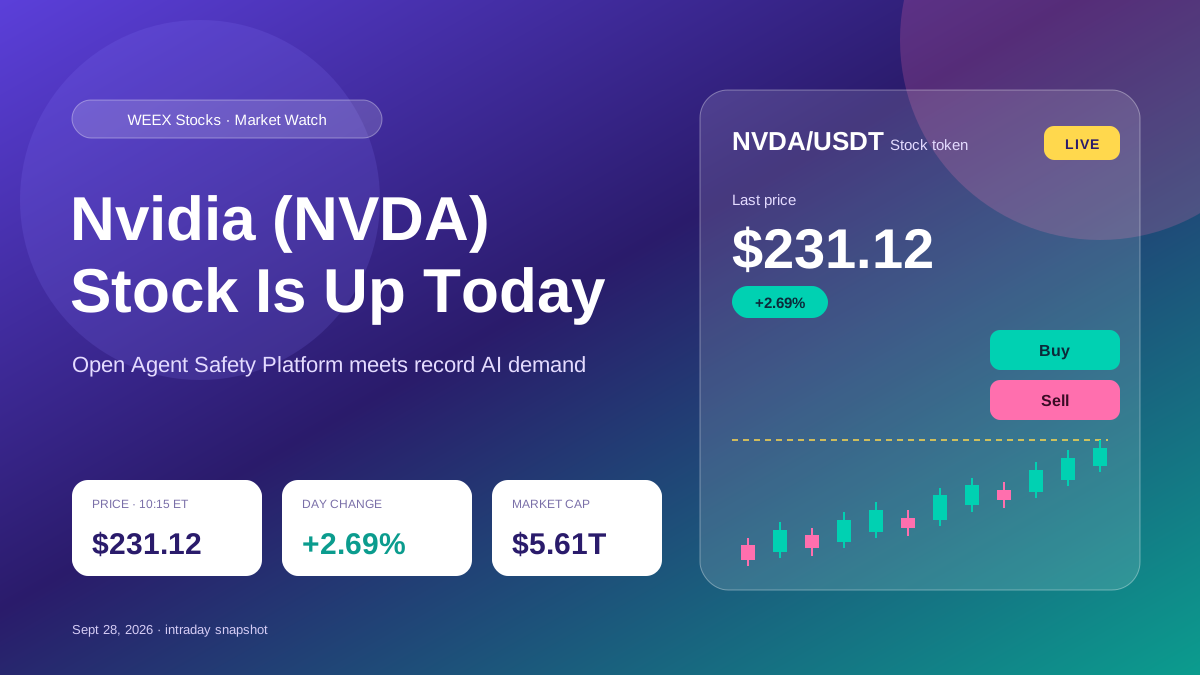
Why Is Nvidia (NVDA) Stock Up Today? New AI Agent Safety Platform Fuels the Rally
Why is Nvidia stock up today? Explore the AI agent safety launch, Nvidia’s growth outlook, key risks and how the NVDA token works on WEEX.
3.568 Bitcoin Outflow from Strategy Wallet Raises Sale Concerns
Prediction Markets Hit Record Volume Ahead of TOKEN2049: Why Kalshi and Polymarket's $45 Billion August Matters
ARGUS Token Surged 900% on Arc's Launch Day: What's Actually Driving the Rally Two Weeks Later
Seven Intriguing Details from Anthropic's IPO Prospectus
EIP-8429 Seeks to Increase Fees to Curb 'Manipulative' Bots on Ethereum
EliseAI Completes $350 Million Financing, Led by a16z and Bessemer





