
Why Are Investors with $15 Billion No Longer Just Investing in Cryptocurrency?

 Prefer us on Google


Unveiling the truth behind the shift of top capital towards AI and robotics.
Written by: lmrankhan
Compiled by: Baihua Blockchain
A few days ago, I attended an LP (Limited Partner) dinner where the guests represented a total capital of $15 billion. The hottest topic of the evening was the sudden shift of capital from cryptocurrency to frontier technology. Everyone was trying to understand the reasons behind this, whether the crypto industry still holds investment value, and some were even taken aback by the rapid transformation of leading players in the industry.
Here are some core takeaways from the discussion, along with my personal reflections.
Historically, top talent has always flowed into emerging industries. Think of the typical founders described by Chris Dixon, who engage in R&D during "nights and weekends"—they are willing to take ten times the career risk to explore the unknown. It is these founders who create entirely new markets, often where the highest investment returns are born.
The crypto industry is no exception. Over the past decade, we have witnessed thousands of experiments, and those projects that found PMF (Product-Market Fit) have carved out their own markets. However, the landscape of opportunities has changed. Now, most of the energy in the on-chain industry is increasingly focused on Wall Street, traditional finance (TradFi), payments, and fintech. These are vast markets with huge TAM (Total Addressable Market), but compared to the grand visions of cryptocurrency in 2020/2021, the current tracks appear more vertical and focused.
We must also remember that most of the growth in cryptocurrency occurred during the Zero Interest Rate Policy (ZIRP) era. At that time, every new public chain, new token, and new narrative gave us the illusion that we had a clear view of the future direction. When token prices soared, we naturally assumed that the investment logic was being validated. But it turned out that things did not unfold entirely according to that script.
Meanwhile, several emerging industries have begun to gain momentum—AI, robotics, and Physical AI. Early catchers like Alex Atallah quickly recognized this shift and decisively turned to AI, which proved to be the right decision at the time.
If we view the 2020s as the "decade of frontier technology," it undoubtedly began with cryptocurrency, followed by AI, robotics, and Physical AI, and by the end of this decade, biotechnology and materials science are likely to gain more attention. Ultimately, all these industries will intertwine in some form.
Interestingly, we are witnessing history repeat itself. Pure AI research groups, AI white paper study groups, and robotics white paper study groups are emerging, with founders exploring these soon-to-explode tracks during nights and weekends. If you remember, we saw the same scene in the early days of cryptocurrency. In my view, the lesson learned from the early days of crypto is that all the cutting-edge talent is attracted to this field precisely because it is fresh and exciting. Now, I see multiple new tracks exploding simultaneously, and I believe they will eventually converge in the future.
Cryptocurrency is currently facing multiple challenges: competing for talent density with emerging tracks, recovering from the bubble of the Zero Interest Rate era (ZIRP), stripping away the broad Web3 grand narrative to focus more on Wall Street and fintech, and dealing with the impact of new technologies like AI or quantum computing.
We also see a phenomenon similar to that in the AI field: large traditional giants can easily leverage existing distribution channels to adopt stablecoins and other on-chain infrastructures, making it harder for startups to compete. Therefore, we see many startups being acquired, merged, or transformed into other fields—this may seem like bad news on the surface, but it is actually a healthy industry reshuffling.
So, the most critical question now is: where are the opportunities?
One LP naturally asked, "Do we still need dedicated crypto VCs?"
After some back-and-forth debate, the general consensus was: yes, but perhaps not for long. Before cryptocurrency fully integrates into the broader frontier technology market, we probably have one or two more cycles to go.
Some may view this pessimistically, but I see it as extremely positive. It indicates that cryptocurrency as an industry is maturing, and the broader tech market has actually validated many of the things we have been building. Many pure fintech companies, pure AI companies, and new founders still need deep crypto expertise, which is mostly concentrated in crypto-native talent and crypto VCs. I also believe we are at the cusp of another major transformation.
Cryptocurrency was one of the earliest tracks in frontier technology but then fell into a period of stagnation. It then helped fintech find new opportunities through stablecoins, asset tokenization, and on-chain infrastructure. Now, with the maturation of AI, we are beginning to see leading AI companies adopting crypto infrastructure through Agentic Payments, wallets, and Agentic Trading.
We likely have not yet uncovered new opportunities in this field because there are still many frontier technology tracks that have not fully surfaced, and each track could become an invisible catalyst for the next wave of cryptocurrency adoption.
Moreover, I believe we have underestimated the extent to which future growth in cryptocurrency will come from those still-maturing fields. We have not yet seen DeFi or Agentic Brokerages reaching millions of users, nor have we seen tokenized stocks penetrating emerging markets.
I have often said that if a typical new technology paradigm takes about 30 years to mature, I would divide it into three stages: the first 1/3 stage generates the highest returns, the middle 1/3 stage earns the most absolute returns, and the last 1/3 stage sees the industry consolidate around the winners. I believe we are currently in the second stage of this transition.
So, why are large crypto VCs suddenly making a big push into frontier technology?
Aside from all the reasons mentioned above, the answer from a fund perspective is actually quite straightforward. The range of opportunities in the cryptocurrency space today is narrower than we imagined in 2020. You simply cannot effectively deploy $1 billion to $3 billion entirely in pure crypto and expect to achieve the same returns.
From a fund math perspective, a $2 billion fund aiming for a 3x return needs to return $6 billion, which means you need to invest in multiple successful projects valued between $10 billion and $50 billion and hold a substantial equity stake for the math to work out.
Historically, one of the few categories that could support this scale of investment logic is Layer 1 public chains and other infrastructure projects. However, as the industry matures, more and more value is flowing to applications or existing giants with distribution channels, making it difficult to justify those super-large funds that focus solely on cryptocurrency.
Thus, it is entirely reasonable for these institutions to extend their reach into robotics, Physical AI, computing power, and other frontier technologies. They need a broader landscape of opportunities to deploy capital and create venture-level returns. In these fields, they can obtain substantial equity stakes, and the current valuation increases in venture rounds also have feasible IPO paths—just look at some of the AI and robotics companies today.
So, what about domain-specific VCs? They will continue to hold unique advantages, just like fintech VCs or vertical VCs in other industries, but over time, the market simply does not need that many of them. We are currently just clearing out the excess capacity left over from previous cycles, and the institutions that remain will either double down in their original focus areas or broaden their horizons to incorporate frontier technology into their portfolios.
Additionally, there is the talent issue.
We are indeed feeling the migration of young tech talent to the AI and robotics fields. Historically, this talent would have studied Dan Boneh's cryptography white papers and then engaged in building underlying protocols, but now this talent is flowing elsewhere. However, this does not mean we are experiencing a "brain drain." Just from Alliance's data, we see a significant number of seasoned talents from the existing crypto industry leaving large companies to start their own ventures, and their proportion even exceeds that of younger talents.
So, what does all this ultimately mean?
Cryptocurrency and the on-chain ecosystem will always exist as an independent industry, but it is becoming more focused on finance, payments, and financial infrastructure. These products still have a long way to go before they truly mature and reach billions of people; we are far from that stage today. What I found most interesting at the dinner was that the LPs were not bearish on cryptocurrency. On the contrary, they were excited about cryptocurrency "growing up"—watching it intertwine with emerging tracks to bring new opportunities, and they are actually doubling down on institutions that have a long-term vision in the crypto space.
-- Price
This content is provided for general informational purposes only and doesn't constitute financial, investment, legal, or tax advice. Any events, rewards, online promotions, or related information mentioned herein should not be considered a recommendation, solicitation, or invitation to purchase, sell, trade, or otherwise deal in any crypto assets. Crypto assets are highly volatile and may result in loss. The availability of WEEX services, products, and related events may vary by region. You are responsible for ensuring that your participation is in accordance with applicable local laws and regulations.
You may also like

'Tokenization Is Not the Finish Line': Jupiter to Let Users Borrow Against Bullish Shares

'Nobody Knows Who's in Charge': Boris Johnson Stands by Bitcoin Skepticism at Breakpoint

Mazama Energy Finds New Solution to the Biggest Challenge in Geothermal Drilling

Have Semiconductors Bottomed? Here's How the Current Chip Stock Plunge Compares With Past Bear Markets.

Is Apple Losing Its Memory?

Rising Transportation Costs Make Large Holiday Purchases More Difficult
Zhao Changpeng Lists Six Possible Reasons for Bitcoin's Decline: Anthropic IPO and ETF Redemptions, Security Incidents, Regulatory Uncertainty, and More

J.P. Morgan's Forecast for 2027: Inflation Around 2% and Increased Pressure on the Dollar

The Amber Controversy: Diverging Paths with Wintermute
First Financial Report After Jensen Huang's Departure: Colette Kress Faces Core Questions

Dreamteam Completes $53 Million Financing to Expand AI CRM Business

Stellar Bell Vote on November 23: What It Means for XLM Holders

Solana Breakpoint attendees warned of robberies after reported wallet theft

Federal Reserve Governor Barr Warns AI Agents May Exacerbate Bank Runs
Trezor found implants in reseller wallets. What protects the buyer?

The Vast Used Car Market: CarMax and Carvana Clash Over Americans' Car Buying Methods
Trump and Xi Jinping to Meet in Shenzhen, Focusing on Chip Regulation and AI Security

Why is the only spot Bitcoin ETF in continental Europe acquired by an Asian group, BIT?

The Application is Landing, Wealth is Evaporating: Analyzing the Painful Roots of the Crypto Industry through Three Financial Statements
A Look at Traditional Banks Entering Web3: Who Made Money and Who Lost?

IMF President Warns Global Economy is 'Standing on One Leg': AI Circular Financing Reaches $1 Trillion

Tesla Autopilot Team Veterans Found Simulation Startup Valued at $1 Billion
Ministry of Industry and Information Technology to Interview Automotive Companies with Large Accounts Payable
Twenty One Capital’s $1.09 Billion Profit Is Mostly a Bitcoin Accounting Story
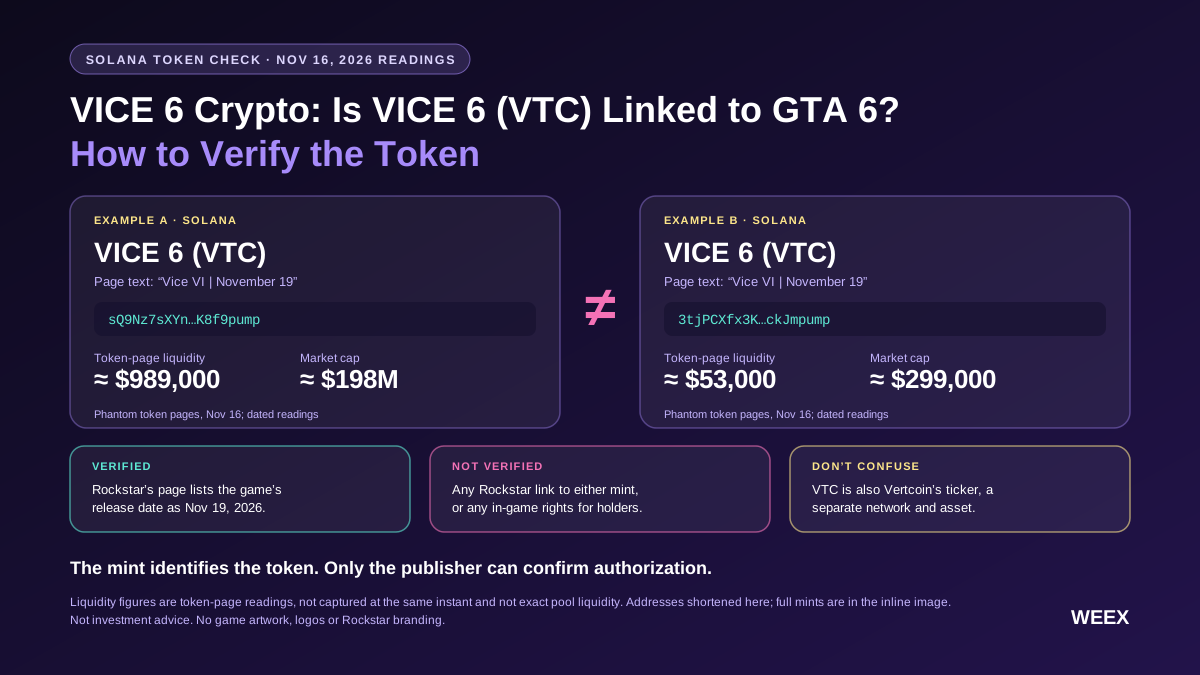
VICE 6 Crypto: Is VICE 6 (VTC) Linked to GTA 6? How to Verify the Token
Is VICE 6 crypto linked to GTA 6? Compare two Solana tokens using VTC, verify their mint and pool addresses, and see what Rockstar has confirmed.

Enterprise Blockchain: Why It's Time to Return?

DTCC Plans to Introduce Tokenized Securities and Bonds on Solana by 2027—Expanding Under Wallet Restrictions
Cardano holders reject 22M ADA treasury bid to buy physical copper

What Licenses Are Needed for Crypto Payments in Hong Kong?
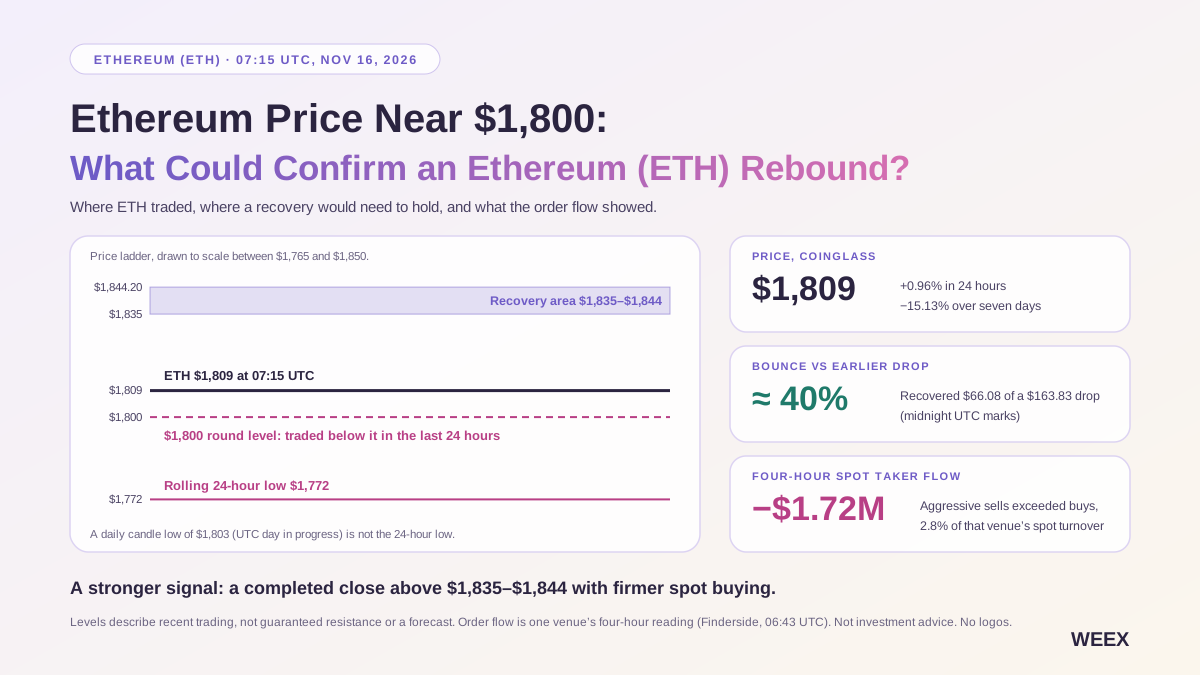
Ethereum Price Near $1,800: What Could Confirm an Ethereum (ETH) Rebound?
Ethereum traded near $1,800 on November 16. See what four-hour spot order flow, futures positioning, and Friday’s ETF flows say about an ETH rebound.
'Tokenization Is Not the Finish Line': Jupiter to Let Users Borrow Against Bullish Shares
'Nobody Knows Who's in Charge': Boris Johnson Stands by Bitcoin Skepticism at Breakpoint
Mazama Energy Finds New Solution to the Biggest Challenge in Geothermal Drilling
Have Semiconductors Bottomed? Here's How the Current Chip Stock Plunge Compares With Past Bear Markets.
Is Apple Losing Its Memory?
Rising Transportation Costs Make Large Holiday Purchases More Difficult
Latest articles




Latest coin listings on WEEX


