
ETH to USDT: What the Converter Rate Leaves Out

 Prefer us on Google
Data snapshot: WEEX Ethereum price page, last updated 20 Aug 2026, 02:51 UTC. USDT/USD figures from WEEX's USDT converter, dated 13 Aug 2026.
Ethereum traded at $2,266.33 on WEEX's price page as of 20 Aug 2026, 02:51 UTC, against 24-hour volume of $31.33B and a market cap of $273.51B. That is the number every ETH to USDT converter is built around.
It is also not the number you end up holding.
An ETH to USDT conversion moves you out of a volatile asset and into a stablecoin — not into dollars. Those are different things, and the difference is measurable. Below: the dated rate, what the USDT leg actually costs, a line-by-line breakdown of a 1 ETH conversion, and the network decision that determines whether moving those USDT later costs you 1 USDT or twenty.
How Much Is 1 ETH in USDT?
WEEX priced Ethereum at $2,266.33 as of 20 Aug 2026, 02:51 UTC. Separately, its USDT converter showed 1 USDT ≈ 0.9988 USD as of 13 Aug 2026. Divide one by the other and you get roughly 2,269 USDT per ETH — about 2.7 USDT above the plain dollar figure.
That is arithmetic across two snapshot dates, not a live order-book quote. Use it as a sanity check on the shape of the number, and pull the live figure from the Ethereum price page before you act on anything.
| Metric | Value | Source and date |
|---|---|---|
| ETH price | $2,266.33 | WEEX, 20 Aug 2026 02:51 UTC |
| 24h volume | $31.33B | WEEX, 20 Aug 2026 |
| Market cap | $273.51B | WEEX, 20 Aug 2026 |
| Circulating supply | 120.68M ETH | WEEX, 20 Aug 2026 |
| 7-day change | +20.01% | WEEX, 20 Aug 2026 |
| 30-day change | +21.75% | WEEX, 20 Aug 2026 |
| All-time high | $4,953.73 (24 Aug 2025) | WEEX, 20 Aug 2026 |
| USDT/USD | 0.9988 | WEEX, 13 Aug 2026 |
The 30-day move of +21.75% matters more than the level. A rate that has travelled 20% in a month is a rate that can travel while your order sits unfilled.
ETH to USDT Is Not the Same as ETH to USD
Converter pages quote ETH against USDT and let the reader assume the quote currency is a dollar. It trades close to one, and it is not one.
WEEX's USDT converter, dated 13 Aug 2026, put the peg at 0.9988 USD. Over the preceding windows it recorded:
| Window | Low | Average |
|---|---|---|
| Last 24 hours | 0.9983 | 0.9992 |
| Last 7 days | 0.9983 | 0.9999 |
| Last 30 days | 0.9976 | 0.9991 |
| Last 90 days | 0.9895 | 0.9955 |
Source: WEEX USDT to USD converter, 13 Aug 2026.
The 90-day low of 0.9895 is the row to look at. At that mark, 10,000 USDT was worth $9,895 — a $105 gap against the dollar figure a converter would have implied. Tether has historically restored the peg after these dislocations, and briefly traded in the $0.95–$0.99 band during past market panics according to 2026 stablecoin reviews. The better reading is not that USDT is unsafe; it is that a stablecoin quote is a price, and prices move.
This matters most in the exact moment people convert. Traders reach for ETH to USDT during sharp drawdowns, which is also when stablecoin marks wobble most. You are converting at the worst point in the peg cycle, not the calmest.
What You Actually Receive: The ETH to USDT Cost Chain
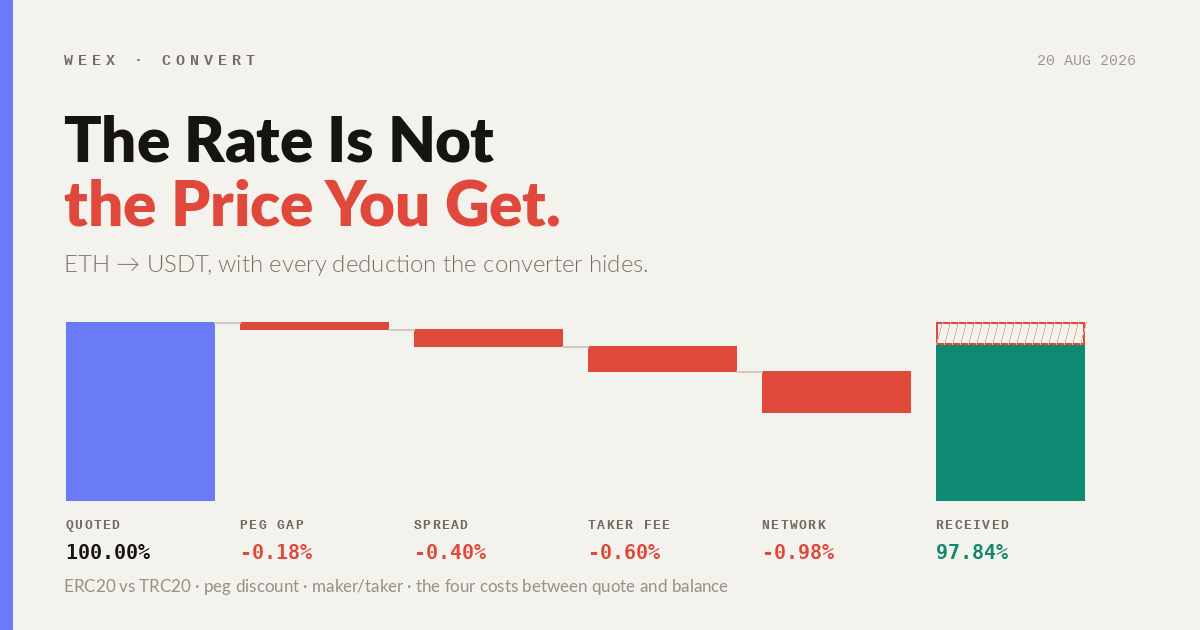
Almost nothing on the first page of results for this term itemises the gap between the displayed rate and the balance that lands in your account. Here is that chain, run on 1 ETH.
| Step | Effect on a 1 ETH conversion | Notes |
|---|---|---|
| Displayed converter rate | ~2,269 USDT | Mid-price, computed from WEEX data (20 Aug and 13 Aug 2026) |
| Bid–ask spread | You transact at the bid, not the mid | Narrow on ETH/USDT; widens on thin books |
| Trading fee | ~2.27 USDT at an illustrative 0.10% taker rate | Rate assumed for the arithmetic, not a quoted WEEX figure — check your fee tier in-app |
| Instant-convert markup | Often larger than a spot fee | "Zero fee" convert tools usually earn on the rate instead |
| USDT withdrawal | ~1 USDT flat on TRON; several USDT plus gas on Ethereum | Per 2026 third-party fee surveys; verify in-app before withdrawing |
Two entries do the damage. The instant-convert button is the first: a one-click tool advertising no trading fee typically takes its margin inside the quoted rate, where you cannot see it. Placing the same conversion as a spot order on the ETH/USDT market puts the fee on the receipt where you can count it.
The second is the withdrawal network, and it is the one people get wrong.
-- Price
Picking the USDT Network Before You Convert, Not After
USDT exists as separate tokens on separate chains. The one you hold after an ETH to USDT conversion is whichever the platform credits you, and switching later means another transaction.
Per 2026 fee surveys of centralised platforms, a TRC-20 (TRON) USDT withdrawal commonly costs a flat 1 USDT and settles in seconds. An ERC-20 (Ethereum) USDT withdrawal ran a platform fee plus mainnet gas, with totals reported across a wide $2–$20 range depending on network load. Those figures move with gas and with each platform's schedule, so treat them as orders of magnitude and confirm the live fee on the withdrawal screen.
The decision rule is about the destination, not the price:
- Sending USDT to another exchange or a counterparty that supports TRON — TRC-20 is the cheap, fast route.
- Sending USDT into an Ethereum DeFi protocol or to an address that only accepts mainnet — ERC-20, and pay the gas.
- Sending to an address on the wrong chain — the funds are frequently unrecoverable. This is the single most common way people lose the entire balance on an otherwise routine transfer.
Decide the chain before you convert. Reversing the order means paying twice.
Converting ETH to USDT on WEEX: The Sequence That Costs Less
The steps are ordinary; the ordering is what saves money.
- Fund and locate the pair. With ETH in your Spot account, open the ETH/USDT spot market. If you are starting from fiat rather than ETH, the step-by-step ETH purchase guide covers the funding leg first.
- Check the book before the button. Look at the depth on the sell side for the size you intend to move. Size that consumes several price levels is size that will fill worse than the top-of-book number you were quoted.
- Choose limit over market when you are not in a hurry. A market sell of ETH into USDT takes whatever the book offers. A limit order sets your worst acceptable price and may not fill — that is the trade-off, and in a fast tape it is a real one.
- Verify the fee tier that applies to you. Headline "as low as" rates are floor figures tied to volume or programme status, not a universal rate. Confirm what your account pays before sizing the order.
- Confirm the received amount, then decide the chain. Compare the USDT credited against your pre-trade estimate. If the gap is larger than the fee explains, the difference was slippage or the convert-tool spread.
Wondering whether the USDT you now hold is really a dollar? The USDT to USD converter gives you the peg reading rather than the assumption.
Where People Lose Money Converting ETH to USDT
The failure modes are boringly consistent, and none of them involve being wrong about direction.
Converting during a cascade. ETH's 30-day move of +21.75% to 20 Aug 2026 cuts both ways. In a violent session, spreads widen, depth thins, and a market order that would normally fill within a few basis points of the mid fills materially worse. Panic conversions are expensive conversions.
Treating the convert button as free. No visible fee is not the same as no cost. If a tool shows a rate rather than a fee line, the cost is in the rate.
Ignoring the peg on large balances. At 0.9988 the gap is trivial. At the 90-day low of 0.9895 recorded on 13 Aug 2026, a six-figure USDT balance carries a four-figure dollar gap. Size decides whether this is trivia or money.
Chain mismatch on withdrawal. Cheapest network, wrong destination, funds gone. Confirm the receiving address's chain before you press send, every time.
Assuming a stablecoin is a savings account. USDT is an operational instrument — it parks value between trades. Holding it for months exposes you to issuer decisions, reserve performance, and regulatory change, none of which you control.
Ready to run the conversion with the fee on the receipt instead of buried in the rate? Open the ETH/USDT spot market on WEEX and place the order yourself.
FAQ
1. How much is 1 ETH in USDT?
ETH was priced at $2,266.33 on WEEX as of 20 Aug 2026, 02:51 UTC, and USDT read 0.9988 USD as of 13 Aug 2026, which works out to roughly 2,269 USDT per ETH. That is a computed cross-check across two snapshot dates, not a live quote — pull the live figure from an ETH/USDT market before trading.
2. Is converting ETH to USDT the same as selling ETH for dollars?
No. USDT is a stablecoin priced close to one dollar, not a dollar. WEEX data dated 13 Aug 2026 showed USDT at 0.9988 USD, with a 90-day low of 0.9895. Converting to USDT leaves you holding an asset with issuer and peg exposure that a bank dollar does not carry.
3. What does it cost to convert ETH to USDT?
Three components: the bid–ask spread you cross, the trading fee your account tier pays, and — if you move the USDT afterwards — the withdrawal network fee. Instant-convert tools that advertise no trading fee generally recover the cost inside the quoted rate. Confirm your applicable fee tier in-app; published headline rates are usually "as low as" floors.
4. Which network should I choose for USDT after converting?
It depends entirely on where the USDT is going. TRC-20 withdrawals commonly cost a flat 1 USDT and settle in seconds per 2026 fee surveys, which suits transfers between platforms that support TRON. ERC-20 costs more but is required for Ethereum mainnet destinations, with totals reported in a $2–$20 range depending on gas. Sending to an address on an unsupported chain usually means permanent loss.
5. Why did I receive less USDT than the converter showed?
Converter pages display a mid-market rate. Your fill happens at the bid, minus your trading fee, and worse than top-of-book if your order size consumed multiple price levels. On a fast-moving tape the rate can also move between the quote you read and the order you submit.
6. Is it safe to hold USDT long term?
USDT has held near its peg through a decade of market stress and remains the largest stablecoin by market value, but it carries issuer, reserve, and regulatory risk that grows with holding period. Reviews published in 2026 consistently frame it as suited to short-term operational use rather than multi-month storage. It is not a deposit and is not covered by deposit insurance.
7. Can I convert ETH to USDT without a centralised exchange?
Yes — decentralised exchanges swap ETH for USDT on-chain, at a swap fee plus gas. Costs depend heavily on the chain: Ethereum mainnet gas has historically run from a few dollars to well over $50 in congested periods, while Layer 2 networks settle for a fraction of that. You keep custody, and you also carry smart-contract and slippage risk yourself.
Risk Warning
Crypto assets are volatile and can lose part or all of their value. ETH moved 21.75% over the 30 days to 20 Aug 2026 and sits well below its 24 Aug 2025 high of $4,953.73 — direction cannot be predicted and nothing here is a forecast, a recommendation, or trading advice.
Converting ETH to USDT does not remove risk; it changes which risk you hold. USDT is a stablecoin, not a bank dollar: it carries issuer, reserve, and regulatory exposure, is not covered by deposit insurance, and has traded below $1.00 — as low as 0.9895 in the 90 days to 13 Aug 2026 per WEEX data, and lower during past market panics. Additional risks specific to this activity include slippage and widened spreads during volatile sessions, undisclosed margin inside instant-convert rates, withdrawal and network fees that vary with chain and congestion, permanent loss of funds when USDT is sent on a chain the recipient does not support, smart-contract risk on decentralised routes, and counterparty and platform risk wherever your balance is held. Availability of these services varies by jurisdiction. All figures cited are dated snapshots and will be stale by the time you read them — verify live before you transact.
This content is provided for general informational purposes only and doesn't constitute financial, investment, legal, or tax advice. Any events, rewards, online promotions, or related information mentioned herein should not be considered a recommendation, solicitation, or invitation to purchase, sell, trade, or otherwise deal in any crypto assets. Crypto assets are highly volatile and may result in loss. The availability of WEEX services, products, and related events may vary by region. You are responsible for ensuring that your participation is in accordance with applicable local laws and regulations.
You may also like
Best Crypto Platform for Beginners: Pick by Goal, Not Brand

Ethereum Glamsterdam Hits 200M Gas on Sepolia: What Changes After the Upgrade?

How to Buy New Crypto Before Listing: 5 Routes and Their Traps

Ethereum Glamsterdam Upgrade: Sepolia Date and ETH Price Impact

Best Crypto Wallet App in 2026: How to Choose Between Hot, Cold, Custodial, and Web3 Wallets
What Is a Decentralized Crypto Exchange (DEX)? How It Works, Costs, Risks, and When to Use One
Ethereum Glamsterdam Upgrade Countdown: Can ETH Price Break Out?

What Is Coinbase Wrapped Zcash (cbZEC)? How It Brings Zcash to Base Without Native ZEC Privacy
What Is Gno.land (GNOT)? How GnoVM, Storage Deposits, Tokenomics, and GovDAO Work

Phantom Wallet vs MetaMask: What's the Difference
What a Blockchain Explorer Can and Cannot Tell You
How to Look Up a Wallet Address and Transaction History
龙虾 (Lobster) 0 Fee on WEEX: How to Buy Spot and Trade Futures

Circle's Arc Mainnet Is Live: Can It Actually Close the Gap With Tether's USDT?
What Is a Blockchain Explorer and How Does It Work?
Is SafePal Safe? A Look at Its Security Features
What Is SafePal Wallet? A Complete Beginner's Guide
LONGARC Token Explained: Arc Chain Stock Memes, Contract, Risks
What Is Aptos (APT)? Complete Layer-1 Blockchain Guide

HYPE Futures Trading Strategy: Sizing Rules Around Unlocks
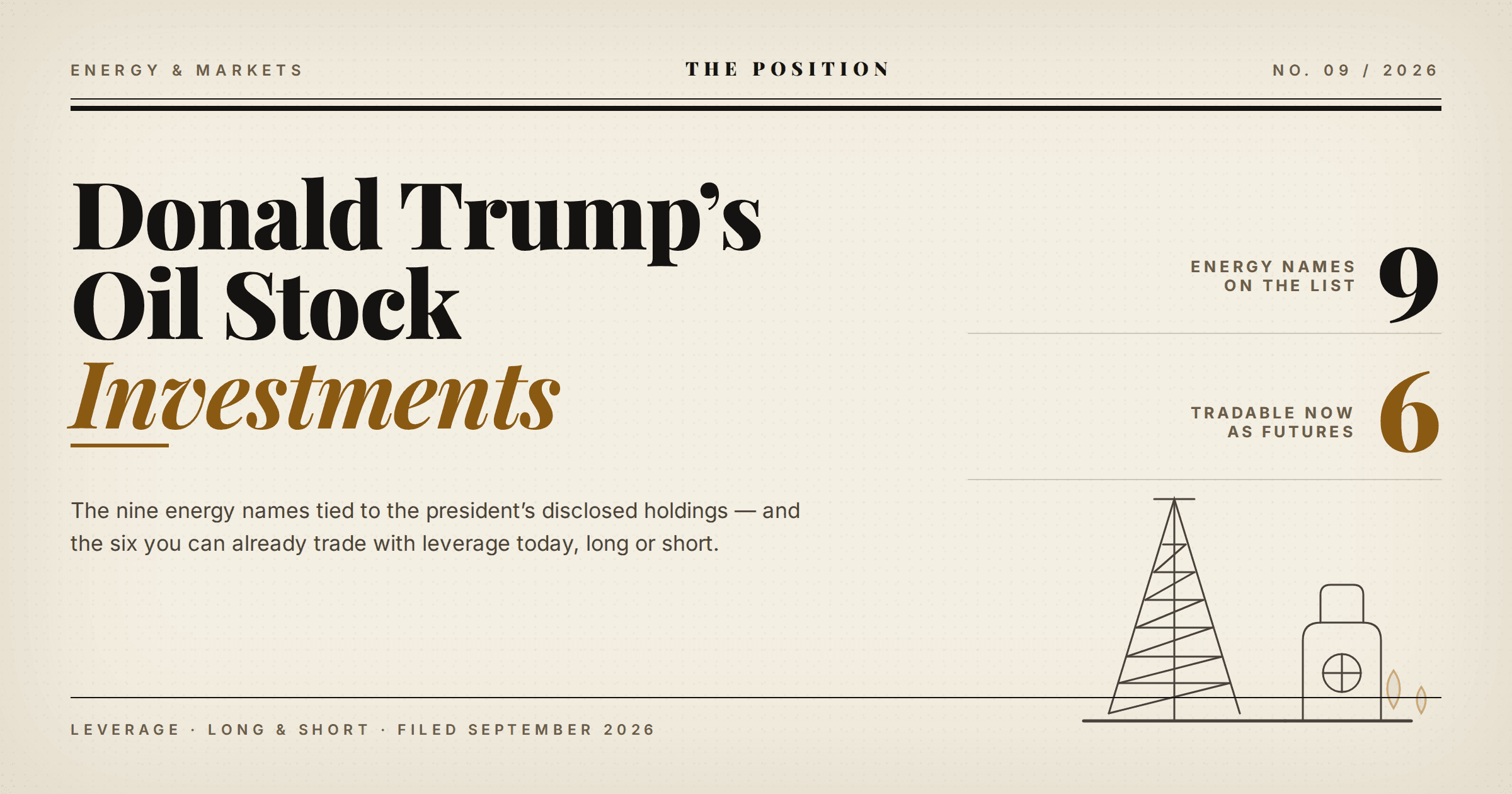
Donald Trump Oil Stock Investments: 9 Names, 6 Tradable Now

MetaMask Transaction Stuck or Failed? Here's How to Fix It
XST Stock: Why This Ticker Points to Four Completely Different Companies
What Is Arbitrum (ARB) and How Does This Ethereum Layer 2 Work?
Plasma Released 88.89 Million XPL Tokens Today—Why the Allocation Matters
What Is IMX Crypto? How Immutable's Layer 2 Became the Largest Web3 Gaming Blockchain
Pakistan Stock Exchange Performance in 2026: What Is Driving the KSE 100 to Record Highs
What Is Niulai Coin? How a 342 Yuan Chinese Animated Film Spawned a Viral BNB Chain Meme Token
SpaceX Rocket Crashes on the Moon: What It Means for SPCX Traders
TradFi Perpetual Futures API: 26 Symbols and How to Wire Them
Best Crypto Platform for Beginners: Pick by Goal, Not Brand
Ethereum Glamsterdam Hits 200M Gas on Sepolia: What Changes After the Upgrade?
How to Buy New Crypto Before Listing: 5 Routes and Their Traps
Ethereum Glamsterdam Upgrade: Sepolia Date and ETH Price Impact
Best Crypto Wallet App in 2026: How to Choose Between Hot, Cold, Custodial, and Web3 Wallets
What Is a Decentralized Crypto Exchange (DEX)? How It Works, Costs, Risks, and When to Use One


