
Meta Stock at $548: The Free Cash Flow Number Behind the Drop

 Prefer us on Google


Meta Platforms (NASDAQ: META) traded at $547.80 as of August 19, 2026, down 3.72% on the day and 8.62% over the past week, with a market capitalization of roughly $1.45 trillion. Wall Street's consensus 12-month target sits at $754.14 across 62 analysts — about 33% above the current price, with a "Strong Buy" consensus intact.
That gap is the whole story. A stock does not trade a third below its own analyst consensus because nobody has noticed it. It trades there because the market is pricing two things the target prices haven't fully absorbed: a collapse in free cash flow, and a seven-week jury trial that opened in Oakland on August 18.
Here is what changed, what it costs, and what a trader can actually do about it while the courtroom calendar and the Nasdaq calendar refuse to line up.
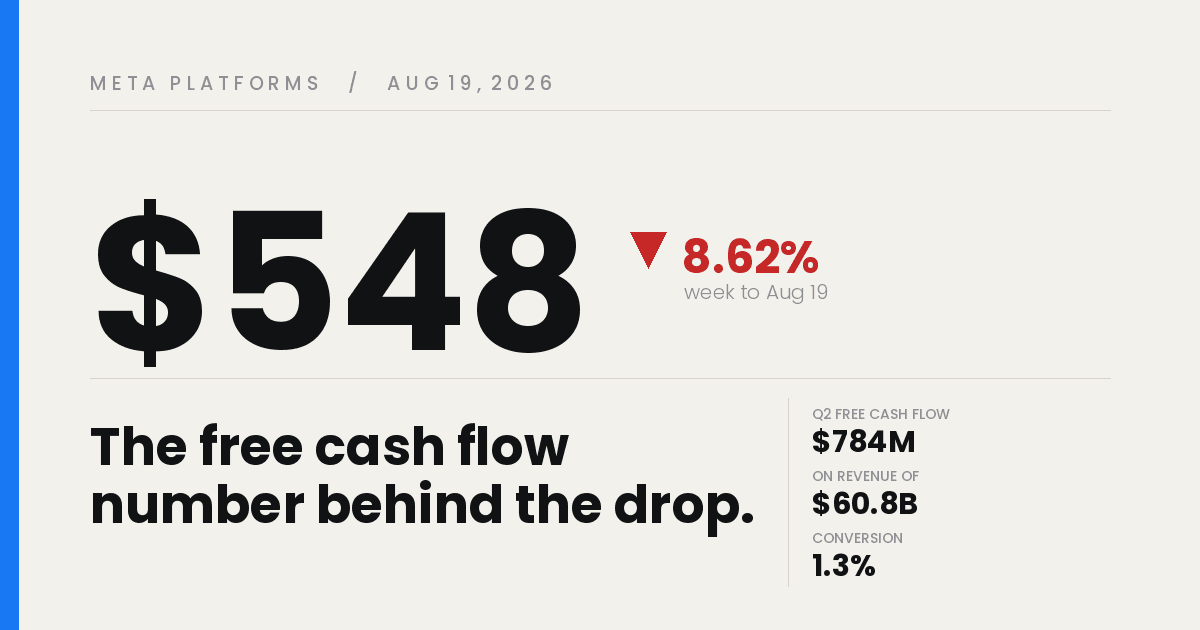
Meta stock price today and the gap to Wall Street targets
| Metric | Value (as of Aug 19, 2026) |
|---|---|
| Meta stock price (NASDAQ) | $547.80 |
| 24h change | −3.72% |
| 7-day change | −8.62% |
| Market cap | ~$1.45T |
| Avg. 3-month volume | 18.13M shares |
| Consensus 12-month target (62 analysts) | $754.14 |
| Target range (low / high) | $700.00 / $1,117.00 |
| Consensus rating | Strong Buy |
| METAON/USDT spot on WEEX | $548.63 |
| META-USDT perpetual on WEEX | $546.27 |
Two details in that table are worth pausing on.
First, the low end of the analyst range is $700 — above where the stock trades. When even the bear on the sell side is 28% above spot, the sell side has not repriced the story yet. Several of those targets were published before the most recent cash flow print. Treat consensus here as a lagging indicator, not a forecast.
Second, the three venues quoting Meta exposure — Nasdaq, WEEX spot, and the WEEX perpetual — sat within about $2.40 of each other, roughly 0.4%. The tokenized track is holding its peg tightly under normal conditions. Whether it holds during a courtroom shock is a different question, and one this article gets to below.
Why Meta stock fell: record revenue, $784 million in free cash flow
Meta's Q2 2026 quarter was, on the top line, one of the best in the company's history:
| Q2 2026 line item | Result | Change |
|---|---|---|
| Total revenue | $60.8B | +28% YoY |
| Advertising revenue | $59.4B | +27% YoY |
| Capital expenditure (quarter) | $31.1B | — |
| FY2026 capex guidance | $130B–$145B | Raised from $125B–$145B |
| Earnings per share | $6.18 | Missed $7.17 consensus by ~14% |
| Free cash flow | $784M | Sharply lower |
The advertising machine is not broken. Twenty-eight percent growth at a $240 billion annual revenue run rate is remarkable, and the AI-driven targeting and ranking improvements Meta has been shipping are visibly working.
The problem is on the other side of the ledger. Meta spent $31.1 billion on capex in a single quarter — more than half its revenue — and guided full-year 2026 spending up to as much as $145 billion. Total expenses rose roughly 55% year over year. Free cash flow, the number that funds buybacks and dividends and gives a mega-cap its defensive character, came in at $784 million.
To put that in scale: Meta generated $60.8 billion of revenue and kept less than 1.3% of it as free cash flow for the quarter. That is not a mega-cap cash machine. That is a company running a capital expenditure program with the risk profile of a utility build-out and the payback uncertainty of a research bet.
The better reading of the sell-off is not "AI spending is bad." It is that Meta has converted itself, for the next 18–24 months, from a cash-return story into a capex story — and the shareholder base that owned it for buybacks is not the shareholder base that owns capex cycles. That rotation takes time, and it happens at lower prices.
The 29-state trial: the risk that isn't in any price target
On August 18, 2026, opening statements began in an Oakland federal courtroom in a case brought by a coalition of 29 state attorneys general, who allege Meta deliberately engineered Facebook and Instagram to be addictive to minors and collected data on young users without parental consent. Meta denies the allegations and argues it has invested substantially in teen safety features, parental controls, and default privacy protections.
The trial is expected to run about seven weeks. Mark Zuckerberg is expected to testify. So is Instagram head Adam Mosseri.
The number that matters for anyone holding or trading the stock: Meta has estimated that the damages sought could reach $1.4 trillion, against a market capitalization of roughly $1.45 trillion. The states have not publicly confirmed the figure they will ask for, and headline damages estimates in litigation of this size are almost never what a court ultimately awards. But the point stands — this is not a fine that gets absorbed in a quarter. It is a binary-tail risk sitting on the tape for seven weeks, and it is essentially absent from a $754 average price target.
Practically, that means Meta stock is now a headline-driven instrument on a schedule that has nothing to do with earnings dates. Damaging testimony, an internal document entered into evidence, a ruling on a motion — any of these can move the stock several percent on a day with no company news at all.
-- Price
Can you trade Meta stock 24/7 without a broker?
Here is the operational problem the trial creates. Court proceedings, filings, and the news cycle around them do not respect the 9:30–16:00 ET Nasdaq window. Testimony transcripts and reporting land in the evening. Weekend analysis moves sentiment before Monday's open. If you hold Meta stock through a conventional broker, you are flat-footed for roughly 70% of the week.
Two crypto-native routes give continuous exposure to Meta's price, and they work differently:
| METAON (tokenized stock) | META-USDT perpetual | |
|---|---|---|
| What it is | Ondo-issued token tracking META, on Ethereum | USDT-margined perpetual futures contract |
| Venue | METAON/USDT spot on WEEX | META perpetual on WEEX |
| Direction | Long only | Long or short |
| Leverage | None (spot) | Up to 100× |
| Funding costs | None | Periodic funding rate |
| Listed on WEEX | February 13, 2026 | — |
| Ownership rights | No voting, no legal share ownership | No ownership; derivative exposure |
Both settle in USDT, need no brokerage account or bank wire, and sit inside the same account as your crypto balance. WEEX TradFi extends the same USDT-margin structure across stocks, gold, silver, oil, and indices. Neither instrument makes you a Meta shareholder — you are trading the price, not the equity. If you want the mechanics of USDT-settled equity exposure spelled out, WEEX's explainer on whether META stock has a token covers the distinction in detail.
What traders usually miss: an $8 million float against a $1.45 trillion stock
This is the part that rarely makes it into tokenized-stock coverage, and it is the reason the 24/7 access above comes with a real cost.
As of August 19, 2026, METAON showed a circulating supply of 14,862 tokens and a market cap of about $8.15 million on WEEX. Meta Platforms itself is a $1.45 trillion company. The tokenized wrapper represents roughly six ten-thousandths of one percent of the underlying equity's value.
Depth like that behaves fine in calm markets — hence the sub-0.5% spread between the tokenized price and the Nasdaq quote noted earlier. It behaves very differently when everyone wants the same side at once. A damaging piece of testimony reported at 8 p.m. ET on a Thursday hits a book with a few million dollars of depth and no Nasdaq arbitrage window open to pull the price back into line. That is precisely when the peg is loosest and the slippage is worst — and precisely when you most want to trade.
The practical rules that follow:
- Size for the venue, not the underlying. Position size that is trivial against Meta's 18-million-share daily volume can be a meaningful share of a tokenized book.
- Use limit orders outside US hours. Market orders into a thin overnight book are how a correct directional call turns into a losing fill.
- Watch funding on the perpetual, not just direction. Crowded one-way positioning around a trial headline pushes funding against you while you wait to be right.
- Treat leverage as inversely proportional to headline density. 100× is available on tokenized stocks; during a seven-week trial with unscheduled catalysts, availability is not a recommendation.
- Remember the counterparty layer. A tokenized stock's value depends on the issuer and custodian honoring the peg. That is a credit assumption a real share certificate does not require.
Is Meta stock a buy near $548?
Nobody can answer that for you, but the question decomposes cleanly into three things that have to go right.
| What has to happen | Current status | Why it matters |
|---|---|---|
| Ad growth holds near 25%+ | Q2 2026: +27% YoY | Funds the capex without balance sheet strain |
| Capex converts to revenue | $130B–$145B FY26 spend, payback unproven | Determines whether FCF recovers or keeps falling |
| Trial outcome is survivable | Opened Aug 18, 2026; ~7 weeks | Meta's own estimate of exposure ≈ its market cap |
The first is already true. The third is genuinely unknowable until roughly October 2026. The second is the one that decides whether $754 was a reasonable target or a stale one — and the honest position is that a single quarter of $784 million free cash flow is data, not a verdict.
What the market is offering at $548 is Meta's advertising business at a discount, bundled with a capex program you cannot yet underwrite and a lawsuit you cannot yet handicap. Some traders will take the first and hedge the rest. Others will wait for the jury. Both are defensible; pretending the last two don't exist is not.
If you want exposure while the trial runs, the tokenized and perpetual routes let you act on Meta stock news the moment it breaks rather than at the next opening bell — as long as you respect the depth constraint that comes with them. Check live METAON and META-USDT pricing on WEEX before sizing anything.
FAQ
1. Why is Meta stock down in August 2026?
Two overlapping pressures. Q2 2026 free cash flow fell to $784 million despite $60.8 billion in revenue, as capex hit $31.1 billion and full-year guidance rose to $130–145 billion; earnings per share of $6.18 missed the $7.17 consensus by about 14%. On top of that, a 29-state trial over alleged harm to minors opened on August 18, 2026.
2. What is the price target for Meta stock?
The consensus 12-month target across 62 analysts is $754.14, roughly 33% above the August 19, 2026 price of $547.80. The range runs from $700 to $1,117. Note that many of these targets predate the most recent free cash flow figure and none of them explicitly price the trial outcome.
3. Does Meta stock have a crypto token?
Meta Platforms has not issued any official cryptocurrency. METAON is a tokenized stock issued by Ondo Finance on Ethereum that tracks META's price and is not affiliated with Meta. It gives economic exposure only — no voting rights, no legal share ownership.
4. Can I trade Meta stock 24/7?
Nasdaq trades Meta shares during US market hours only. USDT-settled instruments — the METAON tokenized stock and the META-USDT perpetual — trade continuously, though liquidity thins substantially when US markets are closed, which widens spreads.
5. How much liquidity does tokenized Meta stock actually have?
Far less than the underlying. METAON showed a circulating supply of 14,862 tokens and a market cap near $8.15 million as of August 19, 2026, against Meta's $1.45 trillion equity market cap. Plan order sizes and order types around that gap.
6. What happens to Meta stock if it loses the trial?
Unknown, and the range of outcomes is wide. Meta has estimated damages sought could reach $1.4 trillion, close to its entire market capitalization, though headline damages figures in cases of this scale rarely match final awards and any judgment would face years of appeals. The more immediate effect is elevated volatility across the roughly seven weeks of proceedings.
Risk Warning
Meta stock, tokenized equity products, and USDT-settled derivatives all carry substantial risk of loss, including total loss of the capital committed. Specific risks in this article's scope: the pending 29-state trial is an unresolved legal proceeding with a wide outcome range and no reliable way to handicap it; Meta's free cash flow has fallen sharply and there is no guarantee its capital expenditure program produces a return. Tokenized stocks such as METAON convey no share ownership, voting rights, or shareholder protections, and depend on the issuer and custodian maintaining the peg — a counterparty and custody risk that direct share ownership does not carry. Tokenized equity order books are far thinner than the underlying Nasdaq listing, so spreads, slippage, and price dislocation are materially worse outside US market hours. Perpetual futures add leverage, funding costs, and liquidation risk; positions can be closed out at a loss on a temporary price move even when the directional view is eventually correct. Availability of these products is restricted in some jurisdictions. Nothing here is investment advice. Never commit capital you cannot afford to lose entirely.
This content is provided for general informational purposes only and doesn't constitute financial, investment, legal, or tax advice. Any events, rewards, online promotions, or related information mentioned herein should not be considered a recommendation, solicitation, or invitation to purchase, sell, trade, or otherwise deal in any crypto assets. Crypto assets are highly volatile and may result in loss. The availability of WEEX services, products, and related events may vary by region. You are responsible for ensuring that your participation is in accordance with applicable local laws and regulations.
You may also like

Roblox Stock Price Prediction 2026-2027: Can RBLX Recover After Falling From $142 to $38

Roblox Stock Is Down 68% in the Past Year: What Age Verification and Sands Capital's Exit Actually Signal

Pakistan Stock Exchange Performance in 2026: What Is Driving the KSE 100 to Record Highs
Master Account vs Sub-Account: What the Difference Means for Crypto Broker Partners

Crypto Broker vs Stock Broker: What Is the Difference and Which Do You Need
Meta Stock Price Is Down 30% From Its 52 Week High: Is META a Buy After the Child Safety Trial Drop
Meta Stock Falls as 29 States Begin Federal Child Safety Trial: What the "Big Tobacco Moment" Warning Actually Means
Adobe Stock Jumps After BlackRock Raises Stake to Over 10%: What an $8.4 Billion Bet Actually Signals
Buy Crypto With JazzCash and Easypaisa, Now Live on WEEX

Is Niulai Coin a Good Investment? What the Film Story Cannot Tell You About NIULAI Risk

What Is Quant (QNT)?

Cardano (ADA) Price Prediction: It's the Right Time to Buy Cardano (ADA)?

User Guide: Why Does Bitcoin Have Value?
Your Crypto Exchange Is Shutting Down: How to Move Your Funds and Choose the Next Exchange

MU Stock Is Down 24% While Micron's Profits Hit Records
Kioxia Stock Before the Oct 1 Split: The 24/7 Perp Problem
Recordati Stock (REC): The Respighi BidCo Tender Offer, the Timetable and What Happens If You Do Nothing
Eiffage Stock (FGR): The Two Engines, the Motorway Concession End Dates and the 26 August 2026 Half-Year Results

Deutz Stock (DEZ): The 24 August 2026 Extraordinary General Meeting, the FFG Share Issue and What the Resolution Says
Logista Stock (LOG): The August 2026 Interim Dividend, the Four Dates That Decide Who Is Paid and What the Company Is
BlackBerry Stock Up 125%: Why BB and BBX Are Not the Same
Netflix Stock Is Down 38%: What the Tape Is Pricing
Nasdaq Futures vs Stocks: NQ at 30,141 and 3 Ways to Trade

XST Coin Has $12,000 of Real Depth Behind a $31 Million Price
CRCL Stock in 2026: Why Rate Cuts Now Drive Circle's Price
Nvidia Stock Is Closed 81% of the Week. Your Risk Isn't.
Nebius Stock After a 34% Pop: What the Capex Math Says
Zhipu, Z.ai and GLM: One Company, and Which Name Is Actually on the Ticker
Tencent Stock (0700): Where the Shares Actually Trade, and What Each Venue Owes You
Lenovo Stock (0992): The German Subsidiary, the Pension Liability and the Segments That Report
Roblox Stock Price Prediction 2026-2027: Can RBLX Recover After Falling From $142 to $38
Roblox Stock Is Down 68% in the Past Year: What Age Verification and Sands Capital's Exit Actually Signal
Pakistan Stock Exchange Performance in 2026: What Is Driving the KSE 100 to Record Highs
Master Account vs Sub-Account: What the Difference Means for Crypto Broker Partners
Crypto Broker vs Stock Broker: What Is the Difference and Which Do You Need
Meta Stock Price Is Down 30% From Its 52 Week High: Is META a Buy After the Child Safety Trial Drop
Contents
Popular coins
Latest articles


