
What Is a Crypto Exchange API and Which Permissions to Enable

 Prefer us on Google


A crypto exchange API is a set of endpoints an exchange opens up to software. It does one thing: it replaces your finger with a line of code. Pull a candle, check a balance, place a limit order — actions that take four or five clicks in a web interface become a single HTTP request.
Most articles stop there. The part that actually burns people is the next question, and it rarely gets a straight answer: what can the key you just issued actually do, and what can it not do? Get the permission model wrong and you have handed a plaintext credential to a third-party script whose source you have never read.
This piece walks four lines — what it is, how to use it, how to call it, and whether it is safe. Concrete parameters come from the WEEX spot API documentation, last updated April 14, 2026. Other venues follow a similar shape with different numbers, so check your own exchange's current docs before you integrate.
What is a crypto exchange API? Public and private endpoints
A crypto exchange API is not one monolithic thing. It splits into two layers, and that split decides whether you need a key at all and how much risk you are carrying.
Public endpoints serve market data anyone can see: last traded price, 24-hour high and low, candles, order book depth, the full list of supported pairs. No authentication — a plain GET returns data. A price alert script or a backtest dataset needs nothing more, and never touches your account.
Private endpoints are the ones tied to your money: balances, order placement, cancellation, fill history, ledger records. Every request must carry a signature, and the server executes only after it validates.
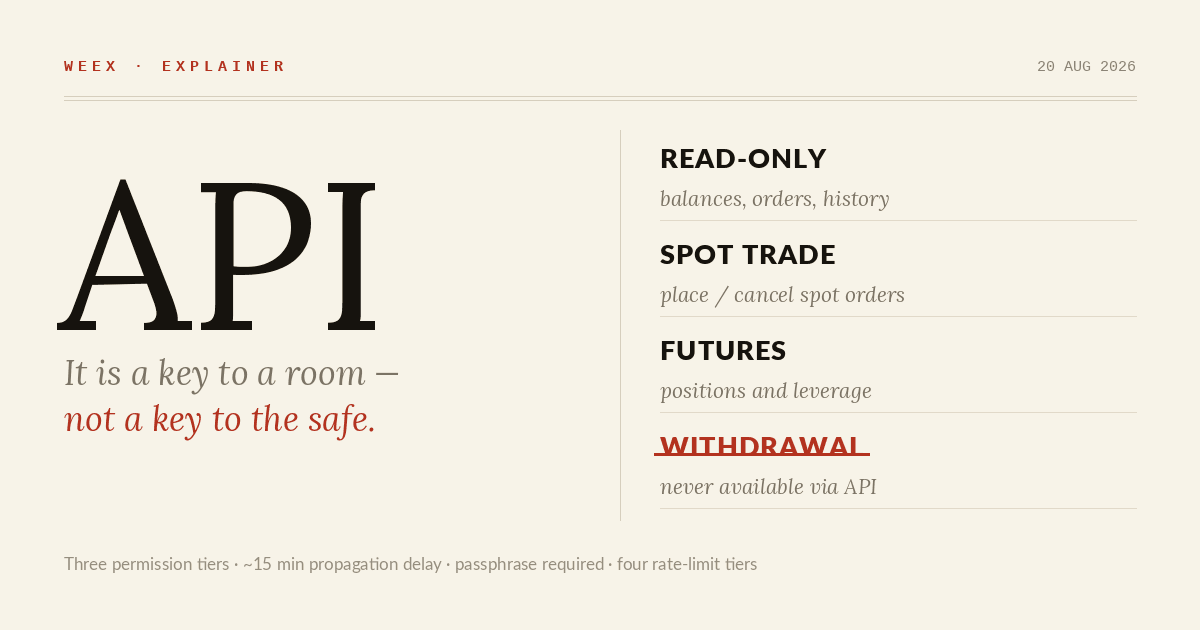
The risk profiles are not comparable. The worst outcome on a public endpoint is that you get rate-limited. The worst outcome on a misconfigured private endpoint is that your positions move. Plenty of newcomers read "I want to use the exchange API" as "I need trading permission," when a large share of real use cases — portfolio dashboards, ledger sync, price alerts — are fully served by read-only access.
| Layer | Key required | Typical use | Cost of getting it wrong |
|---|---|---|---|
| Public endpoints | No | Candles, depth, trades, pair configs | Rate-limited, HTTP 429 |
| Private (read-only) | Yes | Balances, ledger, fill history | Data exposure, positions untouched |
| Private (trading) | Yes | Place, cancel, query open orders | Runaway strategy or malicious orders if the key leaks |
API Key, Secret Key and Passphrase: what each one does
Creating a key hands you three strings at once. They do different jobs, and people routinely store them together, paste the wrong one, and then cannot tell which link in the chain failed.
| Credential | Role | Recoverable | If it leaks |
|---|---|---|---|
| API Key | Identifier telling the server which account is calling | Visible in API management | Cannot sign on its own, but exposes that the account exists |
| Secret Key | Private key used to generate the signature | No — you must create a new key | Combined with the API Key, forges valid requests |
| Passphrase | User-defined phrase acting as a second check | No, and it cannot be edited | All three together equal account-level control |
Two details are worth pulling out. WEEX requires the passphrase to be alphanumeric only — no special characters, a constraint that is not displayed prominently and is a common first-integration failure. And a forgotten passphrase cannot be recovered or changed; the documented fix is to delete the key and create a new one.
The practical move: the moment the key is created, write all three into a password manager or an environment file. Do not assume you can come back and copy them later.
Which crypto exchange API permissions should you enable?
This is the section worth remembering.
On WEEX, an account can create up to 10 API key groups, each configured independently. The documentation (April 14, 2026) lists exactly two permission types:
| Permission | What it allows | Typical use |
|---|---|---|
| Readonly | Query endpoints only — balances, trade history. No trading operations | Asset monitoring, ledger syncing, market analysis |
| Spot | Place and cancel orders, query assets in the spot market | Spot quant bots, automated rebalancing |
New keys default to read-only. Trading has to be enabled deliberately, and the two permissions are independent — without Spot checked, orders will not go through.
Note what is absent from that table: there is no withdrawal permission. That is a design boundary, not an oversight. The most destructive category of API incident — key leaks, funds transferred straight out — has no opening at the permission layer here. A stolen key is still dangerous; an attacker can wash-trade your balance away in an illiquid pair or bleed it out through junk fills. But the shortest path, draining the account, is closed.
To be clear: exchanges differ on this. Some venues do issue keys with withdrawal rights. Before creating a key anywhere, look at the permission checkboxes and see whether "Withdraw" is one of them. If it is, leave it off unless you are running cross-exchange automation and know exactly what you are doing.
One more parameter almost nobody mentions, and it will cost you half an hour: a newly created or modified API key typically takes about 15 minutes to propagate globally. Running a strategy immediately after creating the key and getting a permission error does not mean your code is wrong. It may just mean the key is not live yet.
The security guidance is equally direct: enable an IP whitelist. Once bound, even a full leak of all three credentials fails from any other address — the request is rejected outright. For a strategy running on a fixed server, this is the cheapest meaningful protection available. You can start from the WEEX API page.
-- Price
How to call a crypto exchange API: signing and rate limits
Once permissions make sense, the rest is engineering. A complete private request looks roughly like this.
Step one, build the signing string. WEEX concatenates timestamp + uppercase method + requestPath + "?" + queryString + body, runs HMAC SHA256 with your secret key, then Base64-encodes the result. For a depth query, the string to be signed reads:
1591089508404GET/api/v3/market/depth?symbol=BTCUSDT&limit=20When the query string is empty — most POST requests — the format collapses to timestamp + METHOD + requestPath + body.
Step two, set the headers. API key, signature, timestamp and passphrase go into their respective ACCESS headers. The timestamp is in milliseconds, and requests are rejected if it deviates more than 30 seconds from server time. That single number explains why the first endpoint in every exchange's docs is "get server time."
Step three, respect case and rate limits. The symbol parameter is case-sensitive and must be fully uppercase — btcusdt fails outright. On the throughput side:
| Operation | Limit |
|---|---|
| Place order | 100 per 10s |
| Cancel order | 80 per 10s, or 200 per minute |
| IP weight | 500 weight per 10s per IP |
| WebSocket | 20 connections per IP |
Breaching any of these returns HTTP 429. Limits are calculated independently per endpoint, so a single global counter is the wrong way to throttle.
Two more traps: REST suits on-demand queries, but WebSocket is the right answer for live market data; and a WebSocket handshake must include a User-Agent header (contents are up to you) or the firewall blocks it with a 403 — an error that looks nothing like a missing header. Full worked examples sit on the official signature reference.
Error code triage: what each one actually means
Most API development time is not spent writing logic, it is spent reading errors. This table maps error to real cause to the action that fixes it.
| Error | What it means | What to do |
|---|---|---|
| -1052 / 40014 | Insufficient permissions | Check that Spot is enabled; if just changed, wait 15 minutes |
| 40018 | IP not whitelisted | Add your current egress IP to the binding list |
| 40008 | Timestamp expired | Sync local clock, or pull server time first |
| 40012 | API key or passphrase incorrect | Passphrase is unrecoverable — usually means recreating the key |
| 429 | Too many requests | Rewrite throttling per endpoint, not globally |
| -1054 | Order does not exist | Wrong order ID passed to cancel |
| WebSocket 403 | Missing User-Agent header | Add the field; any content works |
Note: V1/V2 and V3 use different error-code schemes (4xxxx versus -10xx), so confirm which version you are calling before debugging. WEEX has stated V1/V2 are being deprecated — new integrations should target V3. Also worth knowing upfront: TradingView signal trading and FIX API are not currently supported, so any design depending on either needs a different path.
Is a crypto exchange API safe? Five places things break
"Is the exchange API safe" is too coarse a question. The protocol itself — HMAC signing, timestamp validation, IP checks — is mature. Almost every failure is a usage failure. Ranked by how often they actually happen:
1. Handing credentials to someone who should not have them. The top cause has never been a technical exploit; it is social engineering. Fake "managed quant" and "copy-trading accelerator" services ask you to paste an API key, and the balance is wash-traded into dust. The test is simple: any third party that asks for your secret key should be treated as hostile by default. Legitimate services have you bind the key on their platform; they do not ask you to paste it into a chat window.
2. Skipping the IP whitelist. As above, this is the single step that downgrades a leak from catastrophe to nuisance. The usual reason for skipping it is "my IP is dynamic," and the price is the entire perimeter.
3. Hardcoding keys and pushing to GitHub. Bots scanning public repositories for credentials run around the clock; the window between commit and exploitation is often measured in minutes. Use environment variables and put the config file in .gitignore.
4. Granting far more permission than the job needs. A portfolio dashboard with Spot permission enabled is carrying risk for a capability it never invokes. One purpose, one key, minimum permission — 10 key groups is plenty of headroom to segment properly.
5. Writing optimistic error handling. This one does not involve a leak, but it costs real money. Strategies that do not retry after a 429, that keep firing orders after a disconnect without reconciling positions, that treat a failed cancel as a successful one — these defects surface together during violent moves, which is precisely when you least want the program improvising. The official docs put "ensure your code includes robust error-handling logic" in the developer notes for a reason.
The more useful framing is this: the risk structure of a crypto exchange API is nothing like holding spot. Spot losses come from the market. API losses usually come from you — one unchecked return value, one unthrottled loop, and a position can be shredded while you sleep. Which is why experienced operators run a read-only key for a week first, confirm the data flow, the error paths and the alerting all behave, and only then enable trading.
Three things to remember before your first key
Back to the original question. A crypto exchange API is the interface an exchange opens to software, turning manual clicks into executed code so market data and trading can be automated.
What actually determines whether it goes smoothly comes down to three things:
- Minimum permission. If read-only solves the problem, do not enable trading. One purpose, one key.
- The IP whitelist is the highest-return step you can take. When credentials leak, it is the only defense still standing.
- Run read-only first, trade second. Validate data, errors and alerts before granting permission — far cheaper than the post-mortem.
If you want to start, the WEEX API preparation guide covers key creation and permission setup end to end, and the API FAQ page collects the rate-limit rules and the errors people hit most. Create a read-only key first and run the market data endpoints through your full pipeline before anything else.
FAQ
1. What is a crypto exchange API in one sentence?
It is the interface an exchange exposes to software, letting code fetch market data, check balances, and place or cancel orders — the technical foundation for quant trading, copy-trading bots and automated monitoring.
2. Do I need to know how to code to use an exchange API?
Calling endpoints directly requires basic programming skill, most commonly Python. Many third-party tools wrap that logic so you only bind an API key on their platform — provided the tool is trustworthy and never asks you to paste your secret key into a chat window.
3. If my API key leaks, can someone withdraw my coins?
It depends on whether the platform offers withdrawal permission. The WEEX spot API documentation (April 14, 2026) lists only Readonly and Spot, with no withdrawal option, so a leak cannot move assets off the exchange directly — though an attacker could still cause losses through malicious orders. Other exchanges design permissions differently, so verify yours. Delete any key you believe is compromised immediately.
4. What if I forget the passphrase?
It cannot be recovered or modified. The only fix is deleting the API key and creating a new one. WEEX also requires the passphrase to be alphanumeric, with no special characters.
5. My new API key returns a permission error — did I configure it wrong?
Not necessarily. Newly created or modified keys usually take around 15 minutes to propagate globally, so retry after waiting. If it persists, check that the trading permission is enabled and that the pair supports API orders.
6. Should I use REST or WebSocket?
REST for on-demand calls — balances, placing and cancelling orders. WebSocket for live data — tick-level fills and depth updates. Production strategies typically run both: WebSocket in, REST out.
7. Can I run arbitrage or high-frequency strategies through an exchange API?
Technically yes, but rate limits bind. On WEEX spot that means 100 orders per 10 seconds and 500 IP weight per 10 seconds, with each endpoint counted independently. Genuine high-frequency work also has to price in latency, slippage and fee structure, which regularly consume the spread that looked available on paper.
Risk Warning
Crypto asset prices are highly volatile and may result in partial or total loss of capital. Trading programmatically through a crypto exchange API layers additional risk on top of market risk: a flawed strategy can compound losses unattended; network interruptions, rate-limit rejections or unexpected responses can leave order state out of sync with actual positions; and API credentials leaked through phishing, exposed code or untrusted third parties can enable losses through malicious orders even where withdrawal is not permitted. Futures and leveraged trading add liquidation risk, where a short-lived price move can wipe out the full position. Test strategies thoroughly, enable IP whitelisting and minimum permissions, and commit only capital you can afford to lose. This article is informational and does not constitute investment advice.
This content is provided for general informational purposes only and doesn't constitute financial, investment, legal, or tax advice. Any events, rewards, online promotions, or related information mentioned herein should not be considered a recommendation, solicitation, or invitation to purchase, sell, trade, or otherwise deal in any crypto assets. Crypto assets are highly volatile and may result in loss. The availability of WEEX services, products, and related events may vary by region. You are responsible for ensuring that your participation is in accordance with applicable local laws and regulations.
You may also like

How to Call a Crypto Exchange API Without Getting Blocked
Crypto Exchange API: Permissions, Signing and Rate Limits

WEEX Daily Lucky Wheel and Event Airdrops: How the Rewards Actually Work

What Is ISOR Coin (Iran Strategic Oil Resource)? Facts, Risks and Where It Trades

How to Earn WXT Rewards with WEEX Trade to Earn S6 Futures Event

Roblox Stock Is Down 68% in the Past Year: What Age Verification and Sands Capital's Exit Actually Signal

Is XST Crypto a Long-Term Opportunity or Short-Term Hype?

Meta Stock Price Is Down 30% From Its 52 Week High: Is META a Buy After the Child Safety Trial Drop
MicroStrategy's STRC Unpegged: Buy the Dip or Brace for Impact?
How to Buy Crypto on WEEX Exchange 2026: Complete Guide
JPMorgan Says Buy the Chip Dip but Morgan Stanley Says Sell: What the SOXL Analyst Disagreement Actually Means
Bitcoin's $2.7 Billion Short Squeeze: What Triggered the Largest Liquidation Event of August 2026
Is SOXL a Good Investment? What 3x Leverage Actually Does to Your Returns in Both Directions
XST Share Price: Why XSolut Has No Share Price and What the Token Price Actually Represents

XST Coin and Stargate: What XSolut's AI Infrastructure Narrative Has to Do With the $500 Billion OpenAI Project

SK Hynix (SKHY) Announces Record $28.6 Billion Buyback: 40 Trillion Won in Shares to Be Cancelled, Shareholder Return Target Raised Above 50%
Bitcoin Price Surges 11% Past $70,000 for the First Time Since June: What the Three Catalysts Actually Drove the Move
Bitcoin Price Prediction 2026: What Reclaiming $70,000 Means for the Path Back to $126,000
Merck Stock Rose 12.7% on Vaccine Data That Has No Numbers Yet

Is the Trump $500 Billion XST Investment Real? What the Viral Claim About XSolut and Nvidia Actually Is
XST Coin Rebounds From Its Post Peak Low: What the Recovery to a $45M Market Cap Actually Signals
What Is Espresso (ESP)? The Rollup Confirmation Layer, Tokenomics and the 2027 Unlock
What Is Billions Network (BILL)? The ZK Identity Token, Tokenomics and Outlook
What Is ANSEM (The Black Bull)? The Pump Story, the 60 Percent Wallet and the Risks
What Is Based (BASED)? The Hyperliquid Super App Token Explained
Why Did Sahara AI (SAHARA) Drop? The 600M Token Transfer, Tokenomics and What Comes Next
Telegram Games That Pay in 2026: Which Issued Tokens and What Happened After Listing
Telegram Airdrop Calendar: Hamster Daily Cards, Notcoin and New Mini-App Tokens

Why Did SIREN Crash? The Whale Dump Explained, and What SIREN Is
Broadcom (AVGO) Earnings Date: September 2, 2026 (Confirmed) — Japan Time and What to Watch
How to Call a Crypto Exchange API Without Getting Blocked
Crypto Exchange API: Permissions, Signing and Rate Limits
WEEX Daily Lucky Wheel and Event Airdrops: How the Rewards Actually Work
What Is ISOR Coin (Iran Strategic Oil Resource)? Facts, Risks and Where It Trades
How to Earn WXT Rewards with WEEX Trade to Earn S6 Futures Event
Roblox Stock Is Down 68% in the Past Year: What Age Verification and Sands Capital's Exit Actually Signal


